
MCP vs REST API: When to Use Each for AI Agent Integration
I have been building AI-powered features into production systems for the past year. And the one question I keep running into is this: should I wire my AI agent to my backend through a plain REST API, or should I use Model Context Protocol (MCP) for AI agent integration?
After building with both, I have a clear answer. But it depends on what you are building.
What MCP Actually Is (And Is Not)
Model Context Protocol (MCP) is an open standard created by Anthropic in late 2024. It defines how AI models discover and use external tools, data sources, and services.
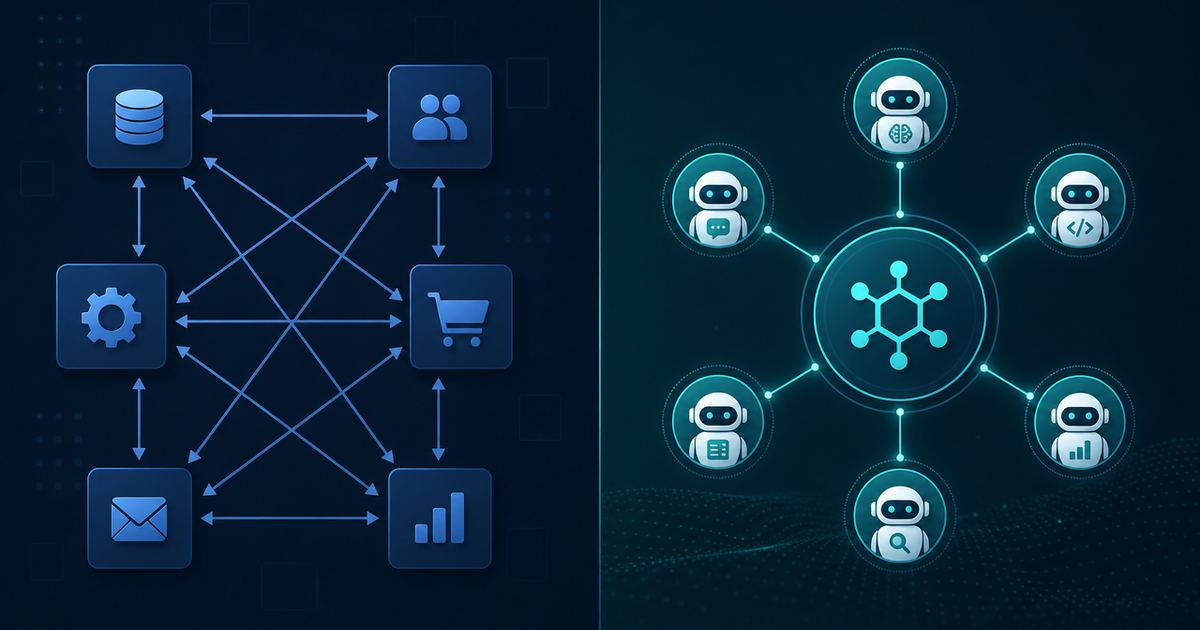
The critical distinction that many MCP vs API comparisons overlook: MCP does not replace your REST API. It sits on top of it. Your REST API still handles the business logic, the data validation, the auth flows. MCP adds a discovery and interaction layer that makes your existing services consumable by AI agents without writing custom integration code.
The architecture looks like this: your AI agent connects to an MCP server. That server exposes tools, resources, and prompts. Under the hood, those tools call your REST API. But the agent does not need to know that.
How REST APIs Work for AI Integration
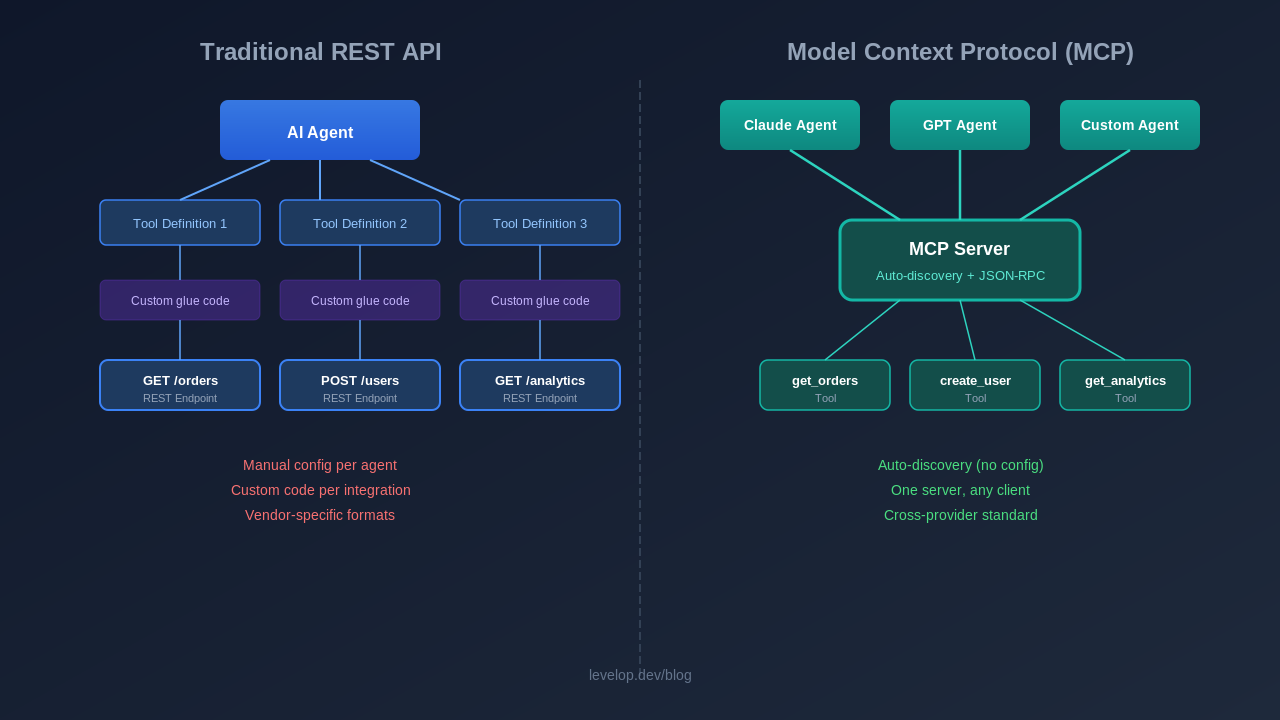
REST is a well-established pattern. Defined endpoints, HTTP methods, JSON payloads. When you wire an AI agent to a REST API, you write explicit integration code. You define the function signatures, map the parameters, handle the responses, and teach the agent what each endpoint does through system prompts or tool definitions.
This approach works and has been reliable for years. Every major AI provider supports function calling. You define each tool manually, write the glue code, and handle errors yourself. For 3-5 integrations, this is perfectly manageable.
How MCP Handles the Same Problem
With MCP, the integration story changes. Instead of defining each tool manually, you point your agent at an MCP server. The server advertises its capabilities through a standardized protocol. The agent connects, discovers what tools are available, and uses them.
The key difference: the agent discovers tools automatically. No manual tool definitions in system prompts. No per-agent configuration. Any MCP-compatible client can connect to this server and immediately know what it offers.
The Real Differences That Matter
Discovery vs Configuration
REST API integrations require you to configure every tool in every agent. MCP servers handle this automatically. Add a new tool to your server, and every connected agent sees it on the next connection.
Session State vs Stateless
REST APIs are stateless by design. MCP maintains a persistent session between client and server. The server can track what the agent has already accessed and manage state across multiple tool calls.
Standardization vs Flexibility
MCP gives you a standard protocol that works across providers. Build an MCP server once, and it works with Claude, Cursor, or any MCP-compatible client. REST APIs give you complete control over your interface design.
Protocol Overhead
MCP adds protocol overhead through JSON-RPC messages and session management. REST APIs are as lean as you make them. For high-throughput scenarios, REST gives you more control over performance optimization.
When to Use MCP
As of May 2026, there are over 17,000 MCP servers indexed across public registries. With 97 million monthly SDK downloads, MCP is becoming the expected interface for AI-to-tool communication.
When to Stick with REST APIs
The Hybrid Approach: Using MCP and REST API Together
In practice, most production systems in 2026 use both. Your REST API handles the business logic and serves traditional clients. An MCP server sits alongside it, wrapping key endpoints as tools for AI agent consumption.
The MCP server is a thin wrapper. It reuses the same service layer as your REST API. AI agents use the MCP interface. Everything else uses REST. This is the approach I would recommend for most teams.
Security Considerations
The NSA published guidelines on MCP security in early 2026. The main concerns: prompt injection through tool descriptions, unauthorized tool access through agent manipulation, and data exfiltration via tool responses. A CVE with a 9.8 severity score hit an open-source MCP server in 2026.
REST APIs have decades of battle-tested security patterns: API keys, OAuth 2.0, rate limiting, input validation. MCP inherits OAuth 2.1 for auth, but the tool discovery layer is newer and less hardened.
Making Your Decision
- Who is consuming this service? If AI agents are primary consumers, lean toward MCP.
- How often does your tool surface change? Frequent changes favor MCP auto-discovery.
- How many agents need access? Multiple agents across providers means MCP saves configuration overhead.
Use MCP when it solves a real problem in your architecture. Use REST when it is simpler. Use both when your system serves both audiences. For more insights, visit the Levelop blog.
Frequently Asked Questions
Does MCP replace REST APIs?
No. MCP adds an AI-native discovery layer on top of existing services. Most MCP servers are thin wrappers around REST APIs.
Is MCP only for Anthropic Claude?
MCP is now an open standard under the Linux Foundation. OpenAI, Google, Microsoft, and Amazon have all adopted it.
Can I use MCP with Python and TypeScript?
Yes. Official SDKs exist for both Python and TypeScript, along with community SDKs for Java, Kotlin, and C#.
What is the performance difference between MCP and REST API?
MCP adds protocol overhead through JSON-RPC messaging. For typical AI agent interactions this is negligible. For high-throughput scenarios, direct REST calls outperform MCP.
How do I secure an MCP server?
MCP supports OAuth 2.1 for authentication. Follow least privilege: only expose needed tools, validate inputs server-side, and monitor invocations.