
Advanced Dynamic Programming: Multi-Dimensional States and Space Optimization
I've been breaking down coding patterns that tripped me up, writing about the process of actually understanding them instead of just memorizing solutions. This one took me longer than I expected.
After my last two posts on dynamic programming (one on state transitions, another on the DP template that keeps showing up), I thought I had a solid handle on DP. Then I hit a problem where the state wasn't just a single index. It was two indices. And a boolean flag. And suddenly my neat 1D array wasn't enough. Advanced dynamic programming requires you to think beyond simple one-dimensional tables, and that shift in thinking is what this post is about.
Where Basic Dynamic Programming Patterns Break Down
Most dynamic programming problems you encounter early on have a clean, one-dimensional state. You're at position i in an array, and you make a decision: take this element or skip it. The state is just "where am I?" These are the foundational dynamic programming patterns that every interview prep guide covers.
But real interview problems (especially at companies like Google and Meta) love multi-dimensional states. The classic example: edit distance. This is the kind of problem that separates candidates who can solve problems mechanically from those who truly understand dynamic programming.
You have two strings. You want to find the minimum number of operations (insert, delete, replace) to turn one into the other. The state isn't "where am I in string A?" It's "where am I in string A AND where am I in string B?" Two dimensions. Two indices tracking your position simultaneously.
When I first saw this, I tried to force it into a 1D framework. That didn't go anywhere. The breakthrough was realizing that DP states are just a way of encoding "everything I need to know about my current situation to make the next decision" and find the optimal solution. Sometimes that takes one number. Sometimes it takes two. Sometimes three. Understanding this is what separates solving basic dynamic programming problems from tackling the advanced ones.
Building a Multi-Dimensional DP Table
Let's walk through edit distance with real strings to make this concrete.
Strings: "horse" to "ros"
The DP table is 2D: dp[i][j] represents the minimum number of edits to convert the first i characters of "horse" into the first j characters of "ros".
def min_distance(word1: str, word2: str) -> int:
    m, n = len(word1), len(word2)
    dp = [[0] * (n + 1) for _ in range(m + 1)]

    # Base cases: converting to/from empty string
    for i in range(m + 1):
        dp[i][0] = i
    for j in range(n + 1):
        dp[0][j] = j

    for i in range(1, m + 1):
        for j in range(1, n + 1):
            if word1[i-1] == word2[j-1]:
                dp[i][j] = dp[i-1][j-1]
            else:
                dp[i][j] = 1 + min(
                    dp[i-1][j],      # delete
                    dp[i][j-1],      # insert
                    dp[i-1][j-1]     # replace
                )

    return dp[m][n]
Each cell depends on three neighbors: the cell above, the cell to the left, and the cell diagonally above-left. This dependency pattern is what makes the multi-dimensional approach necessary. You can't collapse this into a single row without losing information you still need.
Or can you?
Dynamic Programming Space Optimization: The Core Trick
Here's what caught me off guard when studying advanced dynamic programming: you actually CAN optimize the space. Not always, but more often than you'd think.
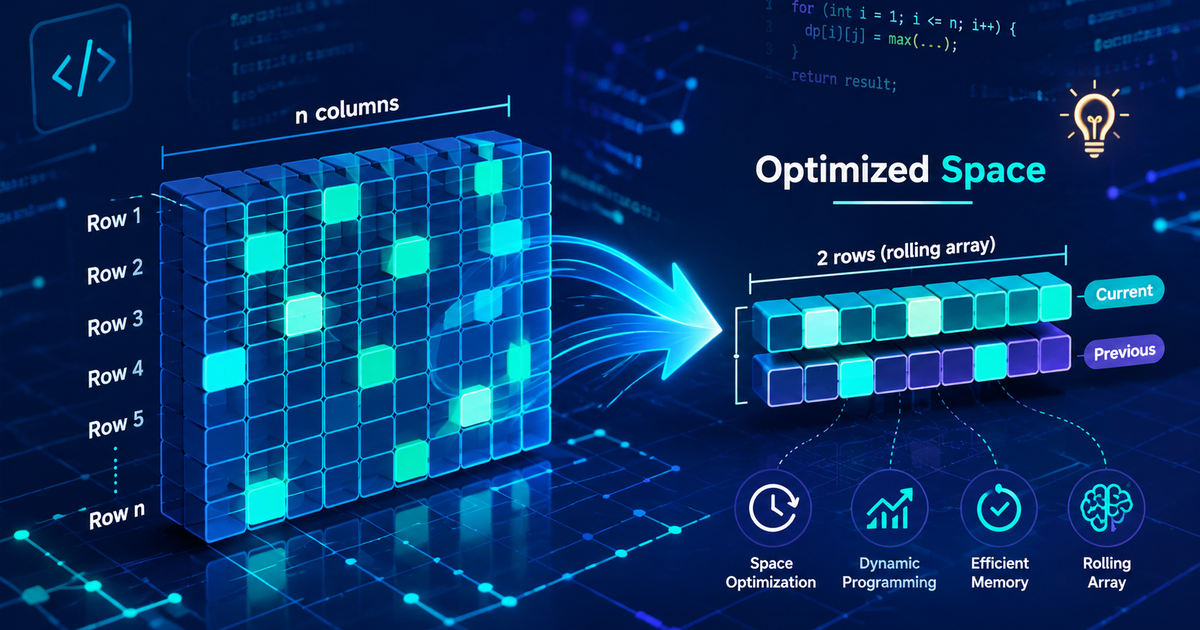
Look at the dependency pattern again. When computing dp[i][j], you only look at dp[i-1][j] (previous row, same column), dp[i][j-1] (current row, previous column), and dp[i-1][j-1] (previous row, previous column). You never look at dp[i-2] or anything further back. Row i only depends on row i-1. So why store all the rows?
def min_distance_optimized(word1: str, word2: str) -> int:
    m, n = len(word1), len(word2)
    prev = list(range(n + 1))
    curr = [0] * (n + 1)

    for i in range(1, m + 1):
        curr[0] = i
        for j in range(1, n + 1):
            if word1[i-1] == word2[j-1]:
                curr[j] = prev[j-1]
            else:
                curr[j] = 1 + min(
                    prev[j],      # delete
                    curr[j-1],    # insert
                    prev[j-1]     # replace
                )
        prev, curr = curr, prev

    return prev[n]
We went from O(m * n) space to O(n) space. The time complexity stays the same, but memory usage drops dramatically. For two strings of length 1000, that's the difference between storing 1,000,000 values and storing 2,000.
When You Can (and Can't) Apply Space Optimization
I kept getting confused about when this trick works, so I mapped out the rules for myself.
You can optimize when:
- Current state depends only on the immediately previous layer (row, column, or diagonal)
- You process states in an order where dependencies are already computed
- You don't need to reconstruct the full solution path (just the final answer)
You can't optimize when:
- Dependencies span more than one layer back
- You need the complete DP table for backtracking (like reconstructing the actual edit operations)
- The dependency pattern is irregular (some cells depend on arbitrary earlier cells)
0/1 Knapsack: From 2D to 1D
The standard 0/1 knapsack uses dp[i][w]: the maximum value using the first i items with weight capacity w. It is one of the most common dynamic programming problems in coding interviews and demonstrates the space optimization pattern clearly.
def knapsack_1d(weights, values, capacity):
    dp = [0] * (capacity + 1)

    for i in range(len(weights)):
        # MUST iterate right to left
        for w in range(capacity, weights[i] - 1, -1):
            dp[w] = max(dp[w], dp[w - weights[i]] + values[i])

return dp[capacity]I made this mistake and couldn't figure out why my answers were too high until I traced through a small example by hand. Right-to-left iteration ensures that when you compute dp[w], the values you read from dp[w - weights[i]] still reflect the previous item's decisions.
Adding a Third Dimension: DP with Constraints
Sometimes you need more than two dimensions. Consider this problem: given a set of items, find the maximum value where you use at most k items and the total weight doesn't exceed capacity.
def knapsack_with_count(weights, values, capacity, k):
    n = len(weights)
    dp = [[0] * (k + 1) for _ in range(capacity + 1)]

    for i in range(n):
        for w in range(capacity, weights[i] - 1, -1):
            for j in range(k, 0, -1):
                dp[w][j] = max(dp[w][j],
                    dp[w - weights[i]][j-1] + values[i])

    return dp[capacity][k]
Notice we already applied dynamic programming space optimization: we collapsed the item dimension i by iterating in reverse. The 3D problem runs in 2D space. This pattern generalizes. Whatever dimension you're iterating over in the outermost loop, you can usually eliminate from the DP table if the dependency only looks one step back.
The Boolean State Trick
One dynamic programming pattern I see in interviews constantly: adding a boolean flag to your state. Example: "Best Time to Buy and Sell Stock with Cooldown." Your state becomes dp[i][holding] where holding is 0 or 1.
def max_profit_cooldown(prices):
    n = len(prices)
    if n < 2:
        return 0
    sold, held, rest = 0, float('-inf'), 0

    for price in prices:
        prev_sold = sold
        sold = held + price
        held = max(held, rest - price)
        rest = max(rest, prev_sold)

    return max(sold, rest)
The boolean dimension is small (just 2 values), so instead of a 2D table, you track a handful of variables. This is the extreme case of dynamic programming space optimization: when a dimension has constant size, you can replace it with named variables.
Common Mistakes I Made (So You Don't Have To)
- Optimizing space too early: Write the full multi-dimensional version first, verify it works, then optimize. The space-optimized version is harder to debug.
- Wrong iteration order: In 0/1 knapsack, right-to-left is required. For unbounded knapsack, left-to-right is correct. The direction depends on whether you can reuse items.
- Forgetting the diagonal dependency: In edit distance, dp[i-1][j-1] gets overwritten when using two rows. You need a temporary variable to save it before the update.
- Thinking space optimization always means O(n): Sometimes you can go down to O(min(m, n)) by iterating along the shorter dimension.
What to Practice Next
These dynamic programming problems build on each other. I suggest this order:
- Edit Distance (LeetCode 72): The classic 2D DP. Practice both the full table and the space-optimized version.
- Target Sum (LeetCode 494): A 0/1 knapsack in disguise.
- Longest Common Subsequence (LeetCode 1143): Another 2D DP with clean space optimization.
- Best Time to Buy and Sell Stock with Cooldown (LeetCode 309): Boolean state plus space optimization.
- Interleaving String (LeetCode 97): 2D DP that tests whether you understand the state definition.
- Ones and Zeroes (LeetCode 474): Multi-dimensional knapsack where items have two costs.
- Profitable Schemes (LeetCode 879): 3D DP with three constraints. The ultimate test.
I've been working through these on Levelop's coding patterns track, and this multi-dimensional state concept was the thing that finally made advanced dynamic programming problems feel approachable instead of terrifying.
Frequently asked questions
What is multi-dimensional dynamic programming?
Multi-dimensional DP uses states that track multiple variables simultaneously. Instead of a single index like dp[i], you might use dp[i][j] or dp[i][j][k] to encode all the information needed to make the next decision. Common examples include edit distance (two string positions) and knapsack with constraints (weight and item count).
How does space optimization work in dynamic programming?
Space optimization reduces memory by only keeping the rows (or layers) that the current computation depends on. If dp[i] only depends on dp[i-1], you can use two arrays instead of a full table. For some problems like 0/1 knapsack, you can reduce to a single array by iterating in reverse order.
When should I iterate right to left in knapsack problems?
Iterate right to left in the 0/1 knapsack (where each item can be used at most once). This prevents using the same item twice. For the unbounded knapsack (unlimited copies), iterate left to right so updated values reflect the possibility of reusing items.
Can you always apply space optimization to DP problems?
No. Space optimization works when the current state depends only on the immediately previous layer and you don't need to reconstruct the full solution path. If you need backtracking (like finding the actual edit operations, not just the count), you need the complete DP table.
What is the boolean state trick in dynamic programming?
The boolean state trick adds a 0/1 flag to your DP state to track a binary condition (like whether you're currently holding a stock). Since the flag only has two values, you can replace the extra dimension with named variables, reducing a 2D table to just a few scalar values.