

Circuit Breaker Pattern in Distributed Systems: When and How to Use It
Picture a payment service that starts responding slowly. Every request that depends on it now waits. Threads pile up, connection pools drain, and within seconds a slow dependency has frozen three services that were healthy a moment ago. This is how one weak link takes down a whole system, and it is the problem the circuit breaker pattern was built to solve.
The circuit breaker pattern is a key resilience technique in distributed systems and microservices. As a fault tolerance pattern, it lets a service stop hammering a failing dependency, fail fast, and recover automatically once the dependency is healthy again. This guide covers what the pattern is, how its three states work, when to use it, and how to implement it well.
What Is the Circuit Breaker Pattern?
The circuit breaker pattern is a fault tolerance design pattern that wraps a call to a remote service and monitors it for failures. The name comes from electrical engineering. Physical electrical circuit breakers trip and cut the flow of current when they detect a fault. The software version does the same for service calls: when a downstream dependency starts failing, the breaker trips and short-circuits further calls so your system stops wasting resources on requests that will almost certainly fail.
Without a breaker, a client keeps calling a broken service and waits for each request to time out. Those waits consume threads, memory, and connections until the failure spreads upstream and degrades the whole system. The circuit breaker design pattern breaks that chain: once failures cross a threshold, it refuses to make the call and returns an error or fallback immediately.
That makes it a cornerstone of reliable microservices architecture, where one request often fans out to a dozen services. For the deeper background on how these failures spread, our guide on cascading failures in distributed systems walks through the full chain reaction.
The Three States: Closed, Open, and Half-Open
A circuit breaker is a state machine with three states.
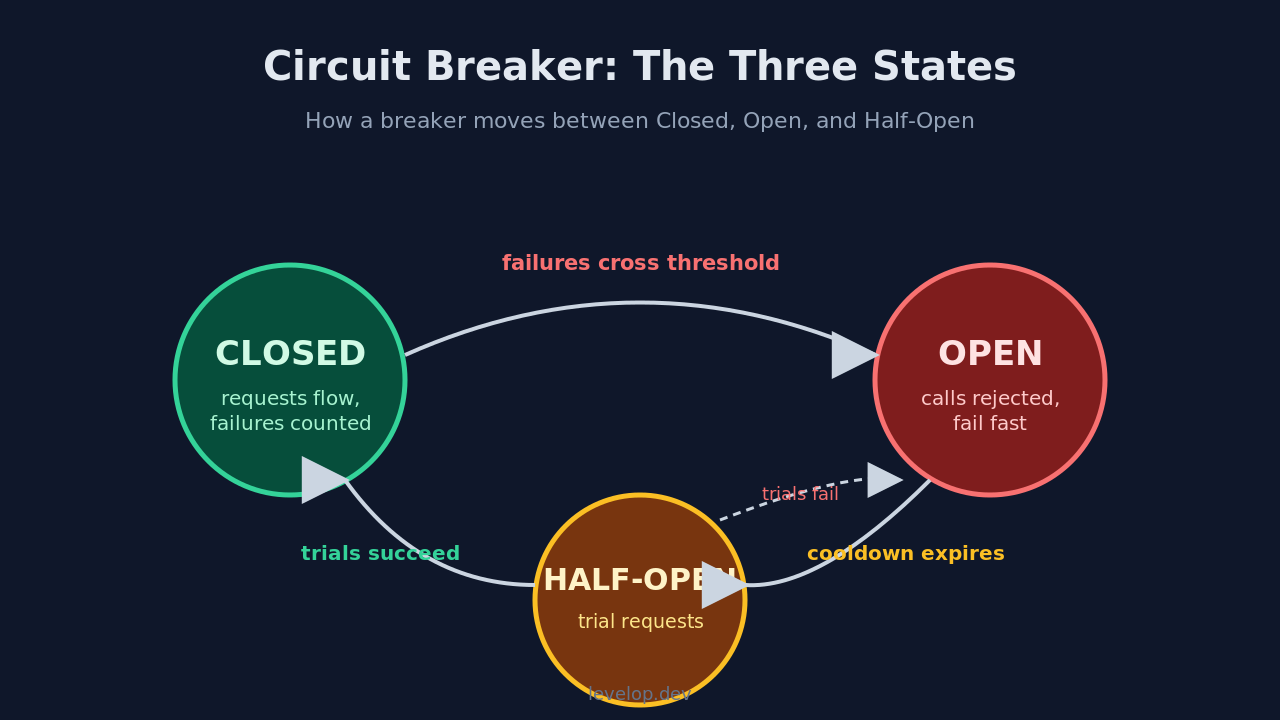
Closed
Closed is the healthy default. Requests flow through to the dependency while the breaker counts failures. If the failure rate stays below the threshold, the breaker stays closed. If failures cross it, the breaker trips and moves to open.
Open
Open means the breaker rejects every request immediately without attempting the call. Callers get a fast failure or fallback instead of a slow timeout. This is the whole point: fail fast, not slow. It also gives the struggling dependency room to recover. The breaker stays open for a cooldown window, often a few seconds to a minute.
Half-Open
Half-open comes next. The breaker lets a few trial requests through to test whether the dependency recovered. If they succeed, it returns to closed. If they fail, it snaps back to open and restarts the cooldown. This is what makes the breaker self-healing: it recovers without anyone flipping a switch.
Here is the state machine as pseudocode:
class CircuitBreaker:
    def __init__(self, failure_threshold=5, cooldown=30):
        self.failure_threshold = failure_threshold
        self.cooldown = cooldown
        self.failures = 0
        self.state = "CLOSED"
        self.opened_at = None

    def call(self, func):
        if self.state == "OPEN":
            if time.time() - self.opened_at >= self.cooldown:
                self.state = "HALF_OPEN"
            else:
                raise CircuitOpenError("Circuit is open, failing fast")
        try:
            result = func()
        except Exception:
            self._record_failure()
            raise
        self._record_success()
        return result
Why Circuit Breakers Prevent Cascading Failures
In a distributed system, resources are finite. Every in-flight request holds a thread and a connection until it completes or times out. When a dependency slows down, requests stop draining, the pool exhausts, and the calling service can no longer serve anyone, including callers who never needed the slow dependency.
A breaker caps this. Once it opens, calls return in microseconds instead of seconds. Threads release immediately, the pool stays healthy, and the service keeps serving every other request. That is why the circuit breaker microservices pattern is essential infrastructure, not an optional nicety. Containing one service failure keeps every unrelated feature healthy and turns a total outage into graceful degradation.
When to Use a Circuit Breaker (and When Not To)
The pattern fits calls to remote services that can fail independently of your code. Good candidates include:
- Network calls to another microservice over HTTP or gRPC
- Third-party APIs you do not control, like payment gateways
- Database or cache connections that can slow down under load
- Any dependency where a slow response would tie up your resources
It is less useful elsewhere. Do not wrap fast local operations, since the overhead buys nothing. Be careful with critical writes that must not be dropped unless you have a durable queue behind them. And a breaker handles a dependency being down, not a bug in your own logic. A useful rule: if a dependency's failure should degrade one feature of the user experience rather than crash your service, a circuit breaker belongs there.
How to Implement a Circuit Breaker
You rarely build one from scratch, but knowing the parts helps you configure a library.
Every implementation exposes similar knobs. The failure threshold decides what failure rate trips the breaker; a 50 percent rate over a rolling window is common. The cooldown sets how long it stays open before half-open. The half-open trial count limits test requests. The timeout bounds each call, which is critical because a breaker that waits forever defeats the purpose.
For production, reach for a proven library. On the JVM, Resilience4j is the modern standard, having largely replaced Netflix's Hystrix:
CircuitBreakerConfig config = CircuitBreakerConfig.custom()
    .failureRateThreshold(50)                       // trip at 50% failures
    .slowCallRateThreshold(80)                      // slow calls count too
    .slowCallDurationThreshold(Duration.ofSeconds(2))
    .waitDurationInOpenState(Duration.ofSeconds(10))// cooldown
    .permittedNumberOfCallsInHalfOpenState(3)
    .slidingWindowSize(20)
    .build();

CircuitBreaker breaker = CircuitBreaker.of("paymentService", config);
Other stacks have equivalents: Polly for .NET, gobreaker for Go, opossum for Node.js, and pybreaker for Python. Service meshes like Istio and Envoy can apply circuit breaking at the network layer without touching application code.
Always pair the breaker with a fallback. Failing fast only pays off when you have a sensible response ready: cached data, a default value, a queued write, or a clear try-again-later message.
Circuit Breaker vs Retry vs Timeout
These three are often confused but work best together. A timeout caps how long you wait for a single call and is a prerequisite for the others. A retry reattempts a failed call, ideally with exponential backoff and jitter, assuming the failure was transient. Retries help with blips but are dangerous during a real outage, since naive retries multiply load on a struggling service.
A circuit breaker sits above both. It watches failures over time and, once it decides the dependency is genuinely unhealthy, stops the retries and timeouts from even being attempted. Layer them: timeout each call, retry a few times for transient errors, and wrap the whole thing in a breaker. Our deep dive on fault tolerance, retry, and recovery patterns covers how to combine these safely.
Common Mistakes and Best Practices
The most common mistake is setting the threshold arbitrarily. Five failures behaves very differently at 10 requests per second versus 10,000. Prefer a failure rate over a rolling window so the breaker scales with traffic. The second mistake is retrying inside the breaker so one logical request generates many failures and trips it early. Retry outside the breaker instead. A third is letting too many trial requests through in half-open, which can knock a half-recovered dependency back down. Keep the trial count small, and emit a metric on every state transition so an open breaker becomes a visible alert.
Monitoring and Tuning
A breaker is only as good as your visibility into it. Track each breaker's state, its transitions, the failure rate feeding it, and how many calls it rejects while open. Dashboards that show breakers flipping open in real time are one of the fastest ways to spot a failing dependency.
Tuning is ongoing. Start with a 50 percent failure rate over a few dozen calls and a cooldown near ten seconds, then adjust. If breakers trip during normal spikes, your threshold is too sensitive. If failures cascade before the breaker reacts, it is not sensitive enough.
Frequently Asked Questions
What is the circuit breaker pattern in simple terms?
It wraps a call to another service and watches for failures. Once failures pass a threshold, it stops making the call and fails immediately, giving the failing service time to recover and protecting your own service from getting stuck waiting.
What are the three states of a circuit breaker?
Closed, open, and half-open. Closed passes traffic normally, open blocks traffic and fails fast after too many failures, and half-open sends a few trial requests to test whether the dependency has recovered before closing again.
How is a circuit breaker different from a retry?
A retry reattempts a failed call assuming the problem is temporary. A circuit breaker does the opposite once a dependency is clearly broken: it stops attempting the call. They complement each other, with retries handling brief blips and the breaker handling sustained outages.
When should I not use a circuit breaker?
Avoid it for fast local operations where the overhead adds no value, and be cautious wrapping critical writes unless you have a durable fallback like a queue. It will not help with bugs in your own code, only with unreliable dependencies.
Which library should I use to implement a circuit breaker?
Use a proven library for your stack: Resilience4j for Java, Polly for .NET, gobreaker for Go, opossum for Node.js, or pybreaker for Python. Service meshes like Istio and Envoy can also provide circuit breaking at the network layer.
Building Reliable Systems
The circuit breaker pattern turns a potential system-wide outage into a contained, recoverable event. Combined with timeouts, sensible retries, and good observability, it is one of the highest-leverage reliability patterns you can add to a microservices architecture. Start with a library, tune the thresholds against real traffic, and always pair the breaker with a fallback.
For more engineering deep dives on distributed systems and reliability, explore the Levelop blog or learn how Levelop helps engineering teams ship more resilient software.