

Agent Workflow Memory: How AI Agents Learn to Reuse Past Steps
Most AI agents are surprisingly forgetful. An agent can solve a multi-step task beautifully, then face a nearly identical task ten minutes later and start from scratch, re-deriving every step as if it had never seen the problem before. That waste is the gap agent workflow memory is designed to close.
Agent workflow memory is the mechanism that lets an agent extract reusable procedures from its own past task trajectories and apply them to new, related tasks. Instead of remembering only facts or conversation history, the agent remembers how it accomplished something: the ordered sequence of steps, tool calls, and decisions that led to success. The next time a similar goal appears, the agent retrieves that procedure and skips the trial and error.
The idea sits at the intersection of two things engineers already care about: making agents cheaper to run and making them behave predictably. An agent that re-plans every task from a blank slate is both expensive and unreliable, because planning is where large language models burn the most tokens and make the most mistakes. Workflow memory attacks both problems at once by turning planning into recall.
This post explains what agent workflow memory is, how it differs from other memory types, how the extraction-and-reuse loop actually works, and how to build a basic version in Python. If you are new to agent memory in general, start with our AI agent memory developer's guide, which covers the full memory landscape that this pattern sits inside.
What Is Agent Workflow Memory?
Agent workflow memory is a form of procedural memory for autonomous agents. A workflow is a reusable, higher-level routine induced from one or more past trajectories. Where a raw trajectory is a long, task-specific log ("clicked this button, typed this string, waited for that element"), a workflow is the generalized recipe behind it ("to filter a product list, open the filter panel, select the category, then apply").
The concept was formalized in the 2024 research paper "Agent Workflow Memory" from Carnegie Mellon University, which showed that giving web-navigation agents a library of induced workflows substantially improved success rates on benchmarks like Mind2Web and WebArena. The core idea is simple and powerful: an agent that has solved tasks before should not solve the same class of task from zero again.
The word "workflow" matters here. A workflow captures the structure of a solution, not the exact inputs. That structure is what transfers across tasks. Booking a flight to Tokyo and booking a flight to Berlin share almost the entire workflow, even though every field value differs. The same is true for filling out expense reports, querying a database, or navigating a checkout flow. The values change every time, but the shape of the solution barely moves, and that shape is exactly what an agent should not have to rediscover.
How It Differs From Other Memory Types
Agent memory is usually split into a few categories, and workflow memory is one specific slice. Episodic memory stores specific past experiences and events. Semantic memory stores facts and general knowledge. Procedural memory, where workflow memory lives, stores skills and routines: the knowledge of how to do things.
The distinction shows up in what gets retrieved and why:
- Episodic memory answers "what happened last time?"
- Semantic memory answers "what do I know about this?"
- Workflow memory answers "what steps worked for tasks like this?"
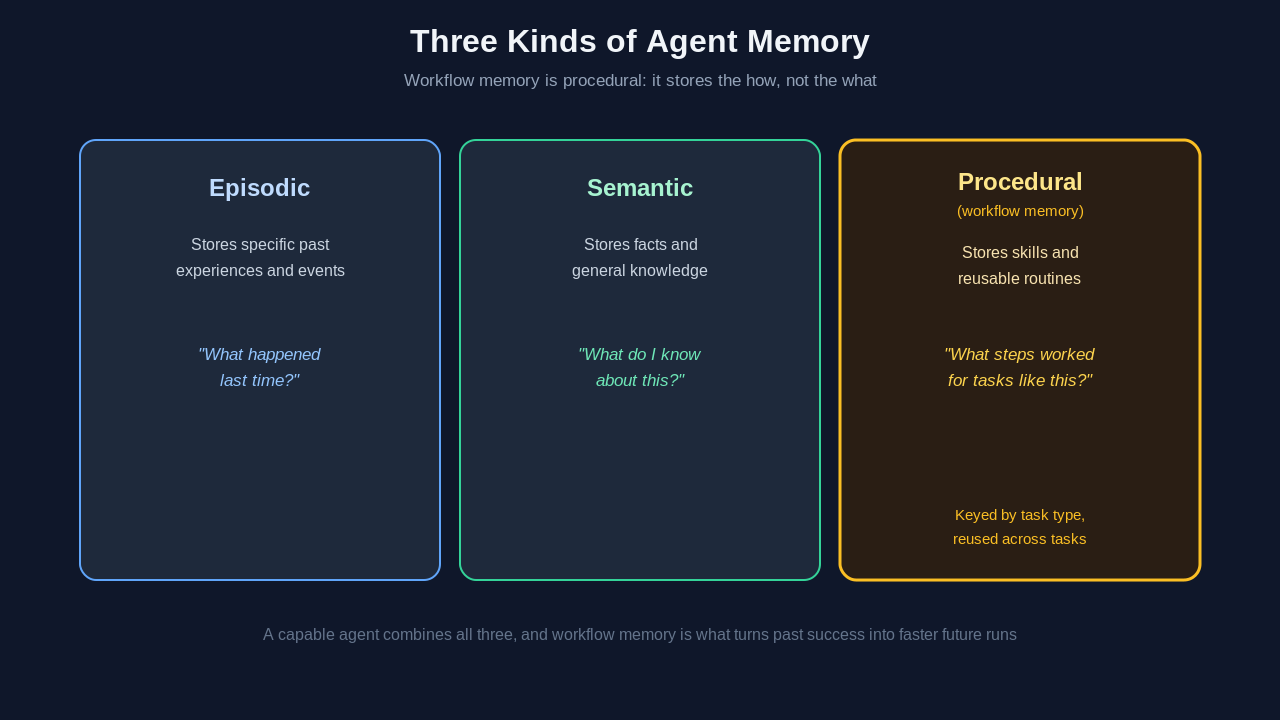
For a deeper treatment of the retrieval, storage, and consolidation layers that all of these share, our companion piece on long-term memory for AI agents is a useful reference. The short version: workflow memory is procedural, reusable, and keyed by task type rather than by conversation or fact.
Why Reusing Past Steps Matters
Three practical problems push teams toward workflow memory.
The first is cost. Every step an agent re-derives means more model calls, more tokens, and more latency. On a task that takes twelve reasoning steps to figure out the first time, a cached workflow might collapse that to two or three. At production scale, that difference is the gap between an agent that is economical to run and one that is not.
The second is reliability. Agents that reason from scratch on every task are non-deterministic in ways that hurt. They find a slightly different path each time, and some of those paths fail. A validated workflow, retrieved and reused, gives you a known-good route. You trade some flexibility for a large gain in consistency.
The third is compounding capability. This is the most interesting one. When an agent stores workflows as it works, later tasks get easier because earlier tasks left behind reusable structure. The agent's competence grows with experience instead of resetting every session. This is what people mean when they say an agent "learns on the job" without any weight updates.
It helps to see the difference on a concrete task. Imagine an agent asked to pull the latest invoice from a vendor portal. The first time, it explores: it reads the page, guesses which menu holds billing, backtracks, finds the invoices tab, and downloads the file. That might take ten or twelve steps of reading and reasoning. With workflow memory, the agent stores the successful path as a short procedure. The next time any invoice-retrieval task arrives, it retrieves that procedure, adapts the vendor name, and executes in three or four steps. Multiply that saving across thousands of runs and the economics change completely.
How Agent Workflow Memory Works
The pattern has two halves: inducing workflows from experience, and retrieving them when a relevant task appears. Most systems run both an offline and an online version of induction.
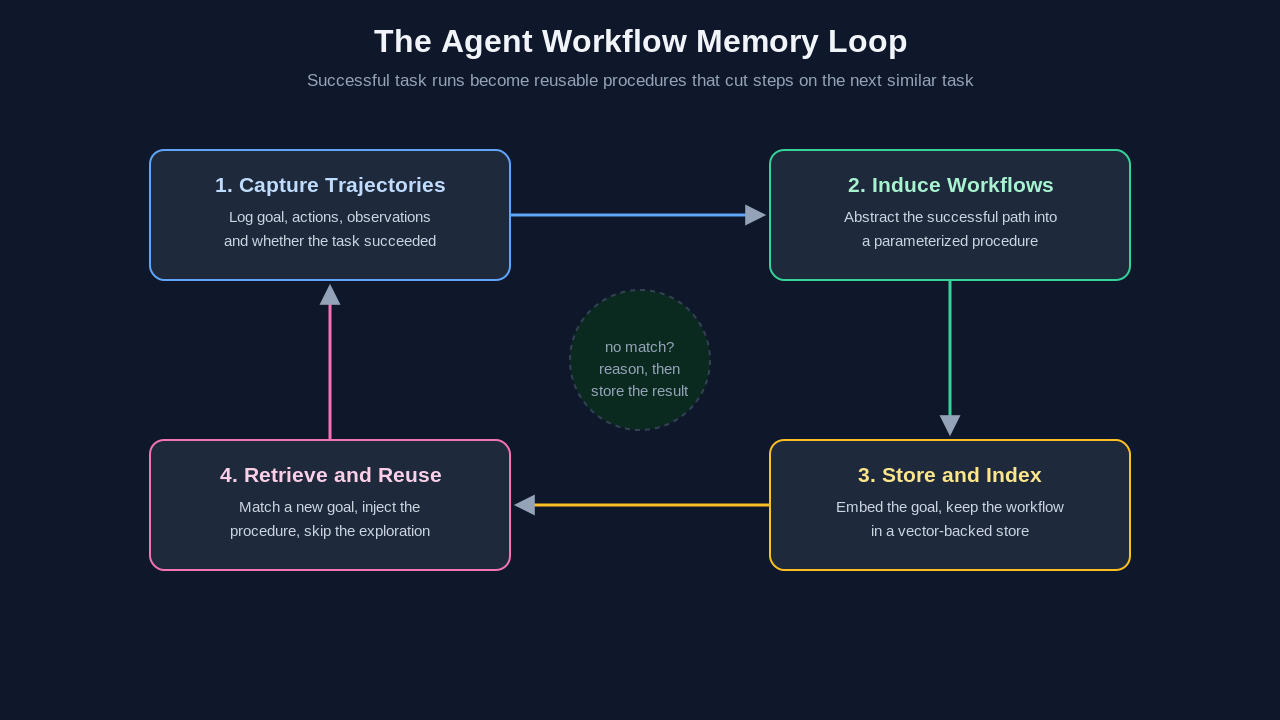
Step 1: Capture Trajectories
Everything starts with the trajectory, the full record of an agent solving a task. A trajectory includes the goal, the sequence of actions, the observations returned after each action, and the final outcome. You log these as the agent runs. Crucially, you also record whether the task succeeded, because you only want to learn from trajectories that worked.
Step 2: Induce Workflows
Induction is the step that turns a raw trajectory into a reusable workflow. In practice this is often an LLM call: you give the model one or more successful trajectories and ask it to abstract the common procedure, replacing task-specific values with placeholders and summarizing the intent of each step.
This can happen offline, over a batch of historical trajectories, to seed the memory before deployment. It can also happen online, during a session, where the agent induces a new workflow immediately after solving a novel task so it is available for the rest of that same run. Online induction is what lets an agent improve within a single long session, not just across deployments.
Step 3: Store and Index
Induced workflows go into a store, indexed so they can be found by relevance. A common approach is to embed a natural-language description of each workflow's goal and store the vector alongside the workflow text. Retrieval then becomes a similarity search: embed the new task's goal, find the closest stored workflows, and pull them in.
Step 4: Retrieve and Reuse
When a new task arrives, the agent embeds the goal, retrieves the top matching workflows, and injects them into its context as guidance. The agent is not forced to follow a workflow blindly. It treats the retrieved procedure as a strong prior, adapting the placeholder values and skipping the exploration it would otherwise need. If no workflow matches well, the agent falls back to reasoning from scratch, then stores whatever it learns.
A Minimal Implementation
Here is a stripped-down workflow memory store in Python. It captures the four steps above without any framework, so the mechanics are visible. In production you would back the store with a real vector database and add validation, but the shape is the same.
from dataclasses import dataclass, field
import numpy as np

@dataclass
class Workflow:
    goal_description: str          # what class of task this solves
    steps: list[str]               # the generalized, reusable procedure
    embedding: np.ndarray          # vector of the goal description
    successes: int = 0             # times reuse led to success

@dataclass
class WorkflowMemory:
    store: list[Workflow] = field(default_factory=list)

    def induce(self, goal, trajectory, embed_fn, llm_fn):
        # Turn a successful trajectory into a reusable workflow.
        steps = llm_fn(
            "Abstract these actions into a reusable, parameterized "
            f"procedure. Replace specific values with placeholders.\n{trajectory}"
        )
        wf = Workflow(goal, steps, embed_fn(goal))
        self.store.append(wf)
        return wf

    def retrieve(self, goal, embed_fn, k=3, threshold=0.75):
        # Find workflows whose goals are similar to the new task.
        if not self.store:
            return []
        q = embed_fn(goal)
        scored = [
            (float(np.dot(q, w.embedding)), w) for w in self.store
        ]
        scored.sort(key=lambda x: x[0], reverse=True)
        return [w for score, w in scored[:k] if score >= threshold]
Using it inside an agent loop looks like this. The agent tries to reuse before it tries to reason.
def run_task(goal, memory, agent, embed_fn, llm_fn):
    hints = memory.retrieve(goal, embed_fn)
    trajectory, success = agent.solve(goal, workflow_hints=hints)

    # Learn online: if this was solved without a matching workflow,
    # induce a new one so the next similar task is faster.
    if success and not hints:
        memory.induce(goal, trajectory, embed_fn, llm_fn)

    return trajectory, success
Two design choices in that loop deserve attention. First, induction only fires on success, which keeps failed exploration out of the memory. Second, the agent induces a new workflow only when retrieval came up empty, so the store does not fill with near-duplicates of procedures it already knows.
Where This Fits With Frameworks and Tools
You rarely have to build all of this by hand. Several tools in the ecosystem give you pieces of the pattern.
LangGraph is a natural home for workflow memory because its graph structure already models an agent's steps explicitly, which makes trajectories easy to capture and reuse. If you are building multi-step agents there, our LangChain context engineering guide covers how to feed retrieved workflows into an agent's context without blowing the token budget. Managed memory services such as Mem0, Zep, and LangMem handle storage, embedding, and retrieval for you, and while they are often marketed around episodic and semantic memory, the same infrastructure stores procedural workflows perfectly well.
Mem0 focuses on a memory layer that extracts and consolidates salient information across sessions. Zep organizes memory into a temporal knowledge graph so relationships and recency are first-class. LangMem, from the LangChain team, exposes procedural, semantic, and episodic memory primitives designed to plug into agent loops. None of these are strictly workflow memory tools, but each gives you a durable, queryable place to keep induced workflows, and each removes the need to run your own vector store and embedding pipeline.
The important thing is to separate the two concerns. The store is plumbing, and any decent vector-backed memory service can hold it. The induction logic, deciding what counts as a reusable workflow and how to generalize it, is where your agent's actual learning lives, and that is worth owning yourself. Treat the store as a commodity you can swap out, and treat induction as a core piece of your agent's design that deserves careful prompts, evaluation, and iteration.
Workflow Memory in the Broader Agent Stack
Workflow memory is one layer of a capable agent, not the whole thing. It pairs naturally with the retrieval and consolidation machinery covered across the agent memory cluster, and it complements rather than replaces episodic and semantic memory. An agent might use semantic memory to recall a user's preferences, episodic memory to remember a specific earlier interaction, and workflow memory to execute the multi-step procedure that ties them together.
It also connects to how you engineer context. Retrieved workflows are just another thing competing for space in the model's context window, so the same discipline you apply to any context-heavy agent applies here: retrieve selectively, compress aggressively, and drop what is not relevant to the current step.
For teams already running agents in production, the payoff is concrete. Instrument your agents to log trajectories and outcomes now, even if you are not inducing workflows yet. Those logs are the raw material. Once you have a few weeks of successful trajectories, offline induction can seed a workflow memory that immediately cuts steps on your most common task types.
Frequently Asked Questions
What is agent workflow memory in simple terms?
It is a way for an AI agent to remember the step-by-step procedures it used to solve past tasks, so it can reuse those procedures on new, similar tasks instead of figuring everything out again. It stores the "how," not just facts or conversation history.
How is workflow memory different from RAG?
RAG retrieves documents or facts to ground a model's answer. Workflow memory retrieves procedures, the sequence of steps and tool calls that accomplished a goal. RAG helps an agent know things, workflow memory helps an agent do things. Many agents use both, and measuring the retrieval side is a separate discipline covered in our RAG evaluation guide.
Does agent workflow memory require fine-tuning the model?
No. Workflow memory works entirely at inference time. Workflows are stored as text or structured data and injected into the agent's context when relevant, so the underlying model weights never change. This is what makes it practical to add to an existing agent.
When should I use online versus offline workflow induction?
Use offline induction to seed memory from a batch of historical successful trajectories before deployment. Use online induction when you want an agent to improve within a single long-running session by learning from tasks it just solved. Most robust systems combine both.
Can workflow memory make an agent worse?
Yes, if you are careless. Stale workflows that no longer match the environment can lead an agent down a broken path. Guard against this by only inducing from successful trajectories, validating retrieved workflows early in execution, and pruning workflows that stop working.
Wrapping Up
Agent workflow memory is one of the highest-leverage upgrades you can give a task-solving agent. By capturing successful trajectories, inducing reusable procedures, and retrieving them when relevant, you turn every solved task into infrastructure that makes future tasks cheaper, faster, and more reliable. The mechanics are approachable, the pattern layers cleanly on top of existing agents, and the payoff compounds the longer your agents run.
To see how this fits alongside episodic and semantic memory, read the AI agent memory developer's guide, and explore more engineering deep dives on the Levelop blog.