
AI Agent Memory: A Developer's Guide to Persistent Memory in 2026
Large language models are stateless. Each call starts from a blank slate, so the model only knows what you put in the current context window. That is fine for one question, but it breaks the moment you build an agent that runs across many turns, tools, and sessions. The fix is agent memory: an external system that stores what matters and feeds it back to the model at the right time. In 2026 it has become a production requirement, because agents that forget user preferences, repeat mistakes, and lose track of long tasks are agents nobody trusts.
What Is Agent Memory?
Agent memory is the set of components that let an AI agent retain and reuse information beyond a single model call. The model itself remembers nothing between requests. Memory is added as a system component around it: a place to write facts, a store to hold them, and a retrieval step that pulls the right pieces back into context when needed.
The mental model is simple. An LLM agent runs a loop: plan, call tools, check results, decide what to do next. Memory sits beside that loop. During the loop the agent writes new observations, and before each step it reads relevant memories back in. Because the context window is fixed, you cannot stuff everything into the prompt, so memory decides what stays, what gets summarized, and what gets pulled in on demand. This is why agentic memory is not the same as a bigger context window. A larger window holds more tokens, but only memory gives durability across sessions and the ability to find the few relevant facts inside a large history. For how context itself is assembled, see our guide to context engineering.
Short-Term vs Long-Term Memory in AI Agents
Almost every design splits into two layers, and getting the split right is the most important decision you will make.
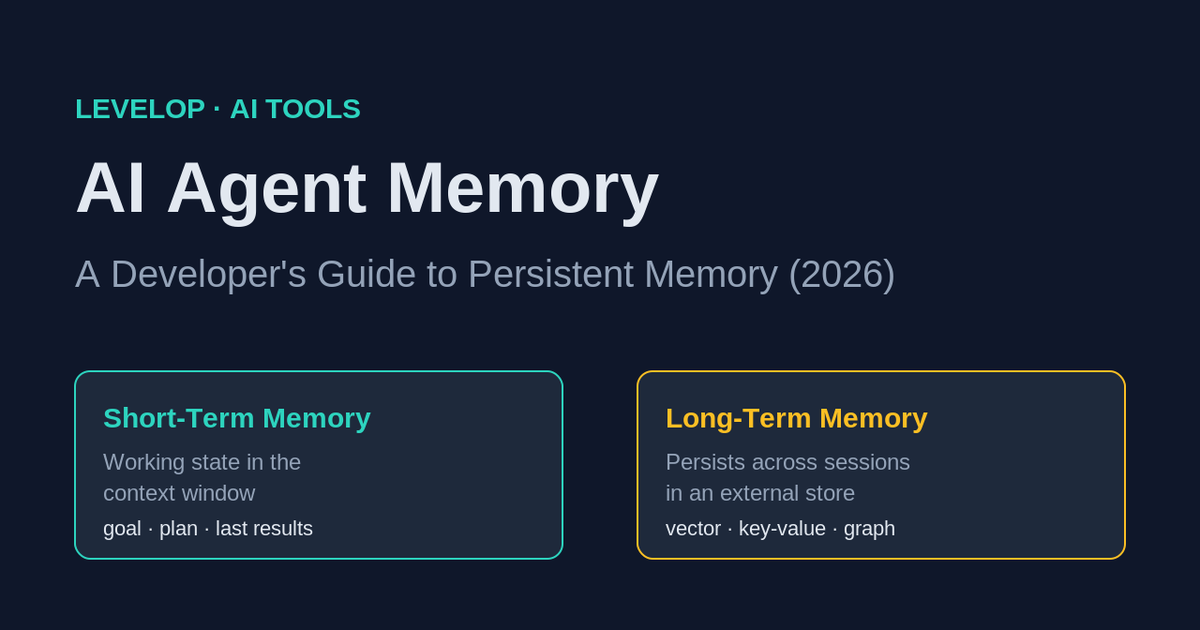
Short-term (working) memory is the agent's state inside the current loop: the active goal, the plan, the last few tool results, and current constraints. Keep it small and easy to overwrite. If it grows without bound, the agent drifts and burns tokens on stale detail. It usually lives in the context window, managed with running summaries, message trimming, and scratchpads.
Long-term memory persists across sessions and stores only what stays true: user preferences, stable identifiers, and decisions the agent must honor later. It lives outside the model in a vector database, key-value store, or graph, and is pulled in through retrieval when a query is relevant. The rule is to write sparingly and retrieve precisely. A good long-term store is small, curated, and high-signal, not a dump of every message the agent ever saw.
Types of Long-Term Agent Memory
Three categories from cognitive science map cleanly onto how developers build agents. Episodic memory records specific past events, like which fix worked on a bug, and makes the agent feel like it remembers your history. Semantic memory holds general facts such as a user's role or a database schema, and overlaps with retrieval-augmented generation. Procedural memory captures how to do things: reusable steps and learned routines. Procedural memory is the newest and most interesting, because it lets an agent improve its own behavior by saving successful action sequences and replaying them later. Most production systems combine all three.
How Agent Memory Works: The Write-Retrieve Loop
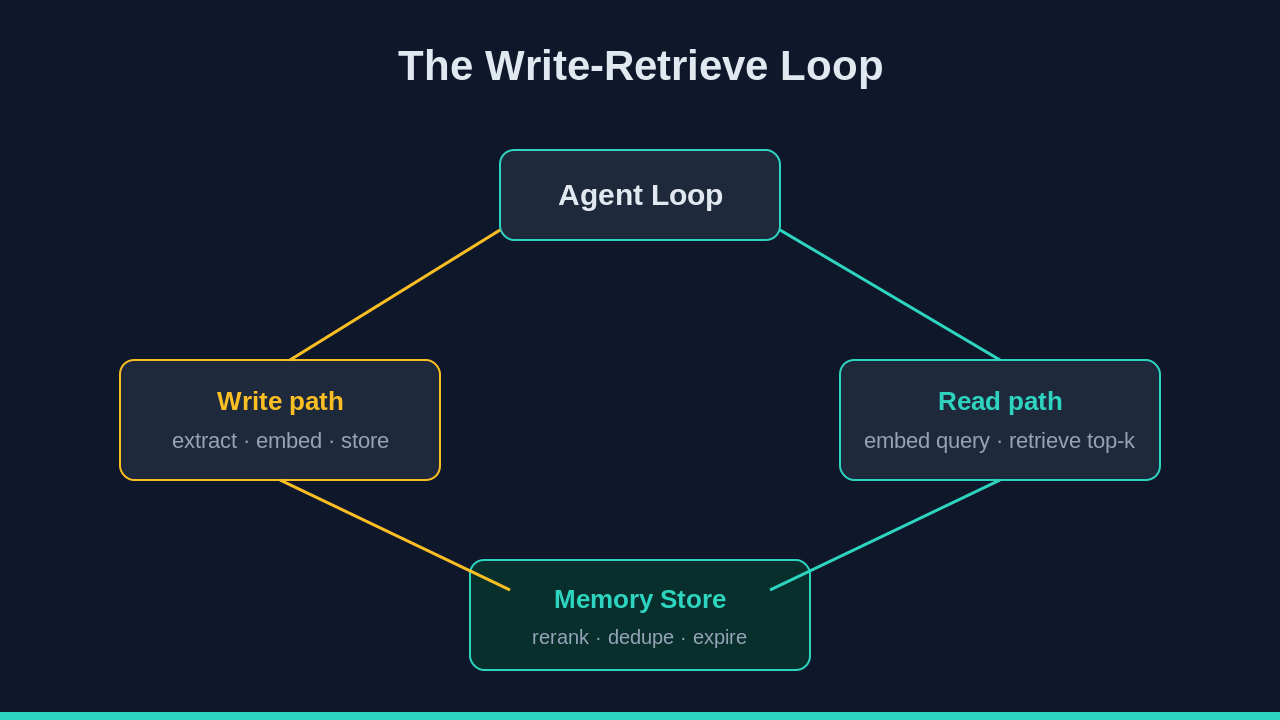
Under the hood, agent memory is a write path and a read path wrapped around the agent loop. On the write path the agent extracts salient information, decides whether to keep it, and stores it with an embedding and metadata. On the read path it embeds the current query, finds the closest stored memories, and injects the top matches into the prompt.
@dataclass
class MemoryStore:
    records: list = field(default_factory=list)

    def write(self, text, embedding, metadata):
        self.records.append({"text": text, "vec": embedding, "meta": metadata})

    def retrieve(self, query_vec, k=5):
        scored = [(cosine(query_vec, r["vec"]), r) for r in self.records]
        scored.sort(key=lambda x: x[0], reverse=True)
        return [r for _, r in scored[:k]]

def agent_step(agent, store, user_input, embed):
    memories = store.retrieve(embed(user_input), k=5)   # read path
    result = agent.run(format_memories(memories) + "\n" + user_input)
    if result.worth_remembering:                        # write path
        store.write(result.summary, embed(result.summary), result.meta)
    return result
The pattern is universal: embed, store with metadata, retrieve by similarity, and be selective about what you write.
Retrieval quality is where the engineering effort goes. Similarity search alone returns near-duplicates and stale facts, so mature systems add reranking, recency weighting, and deduplication. If you have built a retrieval pipeline, this feels familiar, and the same discipline applies. Our guide to RAG evaluation covers metrics that carry over directly to memory retrieval.
Memory Architectures and Frameworks
You rarely build agent memory from scratch anymore. Mem0 offers a portable memory layer that extracts and consolidates facts automatically, aiming for low latency across stacks. Zep adds a temporal knowledge graph so the agent can reason about how facts change over time. LangMem and the memory utilities in LangGraph integrate tightly with the runtime, letting you attach short-term and long-term stores directly to a graph of agent steps, while LangGraph persistence gives durable checkpoints of the entire agent state for resumable tasks.
When you evaluate a framework, judge it on retrieval quality, latency, how it handles updates and contradictions, temporal reasoning, self-hosting and compliance, observability, and how cleanly it fits your runtime. If you are still choosing an orchestration layer, our AI agent frameworks guide compares the runtimes these memory layers attach to, and the agentic AI architecture breakdown shows where memory fits.
Common Agent Memory Failure Modes
Agent memory is one of the most common points of silent failure. The agent keeps answering, so nothing errors, but the answers slowly get worse. Memory pollution writes low-value or wrong facts that get retrieved forever. Retrieval drift returns plausible but irrelevant memories that pull the agent off task. Stale memory keeps a fact that was true once and is now wrong. Context bloat injects too many memories at once and crowds out the current task. Contradiction stores two memories that disagree with no rule for which wins.
Every one of these is a lifecycle problem. Memory that only grows will eventually rot, so reliable systems treat writing, updating, expiring, and consolidating as first-class operations.
Best Practices for Production Agent Memory
Write selectively: persist durable facts, decisions, and preferences, not raw transcripts, and consolidate a long exchange into one clean fact. Scope memory per user and per project so one tenant's data never leaks into another's retrieval. Add metadata such as source, timestamp, and confidence so you can filter and expire later, and set an update and expiry policy so old facts can die. Rerank retrieved memories rather than trusting raw similarity, and weight for recency where it matters. Above all, evaluate memory the way you evaluate any retrieval system.
def eval_memory_retrieval(cases, store, embed):
    hits = 0
    for case in cases:
        got = {r["text"] for r in store.retrieve(embed(case.query), k=5)}
        if case.expected_memory in got:
            hits += 1
    return {"recall_at_5": hits / len(cases)}
This harness turns memory from a black box into something you can regression-test on every change. The same mindset runs across the stack, from AI agent evaluation to LLM observability, and memory belongs right in the middle of it. Start simple with a clean write-retrieve loop, measure retrieval quality, and add sophistication only where your evaluations show it helps. You can find more deep dives on the Levelop blog, and learn what we are building at Levelop.
Frequently asked questions
What is the difference between agent memory and a context window?
A context window is the fixed number of tokens a model reads in one call. Agent memory is an external system that stores information durably and retrieves the relevant pieces back into that window when needed. A larger window helps, but only memory gives persistence across sessions and the ability to find the few facts that matter inside a large history.
What is the difference between short-term and long-term memory in AI agents?
Short-term memory is the agent's working state for the current task, held in the context window and overwritten often. Long-term memory persists across sessions in an external store and holds only durable facts like user preferences and past decisions.
Do I need a vector database for agent memory?
Not always. Key-value or document stores work for structured facts and preferences. A vector database helps when you need semantic search over unstructured memories, and graph-based stores add value when relationships and how facts change over time matter.
Which agent memory framework should I use?
It depends on your needs. Mem0 targets a portable, low-latency layer, Zep adds temporal knowledge graphs, and LangMem and LangGraph integrate tightly with the runtime. Evaluate each on retrieval quality, latency, update handling, observability, and fit with your existing agent framework.
How do I stop my agent from remembering wrong information?
Write selectively so low-value facts never enter the store, add metadata and expiry so stale facts can be updated or removed, deduplicate and consolidate memories, and rerank retrieval results instead of trusting raw similarity. Most memory failures come from writing too much and never cleaning up.