AI Agent Frameworks in 2026: A Developer's Guide to Building Autonomous Agents
If you shipped software in 2025, you used AI agents. In 2026, you are expected to build them. That shift, from consuming agentic tools to assembling your own, is why "ai agent frameworks" has become one of the most searched phrases among working developers this year. The catch is that the landscape moved faster than most teams could evaluate it, and choosing wrong now means rewriting your orchestration layer six months from now.
This guide is a practical map of the AI agent frameworks that matter in 2026: what each one is actually good at, where the real trade-offs live, and how to pick one without getting lost in GitHub star counts. We will keep it grounded in how these tools behave in production, not in demo videos.
What an AI agent framework actually does
An AI agent framework is the scaffolding that turns a language model into a system that can plan, call tools, remember context, and act across multiple steps without a human driving every turn. Strip away the marketing and every framework is solving the same four problems: control flow (deciding what the agent does next), state and memory (what it remembers between steps), tool integration (how it touches the outside world), and observability (how you debug it when it goes sideways).
The reason there are a dozen serious frameworks rather than one winner is that these four problems have genuinely different answers depending on what you are building. A retrieval agent that reasons over private documents has almost nothing in common with a multi-agent customer-support swarm, even though both are AI agents.
The frameworks that matter in 2026
Here is the honest shortlist, organized by what each one is built to do well.
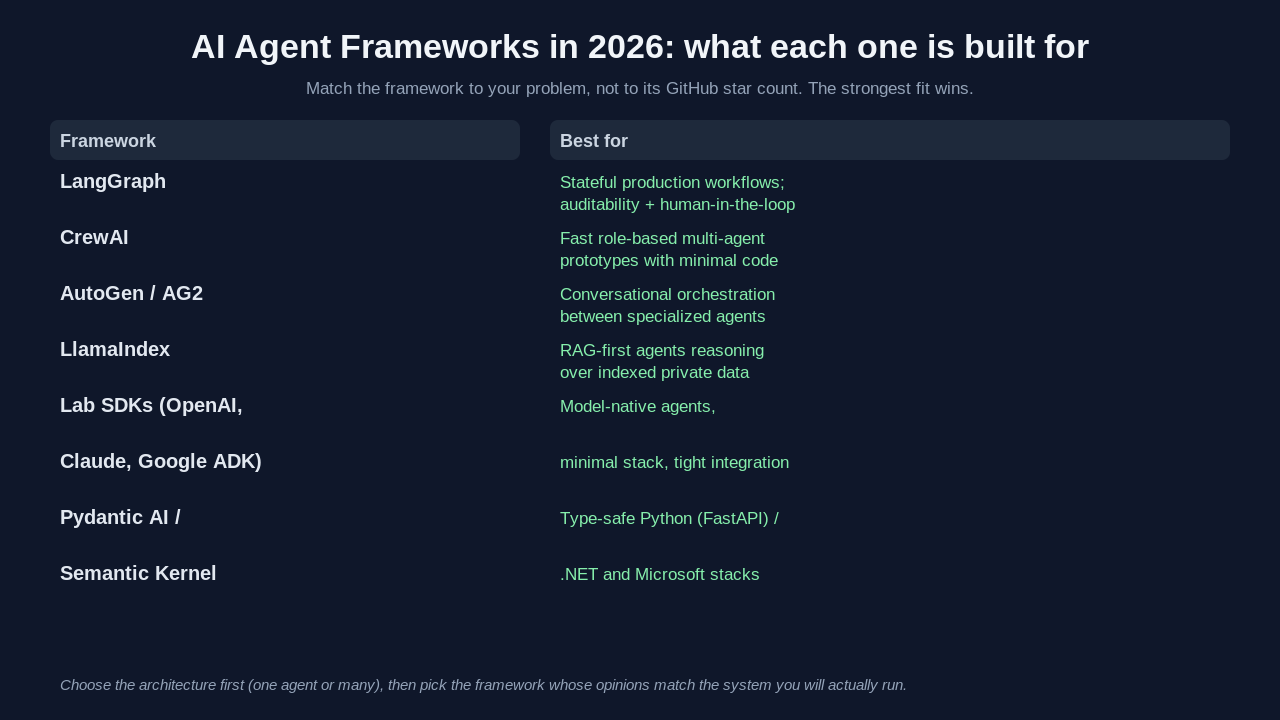
LangGraph: the production default for stateful workflows
LangGraph models your agent as a graph: nodes are steps, edges are transitions, and a shared state object flows through the whole thing. That structure sounds academic until you hit production and need deterministic control, audit trails, and human-in-the-loop checkpoints. Because the graph is explicit, you can pause an agent, inspect its state, route to a human for approval, and resume. For anything where mistakes are expensive, that auditability is the feature you did not know you needed. The cost is verbosity. You write more boilerplate than you would in a lighter framework, because you are defining the control flow yourself.
from langgraph.graph import StateGraph, END
from typing import TypedDict

class AgentState(TypedDict):
    question: str
    research: str
    answer: str

def research_node(state: AgentState) -> AgentState:
    state["research"] = run_search(state["question"])
    return state

def answer_node(state: AgentState) -> AgentState:
    state["answer"] = draft_answer(state["research"])
    return state

graph = StateGraph(AgentState)
graph.add_node("research", research_node)
graph.add_node("answer", answer_node)
graph.set_entry_point("research")
graph.add_edge("research", "answer")
graph.add_edge("answer", END)
agent = graph.compile()
CrewAI: the fastest path to a role-based multi-agent prototype
CrewAI thinks in terms of a crew: a team of role-playing agents, each with a goal, working through a set of tasks. If LangGraph is a state machine, CrewAI is an org chart. You describe a researcher agent and a writer agent, hand them tasks, and the framework coordinates the handoff. It is the quickest way to get a believable multi-agent demo running with minimal code, which is exactly why it dominates prototypes and exactly why teams sometimes over-reach with it.
AutoGen and AG2: conversational orchestration
AutoGen, and its community continuation AG2, frames multi-agent work as a conversation. Agents talk to each other, and the orchestration emerges from that dialogue. This shines when your problem genuinely maps to back-and-forth negotiation between specialized agents, and it can feel like overkill when it does not.
The lab SDKs: OpenAI Agents SDK, Claude Agent SDK, Google ADK
The major model labs now ship their own agent SDKs. These trade framework neutrality for tight, first-party integration: native tool use, built-in memory primitives, and fewer abstraction layers between you and the model. If you have strong model affinity, you are committed to one provider, or you want the smallest possible stack, a lab SDK is often the cleanest choice. The trade-off is portability. Switching models later means rewriting more than you would with a model-agnostic framework.
LlamaIndex: when the agent's real job is your data
LlamaIndex started as a data framework and now ships first-class agent primitives. It is strongest when the agent's core job is reasoning over indexed private data, a retrieval-augmented generation agent rather than a general task runner. If your hardest problem is answering accurately from 200,000 internal documents, this is the framework whose center of gravity matches yours.
Pydantic AI and Semantic Kernel: ergonomics and ecosystems
Pydantic AI brings type-safe, FastAPI-flavored ergonomics to Python developers who want structure and validation baked in. Semantic Kernel is the natural pick when your stack is .NET or Microsoft-centric, because it meets you inside the ecosystem you already run.
The decision nobody tells you to make first: one agent or many
Before you choose a framework, choose an architecture, because the architecture decision has bigger cost consequences than the framework decision. The instinct in 2026 is to reach for multi-agent systems because they look sophisticated. The production data argues for restraint. A 2026 analysis of 47 production deployments found that 68 percent could have achieved the same results with a single well-built agent, at roughly three times lower cost. The operational penalty is just as real: mean time to resolve a production incident was 67 minutes in multi-agent setups versus 18 minutes for single-agent systems, a 3.7x debugging tax. In one case, a 2.1 percentage point accuracy gain in a support workflow cost an extra 24,700 dollars per month in pure orchestration overhead.
This is also where framework choice and architecture choice intersect. CrewAI and AutoGen make multi-agent setups easy, which is a double-edged gift. LangGraph makes you spell out control flow, which feels heavier but keeps a complex system debuggable. If you are still validating whether you even need multiple agents, a single-agent loop in a lightweight framework will tell you faster and cheaper.
State and memory: the real line between a prototype and production
The demos that go viral are stateless. The agents that survive contact with real users are not. Memory and state management are what separate a prototype from a production system, and frameworks differ sharply here, from fully stateless designs to layered, persistent memory. In practice, production agents need at least two kinds of memory. Working memory holds session-specific context and intermediate results, the scratchpad for the current task. Persistent memory holds what should survive across sessions: user preferences, prior decisions, long-running context. A framework that gives you clean primitives for both, like LangGraph checkpointed state or CrewAI layered memory, saves you from rebuilding a memory layer by hand later.
from langgraph.checkpoint.memory import MemorySaver

agent = graph.compile(checkpointer=MemorySaver())
config = {"configurable": {"thread_id": "user-42"}}

# The agent can pause for human review and resume with full state intact
result = agent.invoke({"question": "Refund this order?"}, config)
If you want to go deeper on watching agents behave once they are live, our guide to LLM observability and tracing AI agents in production covers the instrumentation side that pairs with whatever framework you pick.
How to actually choose: a constraint-first checklist
The mistake is defaulting to whichever framework has the most GitHub stars. The better approach is to match your specific constraints against each framework's real strengths. Work through these in order. Start with your language and stack. If you live in .NET, Semantic Kernel removes friction the Python-first frameworks cannot. If you are Python with FastAPI, Pydantic AI or LangGraph fit naturally. Next, look at your data gravity. If the agent's hardest job is reasoning over your private documents, a RAG-first framework like LlamaIndex starts you closer to the finish line than a general orchestrator. Then assess orchestration complexity honestly. A single-agent loop with a few tools does not need a multi-agent framework. Reach for CrewAI or AutoGen only when the work is genuinely a team effort. Weigh model commitment. Strong affinity to one provider plus a desire for a minimal stack points to that provider's lab SDK. A need to swap models or stay neutral points to a model-agnostic framework. Finally, respect the stakes. The higher the cost of a wrong action, the more you want LangGraph explicit control flow, checkpoints, and human-in-the-loop gates.
Where this fits in the broader agentic stack
Frameworks do not live alone. They sit on top of a model, connect to tools (increasingly through standardized protocols), and feed into evaluation and observability. If you are new to how agentic systems work end to end, start with our explainer on how agentic AI coding tools actually work under the hood. For the tool-connection layer, the Model Context Protocol developer guide explains the standard most of these frameworks now speak. And once your agent is built, you cannot ship it responsibly without measuring it, which is what our guide to LLM evaluation and AI evals is for.
The frameworks are the assembly layer. The model, the protocol, the evals, and the observability are the rest of the machine. Picking a framework well means knowing which of those neighbors it plays nicely with.
Conclusion
The AI agent framework you choose in 2026 is a bet on how your control flow, memory, tools, and debugging will look at scale, not just at the demo stage. LangGraph is the safe production default when stakes are high and state matters. CrewAI and AutoGen get multi-agent prototypes running fastest. The lab SDKs reward model commitment with a leaner stack. LlamaIndex wins when your agent is really a data problem. Choose the architecture before the framework, start with a single agent, and let the constraints of the system you will actually operate, not the star count, make the call.
If you are building agents and want more practical, developer-first breakdowns like this, the Levelop blog publishes new guides on agentic engineering, system design, and AI tooling every week.
Frequently Asked Questions
What is the best AI agent framework in 2026?
There is no single best framework, but LangGraph is the most common production default because its explicit, graph-based control flow gives you auditability, checkpoints, and human-in-the-loop gates. For fast multi-agent prototypes, CrewAI leads. For RAG-first agents, LlamaIndex. The right answer depends on your language, data, orchestration complexity, model commitment, and stakes.
Should I build a single-agent or multi-agent system?
Start single-agent. A 2026 review of 47 production deployments found 68 percent could have used a single well-built agent at roughly three times lower cost, and multi-agent systems carried a 3.7x debugging penalty. Add more agents only for a hard compliance boundary, a genuinely parallelizable workload, or a multi-team ownership split.
What is the difference between LangGraph and CrewAI?
LangGraph is a state machine: nodes, edges, and a shared state schema that you define explicitly, built for control and auditability. CrewAI is a team of role-playing agents with goals and tasks, built for fast multi-agent setups with minimal code. LangGraph trades verbosity for control; CrewAI trades control for speed.
Do I need a framework, or can I just call the model API directly?
For a single prompt-and-response, you do not need a framework. The moment you need multi-step planning, tool calling, memory across turns, or the ability to debug why an agent did something, a framework saves you from rebuilding that scaffolding by hand. The four things frameworks give you are control flow, state and memory, tool integration, and observability.
How important is memory and state management?
Critical. Memory and state are the main line between a prototype and a production system. Production agents typically need both working memory for the current session and persistent memory that survives across sessions. Frameworks range from fully stateless to layered persistent memory, so this should be high on your evaluation checklist.
References
- LangChain, "The best AI agent frameworks in 2026," langchain.com/resources.
- Microsoft Learn, "Choosing between a single-agent or multi-agent system," Cloud Adoption Framework.
- Anthropic, "2026 Agentic Coding Trends Report," resources.anthropic.com.
- LangGraph documentation, "Persistence and checkpointers," langchain-ai.github.io/langgraph.
- Turing, "A Detailed Comparison of Top AI Agent Frameworks in 2026," turing.com/resources.