
Best AI Agent Frameworks in 2026: LangGraph, CrewAI, AutoGen and LlamaIndex Compared
Every team I talk to is building agents now, and almost every one of them asks the same question first: which framework do we actually use? The space looked crowded a year ago, with a dozen libraries all claiming to be the right foundation. By 2026 the noise has cleared. Four names keep showing up in real production stacks: LangGraph, CrewAI, AutoGen, and LlamaIndex. This is the comparison of the best AI agent frameworks 2026 has settled on, written from the perspective of someone who has to ship and maintain these systems, not just demo them.
If you want the broader background on what agentic systems are and how they work, start with our AI agent frameworks developer's guide. This ai agent framework comparison zooms in on the head-to-head: where each framework wins, where it hurts, and how to pick. The langgraph vs crewai question comes up most often, and we settle it below.
What Changed in AI Agent Frameworks by 2026
A year ago, picking an agent framework felt like betting on a startup. APIs broke between minor versions, and "production-ready" mostly meant "the demo worked twice." That has changed in three concrete ways.
First, the field consolidated. The crowded middle thinned out, and enterprise adoption coalesced around LangGraph plus the vendor SDKs. LangGraph surpassed CrewAI in GitHub stars during early 2026, largely because its graph model maps cleanly to things production teams need: audit trails, rollback points, and durable state.
Second, the frameworks specialized instead of competing on everything. LangGraph went deep on orchestration and state. CrewAI doubled down on developer velocity. AutoGen leaned into conversational multi-agent patterns and research workflows. LlamaIndex stayed anchored to retrieval. The result is that "which is best" now genuinely depends on your bottleneck.
Third, observability and evaluation stopped being optional. Teams learned the hard way that an agent you cannot trace is an agent you cannot trust. If you are shipping any of these to production, pair your framework choice with real LLM observability from day one.
The Four Frameworks at a Glance
Before the deep dives, here is the short version. Each of these tools made a clear bet, and those bets line up with the four bottlenecks most teams hit.
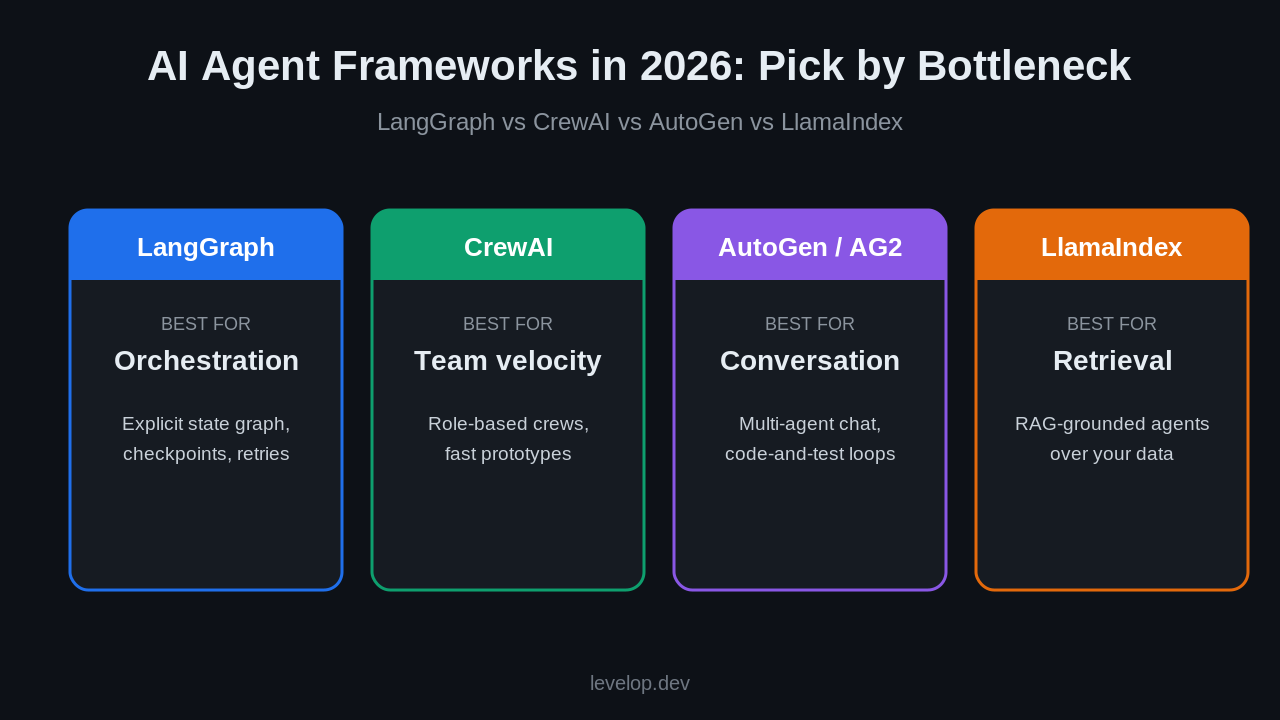
- LangGraph: best for complex, stateful, durable workflows. Explicit state graph with checkpointing. Steepest learning curve, most mature production footprint.
- CrewAI: best for fast role-based multi-agent prototypes. Task-level handoff plus event-driven Flows. Easiest learning curve, lighter observability.
- AutoGen (AG2): best for conversational orchestration and research. Conversation-history state. Medium learning curve.
- LlamaIndex: best for RAG-grounded agents over private data. Workflow events plus index context. Medium learning curve.
LangGraph: Graph-Based Orchestration for Stateful Production Agents
LangGraph models an agent as a directed graph. You define nodes (units of work) and edges (transitions), and a shared state object flows through them. Each node can read and modify that state, which gives you precise control over the agent's memory.
What makes LangGraph the production default in 2026 is everything around that graph: conditional branching, loops, retries, durable checkpoints, and real human-in-the-loop approval steps. Because state is explicit and persisted, you can pause a workflow, wait for a human decision, then resume exactly where you left off. You can also rewind and replay, which is invaluable when debugging a misbehaving agent.
from langgraph.graph import StateGraph, END
from typing import TypedDict

class AgentState(TypedDict):
    question: str
    research: str
    answer: str

def research_node(state: AgentState) -> AgentState:
    state["research"] = run_retrieval(state["question"])
    return state

def answer_node(state: AgentState) -> AgentState:
    state["answer"] = generate(state["question"], state["research"])
    return state

graph = StateGraph(AgentState)
graph.add_node("research", research_node)
graph.add_node("answer", answer_node)
graph.set_entry_point("research")
graph.add_edge("research", "answer")
graph.add_edge("answer", END)

app = graph.compile()
result = app.invoke({"question": "What changed in agent frameworks?"})
The cost is the learning curve. LangGraph is the steepest of the four. You have to think in graphs, manage state shapes, and write more boilerplate than the role-based frameworks. For a quick prototype that is overkill. For a system that needs to survive on-call rotations, it is exactly the kind of explicitness you want.
LangGraph has the largest production deployment footprint of the compared frameworks, with reported use at companies like Klarna, Cisco, and Vizient. When the question is "what will still be running in eighteen months," this is the safe answer.
CrewAI: Role-Based Crews for Fast Multi-Agent Prototypes
CrewAI takes the opposite philosophy. Instead of asking you to design a graph, it asks you to describe roles. You define agents as personas (a researcher, a writer, an editor), give each a goal, then assemble them into a crew that collaborates on tasks. The abstraction is intuitive, and you can have a working multi-agent prototype running in an afternoon.
from crewai import Agent, Task, Crew

researcher = Agent(
    role="Researcher",
    goal="Find accurate, current facts on the topic",
    backstory="A meticulous analyst who never ships an unverified claim."
)
writer = Agent(
    role="Writer",
    goal="Turn research into a clear draft",
    backstory="A developer-advocate who writes like a human."
)

research_task = Task(description="Research {topic}", agent=researcher)
write_task = Task(description="Write a post from the research", agent=writer)

crew = Crew(agents=[researcher, writer], tasks=[research_task, write_task])
result = crew.kickoff(inputs={"topic": "agent frameworks"})
CrewAI's real value is developer experience for teams that are not framework specialists. If you have backend engineers who need to ship a multi-agent feature in two weeks and do not have six months of orchestration experience, the role-and-task model gets them there fast.
The 2026 version is more than a prototype toy. CrewAI Flows added event-driven orchestration with conditional routing and parallel execution, and the power move is combining Crews (autonomous collaboration) with Flows (precise control). That said, CrewAI still trails LangGraph on production observability and error recovery. Its task-level state passing is clean for sequential work but less flexible for complex branching or iterative loops.
AutoGen (AG2): Conversation-Driven Multi-Agent Orchestration
AutoGen models agents as participants in a conversation. Instead of a graph or a task list, you get multiple agents talking in a shared chat, with a selector deciding who speaks next. State lives in the conversation history: each agent reads past messages to decide what to do. This maps beautifully to problems like multi-agent debate, code-and-test loops, and verification patterns where one agent critiques another.
The lineage is worth understanding because it confuses people. Microsoft rearchitected AutoGen with an event-driven, async-first core, and AutoGen 1.0 reached general availability in February 2026. Separately, the original creators maintain a community fork called AG2 (Apache 2.0) that preserves the older v0.2 API. Both are alive, so check which one a tutorial targets before you copy code.
from autogen import AssistantAgent, UserProxyAgent, GroupChat, GroupChatManager

planner = AssistantAgent("planner")
coder = AssistantAgent("coder")
critic = AssistantAgent("critic")
user = UserProxyAgent("user", human_input_mode="NEVER")

chat = GroupChat(agents=[user, planner, coder, critic], messages=[], max_round=12)
manager = GroupChatManager(groupchat=chat)
user.initiate_chat(manager, message="Build and test a CSV parser.")
AutoGen leads research and academic adoption, where its multi-agent debate and verification patterns are mature and well studied. Production adoption is smaller than LangGraph's, partly because conversation-history state is harder to track precisely once workflows get complex. If your problem is naturally conversational, like agents that iteratively write and test code, AutoGen is a strong fit. If you need strict, auditable state transitions, you will fight the model.
LlamaIndex: RAG-First Agents Grounded in Your Data
LlamaIndex started as a data framework for LLMs, and that heritage is still its superpower. It is the framework to reach for when the agent's main job is to reason over your indexed private data. Retrieval is first-class, not bolted on, and that matters more than people expect, because in most real applications the bottleneck is not orchestration, it is retrieval quality.
LlamaIndex has grown well beyond a RAG library. LlamaIndex Workflows add event-driven, multi-agent capabilities, so you can build genuine agents that plan and call tools while keeping retrieval at the core.
from llama_index.core import VectorStoreIndex, SimpleDirectoryReader
from llama_index.core.agent import ReActAgent
from llama_index.core.tools import QueryEngineTool

docs = SimpleDirectoryReader("./company_docs").load_data()
index = VectorStoreIndex.from_documents(docs)
query_tool = QueryEngineTool.from_defaults(
    query_engine=index.as_query_engine(),
    name="company_knowledge",
    description="Answers questions from internal docs"
)
agent = ReActAgent.from_tools([query_tool])
print(agent.chat("What is our refund policy for annual plans?"))
The honest framing: LlamaIndex is not trying to be the most powerful general orchestrator. It is trying to be the best way to ground an agent in your data. If retrieval is your hard problem, start here. If orchestration is your hard problem, LlamaIndex pairs well as the retrieval layer under a LangGraph orchestration layer.
Head-to-Head: State, Learning Curve, and Production Readiness
Three axes separate these frameworks in practice. Whether you are building a single agent or a full multi agent system, all four handle tool integration so your agents can call external APIs, but they diverge sharply on the three points below.
State management. LangGraph gives you the most explicit and powerful model, with an addressable state object and durable checkpoints. CrewAI passes state at the task level, simple but less flexible. AutoGen keeps state in conversation history, natural for chat but fuzzy for precise tracking. LlamaIndex centers state on retrieval context and workflow events.
Learning curve. From easiest to hardest: CrewAI, then AutoGen and LlamaIndex in the middle, then LangGraph as the steepest. There is a direct trade-off here. The frameworks that are easiest to start with give you the least control, and the one that gives you the most control asks the most of you up front.
Production readiness. LangGraph is the most mature with the largest deployment footprint. CrewAI is solid but lighter on observability and error recovery. AutoGen is improving and strongest in research settings. LlamaIndex is mature for retrieval-heavy agents specifically.
Whatever you pick, do not skip evaluation. Agents fail in ways that unit tests do not catch, so build an AI agent evaluation harness around tool-calling correctness and trace quality before you trust the system with anything that matters.
How to Choose: A Decision Framework
The cleanest way to decide is to name your bottleneck and let it pick the framework.
If retrieval quality is the bottleneck, choose LlamaIndex. If orchestration complexity is the bottleneck, with cycles, branching, and durable state, choose LangGraph. If team velocity and developer experience are the bottleneck, evaluate CrewAI. If your problem is naturally a conversation between agents that write and verify each other's work, evaluate AutoGen.
A few honest defaults. For a first agent where you want to learn fast and ship a demo, start with CrewAI. For a system you will run in production and maintain for years, invest in LangGraph. For a knowledge assistant over private documents, build on LlamaIndex. For agentic code generation and verification, try AutoGen.
Can You Combine Frameworks?
Yes, and the most resilient architectures in 2026 do exactly that. They are not single-framework stacks. A common production shape uses LlamaIndex for retrieval, LangGraph for orchestration, and either CrewAI or AutoGen for the specialized agent modules that need their particular strengths.
This works because the frameworks have stopped trying to own the whole stack and started doing one thing well. Treat them as composable layers rather than competing religions, and you get the best of each. The cost is operational complexity, so only reach for a multi-framework stack once you have hit a real limit with one. For most teams, picking the single framework that matches the main bottleneck is the right first move.
Final Word
The best AI agent frameworks 2026 has to offer are not interchangeable, and that is good news. LangGraph, CrewAI, AutoGen, and LlamaIndex each made a clear bet, and those bets now line up neatly with the four bottlenecks most teams actually hit. Name your bottleneck, pick the framework that targets it, instrument it properly, and you will avoid the most expensive mistake in this space: choosing on hype instead of fit.
For more on building and shipping agentic systems, browse the Levelop blog or start with the AI agent frameworks developer's guide.
References
LangGraph documentation, LangChain.
CrewAI official site and docs, crewai.com.
Microsoft AutoGen documentation, microsoft.github.io/autogen.
LlamaIndex official site and docs, llamaindex.ai.
Frequently Asked Questions
What is the best AI agent framework in 2026?
There is no single best framework for everyone. LangGraph is the most production-mature and has the largest deployment footprint, which makes it the safest default for complex, long-lived systems. But CrewAI is best for fast prototyping, AutoGen for conversational and research workflows, and LlamaIndex for retrieval-grounded agents. The right choice depends on your main bottleneck.
Is LangGraph better than CrewAI?
They optimize for different things. LangGraph gives you explicit state, durable checkpoints, and fine-grained control, at the cost of a steeper learning curve. CrewAI gives you a fast, intuitive role-based model that ships prototypes in hours, at the cost of weaker observability and less flexible state handling. Choose LangGraph for production durability and CrewAI for speed to first working version.
What is the difference between AutoGen and AG2?
Both descend from the original AutoGen project. Microsoft maintains an event-driven rewrite that reached AutoGen 1.0 general availability in February 2026. AG2 is a community fork maintained by AutoGen's original creators that preserves the older v0.2 API under an Apache 2.0 license. When following a tutorial, confirm which one it targets, because the APIs differ.
When should I use LlamaIndex instead of LangGraph?
Use LlamaIndex when your agent's core job is reasoning over your own indexed data and retrieval quality is the hard problem. Use LangGraph when orchestration complexity, like branching, loops, retries, and durable state, is the hard problem. Many teams use both: LlamaIndex as the retrieval layer underneath a LangGraph orchestration layer.
Can I use more than one agent framework in the same system?
Yes. The most resilient 2026 architectures often combine them: LlamaIndex for retrieval, LangGraph for orchestration, and CrewAI or AutoGen for specialized agent modules. Treat the frameworks as composable layers, but only add this complexity once a single framework has hit a real limit for your use case.