
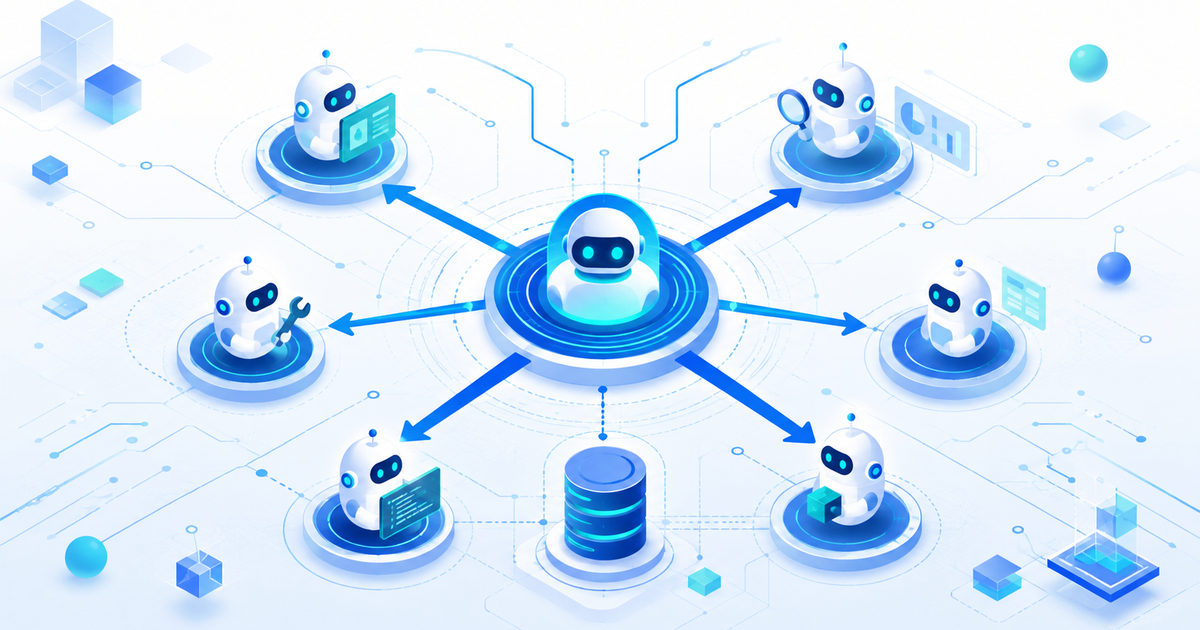
How to Build Multi-Agent Systems: A Practical 2026 Guide
A year ago, most production AI features were a single model behind a single prompt. In 2026 that is changing fast. Teams are splitting work across several cooperating models, each with a narrow job, and wiring them together into something that behaves less like a chatbot and more like a small team. If you have been asked to figure out how to build multi agent systems without drowning in framework hype, this guide is the practical walkthrough we wish we had when we started.
We will keep the theory light and the decisions concrete: what a multi-agent system actually is, when you need one, the building blocks that every design shares, and a step-by-step path from a blank editor to a working prototype. This post supports our deeper reference on AI agent orchestration frameworks, so if you want the framework-level view after this, start there.
What is a multi-agent system?
A multi-agent system is an application where two or more language-model agents, each with its own instructions, tools, and sometimes its own model, work together to complete a task that would be awkward for one agent alone. Instead of one giant prompt that tries to research, write, review, and format in a single pass, you give each responsibility to a focused agent and let them pass work between each other.
The word agent carries weight here. An agent is not just a prompt. It is a loop: it receives a goal, decides on an action, calls a tool or another agent, observes the result, and repeats until the goal is met or a stopping condition fires. When you connect several of these loops, you get multi agent systems. The interesting engineering is not in any single agent, it is in how they hand off work and share context. We cover the underlying design in more depth in our piece on agentic AI architecture.
When you actually need multiple agents (and when you do not)
The honest answer is that most tasks do not need multiple agents. A single well-prompted agent with good tools handles a surprising amount. Reaching for a multi-agent design too early adds latency, cost, and failure modes without buying you much. So before you build, pressure-test the need.
Multiple agents earn their keep when the task has genuinely distinct sub-skills (research versus writing versus code review), when different steps need different tools or permissions, when you want parallelism across independent subtasks, or when one context window cannot hold everything and you need to divide and summarize. If none of those apply, a single agent with a tighter prompt is usually the better call.
The core building blocks of multi agent systems
Every multi-agent design, no matter which framework you pick, is assembled from the same five parts. Get these concepts straight and the frameworks become interchangeable implementation details rather than magic.
1. Agents and roles
Each agent needs a crisp role: a name, a one-sentence job description, a system prompt, and the specific tools it is allowed to use. The tighter the role, the more reliably the agent behaves. A Researcher agent that only searches and summarizes will outperform a do-everything agent that also tries to write and format. Treat role design like writing a job description for a new hire.
2. Orchestration and control flow
Orchestration is the logic that decides which agent runs, in what order, and when the whole thing stops. This is the heart of the system. You can hard-code the flow (a fixed pipeline), let a supervisor agent route dynamically, or use a graph where nodes are agents and edges are transitions. For the full landscape of options, our AI agent orchestration frameworks guide compares the leading approaches side by side.
3. Agent coordination and communication
Agent coordination is how agents exchange information: what one agent produces and what the next one consumes. Some systems pass full message histories, others pass compact structured summaries, and others write to a shared scratchpad that every agent can read. Passing everything is simple but blows up token cost and confuses downstream agents. Passing too little starves them of context. Good agent coordination is mostly the discipline of deciding exactly what each agent needs to know.
4. Agent handoff and control transfer
An agent handoff is the moment one agent decides its part is done and control moves to another agent. A clean handoff carries three things: the result so far, the reason for the transfer, and any constraints the next agent must respect. Sloppy handoffs are where multi-agent systems quietly break, because context leaks or gets duplicated. Frameworks such as the OpenAI Agents SDK model the handoff as a first-class primitive for exactly this reason.
5. Shared memory and state
Agents need somewhere to keep the growing picture of the task: intermediate results, decisions made, and facts learned. This shared state can be as simple as an in-memory dictionary or as involved as a vector store for long-running context. If your agents need to remember across sessions, read our developer guide to AI agent memory before you pick a storage layer.
How to build multi agent systems step by step
With the building blocks in hand, here is the path we follow to go from an idea to a working prototype. The order matters: each step removes a class of uncertainty before you write more code.
Step 1: Define the goal and decompose the task
Write one sentence describing what a successful run produces. Then list the distinct sub-skills required. If your list collapses into one skill, stop and build a single agent. If it has two or more genuinely different skills, each becomes a candidate agent. Resist the urge to create an agent per step; create an agent per skill.
Step 2: Choose an architecture
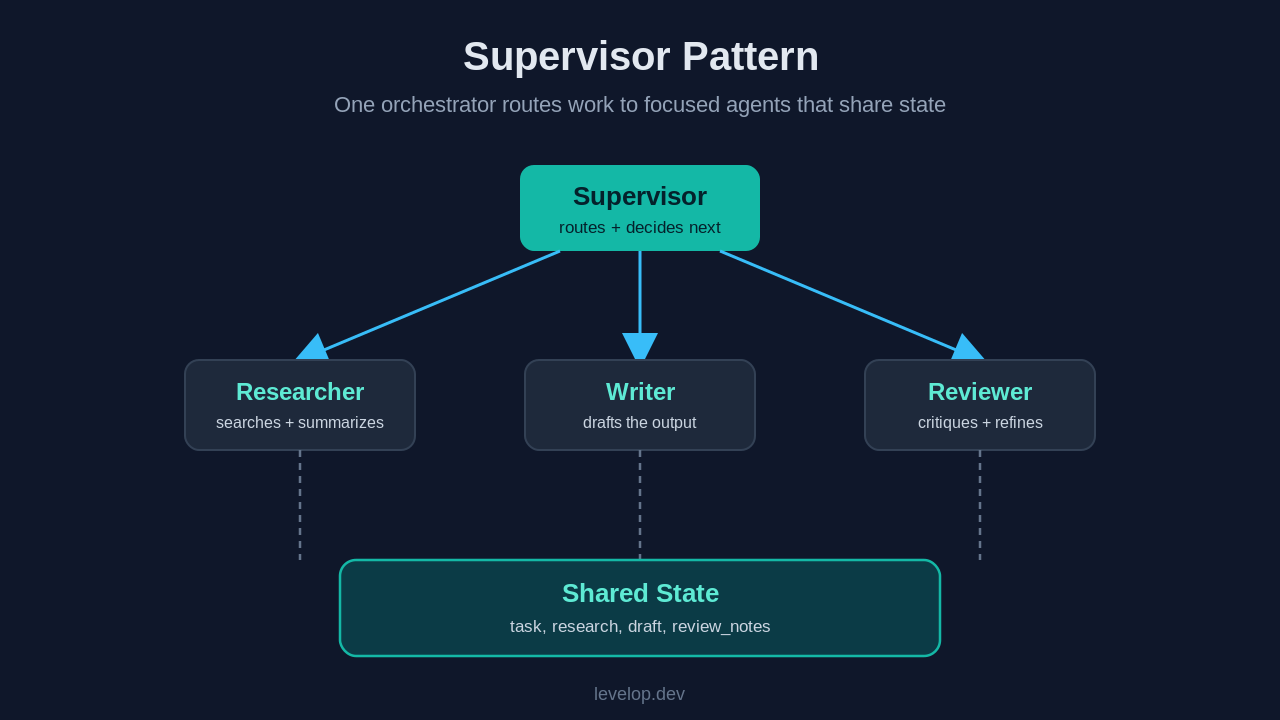
Three shapes cover the vast majority of real systems. A supervisor architecture has one orchestrator agent that decides which worker runs next, which is flexible and easy to reason about. A pipeline (or sequential) architecture runs agents in a fixed order, which is predictable and cheap. A hierarchical architecture nests supervisors, which suits large systems with sub-teams. Start with a supervisor or a pipeline; reach for hierarchy only when a flat design becomes unwieldy.
Step 3: Implement the agents and their handoffs
Now write the agents. Below is a minimal supervisor built with LangGraph, which models the system as a graph of nodes. Notice that each agent is small and the interesting logic is the routing and the agent handoff between nodes.
from langgraph.graph import StateGraph, END
from typing import TypedDict, Literal

class State(TypedDict):
    task: str
    research: str
    draft: str
    next: str

def supervisor(state: State) -> State:
    # Decide the next agent based on what is already done.
    if not state.get("research"):
        state["next"] = "researcher"
    elif not state.get("draft"):
        state["next"] = "writer"
    else:
        state["next"] = "done"
    return state

def researcher(state: State) -> State:
    state["research"] = run_agent(role="researcher", goal=state["task"])
    return state  # handoff: research is now in shared state

def writer(state: State) -> State:
    state["draft"] = run_agent(role="writer", context=state["research"])
    return state

graph = StateGraph(State)
graph.add_node("supervisor", supervisor)
graph.add_node("researcher", researcher)
graph.add_node("writer", writer)
graph.set_entry_point("supervisor")
graph.add_conditional_edges(
    "supervisor",
    lambda s: s["next"],
    {"researcher": "researcher", "writer": "writer", "done": END},
)
graph.add_edge("researcher", "supervisor")
graph.add_edge("writer", "supervisor")
app = graph.compile()
The pattern generalizes. Each worker reads what it needs from the shared State and writes its output back, and the supervisor inspects that state to choose the next hop. If you prefer a role-based framework instead of a graph, our comparison of CrewAI versus LangGraph walks through the same idea in a different style.
Step 4: Design the shared state deliberately
Decide up front what lives in shared state and what stays private to an agent. A good default: agents write only their finished output to shared state, not their internal chatter. This keeps agent coordination clean and stops one agent's reasoning noise from polluting another's context window.
# Keep the shared contract explicit and minimal.
shared_state = {
    "task": "Write a 500-word brief on vector databases",
    "research": None,   # filled by researcher, read by writer
    "draft": None,      # filled by writer, read by reviewer
    "review_notes": None,
}
# Rule of thumb: if two agents do not both touch a field,
# it probably should not be in shared state.
Step 5: Add observability, guardrails, and a stop condition
Multi-agent runs fail in ways single prompts never do: agents loop forever, hand off in circles, or silently drop context. You need a hard cap on total steps, tracing so you can see every handoff, and guardrails on tool use. Instrument this before you scale up, not after. Our guide to LLM observability and tracing covers what to log and how to read agent traces.
Common orchestration patterns
Beyond the three architectures, a handful of coordination patterns show up again and again. A supervisor-worker pattern centralizes routing. A pipeline chains specialists in order. A blackboard pattern lets agents collaborate through shared state without direct messaging. A debate or reviewer pattern has one agent critique another's output to raise quality. You will mix these rather than pick one, and the orchestration frameworks guide maps which frameworks make each pattern easy.
Testing and evaluating multi-agent systems
You cannot eyeball your way to a reliable system. Build a small evaluation set of representative tasks and score runs on outcome quality, cost, and step count. Test agents in isolation first (does the researcher return usable research?), then test handoffs (does the writer actually use the research?), then test the whole flow. Trace-based evaluation, where you inspect each hop rather than just the final answer, is what separates a demo from a system you can trust in production.
Production pitfalls to avoid
- Too many agents: every extra agent multiplies latency, cost, and coordination bugs. Merge agents that share a skill.
- Context bloat: passing full histories between agents balloons token spend and degrades quality. Pass summaries.
- No stop condition: without a step cap, supervisors can loop indefinitely.
- Untraced handoffs: if you cannot see the transfer between agents, you cannot debug it.
- Skipping security: agents with tool access need the same guardrails as any privileged system.
That last point matters more as these systems touch real tools and data. If your agents can act on production systems, read our enterprise AI agent security guide before you ship. For a broader mental model of how the pieces fit, Anthropic's essay on building effective agents and Microsoft's AutoGen documentation are both worth an afternoon.
Frequently asked questions
What is the difference between an agent and a multi-agent system?
A single agent is one loop of decide, act, observe against a goal. A multi-agent system connects several such agents, each with a focused role, and coordinates how they hand off work and share state. The complexity moves from the prompt to the orchestration between agents.
Do I need a framework to build multi agent systems?
No, but a framework saves you from reinventing routing, state, and handoffs. LangGraph, CrewAI, AutoGen, and the OpenAI Agents SDK each package these primitives differently. Start with whichever matches your mental model: graphs, roles, or conversations.
How many agents should a system have?
As few as possible. Create one agent per distinct skill, not per step. Most reliable production systems we see run with two to four agents. If you are past five, look for agents that share a skill and merge them.
How do agents share information with each other?
Through a shared state object, structured summaries, or a common scratchpad. The key discipline is deciding exactly what each agent needs. Passing full conversation histories is the most common cause of high cost and degraded output in multi agent systems.
How do I stop a multi-agent system from looping forever?
Set a hard maximum step count and a timeout on every run, and give your supervisor an explicit done condition. Add tracing so you can see when and why a handoff repeats, then fix the routing logic that caused the loop.
Where to go next
You now have the vocabulary and the steps to build your first real multi-agent system: define the skills, pick a supervisor or pipeline, implement focused agents with clean handoffs, share state deliberately, and instrument everything. Start with two agents, get the handoff solid, and grow only when evaluation tells you to.
For the framework-by-framework view, read our pillar on AI agent orchestration frameworks. For hands-on code, the LangGraph multi-agent tutorial builds one end to end in Python. And if you are learning system design and AI engineering the practical way, explore more guides on the Levelop blog or start at Levelop.