
AI Agent Orchestration Frameworks: A 2026 Guide
A single large language model call can answer a question. It cannot reliably plan a multi-step task, call five tools in the right order, recover from a failed step, and hand work to a specialist without losing the thread. That gap is why teams building real products have moved from one clever prompt to systems of cooperating agents. Coordinating those agents is the hard part, and it is exactly what ai agent orchestration frameworks are built to solve.
This guide is about the coordination layer, not a ranking of tools. If you want a head-to-head product comparison, we cover that separately in our breakdown of the best AI agent frameworks of 2026. Here we focus on the patterns that every orchestration framework has to implement, and how the leading options express those patterns in code.
What agent orchestration actually means
Orchestration is the control logic that decides which agent runs, when it runs, what context it sees, and what happens to its output. In a single-agent setup, that logic is trivial: the model loops over tool calls until it decides it is done. Once you add a second agent with its own instructions, tools, and memory, you need explicit rules for routing, sequencing, shared state, and termination.
The useful mental model is a small operating system for agents. The orchestrator is the scheduler. Agents are processes. Tools are system calls. Shared memory is the file system. Framed that way, ai agent orchestration frameworks are competing on how well they schedule work, isolate failures, and pass state between processes without corrupting it.
Why orchestration matters more in 2026
Two things changed. Models got good enough to run autonomously for long stretches, and the industry started shipping multi-agent systems in production rather than in demos. Gartner reported a large surge in multi-agent system inquiries through 2025, and the pattern held into 2026 as teams split monolithic assistants into specialized crews. The practical driver is reliability: a narrow agent with three tools and a tight prompt is easier to test and debug than one agent asked to do everything.
That reliability only shows up if the orchestration is disciplined. Loose coordination produces agents that talk past each other, loop forever, or silently drop context. Good coordination is the difference between a system you can put in front of customers and a science project.
The core orchestration patterns
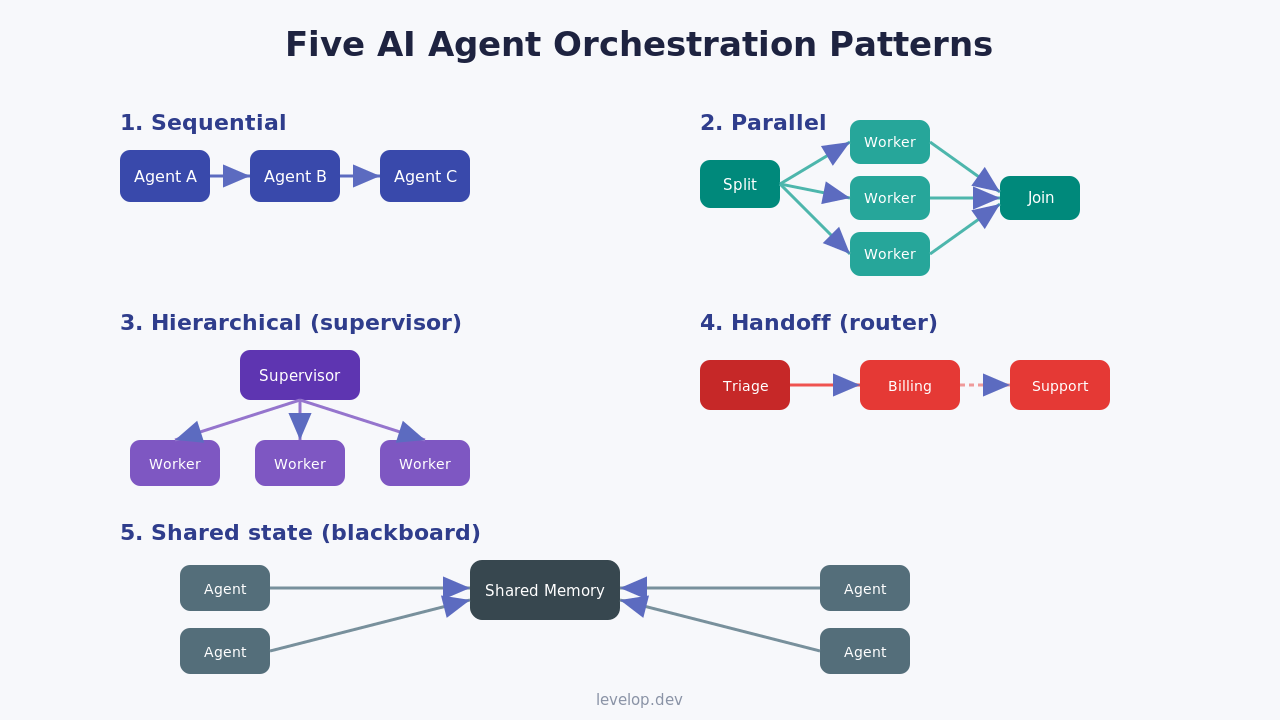
Every framework, whatever its marketing says, implements some combination of five patterns.
Sequential (pipeline)
Agents run in a fixed order, each consuming the previous one's output. A research agent gathers sources, a writer drafts, an editor revises. This is the simplest pattern and the easiest to reason about, which makes it the right default when the task has clear stages.
Parallel (concurrent)
Independent subtasks run at the same time, and a join step merges the results. Fan out to three agents that each analyze a different document, then combine their findings. Parallelism cuts latency but forces you to think about how conflicting outputs get reconciled.
Hierarchical (supervisor)
A supervisor agent decomposes a goal, delegates pieces to worker agents, and assembles the final answer. This is the pattern most people mean when they say multi-agent. It scales to complex goals but concentrates risk in the supervisor's routing decisions.
Handoff (router)
Control transfers from one agent to another based on the situation, with no central supervisor. A triage agent decides a billing question belongs to the billing agent and hands over the conversation entirely. Handoffs keep each agent simple at the cost of making the overall flow harder to trace.
Shared state (blackboard)
Agents read from and write to a common workspace rather than passing messages directly. This decouples agents from each other but makes state management, and the memory layer behind it, the thing most likely to break. If you are building on this pattern, our guide to AI agent memory covers the storage side in depth.
How the leading frameworks implement orchestration
The frameworks differ less in what they can do and more in how they ask you to express coordination.
LangGraph: orchestration as a state graph
LangGraph models a system as a directed graph. Nodes are agents or functions, edges are transitions, and a shared state object flows through the graph. Conditional edges let you route based on the current state, which makes hierarchical and handoff patterns explicit rather than hidden inside prompts. Because the graph is a first-class object, you can checkpoint it, resume it, and inspect exactly where execution is. That auditability is why many teams reach for it in regulated settings. We walk through a full build in our LangGraph tutorial.
def supervisor(state):
    # route to the next worker based on accumulated state
    if not state["research_done"]:
        return "researcher"
    if not state["draft_done"]:
        return "writer"
    return END

graph = StateGraph(dict)
graph.add_node("researcher", run_researcher)
graph.add_node("writer", run_writer)
graph.add_conditional_edges("supervisor", supervisor)
graph.set_entry_point("supervisor")
app = graph.compile()
CrewAI: orchestration as roles and processes
CrewAI leans on a human metaphor. You define agents with a role, a goal, and a backstory, then assemble them into a crew with a process that is either sequential or hierarchical. The framework handles task passing and delegation. This is the fastest way to stand up a working multi-agent flow, and it reads clearly to people who are not framework experts. The tradeoff is less fine-grained control over routing than a graph gives you. Our CrewAI versus LangGraph comparison digs into where each one fits.
AutoGen: orchestration as conversation
Microsoft's AutoGen frames multi-agent work as a structured conversation. Agents send messages to each other, and a group chat manager decides who speaks next. This maps naturally onto handoff and hierarchical patterns and is strong for open-ended problem solving where the exact sequence is not known in advance. The cost is that free-flowing conversation is harder to bound and test than a fixed graph.
OpenAI Agents SDK: orchestration as handoffs
The OpenAI Agents SDK makes handoffs the primitive. Each agent declares which other agents it can transfer to, and the runtime moves control accordingly. It is deliberately minimal, which suits teams that want lightweight routing without adopting a heavier graph or crew abstraction.
Choosing an orchestration framework
The honest answer is that the pattern your problem needs should drive the choice, not the other way around.
If your workflow has clear, ordered stages, a sequential crew in CrewAI gets you shipping quickly. If you need explicit routing, checkpointing, and the ability to audit every transition, LangGraph's state graph pays off. If the problem is exploratory and the sequence is genuinely unknown, AutoGen's conversational model fits. If you want the thinnest possible handoff layer, the OpenAI Agents SDK stays out of your way.
Two non-functional requirements should weigh heavily. First, can you observe it? A multi-agent system you cannot trace is a system you cannot debug, which is why an LLM observability tool belongs in the stack from day one. Second, can you govern it? Autonomous agents making tool calls need audit logging and policy controls, a topic we cover in our guide to AI agent governance.
Production concerns the demos skip
Getting a multi-agent demo to work is a weekend. Getting it to hold up in production is the real project.
State and memory are the first thing to break. As agents accumulate context, you have to decide what persists across steps, what gets summarized, and what gets dropped before you blow the context window. Cost is the second. Every agent hop is more tokens, and hierarchical systems can fan out into surprising bills, so budget and cap the number of steps. Failure handling is the third. A worker agent will return garbage eventually, and the orchestrator needs a retry, fallback, or escalation path rather than passing the garbage downstream. Latency is the fourth. Sequential chains add up, so parallelize independent work and set hard timeouts.
None of these are framework features you can buy. They are design decisions the orchestration layer forces you to make, which is why understanding the patterns matters more than memorizing any one library's API.
Bringing it together
Ai agent orchestration frameworks are converging on the same set of ideas from different directions. LangGraph gives you a graph, CrewAI gives you a crew, AutoGen gives you a conversation, and the OpenAI Agents SDK gives you handoffs, but underneath they are all scheduling agents, routing work, and passing state. Learn the five patterns, decide which one your problem needs, and pick the framework that expresses it most clearly and that you can observe and govern in production.
If you are building agentic systems and want more practical, engineering-first walkthroughs, the rest of the Levelop blog covers the surrounding stack, from memory to security to evaluation.
Frequently asked questions
What is an AI agent orchestration framework?
It is a library that coordinates multiple AI agents: deciding which agent runs, in what order, what context each one sees, and how their outputs combine. Examples include LangGraph, CrewAI, AutoGen, and the OpenAI Agents SDK. The framework handles routing, shared state, and termination so you do not hand-code the control loop.
Do I need a framework, or can I orchestrate agents myself?
For a simple sequential flow you can write the loop yourself. Once you need conditional routing, parallel steps, checkpointing, or handoffs, a framework saves substantial effort and reduces bugs. Frameworks also give you observability hooks and state management that are tedious to build from scratch.
What is the difference between single-agent and multi-agent orchestration?
A single agent loops over its own tool calls until it finishes. Multi-agent orchestration coordinates several specialized agents, each with its own instructions and tools, using patterns like supervisor delegation or handoffs. Multi-agent systems are more capable on complex tasks but add coordination and cost overhead.
Which orchestration pattern should I start with?
Start sequential. Most production systems are a sequential backbone with one or two parallel or hierarchical steps added only where they clearly help. Reach for a full supervisor or handoff architecture when a single ordered pipeline genuinely cannot express your task.
How do I keep a multi-agent system reliable in production?
Trace everything with an observability tool, cap the number of agent steps to control cost and loops, add retry or escalation paths for failed steps, and manage memory so you do not overflow the context window. Governance and audit logging matter once agents can call real tools.