
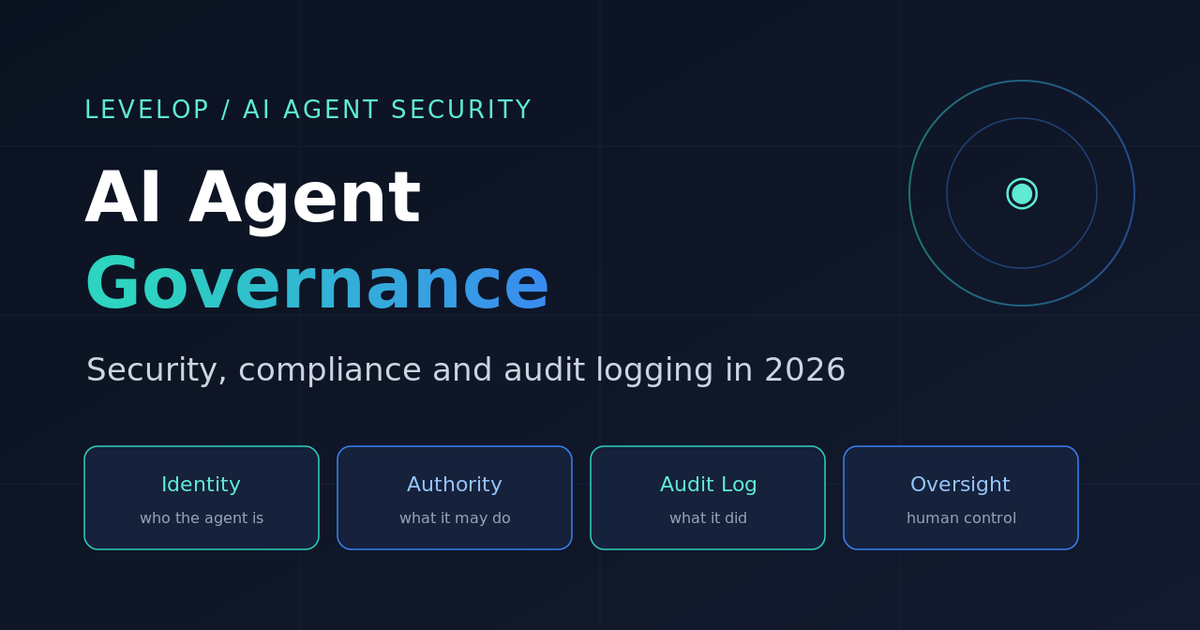
AI Agent Governance: Security, Compliance and Audit Logging in 2026
Autonomous agents now write code, move money, file tickets, and touch production systems on their own. That autonomy is exactly what makes them useful, and exactly what makes them risky. AI agent governance is the discipline that keeps that autonomy accountable: it defines who an agent is allowed to be, what it is allowed to do, and how every one of its actions is recorded so a human can answer for it later.
This guide is the practical, engineering-first view of governance for teams already running agents in production. It covers the control plane you need, how compliance obligations map onto agent behavior, and why audit logging is the single most important investment you can make. It sits alongside our broader work on AI agent security frameworks, which is the pillar this post supports.
What AI Agent Governance Actually Means
Governance is often confused with security. They overlap, but they answer different questions. Security asks "can an attacker make this agent do something harmful?" Governance asks "even when everything works as designed, is the agent allowed to do this, and can we prove what it did?"
A useful ai agent governance framework rests on four pillars that map cleanly to controls you can build:
The first is identity. Every agent needs a distinct, non-human identity, not a shared service account borrowed from a human team. The second is authority, the explicit set of tools, data, and actions each identity may use. The third is accountability, the durable record that ties every action back to an identity and a triggering request. The fourth is oversight, the mechanism by which humans review, approve, or halt agent behavior before or after the fact.
Miss any one pillar and the others weaken. An agent with a strong identity but no authority limits can still do anything. Perfect authority limits with no audit trail leave you unable to prove compliance when a regulator or customer asks.
Identity: Give Every Agent Its Own Passport
The most common governance failure we see is agents authenticating as a human user or a broad shared key. When an agent inherits a developer's OAuth token, its actions are indistinguishable from that developer's, and your audit trail collapses into noise.
Each agent, and ideally each agent instance, should carry a scoped machine identity. Modern setups issue short-lived credentials tied to a workload identity rather than long-lived secrets. That way an action can always be traced to a specific agent, version, and run.
# agent_identity.py
from dataclasses import dataclass

@dataclass(frozen=True)
class AgentIdentity:
    agent_id: str          # stable identity, e.g. "billing-reconciler"
    version: str           # deployed version, for reproducibility
    run_id: str            # unique per invocation
    principal: str         # human or system that triggered the run
    scopes: frozenset      # explicit granted capabilities

    def can(self, capability: str) -> bool:
        return capability in self.scopes
Binding the principal to every identity matters for agentic ai governance: it preserves the chain of delegation. When the billing agent issues a refund, you can show that a specific support ticket, opened by a named user, triggered it. That chain is what auditors and incident responders actually need.
Authority: Least Privilege for Non-Human Actors
Once agents have identities, governance means constraining what those identities can do. The principle is the same least-privilege model you apply to humans, but agents make it harder because their action space is dynamic. An agent with shell access can, in principle, do almost anything.
Practical authority control has three layers. At the tool layer, you allowlist the specific functions an agent can call rather than handing it a general-purpose interpreter. At the data layer, you scope which records each identity can read or write, ideally row-level rather than table-level. At the action layer, you gate irreversible or high-impact operations behind explicit policy checks.
A policy file makes these limits reviewable and versionable, which is itself a governance win because changes go through code review.
# governance_policy.yaml
agent: billing-reconciler
version: "2.4.0"
allowed_tools:
  - read_invoice
  - read_payment
  - propose_refund      # proposes only, cannot execute
denied_tools:
  - execute_refund      # requires human approval step
  - delete_record
data_scope:
  invoices: "org_id = {caller_org}"   # row-level, never cross-tenant
limits:
  max_refund_amount_usd: 500
  approval_required_above_usd: 100
Notice the split between propose_refund and execute_refund. High-impact actions are separated into a proposal the agent can generate and an execution a human or a stricter policy must confirm. This human-in-the-loop pattern is central to responsible deployment and is covered in depth in our AI agent security best practices guide.
Compliance: Mapping Regulations onto Agent Behavior
Compliance is where governance meets the outside world. The good news is that most agent obligations map onto controls you should build anyway. The frameworks that matter most for AI agents in 2026 are the NIST AI Risk Management Framework, the EU AI Act, and sector rules like SOC 2, HIPAA, or PCI DSS depending on your domain.
Rather than treating each framework as a separate project, translate their requirements into agent-level controls. Data minimization from privacy law becomes tight data scopes on each identity. Right-to-explanation obligations become the requirement that every agent decision carries its reasoning and inputs. Access-control requirements become your authority policies. Record-keeping requirements become audit logging.
The NIST framework is worth reading directly because its govern, map, measure, and manage functions line up almost perfectly with the four governance pillars above. It gives you a shared vocabulary when talking to security and legal teams who may not think in terms of tools and scopes.
For teams operating at scale, the organizational side of this matters as much as the technical side. Our guide to enterprise AI agent security covers how governance responsibilities get split across platform, security, and application teams so nothing falls through the cracks.
Audit Logging: The Foundation Everything Rests On
If you build only one governance control, build audit logging. Every other pillar depends on it. Identity is meaningless if actions are not recorded against it. Authority limits are unprovable without a log of what was attempted and allowed. Compliance evidence is, quite literally, the log.
Agent audit logs differ from ordinary application logs in an important way: they must capture intent, not just outcome. A traditional log records that a refund was issued. An agent audit log records the request that triggered the agent, the reasoning the model produced, the tool calls it chose, the inputs and outputs of each call, and the policy decisions that allowed or blocked each step.
A well-structured audit event looks like this:
{
  "event_id": "evt_9f2c",
  "timestamp": "2026-08-05T10:14:22Z",
  "agent_id": "billing-reconciler",
  "version": "2.4.0",
  "run_id": "run_71ab",
  "principal": "ticket:SUP-4821 (user: jaya@acme.com)",
  "action": "propose_refund",
  "inputs": { "invoice_id": "inv_338", "amount_usd": 120 },
  "reasoning": "Duplicate charge detected on inv_338 matching inv_337.",
  "policy_decision": "allowed_with_approval",
  "outcome": "pending_human_review",
  "tool_calls": ["read_invoice", "read_payment"]
}
Three properties make an audit log trustworthy. It must be immutable, so append-only storage or a write-once sink prevents tampering. It must be complete, so a blocked or failed action is logged as loudly as a successful one. And it must be attributable, so every event links back to an identity and a principal. Miss immutability and your logs prove nothing in a dispute. Miss completeness and your quietest failures become your biggest blind spots.
Retention deserves explicit thought. Compliance regimes often require you to keep records for years, while privacy regimes may require you to delete personal data on request. Resolve this tension by logging references and hashes rather than raw sensitive payloads wherever possible, so you can prove an action occurred without indefinitely storing the personal data it touched.
Putting It Together: A Governance Control Loop
These pillars are not a checklist you complete once. They form a loop. An agent acts under an identity, constrained by authority policy, and every step is written to the audit log. Oversight, whether an automated monitor or a human reviewer, reads that log, catches drift or abuse, and feeds changes back into the policies. The tighter that loop, the faster you catch a misbehaving agent.
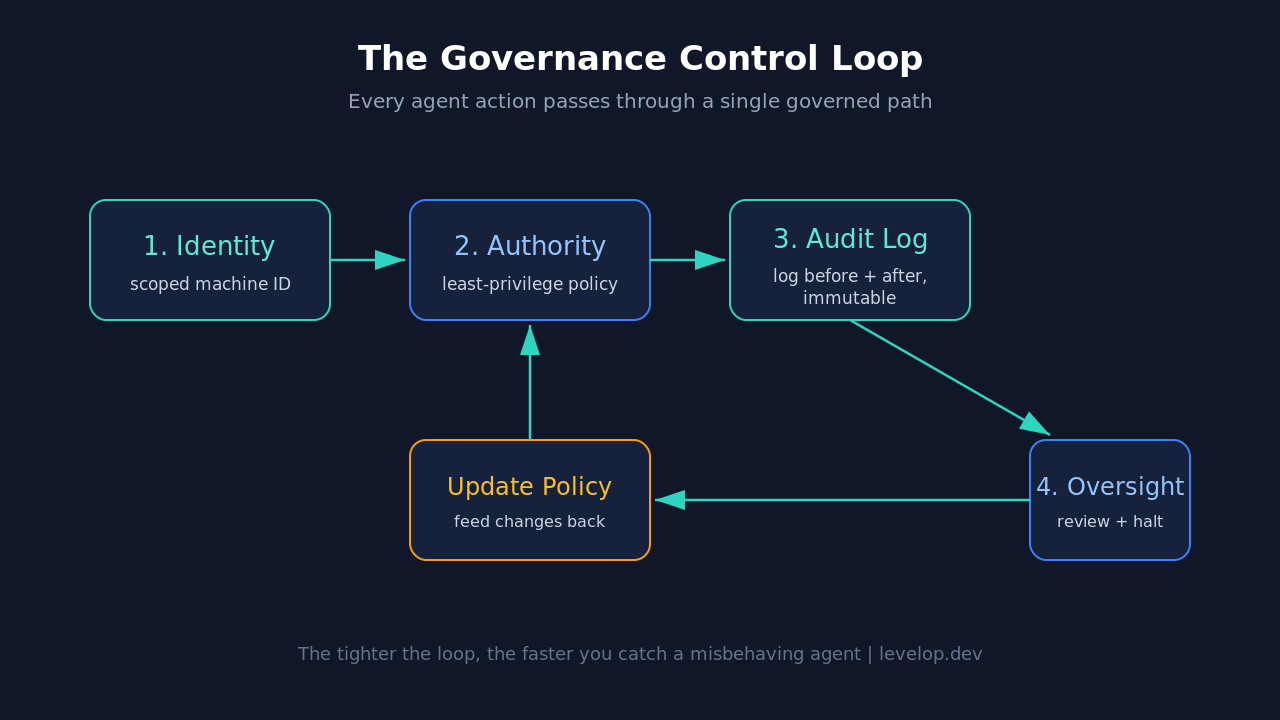
Instrumenting the loop is mostly a matter of wrapping every tool call in a single governed execution path, so no action can bypass the checks.
# governed_execution.py
def governed_call(identity, tool, args, policy, audit_sink):
    decision = policy.evaluate(identity, tool, args)
    audit_sink.write(identity, tool, args, decision)   # log BEFORE acting
    if decision.blocked:
        return {"status": "denied", "reason": decision.reason}
    if decision.needs_approval:
        return {"status": "pending", "approval": decision.ticket}
    result = tool.run(args)
    audit_sink.write(identity, tool, args, decision, result)  # and after
    return {"status": "ok", "result": result}
Logging before the action, not just after, is deliberate. If the agent or the host crashes mid-action, you still have a record that the attempt was made. That single ordering choice is the difference between a log you can trust in an incident and one full of silent gaps.
Common Governance Anti-Patterns
A few failure modes show up again and again. Shared identities, where many agents authenticate as one account, destroy attributability. Log-after-only patterns lose records of actions that fail mid-flight. Over-broad tool grants, especially raw shell or database access, make authority policy meaningless. And treating governance as a launch-time gate rather than a runtime loop means drift goes unnoticed until something breaks.
The fix for all of them is the same underlying commitment: make every agent action pass through a governed path that identifies, authorizes, and records it. Governance that lives in a design document does nothing. Governance that lives in the execution path protects you.
Getting Started Without Boiling the Ocean
You do not need a full governance platform on day one. Start with the highest-leverage move: give each agent its own identity and route every tool call through a single wrapper that logs before and after. That alone gives you attributable, complete audit trails, which is most of what an auditor or an incident responder will ask for.
From there, layer in authority policies for your highest-risk tools, add human approval on irreversible actions, and connect your logs to whatever monitoring already watches your production systems. Governance grows well incrementally as long as the execution path is right from the start.
To see how these controls fit into a complete security posture, start with our pillar guide on AI agent security frameworks, and explore more engineering deep-dives on the Levelop blog.
Frequently Asked Questions
What is AI agent governance?
AI agent governance is the set of controls that make autonomous agents accountable: giving each agent a distinct identity, constraining what actions and data it can access, recording every action in an audit log, and providing human oversight. It ensures that even when an agent works as designed, its behavior stays within allowed bounds and can be fully reconstructed later.
How is agent governance different from agent security?
Security focuses on preventing attackers from making an agent behave harmfully. Governance focuses on accountability: proving what an agent did, why, and under whose authority, even during normal operation. Security is about stopping bad inputs, while an agentic ai governance framework is about controlling and evidencing the agent's own authorized actions.
What should an AI agent audit log capture?
An agent audit log should capture intent as well as outcome: the triggering request and principal, the agent identity and version, the model's reasoning, each tool call with its inputs and outputs, the policy decision for each step, and the final result. Logs must be immutable, complete (including blocked and failed actions), and attributable to a specific identity.
Which compliance frameworks apply to AI agents in 2026?
The most relevant are the NIST AI Risk Management Framework, the EU AI Act, and sector-specific rules such as SOC 2, HIPAA, or PCI DSS depending on your domain. Rather than treating each separately, translate their requirements into agent-level controls: data minimization becomes tight data scopes, record-keeping becomes audit logging, and access control becomes authority policy.
How do I start implementing AI agent governance?
Begin with the two highest-leverage controls: give every agent a distinct machine identity, and route every tool call through a single wrapper that logs before and after each action. That produces attributable, complete audit trails immediately. Then layer in least-privilege authority policies and human approval on irreversible actions as your ai agent governance framework matures.