
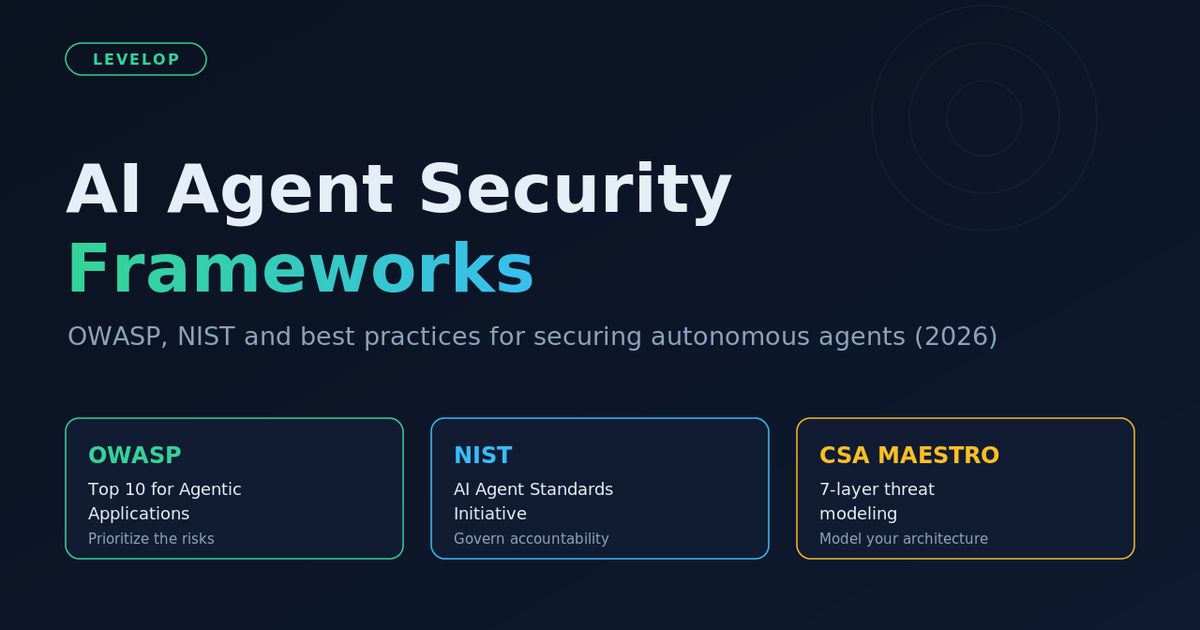
AI Agent Security Frameworks: OWASP, NIST and Best Practices (2026)
AI agents no longer just suggest code. They plan work, call tools, write files, run shell commands, query databases, and open pull requests on their own. By early 2026, a majority of code committed to GitHub was generated or substantially assisted by AI, and the same autonomy that makes agents useful is exactly what makes them dangerous. An agent that can act is an agent that can be turned against you.
That shift has forced security teams to stop treating agents like ordinary applications. A traditional app does what its code says. An agent decides what to do next based on natural language it reads at runtime, and it cannot reliably tell a legitimate instruction from a malicious one buried in a web page, an email, or a tool response. This is why a new class of AI agent security frameworks emerged in late 2025 and 2026, led by OWASP, NIST, and the Cloud Security Alliance.
This guide explains the threat landscape, walks through the three frameworks that matter most, and gives you a defense-in-depth blueprint you can apply this quarter.
Why AI Agent Security Is a Different Problem
Classic application security assumes a fixed control flow. You know the inputs, you validate them, and the program behaves deterministically. Agents break every one of those assumptions. They ingest untrusted text and treat it as instructions. They hold credentials and decide, autonomously, when to use them. They keep memory across sessions, so a poisoned fact can influence behavior days later. And they chain tools together, so one compromised step can cascade through an entire workflow.
The practical result is a much larger blast radius. When a normal service is exploited, the damage is bounded by what that service was coded to do. When an agent is exploited, the damage is bounded by what the agent is allowed to decide, which is often far broader. Prompt injection, where an attacker plants instructions in data the agent reads, remains the number one large language model risk in the OWASP rankings and is still unsolved in 2026. The working consensus is blunt: assume some injections will land, and design so that a successful injection cannot reach anything sensitive.
The AI Agent Threat Landscape
Before choosing a framework, it helps to name the concrete threats. Most agent incidents fall into a handful of recurring patterns.
Goal Hijacking and Prompt Injection
Goal hijacking happens when an attacker manipulates an agent's objectives by exploiting how it interprets natural-language instructions. Because agents cannot reliably separate trusted commands from untrusted content, an attacker can redirect goals, change task selection, or steer multi-step behavior simply by getting text in front of the agent. Injection through tool outputs, where a compromised API returns instructions rather than data, is a vector that NIST has explicitly flagged.
Tool Misuse and Excessive Agency
Agents are given tools: shell access, HTTP clients, database connections, payment APIs. Excessive agency is the gap between what an agent needs to do a task and what it is actually able to do. An agent with broad write access and weak guardrails can delete data, exfiltrate secrets, or spend money when manipulated, even if its credentials were technically valid the whole time.
Identity and Privilege Abuse
Agents act with credentials, but most systems were never designed to treat a non-human actor as a first-class identity. When agents share a service account or inherit a human's full permissions, there is no way to scope, attribute, or revoke their access cleanly. Attackers exploit this to move laterally under a trusted identity.
Memory Poisoning and Tool-Chain Poisoning
Persistent memory is a feature and a liability. Memory poisoning plants false or malicious information that the agent later retrieves and acts on. Tool-chain poisoning corrupts an upstream tool or its description so that every downstream agent that uses it inherits the compromise. NIST has called out cross-session memory persistence and tool-chain poisoning as core gaps.
Rogue Agents and Cascading Failures
A rogue agent drifts from its intended behavior and acts with harmful autonomy. It is the ultimate insider threat: authorized, trusted, and misaligned. In multi-agent systems, one misbehaving agent can trigger cascading failures as other agents act on its bad output, amplifying a single fault into a system-wide event.
The Core AI Agent Security Frameworks in 2026
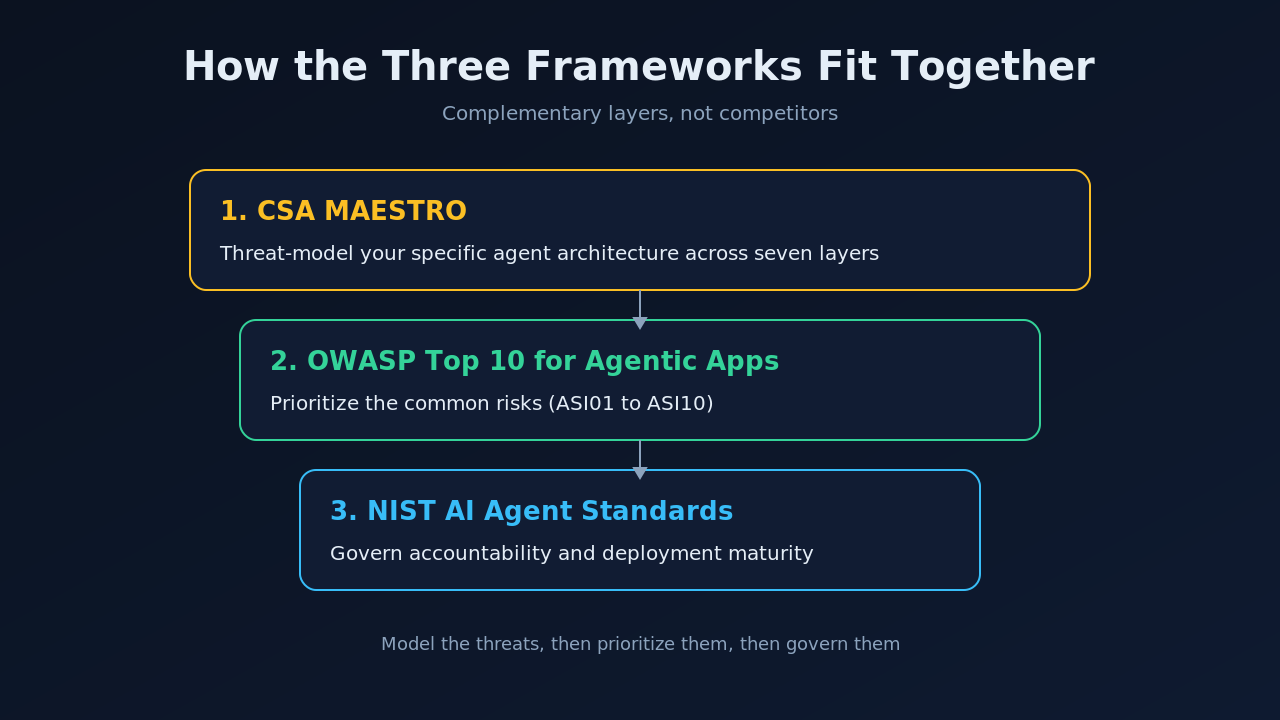
Three frameworks have become the reference points for securing agents. They are complementary, not competing: one ranks risks, one sets governance standards, and one gives you a structured way to model threats.
OWASP Top 10 for Agentic Applications
Released in December 2025, the OWASP Top 10 for Agentic Applications is the first peer-reviewed framework built specifically for autonomous AI security. It was developed with input from more than 100 security experts and endorsed by organizations including NIST, Microsoft, and NVIDIA. The list runs from ASI01 to ASI10 and covers agent goal hijacking, tool misuse, identity and privilege abuse, supply-chain vulnerabilities, unexpected code execution, memory poisoning, insecure inter-agent communication, cascading failures, human-agent trust exploitation, and rogue agents.
Its value is prioritization. If you are new to agent security, the OWASP Top 10 tells you which risks to address first and gives you a shared vocabulary that maps to the threats above. OWASP pairs each risk with mitigations: treat agents as first-class identities with scoped privileges, sandbox all code execution, authenticate inter-agent communication, add circuit breakers to multi-agent workflows, and keep humans in the loop for high-impact decisions.
NIST AI Agent Standards Initiative
On February 17, 2026, NIST's Center for AI Standards and Innovation formally announced its AI Agent Standards Initiative, treating agentic AI as a distinct standardization priority. NIST directs organizations to assign clear human accountability for every autonomous system, and its core controls include human-in-the-loop checkpoints, model drift monitoring, and maturity assessments before deployment. The Cloud Security Alliance has published a companion AI Risk Management Framework Agentic Profile to help teams apply the existing NIST AI RMF to agents today.
The most technically specific guidance, control overlays for single-agent and multi-agent systems built on top of SP 800-53, is still in development, and NIST's AI Agent Interoperability Profile is planned for late 2026. Finalized agent-specific guidance is unlikely before 2027, so NIST is best used now for governance structure and accountability rather than as a checklist of finished controls.
CSA MAESTRO Threat Modeling
MAESTRO, from the Cloud Security Alliance, is a threat-modeling framework designed for the layered reality of agents. It breaks an agent system into seven layers, including foundation models, data operations, agent frameworks and orchestration, and deployment infrastructure, and it walks you through the vulnerabilities in each layer and how those layers interact. Rather than a top-ten list, MAESTRO gives you a repeatable process to find threats specific to your architecture. The CSA has demonstrated it against real systems, including OpenAI's Responses API and Google's Agent-to-Agent protocol.
Used together, the three frameworks form a stack: MAESTRO to model your specific threats, the OWASP Top 10 to prioritize the common ones, and NIST to govern accountability and deployment maturity.
A Defense-in-Depth Blueprint
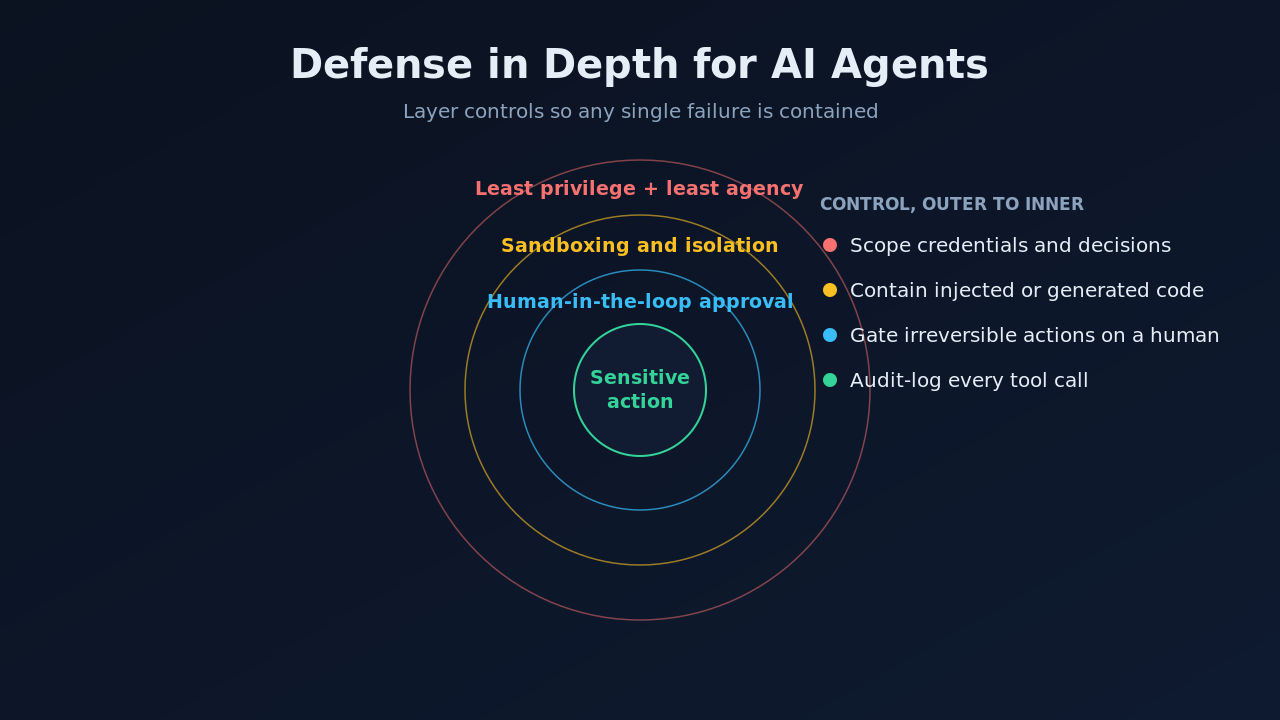
Frameworks tell you what to worry about. These practices tell you what to build. None of them is sufficient alone, which is the entire point of defense in depth: layer them so that any single failure is contained.
Least Privilege and Least Agency
Start with the principle of least privilege. An agent should hold only the minimum permissions the current task requires, and those permissions should be scoped down or revoked when the task completes. Separate read-only access from write access, and give different agent capabilities different permission sets.
Then add the complementary discipline of least agency. Least privilege asks what an identity can access. Least agency asks what an agent is allowed to decide. Privilege constrains credentials; agency constrains the reach of a plan even when the credentials are valid. An agent that can read a payments database should still not be allowed to autonomously issue a refund without an approval step.
# agent-permissions.yaml: scoped, task-bound permissions
agent: invoice-reconciler
credentials:
  ttl: 15m            # short-lived, auto-expiring
  scope:
    - db:invoices:read      # read-only where possible
    - storage:reports:write # narrow write target
forbidden:
  - db:invoices:delete
  - payments:*            # no agency over money, ever
approval_required:
  - action: refund
    reviewer: human
Sandboxing and Isolation
Any time an agent runs generated code or executes a tool, run it in a sandbox: an isolated environment with restricted access to the filesystem, network, and system resources. Modern approaches use microVMs and lightweight isolation layers such as gVisor to keep the blast radius small around shell execution, package installs, and file access. If an injection does land and code runs, sandboxing is what stops it from reaching your real infrastructure.
Contain Prompt Injection, Do Not Just Filter It
You cannot filter your way out of prompt injection. Output filtering that scans tool responses for known injection patterns helps, and structural defenses that separate instructions from data through dedicated input channels reduce success rates in testing, but neither is complete. The reliable defense is containment: assume the injection succeeds, then rely on least privilege, sandboxing, and human approval so the compromised agent cannot do anything that matters.
Treat Agents as First-Class Identities
Give each agent its own identity, its own scoped credentials, and its own audit trail. Do not let agents share service accounts or inherit a human user's full rights. Authenticate communication between agents so a rogue or spoofed agent cannot inject instructions into a peer.
Human-in-the-Loop for High-Impact Actions
Keep a human checkpoint on any action that is expensive, destructive, or hard to reverse: sending money, deleting records, deploying to production, emailing customers. This is the single control that both OWASP and NIST emphasize, because it caps the worst-case outcome regardless of how the agent was manipulated.
Audit Logging and Observability
You cannot secure what you cannot see. Log every tool call, decision, and credential use with enough context to reconstruct what an agent did and why. Observability and tracing are how you detect a rogue agent early, investigate an incident, and prove compliance. This overlaps directly with the evaluation and monitoring practices covered in our guide to observability for AI agents in production.
# Minimal audit wrapper around a tool call
import time, json, logging

def audited_tool(agent_id, tool_name, args, run_tool):
    record = {"agent": agent_id, "tool": tool_name,
              "args": args, "ts": time.time()}
    try:
        result = run_tool(args)          # runs inside the sandbox
        record["status"] = "ok"
        return result
    except Exception as e:
        record["status"] = f"error:{e}"
        raise
    finally:
        logging.info("agent_action %s", json.dumps(record))
A Practical Checklist to Ship Secure Agents
If you are putting an agent into production this quarter, work through this sequence.
- Model your architecture with MAESTRO to find threats specific to your design.
- Map those threats to the OWASP Top 10 to prioritize.
- Give every agent its own scoped, short-lived identity.
- Enforce least privilege and least agency, separating what the agent can access from what it can decide.
- Sandbox all code and tool execution.
- Add human approval on any irreversible or costly action.
- Log everything and wire the logs into monitoring.
- Adopt NIST's governance posture: name a human owner for each agent and require a maturity assessment before launch.
Security for agents is not a feature you add at the end. It is an architecture you choose at the start. The frameworks above exist so you do not have to invent that architecture from scratch, and the teams that adopt them now will avoid the incidents that the rest of the industry is about to learn from the hard way. To go deeper on the systems these controls protect, see our developer's guide to AI agent frameworks and our breakdown of MCP security risks, both of which pair naturally with the practices here.
For more engineering deep-dives, visit the Levelop blog or learn more about Levelop.
Frequently asked questions
What is the difference between AI agent security and traditional application security?
Traditional application security protects deterministic software with fixed control flow and known inputs. AI agent security has to protect a system that reads untrusted natural language at runtime, decides its own next action, holds credentials, and chains tools together. The attack surface is larger and less predictable, so agent security emphasizes containment, least agency, and human oversight rather than input validation alone.
Which AI agent security framework should I start with?
Start with the OWASP Top 10 for Agentic Applications to understand and prioritize the most common risks, because it is concise and maps directly to real threats. Use CSA MAESTRO when you need to threat-model your specific architecture, and use NIST's guidance to set governance and accountability. They are complementary layers, not alternatives.
Is prompt injection solved in 2026?
No. Prompt injection remains the top large language model risk and is considered unsolved. Filtering and structural defenses reduce the success rate but do not eliminate it. The practical defense is to assume injection will occasionally succeed and to contain the damage with least privilege, sandboxing, and human approval on sensitive actions.
What does least agency mean for AI agents?
Least privilege limits what an identity can access. Least agency limits what an agent is allowed to decide and how far a single plan can reach, even when its credentials are valid. For example, an agent might have read access to a payments system but still be blocked from autonomously issuing refunds without human approval. Constraining agency is how you cap worst-case behavior.
How do I sandbox an AI agent?
Run any generated code or tool execution inside an isolated environment with restricted filesystem, network, and system access. Common 2026 approaches use microVMs and isolation layers such as gVisor. The goal is to keep the blast radius small so that if an agent is manipulated into running malicious code, that code cannot reach production systems, secrets, or sensitive data.
Do AI agents need their own identities?
Yes. Treat each agent as a first-class identity with its own scoped, short-lived credentials and its own audit trail, rather than sharing a service account or inheriting a human user's full permissions. Distinct identities let you scope access, attribute actions during an incident, and revoke a single agent cleanly without disrupting others.