
Enterprise AI Agent Security: A Deployment Guide for 2026
Autonomous agents reached production faster than almost any recent technology. By 2026, most large organizations run agents that read internal data, call APIs, and act on behalf of employees. Security did not keep pace.
In one widely cited survey, 88% of organizations reported a confirmed or suspected AI agent security incident. Only 14.4% send agents to production with full security or IT approval. Enterprise AI agent security is the discipline that closes that gap.
This guide is a deployment playbook. It covers what makes agents different, the OWASP Top 10 for Agentic Applications, a six-layer control architecture, and how it maps to the NIST AI Risk Management Framework. For the standards foundation, start with our pillar guide to AI agent security frameworks.
What Makes Enterprise AI Agent Security Different
Traditional application security assumes deterministic code. A function does what it was written to do. Agents break that assumption. They plan, reason over untrusted input, choose tools, and chain actions in ways their authors never coded. That autonomy is the value and the risk.
Agents Are Non-Human Identities, Not Features
The biggest shift is to stop treating an agent as an application feature and start treating it as an identity. An agent authenticates, holds credentials, and acts. In identity terms it is a non-human identity, and these already dominate: they outnumber human identities by roughly 50 to 1.
That population is poorly governed. Researchers found 24 million leaked non-human identity credentials on GitHub in 2025, and around 70% of the 2022 ones were still valid. If an agent inherits a shared service account or a human's full permissions, you have built an overprivileged, hard-to-audit principal.
The fix, recommended across NIST and identity vendors, is to make each agent a first-class identity with its own provisioning record, scoped policy, credential lifecycle, and decommissioning process.
The Blast Radius Problem
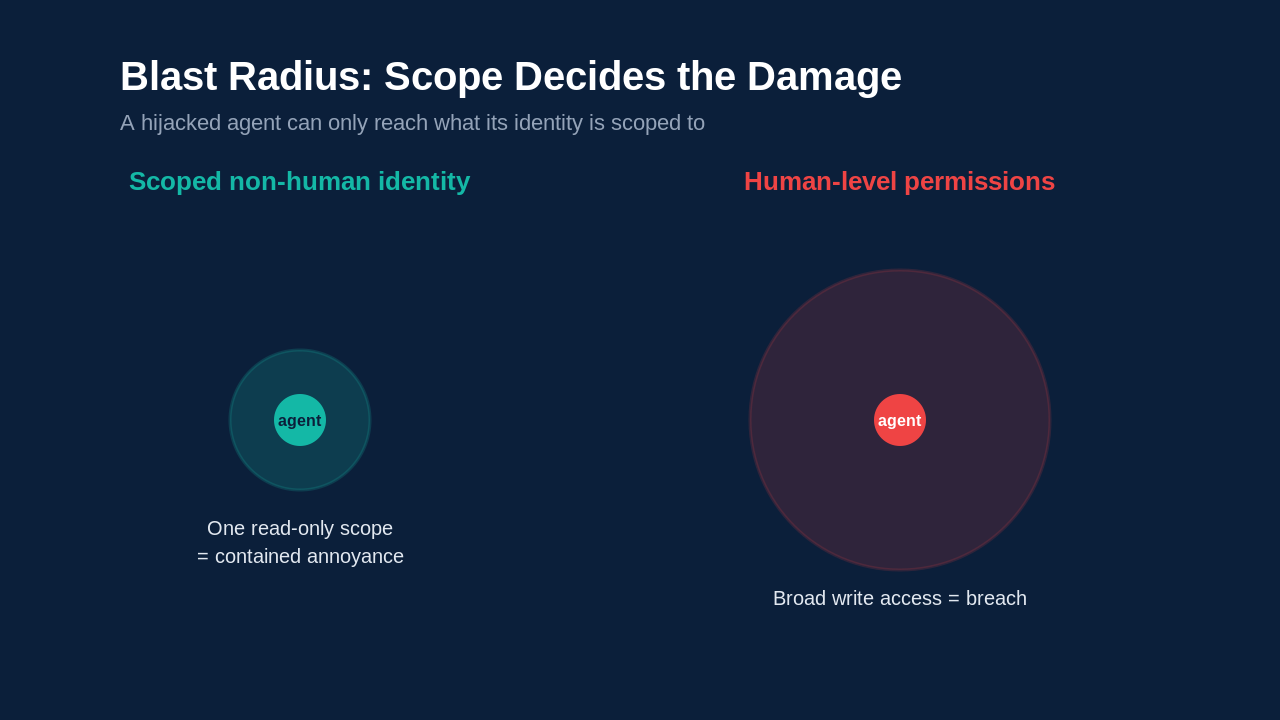
When an agent is compromised through prompt injection or a poisoned tool response, the damage is bounded by what it can reach. An agent limited to a read-only scope is an annoyance. One with broad write access to production is a breach. Least privilege is the primary containment control.
The Threat Landscape: OWASP Top 10 for Agentic Applications
In 2026 the OWASP GenAI Security Project published the Top 10 for Agentic Applications, a peer-reviewed taxonomy that regulators and auditors now reference. The highest-impact entries for enterprises are:
- Agent Goal Hijack (ASI01): an attacker manipulates the agent's objective, often through indirect prompt injection hidden in a document or tool output.
- Tool Misuse (ASI02): the agent is tricked into using a legitimate tool harmfully, such as exfiltrating data through an email function.
- Identity and Privilege Abuse (ASI03): over-broad permissions are exploited to reach systems the agent should never touch.
- Memory Poisoning (ASI04): malicious content is written into persistent memory so it corrupts future decisions.
- Supply Chain Vulnerabilities (ASI06): compromised models, tools, or Model Context Protocol servers introduce risk before the agent runs.
These are not theoretical. Agent platforms produced critical CVEs scoring 9.3 to 9.4 across ServiceNow, Langflow, and Microsoft Copilot in 2025 and 2026. In September 2025, the first documented AI-orchestrated cyberattack used a manipulated coding agent to target roughly 30 organizations.
If your agents call external tools over MCP, the supply chain risk is acute. Our guide to MCP security risks covers that vector.
A Control Architecture for Enterprise AI Agent Security
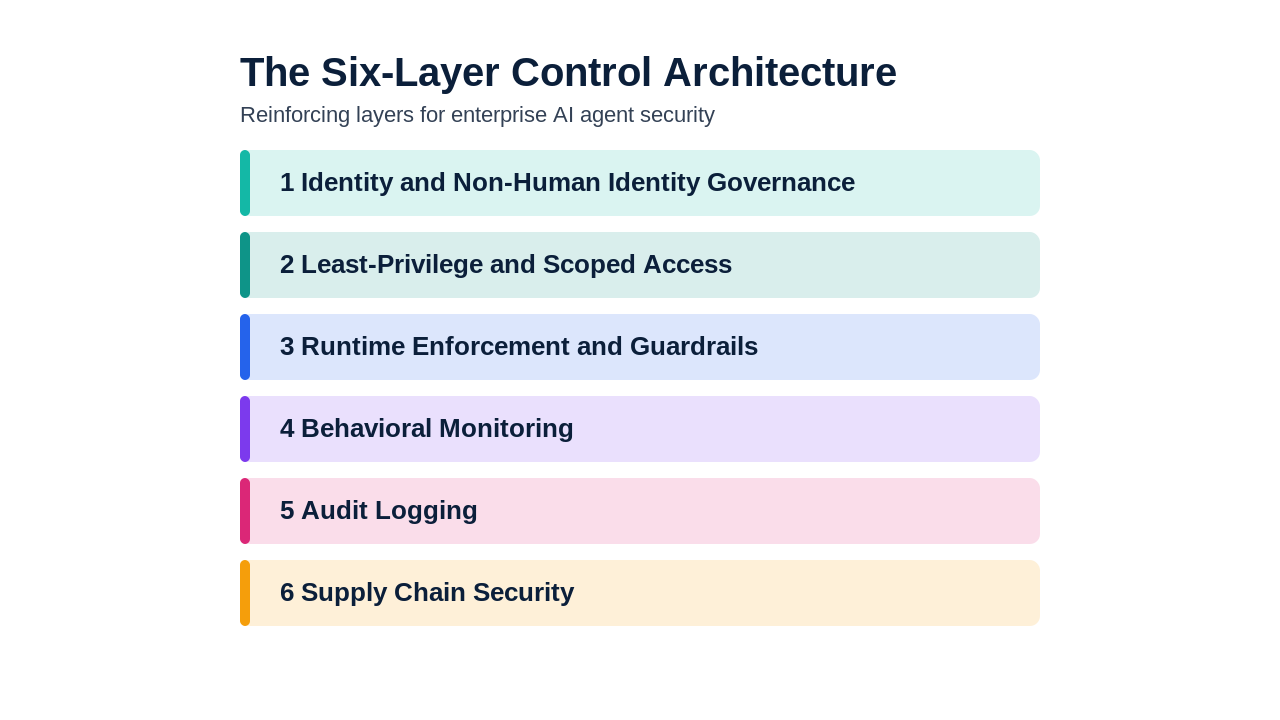
No single control stops every threat. Mature programs build six reinforcing layers: identity, least-privilege access, runtime enforcement, behavioral monitoring, audit logging, and supply chain security.
1. Identity and Non-Human Identity Governance
Give every agent a distinct, verifiable identity. Register it as a non-human principal with an owner, purpose, and expiry. Avoid long-lived static secrets. Prefer short-lived, rotated credentials, and manage the agent through the same lifecycle you run for service accounts.
2. Least-Privilege and Scoped Access
An agent should hold only the permissions its task requires. Treat it as its own identity, not an extension of the invoking user, then delegate a narrow scope:
# agent-access-policy.yaml
agent: invoice-reconciler
identity: nhi://agents/invoice-reconciler
credentials:
  type: short-lived-token
  ttl: 15m
  rotation: per-session
scopes:
  - resource: erp.invoices
    actions: [read]
  - resource: erp.ledger
    actions: [read, propose]   # propose, never post directly
approval_required:
  - action: ledger.post
    approver: finance-controller
The pattern that matters is the split between propose and execute. High-impact actions are proposed by the agent and committed by a human or policy engine, never by the agent alone.
3. Runtime Enforcement and Guardrails
Static permissions are not enough, because agents receive untrusted input at runtime. A runtime layer inspects each proposed action against policy before it executes. This blocks a reconciliation agent that suddenly tries to email a customer list, or halts a tool call whose arguments look like an injection payload.
4. Behavioral Monitoring
Agents are non-deterministic, so you cannot pre-approve every path. Baseline normal behavior and alert on deviation. A finance agent that has never touched the HR system suddenly querying employee records is a signal worth interrupting.
5. Audit Logging
Every decision and action needs a durable, tamper-evident record: the prompt, retrieved context, tool calls, and outcome. This is how you answer what the agent did and why after an incident, and it is what auditors expect. Log at the action level, not just the request level.
6. Supply Chain Security
Vet the models, libraries, and tool servers your agents depend on. Pin versions, verify provenance, and scan MCP servers and plugins before connecting them. A poisoned tool can compromise an otherwise well-governed agent.
Mapping to NIST and Recognized Standards
Enterprise buyers and auditors want agent security tied to a recognized framework, and the NIST AI Risk Management Framework is the reference. Its Govern and Map functions require organizations to manage risk across the AI lifecycle, including the systems acting on their behalf.
NIST has moved toward agents directly. Its Center for AI Standards and Innovation launched an AI Agent Standards Initiative in February 2026, and its guidance names traits for secure agentic design, including observability, least privilege, fail-safe defaults, defense in depth, and separation of privilege. The Cloud Security Alliance has published complementary agentic profiles and red-teaming guidance.
Document how each of your six control layers satisfies a NIST function. That mapping turns an internal design into something you can defend in a vendor review or audit. For the cross-framework walkthrough, see our AI agent security frameworks pillar.
A Phased Rollout Plan
You do not need all six layers before shipping. Phase one is identity and least privilege: before any agent reaches production, give it a scoped non-human identity and short-lived credentials, which eliminates the worst blast-radius outcomes. Phase two adds runtime enforcement and action-level audit logging, so you can both prevent and reconstruct. Phase three adds behavioral monitoring and supply chain hardening, wiring alerts into your existing SOC.
Run each phase against a low-risk agent first, then promote the pattern upward. For a checklist, our AI agent security best practices post breaks these controls into concrete steps.
Common Mistakes to Avoid
The most frequent failure is letting agents run under a human's full permissions because it is faster. That shortcut creates the overprivileged identity that turns a minor injection into a major breach. A close second is treating guardrails as text filtering while leaving tool calls unchecked. Third is shipping without audit logs, which makes incidents unexplainable. Fourth is connecting unvetted MCP servers or plugins. Each is cheap to fix early and expensive later.
Conclusion
Enterprise AI agent security is not a product you buy. It is a set of layered controls you design in from the start: distinct identities, least privilege, runtime enforcement, behavioral monitoring, audit logging, and supply chain vetting, all mapped to a framework like NIST. Start with identity and least privilege, ship a low-risk agent, and build the rest as you scale.
To go deeper, explore the Levelop blog or the AI agent security frameworks pillar guide.
Frequently Asked Questions
What is enterprise AI agent security?
It is the practice of protecting autonomous AI agents deployed inside an organization: giving each a governed identity, enforcing least-privilege access, checking actions at runtime, monitoring behavior, logging decisions, and securing the supply chain, aligned to the NIST AI RMF and the OWASP Top 10 for Agentic Applications.
Why can't we secure AI agents like normal applications?
Traditional apps are deterministic, but agents reason over untrusted input and choose their own actions, so you cannot pre-approve every path. Agents also authenticate and act, making them identities rather than features, which requires identity governance and runtime enforcement on top of standard security.
What is the most important first control?
Identity and least privilege. Registering each agent as a scoped non-human identity with short-lived credentials, rather than inheriting a human's full permissions, delivers the largest reduction in blast radius if the agent is later hijacked.
How does AI agent security map to NIST?
The NIST AI RMF's Govern and Map functions require managing risk across the AI lifecycle, including systems acting on your behalf. NIST's 2026 agent standards work names traits such as least privilege, observability, fail-safe defaults, and defense in depth that map onto a layered control architecture.
What are the biggest AI agent threats enterprises face?
The OWASP Top 10 for Agentic Applications highlights agent goal hijack, tool misuse, identity and privilege abuse, memory poisoning, and supply chain vulnerabilities. These have produced real critical CVEs and a documented AI-orchestrated attack, so they warrant concrete controls.