
CrewAI vs LangGraph 2026: Which Should You Use?
Picking a multi-agent framework in 2026 usually comes down to two names that keep showing up in production stacks: CrewAI and LangGraph. Both let you coordinate multiple LLM-powered agents to solve tasks that a single prompt cannot handle well, but they take almost opposite design philosophies to get there. CrewAI leans on a friendly, role-based abstraction that reads like assembling a small team. LangGraph gives you a low-level, graph-based state machine where you control every transition. This guide breaks down the crewai vs langgraph decision the way an engineer actually experiences it, so you can pick the right tool before you write a thousand lines you later have to unwind.
If you are still mapping the wider landscape first, our AI agent frameworks developer guide is a good starting point, and this post zooms into the head-to-head that most teams end up debating.
CrewAI vs LangGraph at a glance
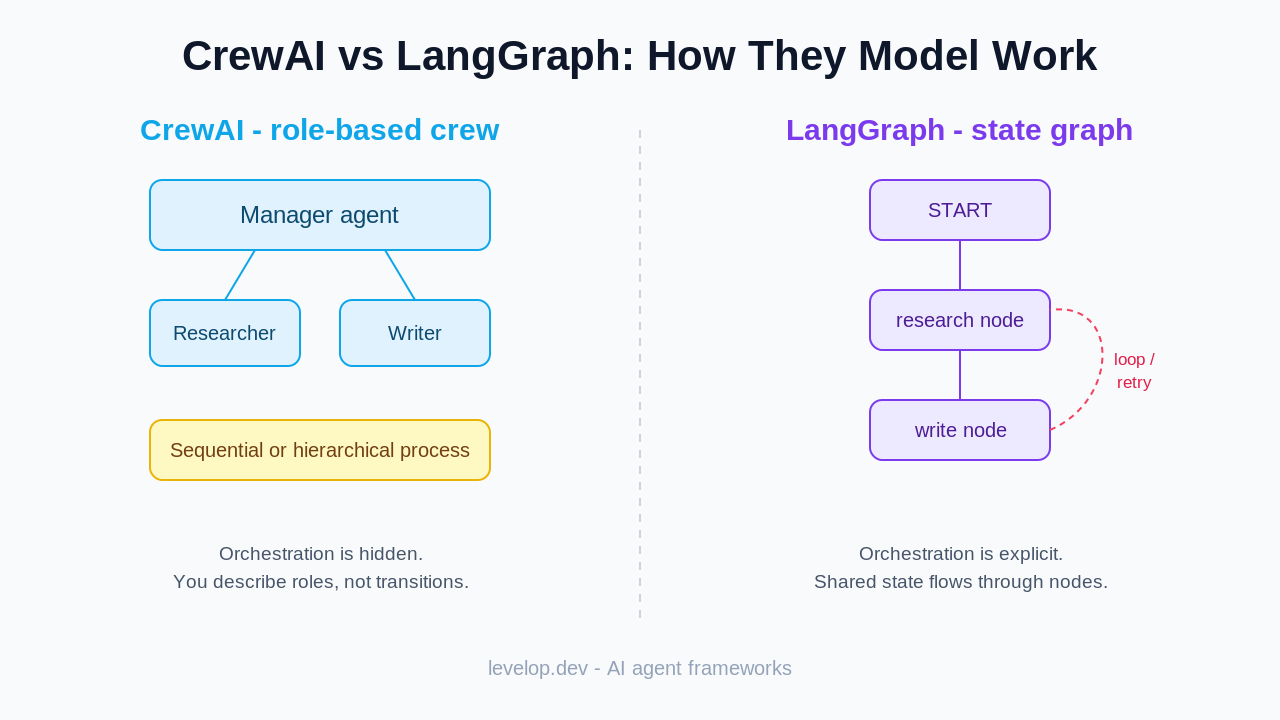
Before we go deep, here is the short version. CrewAI is opinionated and fast to start. You describe agents by role, goal, and backstory, hand them tasks, and let a crew run them in sequence or through a manager agent. LangGraph is unopinionated and explicit. You define a graph of nodes and edges, carry a shared state object between them, and decide exactly when the workflow loops, branches, or stops.
That difference in abstraction level is the whole story. CrewAI hides orchestration so you can focus on the roles. LangGraph exposes orchestration so you can shape it. Whether you search for crewai vs langgraph or langgraph vs crewai, the tradeoff is identical: convenience versus control. Neither is strictly better. The right answer depends on how much control your workflow needs and how much complexity your team is willing to own. Each framework supports tools, memory, and tracing, so the decision comes down to how the orchestration itself is expressed.
What is CrewAI?
CrewAI is an open-source Python framework for building multi-agent systems using a team metaphor. Instead of thinking about graphs or state machines, you think about people. You create agents, give each one a role such as "senior researcher" or "technical writer," assign them tasks, and group them into a crew that executes the work.
How CrewAI models agents
The core CrewAI primitives are Agents, Tasks, and Crews. An Agent has a role, a goal, an optional backstory that shapes its behavior, and a set of tools it can call. A Task describes a unit of work and which agent should own it. A Crew ties agents and tasks together and defines the process, which is usually sequential or hierarchical. In a hierarchical process, a manager agent delegates and reviews the work of the others, which is closer to how a real team operates.
This design makes CrewAI approachable. Defining agents is as simple as writing a role and a goal, so you can express a research-and-write pipeline in a handful of lines, and the mental model transfers cleanly from how you would brief a human team.
A minimal CrewAI example
from crewai import Agent, Task, Crew, Process

researcher = Agent(
    role="Senior Research Analyst",
    goal="Find the key facts about a topic",
    backstory="You dig through sources and summarize what matters.",
)

writer = Agent(
    role="Technical Writer",
    goal="Turn research notes into a clear brief",
    backstory="You write tight, accurate copy for engineers.",
)

research = Task(description="Research the topic", agent=researcher)
draft = Task(description="Write a 200-word brief", agent=writer)

crew = Crew(
    agents=[researcher, writer],
    tasks=[research, draft],
    process=Process.sequential,
)

result = crew.kickoff()
That is a complete two-agent workflow. You did not describe a single edge or transition. CrewAI decided the plumbing for you.
What is LangGraph?
LangGraph is a low-level orchestration library from the LangChain team for building stateful, multi-step agent workflows as graphs. Where CrewAI hides the control flow, LangGraph makes it the center of the design. You model your application as a directed graph: nodes do the work, edges decide what runs next, and a shared state object flows through the whole thing.
How LangGraph models workflows
A LangGraph app is built from a StateGraph. You define a state schema, register nodes as functions that read and update that state, and connect them with edges. Edges can be conditional, so the graph can branch based on the current state or loop back on itself. That cyclic capability is the point. Agentic behavior such as "reason, act, observe, repeat" maps naturally onto a graph with cycles, which is awkward to express in a purely linear pipeline.
LangGraph also ships first-class support for persistence through checkpointers, streaming of intermediate steps, and human-in-the-loop interrupts. These features matter a lot once a workflow leaves your laptop and has to survive restarts, reviews, and long-running tasks.
A minimal LangGraph example
from langgraph.graph import StateGraph, START, END
from typing import TypedDict

class State(TypedDict):
    topic: str
    notes: str
    brief: str

def research(state: State) -> dict:
    return {"notes": f"notes about {state['topic']}"}

def write(state: State) -> dict:
    return {"brief": f"brief based on {state['notes']}"}

graph = StateGraph(State)
graph.add_node("research", research)
graph.add_node("write", write)
graph.add_edge(START, "research")
graph.add_edge("research", "write")
graph.add_edge("write", END)

app = graph.compile()
result = app.invoke({"topic": "agent frameworks"})
Same logical task as the CrewAI example, but now you can see every hop. You declared the nodes, wired the edges, and controlled where the state starts and ends. That verbosity is a feature when you need precision.
CrewAI vs LangGraph: the key differences
Now the part you came for. Here is how the two frameworks diverge on the axes that decide production outcomes.
Abstraction and control
CrewAI trades control for speed. Its role-and-task abstraction is excellent when your workflow fits a team pattern: gather information, analyze it, produce output. You get a working system quickly and the code stays readable.
LangGraph trades speed for control. You write more boilerplate, but you can express branching, retries, conditional routing, and cycles that do not fit a neat team metaphor. If your logic includes "if the validator rejects the output, send it back to the writer with feedback, up to three times," LangGraph lets you encode that directly. CrewAI can approximate it, but you are fighting the abstraction.
State management and memory
LangGraph makes state a first-class citizen. The shared state object is explicit, typed, and passed through every node, which makes complex data flow easy to reason about and debug. CrewAI manages context and memory more implicitly, passing task outputs along and offering built-in short-term and long-term memory options. For simple pipelines this is convenient. For workflows where many agents read and write overlapping data, LangGraph's explicit state tends to scale better.
Human-in-the-loop and durability
Production agents rarely run fully unattended. LangGraph's checkpointing lets you pause a graph, wait for a human decision, and resume from the exact point later, even after a process restart. This durable-execution model is one of the strongest reasons teams pick LangGraph for high-stakes workflows. CrewAI supports human input on tasks too, but its persistence story is lighter, so long-running or approval-heavy flows take more custom work.
Learning curve and developer experience
CrewAI wins on time-to-first-agent. A developer new to agents can ship something useful in an afternoon because the concepts map to intuition. LangGraph has a steeper curve because you must understand graphs, state schemas, and edges before anything runs. The payoff is that once the mental model clicks, LangGraph scales to complexity without surprises, while CrewAI can feel constraining as requirements grow.
Ecosystem and observability
LangGraph benefits from the broader LangChain ecosystem, including tight integration with LangSmith for tracing, evaluation, and debugging of agent runs. That observability is valuable when you are trying to understand why an agent looped forever or picked the wrong tool. CrewAI has its own growing ecosystem, tooling, and a managed platform, and integrates with common observability vendors, but the graph-level tracing in LangSmith is hard to match for deep debugging.
Performance and production considerations
Raw latency between the two is usually dominated by the LLM calls, not the framework, so micro-benchmarks rarely decide anything. What matters in production is how each framework handles failure, concurrency, and change.
LangGraph's explicit graph makes concurrency and partial failure easier to model, which is a big part of why teams call it production ready for complex systems. You can run independent nodes in parallel and recover a checkpointed run after a crash. CrewAI's higher-level model means you write less code, but you also have less visibility into where a run stalled when something goes wrong. As a rule of thumb, the more your workflow looks like a state machine with branches and retries, the more LangGraph's structure pays off. The more it looks like a linear assembly line of specialists, the more CrewAI's simplicity pays off.
Whichever you choose, instrument it. Agent systems fail in subtle ways, and the teams that succeed treat tracing and evaluation as day-one requirements rather than afterthoughts. Our comparison of the best AI agent frameworks of 2026 goes deeper on that.
When to choose CrewAI
Reach for CrewAI when your problem decomposes into clear roles and a mostly linear flow. Content generation pipelines, research assistants, and internal automations where a few specialized agents hand work down a line are a natural fit. It is also the better pick when the team is newer to agents and you want a working prototype fast, or when readability and onboarding speed matter more than fine-grained control.
When to choose LangGraph
Reach for LangGraph when control, state, and durability are non-negotiable. Choose it for workflows with conditional branching, loops, retries, and human approval gates, or for any system that must checkpoint and resume reliably. If you are already invested in LangChain and LangSmith, the integration is a strong pull. Teams building complex, long-running, or safety-sensitive agents almost always end up wanting the explicitness LangGraph provides.
Can you use CrewAI and LangGraph together?
Yes, and some teams do. Because both are just Python, you can wrap a CrewAI crew as a node inside a LangGraph graph, using LangGraph for the top-level orchestration, branching, and durability while letting a crew handle a self-contained sub-task like research. This hybrid approach lets you get CrewAI's fast role modeling where the work is linear and LangGraph's control where the workflow is complex. It adds moving parts, so only reach for it once you have hit a real limit with one framework alone.
The bottom line on crewai vs langgraph
CrewAI and LangGraph are not really competing for the same job. CrewAI optimizes for developer speed and a clean team metaphor. LangGraph optimizes for control, explicit state, and durable execution. Start with the shape of your workflow, not the marketing. If it reads like a team running down a checklist, CrewAI will get you there faster. If it reads like a state machine with branches, loops, and approvals, LangGraph will save you from rebuilding orchestration by hand. Many teams even land on both.
Wherever you land, the framework is only half the battle. The other half is measuring whether your agents actually help. That is the problem we care about at Levelop, and you can browse more engineering deep dives on the Levelop blog.
Further reading: the official CrewAI documentation and the LangGraph documentation are the best primary sources for API details and current features.
Frequently asked questions: CrewAI vs LangGraph
Is CrewAI or LangGraph better for beginners?
CrewAI is friendlier for beginners. Its role, goal, and task model maps to how you would brief a human team, so a new developer can ship a working multi-agent workflow in an afternoon. LangGraph has a steeper learning curve because you must understand graphs, state schemas, and edges first.
Can CrewAI and LangGraph be used together?
Yes. Because both are plain Python, a common pattern is to wrap a CrewAI crew as a single node inside a LangGraph graph. LangGraph handles top-level orchestration, branching, and durability, while the crew handles a self-contained sub-task like research.
Does LangGraph replace LangChain?
No. LangGraph is a separate orchestration library from the LangChain team that focuses on stateful, cyclic agent workflows. It works alongside LangChain components and integrates tightly with LangSmith for tracing and evaluation.
Which framework is better for production agents?
For complex, long-running, or approval-heavy production systems, LangGraph's explicit state and checkpointing make it easier to recover from failures and pause for human review. For linear, role-based automations, CrewAI is production-capable and faster to build and maintain.
Is CrewAI built on LangChain?
CrewAI started with LangChain dependencies but has moved toward a more standalone framework focused on its role-based crew abstraction. Check the official CrewAI documentation for the current dependency and integration details, since this evolves quickly.