
Agentic AI Architecture: The 5 Parts of an AI Agent
Most people meet an AI agent as a chat box that somehow books a flight, files a pull request, or answers a support ticket end to end. What they do not see is the machinery underneath: a control loop that decides which tool to call, keeps track of what has happened, remembers what matters across steps, plans several moves ahead, and recovers when a step fails. That machinery is the agentic AI architecture, and understanding it is the difference between an agent that demos well and one that survives production.
This post walks through the five parts of an agentic AI architecture that matter most in 2026: tool routing, context management, memory, multi-step planning, and error recovery. We will look at how each one works, where it breaks, and how the pieces connect into a single reliable loop. The same anatomy shows up whether you call it an AI agent architecture or an agentic AI architecture, and whether you draw it as a diagram or build it in code.
What an AI Agent Actually Is
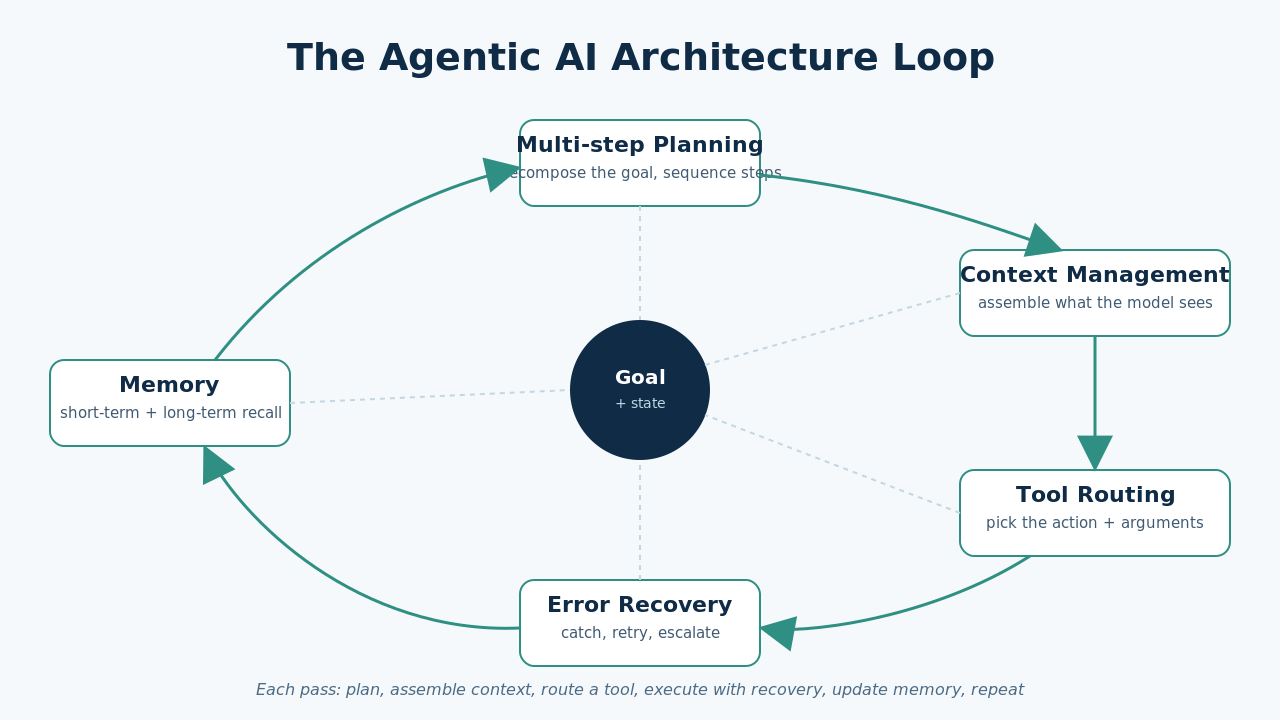
Strip away the marketing and an agent is a loop. A language model receives a goal and the current state, produces either a final answer or an action to take, an executor runs that action, and the result is fed back into the model. The loop repeats until the goal is met or a stopping condition fires. This is often called the sense, think, act cycle, and it is the backbone every agent framework implements in some form.
The reason agents feel qualitatively different from a single model call is that the loop lets the model observe the consequences of its own decisions and correct course. A single prompt is a guess. An agent is a guess, a check, and a revision, repeated until the work is done. Everything in the architecture exists to make that repetition trustworthy.
The five subsystems below are not optional add-ons. Each one addresses a specific way the naive loop falls apart at scale.
Tool Routing: Choosing the Right Action
Tool routing is how the agent decides which capability to invoke and with what arguments. A modern agent might have access to a web search, a code interpreter, a database query tool, a calendar API, and a dozen internal functions. Routing is the model reading the current state and selecting one.
Under the hood, most agents implement routing through function calling. Each tool is described to the model as a schema: a name, a natural language description, and a typed set of parameters. The model returns a structured request naming the tool and filling in the arguments, and the runtime dispatches it. The quality of those descriptions matters more than almost anything else. A tool called search with the bare description searches will be misused constantly. A tool described as searches internal HR documents for policy questions, not for general web facts gets routed correctly far more often.
Routing degrades in a predictable way as the tool count grows. With five tools the model chooses well. With fifty, it starts confusing similar tools, calling the wrong one, or hallucinating parameters. The common fixes are hierarchical routing and retrieval-based tool selection, where only the handful of tools relevant to the current step are shown to the model at all. Anthropic's Model Context Protocol standardizes how tools are exposed to agents, which makes retrieval-based routing across many servers far more practical.
tools = [
    {
        "name": "query_orders",
        "description": (
            "Look up a customer's order history by customer_id. "
            "Use for questions about past purchases, refunds, or shipping status. "
            "Do NOT use for product catalog questions."
        ),
        "parameters": {
            "type": "object",
            "properties": {
                "customer_id": {"type": "string"},
                "since": {"type": "string", "description": "ISO date, optional"},
            },
            "required": ["customer_id"],
        },
    }
]
The key insight is that routing is a retrieval problem wearing a reasoning costume. The better you narrow the candidate tools before the model reasons, the more reliable the selection.
Context Management: Deciding What the Model Sees
Every step of the loop, the agent has to assemble a prompt: the system instructions, the goal, the relevant history, the tool outputs so far, and the available tools. Context management is the discipline of deciding what goes into that finite window and what gets left out. This is where a huge share of agent failures actually live.
The naive approach is to append everything. Each tool call and its result gets stacked onto the conversation, and after twenty steps the context is a wall of stale observations. Two things go wrong. First, cost and latency climb with every token. Second, and worse, the model's attention gets diluted. Research on long-context models has repeatedly shown a lost in the middle effect, where information buried in the center of a long context is used less reliably than information at the start or end. An agent that dumps everything into context is actively hiding the important facts from itself.
Good context management is selective. It keeps the goal and the system prompt pinned, summarizes or drops old tool outputs that are no longer relevant, and surfaces the two or three facts the current step actually depends on. Techniques include running summaries, scratchpads that hold intermediate results outside the model's context until needed, and structured state objects the runtime renders into the prompt on demand. If you want the deeper playbook, see our guide to context engineering best practices.
Context management and memory are often confused, so it helps to draw the line clearly. Context management is about the current window: what the model sees this step. Memory is about persistence: what survives across steps and sessions. They work together, but they are different subsystems with different failure modes.
Memory: Persistence Across Steps and Sessions
Memory is how an agent carries information forward. It usually splits into short-term and long-term.
Short-term memory is the working set for the current task. It is the running record of what the agent has tried, what it observed, and what it concluded so far. Much of this lives in the context window, but robust agents also keep a structured copy outside the model, so a summarization pass or a context reset does not erase the plan.
Long-term memory persists across sessions. The dominant pattern in 2026 is retrieval augmented memory: important facts, past interactions, and learned preferences are written to a vector store or a database, and relevant entries are retrieved and injected into context when they matter. When a support agent remembers that a specific customer prefers email over phone, that preference was written to long-term memory in a prior session and retrieved at the start of this one.
The hard problems in memory are not storage, they are curation. What deserves to be remembered? When should a memory be updated or invalidated? A stale memory is worse than no memory, because the agent will confidently act on outdated facts. Mature systems attach timestamps and provenance to memories, prefer recent entries when facts conflict, and periodically prune or re-summarize the store. The goal is not to remember everything, it is to remember the right things and to keep them fresh.
Multi-Step Planning: Sequencing the Work
Simple agents are reactive. They look at the current state and pick the next action, one step at a time. This works for short tasks, but it falls apart when the goal requires a sequence of interdependent steps, because a greedy next-step choice can walk the agent into a dead end.
Planning adds a layer that thinks about the whole task before or during execution. There are two broad styles. Plan-then-execute agents produce a full plan up front and then execute the steps in order, replanning only if something breaks. This is efficient and easy to audit, but brittle if the environment is unpredictable. Interleaved planning, popularized by the ReAct pattern, alternates reasoning and action at every step, letting the agent adjust its plan continuously based on what it observes. This is more robust in messy environments but costs more tokens and is harder to reason about.
Most production agents in 2026 use a hybrid. They generate a coarse plan up front to give the loop direction, then execute steps with interleaved reasoning, and trigger a replanning pass when an observation contradicts the plan. Task decomposition is the other half of planning: breaking a large goal into sub-goals small enough that each maps to a handful of tool calls. Decomposition also makes error recovery tractable, because a failure is scoped to one sub-goal rather than the entire task.
def run_agent(goal, tools, model, max_steps=20):
    plan = model.plan(goal, tools)      # coarse up-front plan
    state = {"goal": goal, "history": [], "plan": plan}
    for step in range(max_steps):
        decision = model.decide(state)  # reason + choose a tool or finish
        if decision.is_final:
            return decision.answer
        try:
            result = dispatch(decision.tool, decision.args)
        except ToolError as e:
            result = {"error": str(e)}   # feed failure back, do not crash
        state["history"].append((decision, result))
        if contradicts(result, state["plan"]):
            state["plan"] = model.replan(state)  # recover by replanning
    return escalate(state)               # stopping condition hit
Notice that the loop never trusts a step to succeed. That assumption is what the last subsystem is built around.
Error Recovery: Surviving Failure Gracefully
In production, tools fail. APIs time out, return malformed data, hit rate limits, or succeed but with a result that does not make sense. An agent architecture that assumes every action works is an architecture that will hang, loop forever, or confidently return garbage. Error recovery is the set of mechanisms that let the loop continue safely when a step goes wrong.
The first layer is catching and feeding back. When a tool raises, the runtime should not crash the loop. It should capture the error and pass it back to the model as an observation, so the model can decide whether to retry, try a different tool, or ask for help. Models are often good at recovering when they can see what went wrong, and terrible when the failure is silent.
The second layer is bounded retries with backoff for transient failures, so a single flaky network call does not derail the task, while a persistent failure does not retry forever. The third layer is loop detection. Agents can get stuck repeating the same failing action, and the runtime needs a stopping condition: a maximum step count, a detector for repeated identical actions, or a budget on tokens and wall-clock time. The fourth layer is human-in-the-loop escalation. When the agent exhausts its recovery options, or when a step is high-stakes and irreversible, the right move is to stop and hand off to a person rather than guess. A well-designed agent knows the boundary of its own competence and respects it.
How the Pieces Fit Together
Put the five subsystems on one diagram and the architecture becomes clear. The planning layer sets direction and decomposes the goal. Each step, context management assembles what the model sees, pulling relevant entries from memory and recent history. The model reasons and tool routing selects an action. The executor runs it, wrapped in error recovery. The result updates memory and history, and the loop either continues, replans, or escalates.
None of these parts is sufficient alone. Great routing with no error recovery gives you an agent that picks the right tool and then hangs when it times out. Perfect memory with no context management gives you an agent that remembers everything and reasons about nothing, because the important facts are buried. The reliability of an agent is a property of how well these subsystems cooperate, not of any single one.
If you are building or evaluating agents, this is also a useful checklist. When an agent misbehaves, ask which subsystem failed. Did it call the wrong tool (routing)? Did it forget a fact it clearly had (memory or context management)? Did it walk into a dead end (planning)? Did it hang or loop on a failure (error recovery)? Naming the failing layer is the fastest path to a fix.
Key Takeaways
An AI agent is a control loop, and the agentic AI architecture is the set of subsystems that make that loop reliable. Tool routing is a retrieval problem: narrow the candidate tools before the model reasons. Context management decides what the model sees each step and is where most silent failures live. Memory is persistence with a curation problem, not a storage problem. Planning sequences interdependent work and makes recovery tractable through decomposition. Error recovery is woven through the loop, not appended to it. Get all five cooperating and you have an agent that survives the messiness of production.
Related Reading on Levelop
AI Agent Frameworks in 2026: A Developer's Guide
Agentic Context Engineering for Self-Improving AI Agents
Agent RAG Architecture: The Retrieval Stack for 2026
LLM Observability: Tracing and Monitoring AI Agents in Production
Explore more guides on the Levelop blog.
Frequently Asked Questions
What is agentic AI architecture?
Agentic AI architecture (also called AI agent architecture) is the set of subsystems that turn a language model into an autonomous agent: a control loop plus tool routing, context management, memory, multi-step planning, and error recovery. Together they let the agent choose actions, track state, remember what matters, sequence interdependent steps, and recover when something fails.
What is the difference between context management and memory in an agent?
Context management decides what the model sees in the current prompt window this step. Memory is about persistence: what survives across steps and sessions. Context management fights dilution and cost in the moment, while memory handles long-term recall and preferences. They cooperate, but they are separate subsystems with separate failure modes.
How does tool routing work in an AI agent?
Most agents route through function calling. Each tool is described to the model with a name, a natural language description, and typed parameters. The model returns a structured request naming a tool and its arguments, and the runtime dispatches it. As the tool count grows, hierarchical routing and retrieval-based tool selection keep accuracy high by narrowing the candidates before the model reasons.
What is the difference between plan-then-execute and ReAct-style planning?
Plan-then-execute agents produce a full plan up front and run it in order, replanning only on failure. ReAct-style agents interleave reasoning and action at every step, adjusting continuously. Up-front planning is efficient and auditable but brittle in unpredictable environments. Interleaved planning is more robust but costs more tokens. Many production agents combine both.
How do agents handle errors and failures?
Through layered recovery: catching tool errors and feeding them back to the model as observations, bounded retries with backoff for transient failures, loop detection with step and budget limits, and human-in-the-loop escalation for high-stakes or unrecoverable situations. The loop never assumes a step succeeded, so failure becomes a normal, handled event rather than a crash.