
AI Secure Code Review: Does It Actually Catch Vulnerabilities?
AI code review tools now ship in nearly every pull request workflow, and most of them advertise the same headline: they find security bugs before your users do. That promise is appealing, but it deserves scrutiny. A secure code review is not the same task as a style check or a "this looks fine" approval. It is a deliberate search for the flaws an attacker would exploit, and getting it wrong is expensive.
So the honest question is this: when an AI reviewer scans your diff, does it actually catch vulnerabilities, or does it just sound confident? This guide walks through where AI-assisted secure code review genuinely helps, where it still misses real risk, and how to build a workflow that gets the benefit without trusting the machine blindly.
If you want the broader landscape of tools first, our best AI code review tools guide compares the major players. This post zooms in on the security dimension specifically.
What a Secure Code Review Actually Means
A secure code review is a focused inspection of source code with one goal: find the weaknesses that lead to security incidents. That includes injection flaws, broken authentication, exposed secrets, unsafe deserialization, and access-control mistakes. The OWASP Top Ten is the standard reference for the categories that matter most, and the OWASP Code Review Guide lays out how a rigorous manual review is supposed to work.
The important nuance is that secure code review is partly mechanical and partly contextual. Some vulnerabilities are pattern-shaped. A string concatenated straight into a SQL query is dangerous almost every time, regardless of the surrounding code. Other vulnerabilities are contextual. Whether a missing permission check is a bug depends on who is allowed to call that function and what data sits behind it. That split, mechanical versus contextual, is exactly the line where AI reviewers perform very differently.
Where AI Secure Code Review Genuinely Shines
The strongest case for AI in security review is coverage at the moment of change. Human reviewers get tired, skim large diffs, and rarely re-check every input path. An AI reviewer reads every line of every pull request at the same energy level at 9 a.m. and 6 p.m.
Pattern-Based Vulnerabilities
For well-understood, pattern-shaped flaws, modern AI reviewers are strong. They reliably flag things like:
- SQL and command injection from unsanitized input
- Cross-site scripting from unescaped output
- Hardcoded API keys, tokens, and passwords committed to the repo
- Weak or missing input validation on request handlers
- Use of known-dangerous functions and deprecated crypto
These map cleanly to entries in the MITRE CWE Top 25, and because the patterns are well represented in training data, models recognize them quickly. In practice, this catches a meaningful slice of the everyday mistakes that slip past a rushed human review.
Breadth, Speed, and Consistency
The second advantage is throughput. A security-focused AI reviewer comments inline on the pull request within a minute or two, so the developer fixes the issue while the context is still fresh. It never says "I ran out of time to review the second half." For teams shipping dozens of pull requests a day, that consistency is the real value. It shifts security left without adding a human bottleneck.
Where AI Code Review Still Misses Vulnerabilities
Now the uncomfortable part. The categories AI reviewers handle worst are often the ones that cause the most damage.
Business-Logic and Authorization Flaws
Broken access control sits at the top of the OWASP Top Ten for a reason, and it is precisely where AI struggles. Consider an endpoint that lets a user fetch an invoice by ID. If the code never checks that the invoice belongs to the requesting user, that is a serious vulnerability. But the code itself looks completely normal. There is no dangerous function, no obvious injection, nothing a pattern matcher would flag. Catching it requires understanding the application's intended authorization model, which is business context the model usually does not have.
Multi-File and Cross-Service Context
Many real vulnerabilities live in the gap between files. Input is validated in one module, then trusted and used unsafely three services away. An AI reviewer scanning a single diff sees only the change in front of it. It rarely reasons across the whole call graph, so a flaw that only appears when two components interact tends to go unreported. This is a structural limit of reviewing diffs rather than whole systems.
False Positives and Alert Fatigue
The opposite failure is just as damaging. AI reviewers frequently flag code that is not actually exploitable, because the mitigation lives somewhere the model did not look. A stream of confident-but-wrong security warnings trains developers to click "resolve" without reading. Once that habit forms, the real finding buried in the noise gets dismissed too. Precision matters as much as recall in a secure code review, and a noisy tool can quietly make a team less safe.
# An AI reviewer often flags this as SQL injection:
query = f"SELECT * FROM orders WHERE id = {order_id}"
db.execute(query)

# But it usually cannot tell whether THIS is a real vulnerability,
# because it depends on where order_id came from and whether the
# caller already enforced that the order belongs to the current user.
# The dangerous pattern is visible. The exploitability is not.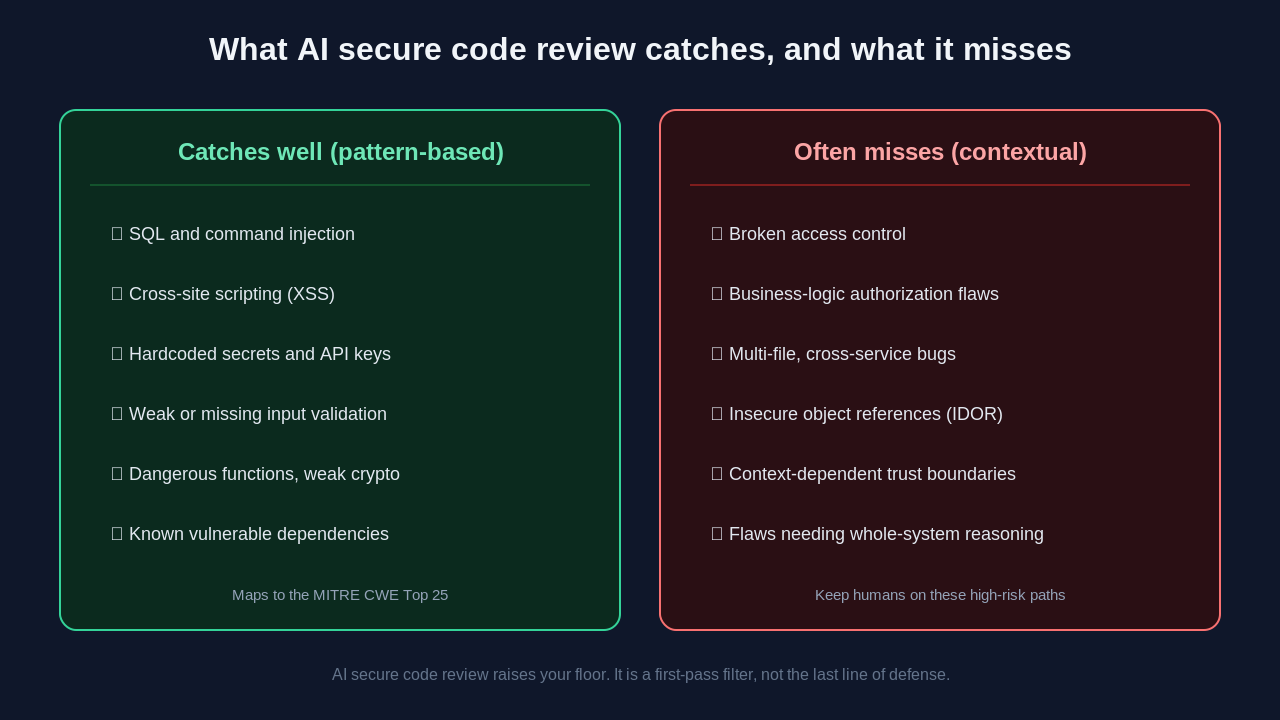
AI Versus SAST Versus Human Reviewers
It helps to place AI review next to the other two options rather than treating it as a replacement.
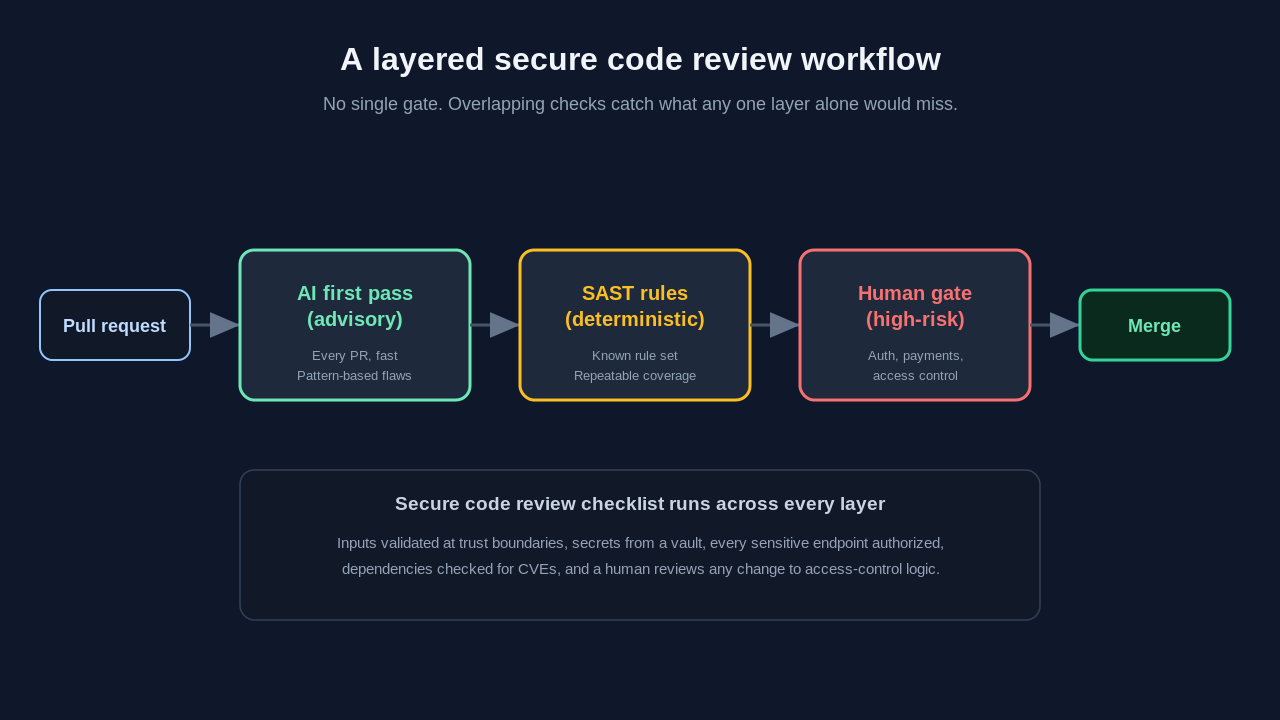
Traditional static application security testing (SAST) tools are rule-based. They are deterministic and thorough within their rule set, but they are famous for false positives and they only find what someone wrote a rule for. AI reviewers are more flexible and explain findings in plain language, but they are less predictable and can hallucinate. Human security reviewers understand intent and business logic better than either, but they are slow, expensive, and inconsistent across a large codebase.
The practical answer is layering, not picking a winner. Frameworks like the NIST Secure Software Development Framework explicitly recommend multiple, complementary checks across the development lifecycle rather than a single gate. We go deeper on the trade-offs in AI code review versus human review, but the short version is that AI is a layer, not the whole defense.
A Practical Secure Code Review Workflow With AI
Here is a workflow that captures the upside while containing the risks. It assumes AI review is one gate among several, not the final word.
Wire AI Review Into CI as a Non-Blocking First Pass
Run the AI security reviewer automatically on every pull request, but treat it as advisory for anything short of a critical, high-confidence finding. That keeps developers moving while still surfacing issues early. Our guide to setting up AI code review in a GitHub CI/CD pipeline covers the wiring in detail.
# .github/workflows/security-review.yml
name: AI Secure Code Review
on: [pull_request]

jobs:
  ai-security-scan:
    runs-on: ubuntu-latest
    steps:
      - uses: actions/checkout@v4
      - name: Run AI security review
        run: ai-review scan --focus security --severity high
        continue-on-error: true   # advisory, not a hard block
      - name: Run SAST
        run: sast-tool run --config .sast.yml
Keep a Human Gate for High-Risk Surfaces
Route pull requests that touch authentication, authorization, payments, or data access to a human security reviewer, no matter what the AI says. These are the business-logic areas AI handles worst, so a person stays in the loop where it counts most.
Use a Secure Code Review Checklist
A short, shared secure code review checklist keeps both the AI and the humans honest. It also gives you a way to spot the categories your AI tool consistently ignores.
- Are all inputs validated and outputs encoded at trust boundaries?
- Does every sensitive endpoint enforce authentication and authorization?
- Are secrets pulled from a vault rather than the source tree?
- Is error handling free of stack traces and sensitive detail?
- Are dependencies checked for known CVEs?
- Did a human review any change to access-control logic?
For the fundamentals of how these tools operate day to day, our AI code review developer's guide is a good companion read.
What the Evidence Suggests
The research and standards community has converged on a consistent message. Automated review is valuable for scale and for the common, well-categorized weaknesses tracked by OWASP and MITRE, and it is unreliable as a sole control for logic-level and access-control flaws. That is why every mature secure development framework, including the NIST SSDF, describes security as a set of overlapping practices rather than one automated checkpoint. AI code review fits neatly as one of those overlapping layers. It raises your baseline. It does not remove the need for the others.
The teams getting the most out of AI secure code review treat it accordingly. They measure what it catches, they watch its false-positive rate, and they keep humans on the high-stakes paths. Used that way, it is one of the highest-leverage additions to a modern security workflow.
Frequently Asked Questions
Can AI code review replace a dedicated security team?
No. AI review is a strong first-pass filter for common, pattern-based vulnerabilities, but it misses business-logic and authorization flaws that require understanding your application's intent. Treat it as one layer alongside SAST and human review, not a replacement for a security team.
What types of vulnerabilities does AI code review catch best?
It is strongest on pattern-shaped issues: injection flaws, cross-site scripting, hardcoded secrets, weak input validation, and use of dangerous functions. These map closely to the MITRE CWE Top 25 and are well represented in the models' training data.
Why does AI code review produce so many false positives?
Because it often flags a dangerous-looking pattern without seeing the mitigation, which may live in another file or an earlier validation step. Tuning severity thresholds and treating low-confidence findings as advisory helps keep alert fatigue under control.
Is AI secure code review better than traditional SAST tools?
It is different, not strictly better. SAST is deterministic and thorough within its rules but noisy, while AI is more flexible and readable but less predictable. Running both, then adding a human gate for high-risk code, gives the best coverage.
How do I add AI security review to my pipeline safely?
Run it automatically on every pull request as an advisory, non-blocking check, keep a mandatory human review for authentication and access-control changes, and pair it with a secure code review checklist so nothing critical depends on the AI alone.
Wrapping Up
AI secure code review earns its place in the workflow. It reads every diff, catches the common vulnerabilities early, and shifts security left without slowing your team down. What it cannot do is understand your application's business logic well enough to be the last line of defense. The winning approach is layered: AI as the tireless first pass, SAST for deterministic rule coverage, and humans on the high-risk surfaces where context is everything.
Want to go deeper on tooling and workflow? Start with the Levelop blog or explore how we think about engineering leverage at Levelop.