

Caching Strategies in System Design: 4 Patterns
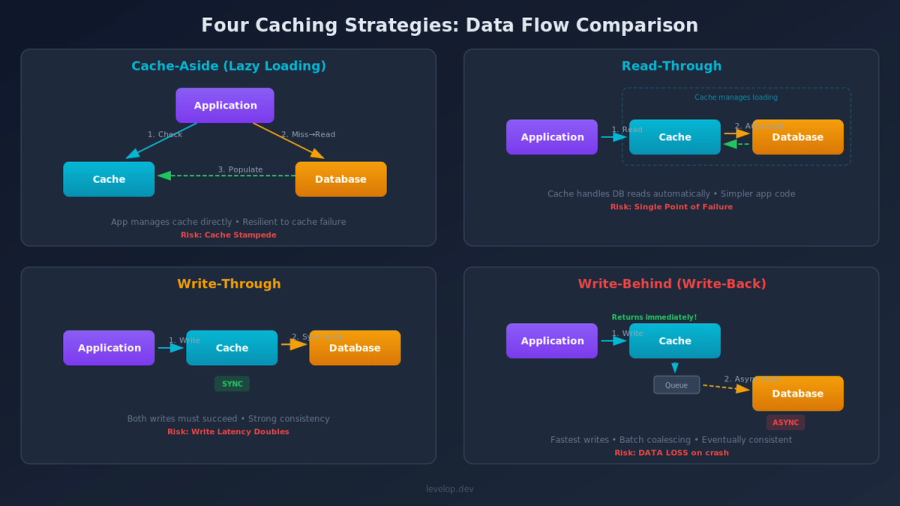
The four caching strategies for system design are cache-aside, read-through, write-through, and write-behind. Cache-aside lazily loads data on a miss, read-through lets the cache load it for you, write-through writes to cache and database together for consistency, and write-behind writes to cache first and flushes to the database later for speed. Each caching strategy trades staleness against write latency differently, and the rest of this guide covers when each one wins and how it fails.
Every system design mock I bombed early on had the same note: "Your caching story is too shallow." I'd say "put Redis in front of the database" and move on. Then the interviewer would ask: "Which caching strategy?" And I'd freeze.
There are four core caching strategies for system design: cache-aside, read-through, write-through, and write-behind. Each makes a different bet about consistency, latency, and what happens when things break. Once I could reason about why one caching pattern fits a problem and another doesn't, my interview answers got dramatically better.
Here is the quick reference. Skim this table first, then read the deep dives below.
Pattern        | Best use case              | Key advantage            | Main failure mode
-------------- | -------------------------- | ------------------------ | -------------------------
Cache-Aside    | Read-heavy, unpredictable  | App controls the cache   | Cache stampede
Read-Through   | Large teams, shared reads  | Simple application code  | Cache becomes a read SPOF
Write-Through  | Read-after-write required  | Strong consistency       | Write latency doubles
Write-Behind   | Extreme write volume       | Fastest writes           | Data loss on crash
This guide is the overview of all four patterns and their tradeoffs. If your real problem is keeping cached data fresh once it has been written, that is a deeper topic on its own: see our companion guide on cache invalidation strategies, which drills into TTLs, surrogate keys, and tag-based purging.
What Caching Strategies Actually Solve in System Design
Before the four types of caching patterns, be honest about what caching does. It reduces read latency and load on the data store by keeping frequently accessed data in a faster layer, like an in-memory cache such as Redis or Memcached, or even a local cache in the process. That improves performance, but it doesn't fix write scalability, a bad data model, or consistency problems. Often it creates new ones.
The fundamental tension in every caching strategy is speed versus truth. Your cache is fast because it's a copy, and copies go stale. Each caching pattern is really a different answer to one question: how much staleness can you tolerate, and who keeps things fresh?
Two metrics define the landscape. Cache hit ratio tells you how often requests are served from the cache instead of the data store; below 80% means the cache is burning memory without pulling its weight. The staleness window tells you how long the cache may serve outdated data after the source changes.
With that framing, the four caching strategies start making sense.
Cache-Aside: The Lazy Loading Caching Pattern
Cache-aside lazy loading is the caching strategy most developers learn first, and probably the one you're using now without naming it.
How Cache-Aside Works
The application manages the cache directly. On a read, it checks the cache first. On a hit, it returns immediately with minimal latency. On a miss, it reads from the data store, writes the result into the cache, then returns it.
On a write, the app updates the database and then invalidates (deletes) the cached entry. The next read misses and repopulates the cache with fresh data. This is one of the simplest cache invalidation strategies available.
def get_user(user_id):
    # Check cache first
    cached = redis.get(f"user:{user_id}")
    if cached:
        return json.loads(cached)

    # Cache miss: read from DB
    user = db.query("SELECT * FROM users WHERE id = %s", user_id)

    # Populate cache for next time
    redis.setex(f"user:{user_id}", 3600, json.dumps(user))
    return user

def update_user(user_id, data):
    # Update database first
    db.execute("UPDATE users SET ... WHERE id = %s", user_id)

    # Invalidate cache
    redis.delete(f"user:{user_id}")
When Cache-Aside Wins
Cache-aside works best for read-heavy workloads with unpredictable access patterns. Only requested data gets cached, so you don't waste memory on things nobody reads. It is resilient too: if the cache goes down, the app still works by falling back to the data store. Response times rise, but the system stays up.
E-commerce product catalogs are the classic example. Millions of products, but only a fraction get viewed often. Cache-aside keeps the popular items warm without you predicting which ones matter.
Cache-Aside Failure Modes
The dangerous scenario is cache stampede, also called thundering herd. A popular entry expires on its TTL, 500 concurrent requests miss the cache at the same instant, and all 500 hit the database for the same row. Your data store melts.
The fix is a technique called cache locking. When the first request sees a miss, it sets a short-lived lock key. Subsequent requests see the lock and either wait or serve slightly stale data while the first request repopulates the cache.
There's also the stale-data window. Between updating the database and invalidating the cache, any read gets the old value. Usually this window is milliseconds and nobody notices. In financial systems, those milliseconds matter.
Read-Through Cache: Simplifying Your Caching Pattern
Read-through looks similar to cache-aside from the outside, but responsibility shifts. Instead of the application managing cache updates, the cache itself loads data from the data store.
How Read-Through Works
The application only talks to the cache. On a miss, the cache layer loads the data from the database, stores it, and returns it. The app never queries the data store directly for reads, which simplifies code and improves performance.
# With a read-through cache, your application code simplifies to:
def get_user(user_id):
    # The cache handles miss logic internally
    return cache.get(f"user:{user_id}")

# The cache is configured with a loader function:
# cache.set_loader(lambda key: db.query("SELECT * FROM users WHERE id = %s", key))
When Read-Through Wins
The big advantage is a simpler application layer. Everyone reads through the same cache interface. Nobody accidentally bypasses the cache or forgets to populate it after a miss. The data-loading logic lives in one place.
This matters in large teams. With cache-aside, I've seen codebases where some endpoints cached results and others didn't, depending on who wrote them. Read-through removes that inconsistency.
Read-through pairs well with write-through for caching systems where you want the cache to act as the primary data interface. Microservice architectures and event driven systems benefit here because each service can treat its distributed cache as a consistent data layer, reducing latency across service boundaries.
Read-Through Failure Modes
The cache becomes a single point of failure for reads. With cache-aside, a cache crash just means slower reads from the data store. With read-through, a crash can break reads entirely if there's no fallback path.
Debugging gets harder too. When data is wrong, you now check the loader function, the cache, and the TTL. The abstraction saves time during development but costs time during incidents.
Write-Through Cache: The Conservative Caching Strategy
This is where we shift from read strategies to write strategies in our caching patterns overview. Among the four types of caching approaches, write-through is the conservative choice, and that's exactly why banks use this caching strategy.
How Write-Through Works
Every write operation goes to the memory cache and the database synchronously, in the same operation. The write only succeeds if both the distributed cache and the database confirm it. This means cache updates happen atomically, and the cache always has the latest data.
def update_user(user_id, data):
    # Write to both cache and DB in a single operation
    # Cache write happens first, then DB write
    # Both must succeed for the operation to complete
    cache.put(f"user:{user_id}", data)  # internally also writes to DB

# Under the hood, the cache layer does:
# 1. Write to cache
# 2. Write to database
# 3. Return success only if both succeed
When Write-Through Wins
You get read-after-write consistency. The moment a write completes, any later read sees the updated value with near-zero latency. No staleness window, no eventual consistency.
This is critical where people expect to see changes immediately: profile updates, password changes, account settings. Change an email, load the profile, and the new email must be there. Write-through guarantees it.
Combined with read-through, you get a fully consistent cache layer. The application treats the distributed cache as the source of truth, and the cache keeps the database in sync. The AWS caching patterns whitepaper calls this combination the gold standard for consistency-critical systems.
Write-Through Failure Modes
Write latency doubles. Every write must succeed in two places before returning. At low write volume this is fine; at thousands of writes per second it becomes a real bottleneck.
There's also waste. Write-through populates the cache with every written value, even ones nobody reads. Writing analytics events or logs fills the cache with entries that expire untouched.
Write-Behind Cache: The High-Performance Caching Pattern
Write-behind is the aggressive caching strategy. Among all types of caching patterns it gives the best write performance, but it asks you to accept a risk that makes most engineers nervous.
How Write-Behind Works
Writes go to the cache immediately and return to the caller. The database update happens later, asynchronously. The cache batches pending writes and flushes them on a schedule or when a batch hits a size threshold. This suits event-driven systems where eventual consistency is acceptable.
# From the application's perspective:
def increment_score(player_id, points):
    # Returns instantly after cache write
    cache.put(f"score:{player_id}", new_score)
    # DB update happens async, maybe seconds later

# Behind the scenes, the cache layer:
# 1. Writes to cache immediately
# 2. Adds the write to an async queue
# 3. Periodically flushes the queue to the database
# 4. Coalesces multiple writes to same key (only latest value written)
When Write-Behind Wins
Gaming leaderboards are the textbook example. When millions of players update scores every second, you cannot write each update synchronously without collapsing the database. Write-behind absorbs the burst in the cache and flushes in controlled batches, keeping response times fast.
Coalescing is a hidden superpower. If a player's score changes 50 times in 10 seconds, write-behind performs one database write. That's a 50x reduction in writes to the data store.
Analytics counters, session tracking, real-time bidding: anything where write volume is extreme and the database only needs the right answer eventually. Writes return instantly from the cache, so the experience stays snappy.
Write-Behind Failure Modes
For a leaderboard, losing 10 seconds of score updates is annoying but survivable. For a payment system, losing 10 seconds of transactions is catastrophic. That's why write-behind is never used for financial data.
There's also an ordering problem. If flushes reach the database out of order, an older value can overwrite a newer one. Robust implementations use sequence numbers or timestamps to detect this, at the cost of extra complexity.
How Redis 8 and Dragonfly Change the Failure-Mode Calculus in 2026
The four caching strategies are timeless, but the engine you run them on shifts where the risk sits. By 2026 most production caches run on Redis 8 or a drop-in alternative like Dragonfly, and both change the write-behind and cache-aside math worth naming in an interview.
Redis 8 made its I/O path multithreaded, so a single node absorbs far more write throughput before it becomes the bottleneck. That makes write-through less painful at scale, because the doubled write no longer saturates one core. Dragonfly pushes this further with a shared-nothing core that advertises millions of operations per second on one instance. When you can serve that many writes from a single distributed cache, the case for a risky write-behind buffer gets weaker. For the tradeoffs between engines, see Redis vs Memcached and the 100M-player leaderboard build.
The sharper 2026 issue is TTL invalidation under heavy write load. When thousands of keys share the same expiry, they expire together and every miss stampedes the database at once. Redis 8's active-expiry cycle spreads some of this out, but the real fix is yours: add jitter to TTLs so expirations scatter across a window instead of firing together.
Choosing the Right Caching Strategy for System Design
Implementation Considerations of Caching: Comparing Cache Strategies
Beyond picking a pattern, a few implementation details decide whether caching holds up in production. Set an eviction policy and a memory ceiling so the cache can't grow unbounded, and add TTLs with jitter so keys don't all expire at once. Decide how you serialize values, since large objects inflate memory and network cost, and track your cache hit ratio to confirm the cache earns its keep.
The other consideration is invalidation, which is where most cache strategies go wrong. Whichever pattern you choose, you need a clear answer for how a stale entry gets removed or refreshed when the source of truth changes. We cover the failure modes in depth in the companion guide to cache invalidation strategies.
The choice isn't which caching pattern is "best." It's which tradeoff you can live with in your design. Weighing cache-aside and write-through against write-behind is how you make the call.
Some real-world mappings for these caching strategies:
E-commerce product catalog: Cache-aside with time based cache eviction. Read-heavy, unpredictable access patterns, and a few seconds of staleness is invisible to users while response times stay fast.
Banking account balances: Write-through plus read-through. You need read-after-write consistency and can tolerate higher write latency because write volume is moderate. Strong cache invalidation strategies matter here.
Gaming leaderboard: Write-behind. Write volume is extreme, eventual consistency is fine, and losing a few seconds of data on a crash is acceptable for fast response times and great user experience.
Microservice config store: Read-through with a distributed cache. Every service reads configuration through the cache, and this works especially well in event driven microservice architectures. Clean, consistent interface across dozens of services.
In practice, production caching systems often combine strategies. A common caching pattern is read-through for reads and write-behind for write operations, giving you simplified read logic and high write throughput while reducing latency across the board. Redis supports all four strategies depending on how you configure your client layer.
Caching Patterns for System Design Interviews
If someone asked me today to design caching for a system, I wouldn't start with "let's add Redis." I'd start with three questions about the caching strategy:
- What's the read-to-write ratio? This tells me whether to optimize for read response times or write operations and which types of caching patterns to consider.
- How stale can the data be? This narrows down the consistency requirement and the cache invalidation strategies needed.
- What happens if we lose the distributed cache? This determines the failure tolerance.
From those three answers, the strategy usually picks itself, and then I name it: "I'd use cache-aside here because access patterns are unpredictable and we can tolerate 30 seconds of staleness." That sentence shows you understand the tradeoff, not just the technology.
The failure mode is the part most candidates skip. Mentioning it unprompted shows the interviewer you've thought about what happens when things break. That's the gap between "put Redis in front of the DB" and actually understanding caching strategies.
Frequently Asked Questions
What is the difference between cache-aside and read-through caching patterns?
In cache aside lazy loading, the application code handles checking the distributed cache, running database queries on a miss, and writing requested data back to the memory cache. In read-through, the cache handles all cache updates internally. The application just calls cache.get(key) and never talks to the database directly. The practical difference is where the data loading logic lives. Cache-aside keeps it in your application code, read-through moves it into the cache layer, which can make response times more consistent.
When should you use write-behind instead of write-through as your caching strategy?
Use write-behind when write volume is so high that synchronous database write operations would create a bottleneck, AND you can tolerate the risk of losing a few seconds of writes if the distributed cache crashes. Gaming leaderboards, real-time analytics, and session tracking are typical examples. Use write-through when you need the guarantee that every write operation is durably stored the moment it completes. Financial caching systems, user authentication, and anything involving money should use write-through with strict cache invalidation strategies.
What happens when a write-behind cache crashes before flushing?
The unflushed write operations are lost. They existed only in the memory cache and hadn't been persisted to the database yet. This is the core tradeoff of write-behind as a caching strategy: you get faster response times for writes in exchange for accepting data loss risk. Mitigation strategies include replication across distributed cache nodes, write-ahead logs, and shorter flush intervals for reducing latency between cache and database sync.
Can you combine multiple caching strategies in system design?
Yes, and production caching systems commonly combine patterns. The most frequent combination is read-through for reads and write-behind for write operations. This gives you a clean read interface with the distributed cache and high write throughput. Another common approach is cache aside write through, using cache-aside for most data and write-through for critical data. The key is matching each data access pattern to the caching strategy that fits its consistency and performance requirements.
What is cache stampede and how do you prevent it in your caching strategy?
Cache stampede (or thundering herd) happens when a popular cache entry expires based on time based eviction and hundreds of concurrent requests simultaneously miss the distributed cache and hit the database, destroying response times. Prevention techniques include cache locking (only one request repopulates while others wait), staggered TTLs (adding random jitter to cache eviction times), and background refresh (repopulating the memory cache slightly before expiration using a background worker).
Does Redis 8 change how you choose a caching strategy?
Redis 8's multithreaded I/O and Dragonfly's shared-nothing core let a single node absorb far more write throughput, which makes write-through viable at scales that used to force write-behind. The engine does not change the four strategies, but it moves the point at which each one's failure mode bites. Always add TTL jitter to avoid synchronized expirations under high write load.
This concept came from working through system design problems on Levelop, where the interview-focused practice helped me see that caching strategy questions are really tradeoff questions in disguise.