
Google Coding Interview 2026: What Changed
I've been breaking down coding patterns and interview concepts in this series, working through problems that actually trip people up in real interviews. This one isn't about a specific algorithm. It's about the interview itself, and how Google just rewrote the rules.
Google Changed the Game in April 2026
If you've been grinding LeetCode as part of your Google interview preparation, you might want to pause and read this first. The coding interview changes in 2026 are significant enough that your prep strategy needs updating.
In April 2026, Google CEO Sundar Pichai dropped a number that got everyone's attention: 75% of all new code at Google is now AI-generated and reviewed by engineers. That's up from 50% just six months earlier. And then Google announced changes to how they interview software engineers.
The core question Google is now asking isn't "can you write code from scratch on a whiteboard?" It's closer to "can you work effectively with AI to solve real engineering problems?"
Here's what actually changed, what stayed the same, and how to prepare for both.
The Three Big Changes to Google's Coding Interview
1. The New Code Comprehension Round
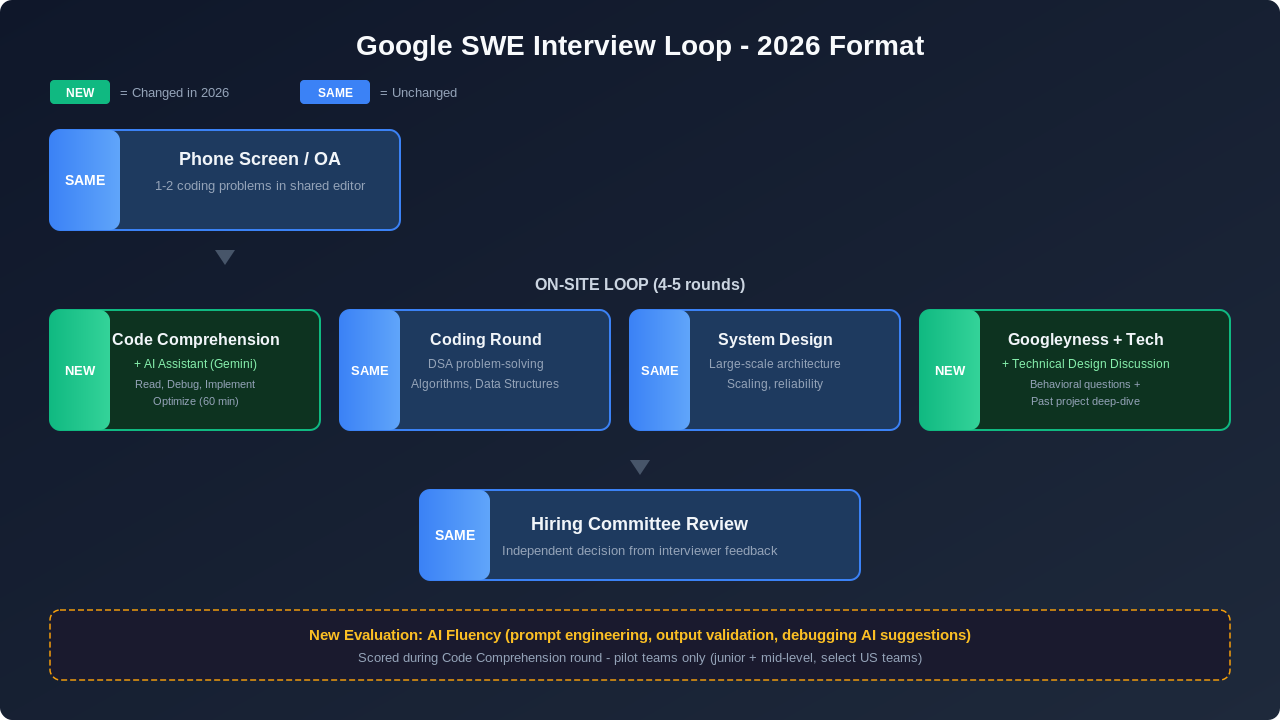
This is the biggest shift. Google added a round where you're handed an existing, multi-file codebase and asked to work through it. You'll read code, find bugs, implement a feature, and optimize performance.
The twist? You get Gemini as an AI coding assistant, right there in the interview environment.
The setup is a CoderPad environment with three panels: a file explorer, a code editor, and an AI chat window. You get 60 minutes and progress through three phases: bug fixing, core implementation, and optimization.
What Google is evaluating here is fundamentally different from a traditional coding interview. They want to see:
- How you navigate unfamiliar code (not code you wrote from scratch)
- How you use AI as a tool (your prompt engineering, whether you blindly accept AI output, how you validate suggestions)
- How you debug (do you read stack traces, add logging, or just ask AI to fix it?)
- How you think about optimization (can you identify the bottleneck, not just make it work?)
This round mirrors what actual software engineering at Google looks like in 2026. Engineers read and modify existing code far more often than they write new code from scratch. And they use AI assistants daily.
2. AI Fluency Is Now Scored
Google interviewers now evaluate what they call "AI fluency" as part of the coding interview. This includes:
- Prompt engineering: Can you write clear, specific prompts that get useful results?
- Output validation: Do you review AI-generated code critically, or do you copy-paste and hope?
- Debugging AI suggestions: When the AI gives you something that's close but not quite right, can you identify and fix the issues?
This isn't a separate interview. It's woven into the code comprehension round. The interviewer watches how you interact with Gemini throughout the session.
I find this interesting because it penalizes two extremes. If you never use the AI assistant, you're leaving a tool on the table and probably won't finish in time. If you over-rely on it without understanding the code it produces, the interviewer will notice when you can't explain your own solution.
3. Googleyness Round Got Technical
The "Googleyness and Leadership" round has been part of Google interviews for years. It used to be almost entirely behavioral questions: tell me about a time you resolved a conflict, how do you handle ambiguity, that sort of thing.
Now it includes a technical design conversation based on your own past work. The interviewer will ask you to walk through a real system you've built or a significant engineering decision you've made. Then they'll dig into the trade-offs.
This change makes the round harder to game. You can't just memorize STAR-format answers to behavioral questions. You need to genuinely understand the technical decisions behind your own projects and be able to defend them under scrutiny.
For earlier-career candidates, Google is replacing one traditional technical interview with a session focused on solving open-ended engineering problems. This shift favors candidates who can think through ambiguous requirements over those who've memorized solutions to specific problem types.
What Stayed the Same
Data Structures and Algorithms Still Matter
The code comprehension round still tests your ability to work with real algorithms and data structures. You'll still need to understand time and space complexity. You'll still need to know when to use a hashmap vs. a tree vs. a graph.
The difference is context. Instead of "implement a function that finds the shortest path," you might be looking at an existing pathfinding implementation, identifying a bug in the edge case handling, and optimizing the time complexity.
If you've been studying dynamic programming patterns or working through template-based problem solving, that knowledge still applies. You just need to apply it to existing code rather than writing it from scratch.
The System Design Round Is Unchanged
Google's system design interview remains the same. You'll design a large-scale system from scratch, discuss trade-offs, and handle follow-up questions about scaling, reliability, and data consistency.
If anything, system design became more important relative to pure coding because Google's overall interview signal is shifting toward "how do you think about engineering problems?" rather than "can you write a sorting algorithm?"
The Phone Screen / Online Assessment
Google still uses an initial screening round (phone or online assessment) before the on-site loop. The format varies but typically involves 1-2 coding problems in a shared editor. This step hasn't seen major changes yet, though expansion of the AI-assisted format to screening rounds is expected.
The Hiring Committee
Google's hiring committee process hasn't changed. Your interviewers submit feedback packets, the committee reviews them, and a decision is made independently of your interviewers. This decoupled structure remains one of Google's distinguishing features.
How to Prepare for Google's 2026 Interview
Given the coding interview changes in 2026, here's what a realistic Google interview preparation plan looks like. Whether you're targeting the traditional or new format, this covers both.
Build Your Code Reading Muscles
Most coding interview prep involves writing code from scratch. That's still necessary, but now you also need to practice reading and understanding unfamiliar code quickly.
Try this: pick an open-source project in a language you know, open a random file, and try to understand what it does within 10 minutes. Trace the call graph. Identify the entry points. Find a bug or suggest an improvement.
# Practice exercise: read this function and identify the bug
def find_duplicates(nums):
    seen = set()
    duplicates = []
    for num in nums:
        if num in seen:
            duplicates.append(num)
        seen.add(num)
    return duplicates

# What happens with [1, 2, 2, 2, 3]?
# It returns [2, 2] — but should it return [2]?
# The fix depends on requirements, and that's the conversation
# the interviewer wants to have.
This kind of ambiguity is exactly what Google's new round tests. There's no single right answer. The interviewer wants to see how you think through the requirements and discuss trade-offs.
Practice Using AI Assistants for Coding
If you're not already using AI coding tools in your daily work, start now. The goal isn't to become dependent on them. It's to develop a workflow where you use AI effectively.
Practice these specific skills:
- Writing prompts that give you useful code suggestions (be specific about input/output, constraints, and edge cases)
- Reviewing AI-generated code for correctness (check edge cases, verify time complexity, test with examples)
- Using AI to explain unfamiliar code (paste a function, ask "what does this do and what's the time complexity?")
- Debugging with AI assistance (describe the bug, show the error, ask for specific suggestions rather than "fix this")
Don't Abandon Traditional DSA Prep
The new format adds to what Google tests. It doesn't replace the fundamentals. You still need strong knowledge of:
- Arrays, strings, hashmaps, and sets
- Trees, graphs, and their traversal algorithms
- Dynamic programming (states and transitions, not just memorization)
- Sorting and searching (binary search especially)
- Recursion and backtracking
Work through problems on platforms like Levelop, LeetCode, or HackerRank. Focus on understanding patterns rather than memorizing solutions. When you solve a problem, explain your approach out loud. That verbal reasoning skill translates directly to the interview. Run mock interviews with a friend or use a platform that simulates the timed pressure of a real Google coding interview. Mock interview practice is especially important for the new code comprehension round because you need to get comfortable navigating unfamiliar code under time pressure.
Prepare Your Technical Story
For the updated Googleyness round, you need 2-3 solid examples of real engineering work you've done. For each one, be ready to discuss:
- What the system does and why you built it that way
- Trade-offs you considered and why you chose your approach
- What you'd do differently with more time or resources
- How the system handles edge cases, failures, and scale
If you're early in your career, project work and internship experience count. The interviewer isn't looking for years of experience. They're looking for depth of thought about the work you've done.
The Rollout Timeline
This is important: these changes are rolling out gradually. The pilot targets junior and mid-level software engineering roles on select US teams. Google plans to expand if the pilot goes well, but the transition is expected to take 12 to 18 months.
That means right now, you might get the traditional format or the new format depending on which team you're interviewing for. Prepare for both. The traditional format tests a subset of what the new format tests, so preparing for the new format covers you either way.
What This Signals About the Industry
Google doesn't change its interview process on a whim. This is one of the most studied hiring pipelines in tech. When Google decides that AI fluency is worth evaluating in interviews, it sends a message to the entire industry.
Within 12 months, expect other major tech companies to introduce similar AI-assisted interview formats. The companies that already use tools like Copilot and Cursor internally will be the first to follow.
Frequently asked questions
Has Google completely changed its coding interview?
No. Google is piloting changes to the coding interview format for junior and mid-level software engineering roles on select US teams. The pilot adds an AI-assisted code comprehension round and modifies the Googleyness round to include technical discussion. System design and the hiring committee process remain unchanged.
Can I use AI tools during Google's coding interview?
In the new pilot format, yes. Google provides access to Gemini as an AI assistant during the code comprehension round. You cannot bring your own tools. The interviewer evaluates how effectively you use the AI assistant, including your prompt engineering and output validation skills.
Do I still need to study data structures and algorithms for Google?
Absolutely. The new format still tests algorithmic thinking and understanding of data structures. The difference is that you'll apply this knowledge to existing codebases rather than writing solutions entirely from scratch. Strong DSA fundamentals remain essential.
When will Google's new interview format be fully rolled out?
Google's pilot targets select US teams for junior and mid-level roles. The full transition is expected to take 12 to 18 months. During this period, you may encounter either the traditional or the new format depending on the team.
What is the code comprehension round at Google?
It's a 60-minute session where you work with a multi-file codebase in a CoderPad environment. You progress through bug fixing, core implementation, and optimization phases. You have access to Gemini as an AI assistant. Google evaluates your code reading ability, debugging skills, and AI fluency.