
Sliding Window vs Two Pointers: Picking the Right Pattern
Back with another one in the series where I break down the patterns that took me too long to tell apart. This one is about sliding window vs two pointers, two techniques that look almost identical on paper and yet solve different shapes of problems. For a long time I used them the same way and could not explain why half my solutions broke.
If you have ever stared at a problem, thought "this is clearly a pointer problem," and then could not decide which one, this is for you. Both patterns move indices through an array without nested loops, and that surface similarity hides a difference that actually matters.
The gap that kept tripping me up
Both patterns keep two indices and walk them across a sequence. Both turn an O(n^2) brute force into O(n). So when a solution guide said "use two pointers here," I would nod, then the next problem said "sliding window" for what looked like the same setup, and I had no idea what changed.
Here is what nobody told me plainly. Sliding window is not a separate tool from two pointers. It is a specific kind of two pointer movement where both pointers go the same direction. The region between them, the window, is what you care about.
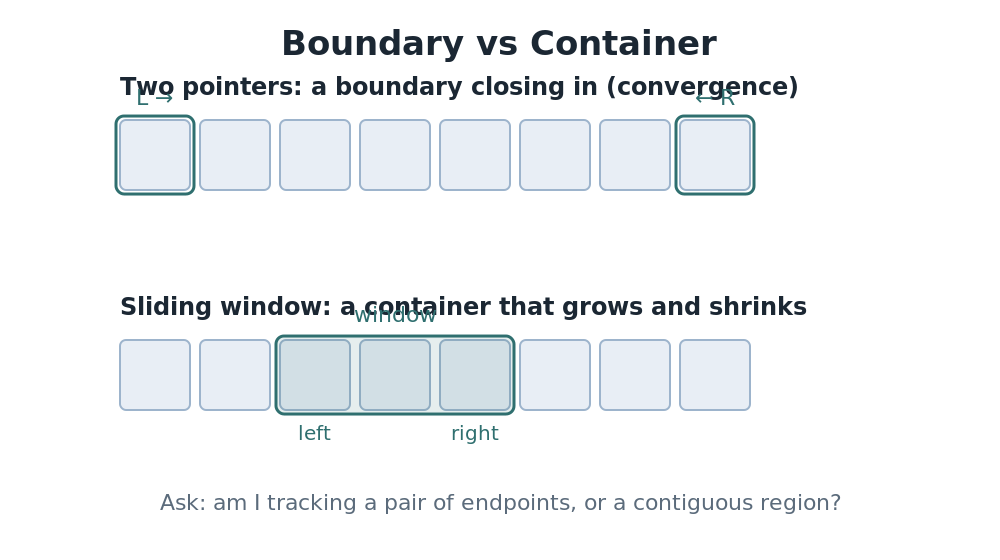
Classic two pointers on a sorted array is different. The pointers move toward each other from opposite ends, and you care about the pair at the ends, not the region between. Once I saw that, the question stopped being "which pattern" and became "am I tracking a contiguous region or a pair of endpoints."
Two pointers: caring about the endpoints
The two pointer technique, in its most common form, works on a sorted array. One pointer starts at the left, one at the right, and you move them based on a comparison. I wrote the full breakdown in the two pointer pattern deep dive, so here is the short version with two sum on a sorted array.
def two_sum_sorted(nums, target):
    left, right = 0, len(nums) - 1
    while left < right:
        s = nums[left] + nums[right]
        if s == target: return [left, right]
        if s < target: left += 1   # need bigger, move up from small end
        else: right -= 1           # need smaller, move down from big end
    return []
It works because the array is sorted. When the sum is too small, moving left right is the only way to increase it. When it is too big, you move right left. Every move eliminates a whole set of pairs.
You care about the two values at the boundary, and the stuff between is invisible. The same convergence shows up in reversing an array, checking a palindrome, container with most water, and three sum.
There is a second flavor where both pointers move forward, like the fast and slow trick for detecting a cycle in a linked list. Two pointers is a family, not a single move. But for this comparison, the opposite ends version is the useful contrast.
Sliding window: caring about the region
A sliding window also uses two indices, but both start at the left and move right. The gap between them is a contiguous chunk, and that chunk is what you measure. You expand by moving the right pointer and shrink by moving the left pointer, both in response to a condition about the window's contents.
The classic hard version is the variable size window, like the longest substring without repeating characters.
def longest_unique(s):
    seen, left, best = {}, 0, 0
    for right in range(len(s)):
        if s[right] in seen and seen[s[right]] >= left:
            left = seen[s[right]] + 1   # shrink past the repeat
        seen[s[right]] = right
        best = max(best, right - left + 1)
    return best
The right pointer advances every iteration. The left pointer jumps forward only when the new character was already in the window. The region between them is always valid, and you track its size. You care about the region, not the endpoints. I go deeper on expanding and contracting in the sliding window pattern post.
The one question that tells them apart
I boiled the sliding window vs two pointers decision, sometimes searched as two pointers vs sliding window, down to one question I ask before writing any code: am I tracking a contiguous region, or a pair of positions?
If the answer depends on a run of consecutive elements, a subarray or substring, and you are measuring its sum, length, or distinct count, that is a sliding window. If it depends on two elements that need not be adjacent, especially on a sorted array where comparing the endpoints tells you which way to move, that is opposite ends two pointers.
Here is the quick lookup I keep in my head, matching a signal in the problem to the pattern to reach for:
- "contiguous subarray" or "substring" points to a sliding window.
- "sorted array" plus "find a pair" points to two pointers (opposite ends).
- Longest or shortest window meeting a condition is a variable size sliding window.
- Sum or average of every window of size k is a fixed size sliding window.
- Reverse, palindrome, or partition in place is two pointers (opposite ends).
The word "contiguous" is the loudest signal. If dropping the requirement that elements be adjacent still leaves a valid answer, you are probably not in sliding window territory.
The mistake I made for way too long
My specific bug was using a sliding window on a problem that was not about a contiguous region. I had a sorted array and needed to count pairs with a difference under some value. I set left and right both at the start and tried to slide a window tracking pairs. It worked on small inputs and gave wrong counts on bigger ones.
A window implies the answer is one contiguous block, but counting pairs is about pairs, not a block. The right move was opposite ends. The reverse mistake happens too: sorting an array to use opposite ends pointers on a "longest contiguous subarray" problem throws away the order that made the subarray meaningful.
A cleaner mental model
Think of two pointers as defining a boundary and sliding window as defining a container. With opposite ends two pointers, the indices are a boundary closing in on an answer, and convergence is the vibe. With a sliding window, the indices are the walls of a container holding a valid region, and expansion and contraction is the vibe. Same raw material, two indices and a while loop, shaped toward different goals. That is why sliding window vs two pointers feels confusing at first. They are cousins, but boundary versus container is a difference you can feel once you name it.
What to practice next
Start with valid palindrome and reverse string, pure opposite ends with no tricky conditions. Then maximum average subarray, a fixed size window that teaches the slide in, slide out bookkeeping. Next, longest substring without repeating characters, the canonical variable window. Then minimum size subarray sum, which combines growing and shrinking in one loop. Finish with two sum two, three sum, and container with most water, all opposite ends on sorted data. Do a few of each and watch your first decision on each problem. If you can say "region, so window" or "pair, so two pointers" before writing a line, you have got it.
Frequently asked questions
What is the main difference between sliding window and two pointers?
Sliding window tracks a contiguous region between two pointers moving the same direction, and you measure something about that region like its sum or length. Opposite ends two pointers tracks a pair of positions, usually on a sorted array, moving toward each other, and you care about the boundary elements, not the ones between. Sliding window is really a specialized form of two pointer movement.
Is sliding window a type of two pointers?
Yes. A sliding window uses two pointers, a left and a right, that both advance forward, with the region between them being what matters. So every sliding window is a two pointer technique, but not every two pointer technique is a sliding window.
When should I use two pointers instead of a sliding window?
Use opposite ends two pointers when the input is sorted and you want a pair or a set of endpoints, such as two sum on a sorted array, container with most water, or checking a palindrome. Use it whenever the answer is defined by two boundary positions rather than a contiguous run.
How do I know if a problem is a sliding window problem?
Look for the words contiguous, subarray, or substring, plus a metric you are optimizing like longest, shortest, or maximum sum. If the answer must be a run of consecutive elements and you grow or shrink that run against a condition, it is a sliding window.
Does sliding window require a sorted array?
No. Sliding window relies on the original order of elements because it is about contiguous regions, so sorting usually breaks it. This is the opposite of the classic two pointer pattern, which depends on the array being sorted so a pointer move changes the comparison predictably.
I have been working through the two pointer and sliding window track on Levelop, and this pair of patterns was the one that finally forced me to slow down and name the difference instead of guessing.