

The 10x Engineer Myth Is Finally Real, Thanks to AI
Back with another one in the series where I break down ideas that changed how I build software. For most of my career the "10x engineer" was something I rolled my eyes at. Then the tooling changed, and for the first time the multiplier feels reachable, not for a genius, but for a normal engineer willing to change how they work.
Where the 10x myth came from
People use 10x developer, 10x software engineer, and 10x programmer to mean the same thing, so if you have ever wondered what is a 10x engineer, the short version is someone supposedly worth ten ordinary ones. The number traces back to a 1968 study by Sackman, Erikson, and Grant that found huge variation between programmers, in some measurements more than 20 to 1. The study had real problems, small sample and mixed experience, but the headline stuck. For fifty years "10x engineer" meant someone innately far more productive than their peers.
The trouble is that framing put all the variance inside the person. The best engineers I worked with were not ten times faster at typing. They were better at avoiding work that did not need doing, asking the right question early, and not getting stuck. The multiplier came from judgment, and judgment is exactly the part AI does not replace. It is the part AI amplifies.
What actually changed
Three concrete things shifted for me. The cost of a first draft went to near zero: boilerplate, a test harness, a regex I would have fought for twenty minutes, all of it now takes one prompt and a review. The cost of context-switching dropped: an unfamiliar API no longer costs me an afternoon of rebuilding muscle memory. And the cost of exploring alternatives dropped, so I can sketch two or three approaches and compare them before I commit. That last one is not about speed. It is about making better decisions, which is where the real leverage always lived.
The multiplier is real, but conditional
The gain is real, but it is not automatic. GitHub's study on Copilot found developers completed one well-scoped task about 55 percent faster. McKinsey's 2023 research found time savings ranging from roughly 25 to 50 percent on some tasks and close to zero on others, sometimes negative when reviewing bad output cost more than it saved. The 2024 DORA report added that teams leaning on AI without discipline saw a dip in delivery stability.
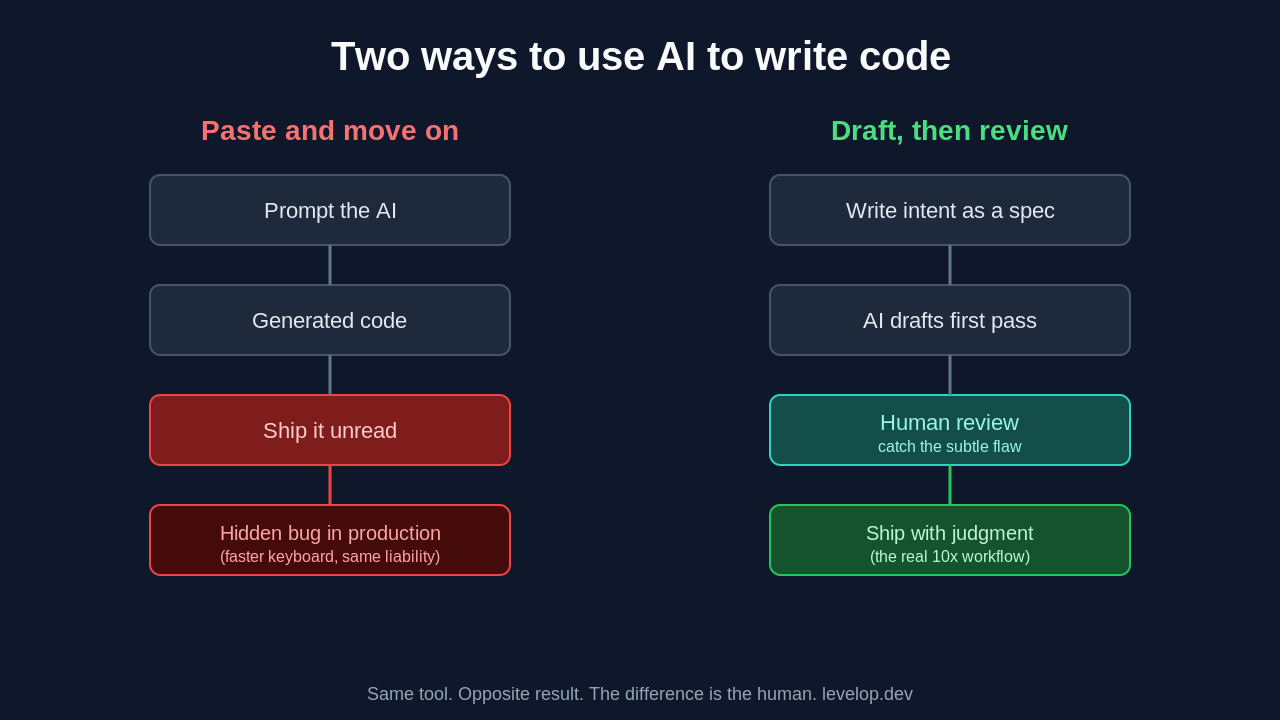
So the picture is not "AI makes everyone 10x." It gives a big multiplier on the parts of the job it suits and a negative one on the parts it does not, and telling the difference is the new core skill. A junior who pastes a generated auth flow without understanding it becomes a liability with a faster keyboard. A senior who drafts the same flow, spots the missing token rotation, and fixes it in two minutes has genuinely multiplied their output. Same tool, opposite result. The difference is the human.
What the workflow looks like
I write the intent down clearly before I touch code, almost like a spec, because a vague prompt gets a vague answer. Then I generate a first pass and switch straight into review mode. I am no longer primarily an author. I am an editor who occasionally writes from scratch. I asked for a rate limiter once and got this:
class RateLimiter:
    def __init__(self, max_calls, period):
        self.max_calls = max_calls
        self.period = period
        self.calls = []

    def allow(self):
        now = time.time()
        self.calls = [t for t in self.calls if now - t < self.period]
        if len(self.calls) < self.max_calls:
            self.calls.append(now)
            return True
        return False
It runs and looks reasonable. But it is not thread safe, so under concurrency two requests can both pass. The list is rebuilt on every call, which is quietly quadratic under load. And there is no shared state, so it breaks the moment you run more than one instance. None of that shows if you paste and move on. All of it is obvious in ten seconds if you know what to look for. The AI wrote the draft. The engineering was in the read.
Floor and ceiling at the same time
For a junior, AI raises the floor. A week of flailing now runs by the end of the day. The risk is skipping the understanding that turns a junior into a senior. If you outsource the struggle, you outsource the growth. For a senior, AI raises the ceiling, because removing grunt work lets you spend more of the day on the judgment you are actually good at. This is where the real 10x lives now, not in a rare individual but in a workflow, and a workflow is available to anyone willing to build the judgment to run it.
The skills that matter now
If the mechanical part of coding is getting cheaper, invest in what stays human. Reading code critically is now a primary skill, since you will read far more generated code than you write. System design thinking matters more, because AI is good at the function but bad at knowing whether that function should exist. The soft skills carry more weight too: clear written communication is now technical, since prompting is just writing a precise spec, and the engineers who describe what they want clearly get better output. The durable edge is using AI to solve problems faster while still being the person who can work through challenging problems it gets wrong. I wrote more about that reasoning on Levelop, where the practice forces you to reason about tradeoffs rather than memorize answers.
So is the 10x engineer real now?
The 10x engineer as a rare, innate genius was mostly a myth, a misread of a flawed 1968 study. But a 10x workflow, where an experienced engineer removes the mechanical drag and spends nearly all day on decisions that matter, is real and reachable. The multiplier moved out of the person and into the practice, which is good news, because a practice is something you can learn. A birthright is not. For more on how the role is shifting, the Levelop blog has other posts worth reading.
Frequently asked questions
What is a 10x engineer?
Traditionally, someone supposedly ten times more productive than an average developer. In practice the gap came from judgment, not raw speed. With AI tooling, that multiplier is now better understood as a property of a workflow than of a rare individual.
Does AI actually make developers 10x more productive?
Not across the board. GitHub's Copilot research shows large gains, around 55 percent faster, on specific well-scoped tasks, but McKinsey and DORA show gains vary enormously by task and can go negative on complex or unfamiliar work. The multiplier shows up when an experienced engineer applies AI to the right parts of the job.
Will AI replace software engineers?
It is replacing mechanical parts of the job, not the engineers. Deciding what to build, how it fits the system, and whether the output is correct is exactly what AI is worst at. The role is shifting from author toward editor and architect, and demand for that judgment is rising.
Is AI more helpful for junior or senior engineers?
Both, differently. It raises the floor for juniors by getting them to working code faster, and raises the ceiling for seniors by removing grunt work. The danger for juniors is using AI to avoid learning rather than to accelerate it.
What skills should I develop to stay valuable?
Reading code critically, system-level design thinking, clear written communication and other soft skills, and the judgment to know when a problem deserves your full attention instead of a generated guess.
- Sackman, H., Erikson, W. J., and Grant, E. E. (1968). "Exploratory experimental studies comparing online and offline programming performance."
- GitHub (2022). "Quantifying GitHub Copilot's impact on developer productivity and happiness."
- McKinsey and Company (2023). "Unleashing developer productivity with generative AI."
- DORA / Google Cloud (2024). "Accelerate State of DevOps Report."
- Stack Overflow (2024). "Developer Survey," on AI tool adoption among professional developers.