
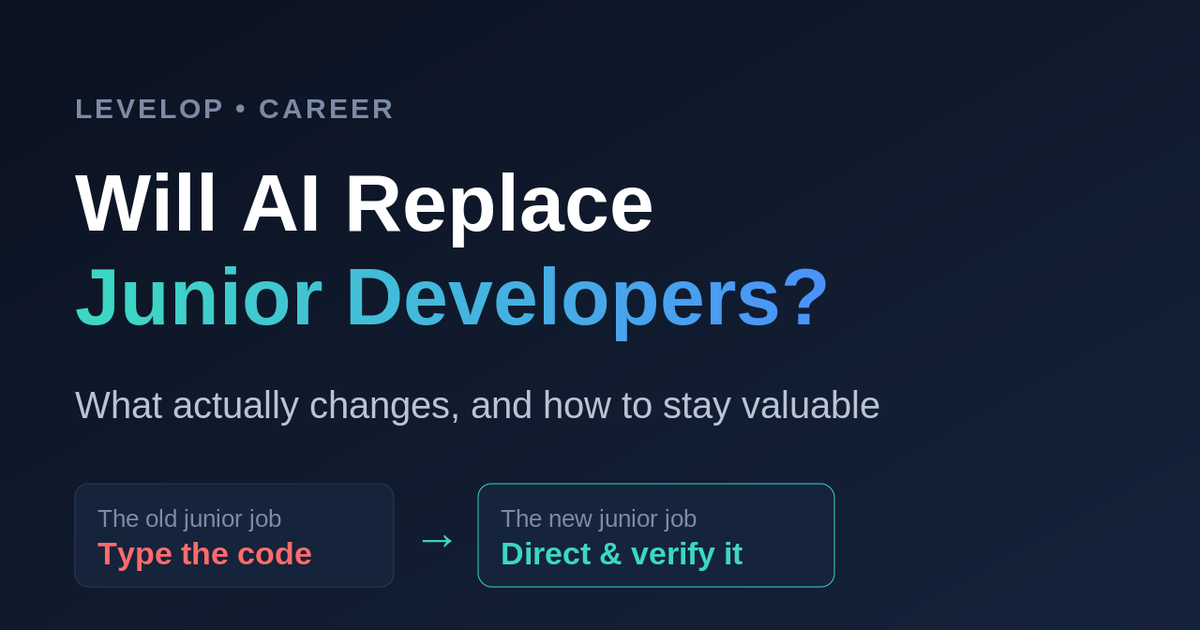
Will AI Replace Junior Developers? What Actually Changes
Every few months a new headline declares that AI has made junior developers obsolete. A model writes a working CRUD app from a one-line prompt, someone screenshots it, and the takeaway spreads: why hire a junior when a senior plus an AI assistant can do the same work? If you are early in your career, or trying to break in, that message lands hard.
The honest answer is more useful than the headline. AI is not replacing junior developers as a category. It is changing what the junior job consists of, which parts of it disappear, and which parts suddenly matter more. The developers who understand that shift will be fine. The ones who assume the old path still works, or who give up because the headline scared them, are the ones who struggle.
This post walks through what is actually happening to entry-level engineering work, what the data says versus what the panic says, and a concrete plan for making yourself hard to replace in an AI-native team.
The claim, stated fairly
Before arguing with the doom take, it helps to state the strongest version of it. The argument goes like this. A large share of junior work is well-specified, low-context implementation: build this form, write this test, fix this off-by-one, wire this endpoint to that component. Large language models are genuinely good at exactly that kind of bounded task. So if a senior engineer can delegate those tasks to a model and review the output in minutes, the economic case for hiring a person to do them weakens. Teams stay smaller, budgets that used to fund two juniors now fund one senior plus a subscription, and the bottom rung of the ladder gets narrower.
That is not a strawman. It is a real pressure, and pretending otherwise does no one any favors. The question is whether the conclusion, junior developers are being replaced, follows from the premise. It does not, and the reason is instructive.
What the data actually shows
Overall employment projections for software developers remain strongly positive. The U.S. Bureau of Labor Statistics projects employment of software developers to grow much faster than the average for all occupations through the early 2030s, driven by demand across sectors that all now run on software. A field that is contracting does not carry that outlook.
Developer surveys tell a nuanced story too. In the Stack Overflow Developer Survey, a large majority of professional developers already use or plan to use AI tools in their workflow, yet trust in the correctness of AI output is far lower than adoption. Developers reach for these tools constantly and still do not fully trust them, which is exactly the environment where human judgment stays valuable rather than becoming redundant.
Where there is real turbulence, it tends to be macroeconomic rather than technological: hiring slowed across tech after the 2021 to 2022 boom, interest rates rose, and entry-level roles are always the first to feel a cautious hiring market. If you scroll through postings for entry level software engineer jobs today, there are fewer than in 2021, but the count of software engineer jobs overall is still large and growing. It is easy to blame AI for a cooldown that has several causes. Conflating the two leads to the wrong personal strategy.
What the junior job used to be, and what it is becoming
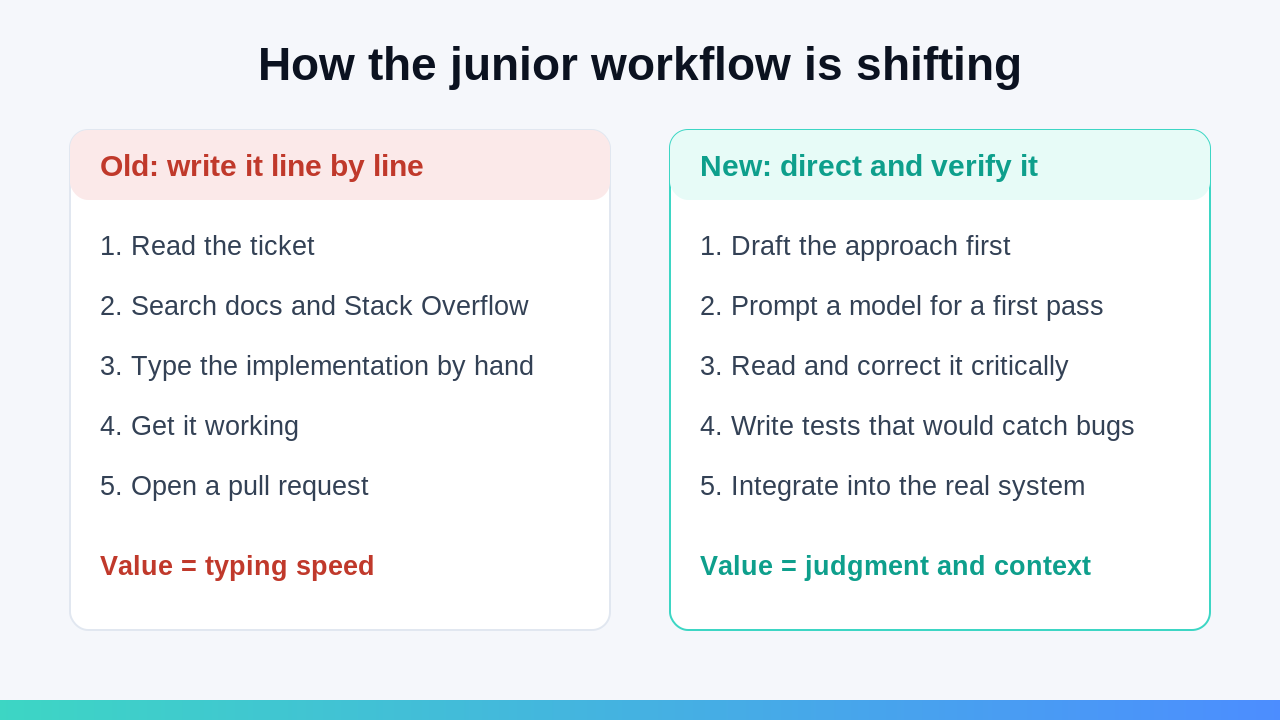
The clearest way to see the change is to compare the old default junior workflow with the emerging one.
The old workflow was: receive a ticket, search the codebase and Stack Overflow, write the implementation line by line, get it working, open a pull request, and absorb feedback in review. Most of the learning happened in the friction of writing code by hand and getting it wrong.
The new workflow is: receive a ticket, draft an approach, prompt a model for a first pass, then spend your effort reading, correcting, testing, and integrating that pass into a real system with real constraints. The typing is faster. The thinking is not optional. If anything the thinking starts earlier, because a plausible-looking wrong answer from a model is more dangerous than a blank editor.
Consider a small but telling example. A model will happily generate this:
# AI-generated first pass: looks fine, ships a bug
def apply_discount(price, percent):
    return price - price * percent / 100

# caller
final = apply_discount(cart_total, user.discount)
It runs. It passes a naive happy-path test. But `user.discount` might be `None` for users without a promo, `percent` might arrive as a string from a form, and negative or above-100 values are never rejected. A junior who only checks that the code runs ships the bug. A junior who reads critically catches all three cases:
def apply_discount(price, percent):
    if percent is None:
        return price
    percent = float(percent)
    if not 0 <= percent <= 100:
        raise ValueError(f"discount out of range: {percent}")
    return round(price - price * percent / 100, 2)
The second version is not more impressive code. It is more responsible code, and responsibility is precisely the skill AI does not supply for you. The tool wrote the first draft in a second. The value you add is everything after that.
The skills that gain leverage
If implementation speed is being commoditized, the way to stay valuable is to invest where AI is weak and human context is decisive. The junior developer skills that matter now are not the ones a bootcamp syllabus front-loaded in 2021. A senior developer already spends most of the day reviewing, deciding, and integrating rather than typing, and the AI-native shift pulls the junior software engineer role in that same direction years earlier than it used to.
Reading code becomes more important than writing it. In an AI-native workflow you review far more code than you author, including code you did not write and do not fully understand yet. The ability to read a diff and spot what is subtly wrong is now a core daily skill, not a senior luxury.
Debugging and verification move to the center. When the first draft comes from a model, your job is to prove it correct or find where it breaks. That means writing tests that matter, reproducing issues, reading stack traces, and reasoning about edge cases the model glossed over.
System context and integration are hard to automate. A model can write a function. It cannot know that your payments service rate-limits at 30 requests per second, that this table is already under write pressure, or that the team agreed last sprint to stop adding new dependencies. Understanding the system you are changing is where juniors become genuinely useful, and it is learnable only by paying attention.
Fundamentals still gate everything. You cannot verify what you do not understand. Data structures, complexity, how databases and networks behave under load: these are what let you tell a good AI answer from a confident wrong one. We have argued before that a strong grasp of core patterns is what separates engineers who use AI well from those it misleads, and that has not changed.
A 90-day plan to be hard to replace
Concrete beats abstract, so here is a plan you can start this week. It assumes you are either a junior in your first role or trying to land one.
Days 1 to 30, build verification habits. For every task, write your intended approach in two or three sentences before you prompt anything. Then use the model, but review its output line by line and write at least one test that would fail if the code were wrong. The goal is to stop treating AI output as an answer and start treating it as a draft.
Days 31 to 60, build system context. Pick the part of your codebase, or an open-source project if you are still job hunting, and learn one subsystem deeply: how a request flows through it, where the data lives, what breaks it. Being the person who understands one area well is worth more than surface familiarity with all of it.
Days 61 to 90, build a portfolio of judgment, not just output. Ship two or three small projects where the interesting part is a decision you made and can defend: why this database, why this trade-off, why you rejected the obvious approach. In interviews and reviews, that reasoning is what signals you are not merely a prompt relay.
Throughout, keep sharpening fundamentals in short daily reps. Twenty focused minutes on a pattern beats a weekend cram you forget. This is the same reason structured, interactive practice beats passive tutorials when the skills you need cannot be faked in front of an interviewer.
What this means if you are still trying to break in
Breaking in is harder than it was in 2021, and it is fair to feel that. Job posts that once asked for zero years of experience now quietly expect a portfolio that proves judgment. But the response that works is not to out-type the machines. It is to demonstrate the judgment they lack. A portfolio full of generated CRUD apps looks like everyone else's. A portfolio with one project where you clearly reasoned through a hard trade-off, tested it, and can explain your choices stands out precisely because AI cannot fake that in an interview.
The broader career math still favors software, and pairing that with a clear-eyed view of the market beats both blind optimism and despair. If you want the numbers behind the outlook, our career outlook analysis with BLS data lays out the salary and demand trends, and our guide to job search strategies that get callbacks covers the application side.
The bottom line
Will AI replace junior developers? No, but it will retire the version of the junior job that was mostly typing. The role is shifting from producing code to directing, verifying, and integrating it, and that shift rewards judgment, fundamentals, and system understanding over raw speed. Those are learnable, and they are exactly what makes an engineer valuable at any level. The panic headline gets the trend right and the conclusion wrong. The junior developer is not going away. The passive one is.
For more on how this fits the bigger picture, see our take on whether software engineers will be replaced by AI and why the 10x engineer myth is finally real thanks to AI. And if you want to practice the judgment skills this post argues for, that is exactly what we build at Levelop.
Frequently asked questions
Will AI replace junior developers entirely?
No. AI is automating the routine implementation part of junior work, not the whole role. Employment projections for software developers remain strongly positive, and teams still need people who can verify, debug, and integrate AI output into real systems. What is disappearing is the version of the job that was mostly mechanical typing, not the job itself.
Is it still worth becoming a software engineer in 2026?
Yes, for most people who enjoy the work. The field is projected to keep growing well above average, and demand spans nearly every industry. The catch is that the entry bar has moved toward judgment and fundamentals rather than the ability to produce boilerplate, so how you prepare matters more than it used to.
What skills should junior developers focus on now?
Code reading and review, debugging and verification, understanding the system you are changing, and solid computer science fundamentals. These are the skills AI does not supply for you and cannot reliably do on its own. Prioritize them over memorizing syntax or chasing every new framework.
Should I still learn to code by hand if AI can write it?
Yes. You cannot verify or correct what you do not understand, and AI produces confident wrong answers often enough that blind trust is dangerous. Writing code by hand early builds the mental models that let you catch a model's mistakes later. Use AI as a drafting tool, not a substitute for understanding.
How do I stand out as a junior in an AI-heavy job market?
Show judgment, not just output. Build a small number of projects where the interesting part is a defensible decision you made, test them, and be ready to explain your trade-offs. Anyone can generate a working app now, so the differentiator is reasoning you can articulate in a review or interview.