

Should I Accept a Counter Offer? When to Stay or Run
You handed in your resignation. Then your manager pulled you aside, looked surprised, and asked what it would take to keep you. Twenty minutes later there is more money on the table than you asked for, and a decision that felt settled this morning is wide open again.
So, should I accept a counter offer? Sometimes, but far less often than the number makes it feel. A counter offer solves your employer's problem, which is losing you. It rarely solves your problem, which is whatever made you start interviewing. This guide covers when to stay, when to run, and how to tell the difference before you reply.
What a Counter Offer Actually Is
A counter offer is a retention move. When you resign, your manager faces a real cost: reopening the role, weeks of interviewing, onboarding a replacement, and lost output the whole time. Backfilling a mid-level engineer takes months, and the knowledge in your head walks out on day one. Against that cost, a raise or a higher salary looks cheap.
That tells you what the money is for. The counter offer is priced against your employer's pain, not your worth. If they find fifteen or twenty percent overnight, the natural question is why that was not already your salary. Sometimes there is a clean answer, like a frozen budget that just thawed. Often it is quieter: it took a resignation letter to get you paid fairly. None of this makes accepting wrong. It makes it a decision to weigh with clear eyes.
Why You Started Looking Is the Only Question That Matters
Separate two things people blur together: the offer, and the reason you went looking. A counter offer speaks only to the offer. It says almost nothing about the reason.
Write down what pushed you to update your resume. Be specific, because "I want more money" is usually a stand-in for something underneath. Common reasons include a manager you have stopped trusting, work that no longer teaches you anything, a roadmap you do not believe in, no path to the next level, or a team that burned you out. If you cannot name it, do not answer yet; our guide on job search strategies covers what to line up before you leave.
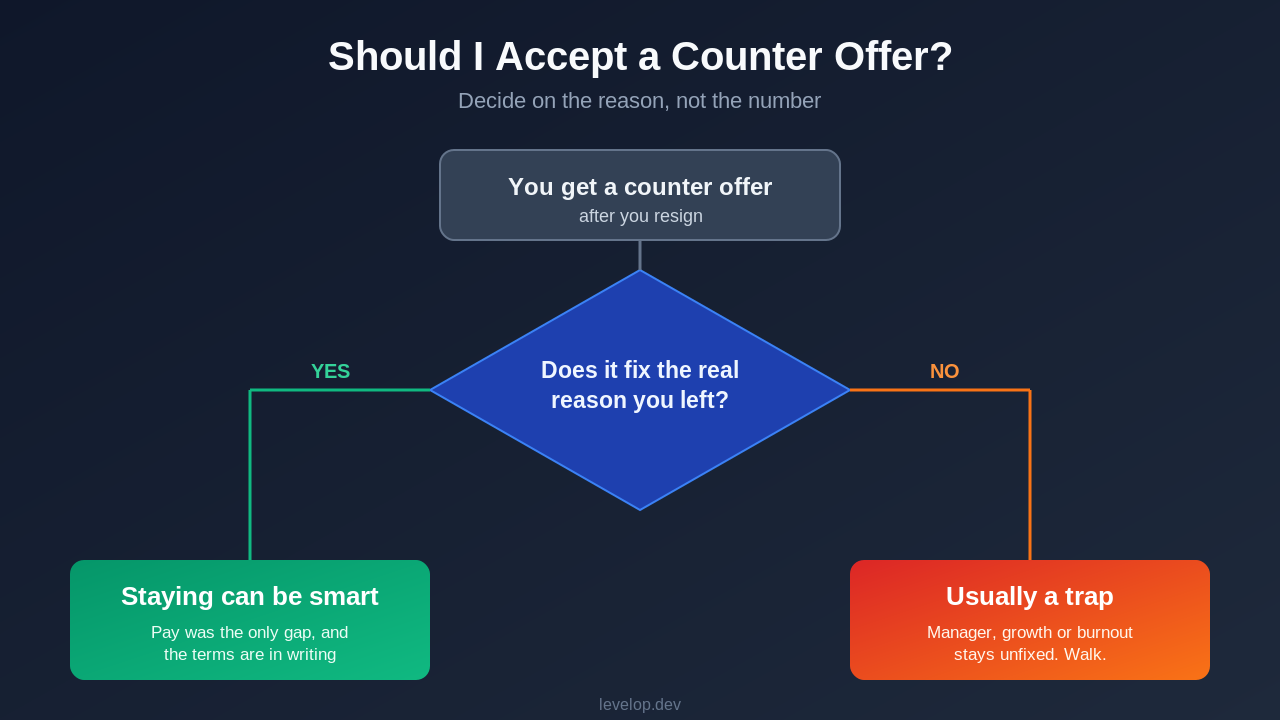
Now hold that reason next to the offer and ask: does the money touch it? If you left only because you were underpaid, a counter offer can be a legitimate fix. If you left because of your manager, the mission, growth, or burnout, a raise changes your bank balance and leaves every real problem in place. Three months later you are doing the same work, for the same people, for a slightly nicer number.
When Accepting a Counter Offer Makes Sense
Accepting is not automatically a mistake. The clearest case is when pay was the only real problem and the offer fully closes the gap. If the work still engages you, you respect your manager, and you can see your next promotion, then a counter that fixes the pay fixes the issue. Staying also avoids the risk inside every new job: the manager who interviews well and manages badly, or the "we move fast" culture that means no tests.
A counter is also reasonable when it comes with structural change, not just cash: a concrete promotion with new scope, a move to a project you wanted, a shift off a draining team, all in writing with a date. Structure alters your day to day. A number alone cannot.
Even in the good cases, slow down. The rush of being wanted is a poor input. Take the night before you make a final decision, and make sure you are choosing to stay, not just enjoying being chased.
When a Counter Offer Is a Trap
A large share of counter offers are traps, not because employers are villains, but because the incentives point against you the moment you accept.
Your resignation just revealed that you are willing to leave. In many organizations that recategorizes you from "committed" to "flight risk," and that label follows you into who gets the marquee project, who is considered for promotion, and who survives budget cuts. Some recruiting-industry surveys report that most senior executives and HR leaders say their trust in an employee drops after a counter offer is accepted. Those numbers come from firms with an interest in the answer, so treat the figures with caution, but Harvard Business Review's discussion of counteroffers lands on a balanced view: attitudes have shifted and accepting is sometimes fine, but the reputational risk has not vanished.
Then there is the statistic quoted everywhere: a large fraction of people who accept a counter offer leave within a year anyway. The exact percentage should be read skeptically, but the mechanism is simple. The counter offer buys your employer time to reduce their dependence on you, and does nothing about why you were unhappy. Both push you back toward the door a few months later.
A Framework for Deciding
When emotion is running high, a structured pass beats gut feel. Run the counter offer through this checklist before you answer.
# Counter-offer decision framework
reason_i_left:              # one specific root cause, not "more money"
counter_fixes_that_reason: true | false   # the whole test lives here
compensation:
  gap_fully_closed: true | false
structure:
  written_promotion_or_scope_change: true | false
  verbal_only_promises: true | false       # treat as false if true
trust:
  will_i_be_seen_as_a_flight_risk: true | false
decision:
  # Accept only if counter_fixes_that_reason is true
  # AND the promises are written, not verbal.
Two questions carry the weight. Does the offer fix the actual reason you left? Is every meaningful promise in writing? If either answer is no, staying is usually the weaker choice. For judging any offer on its full merits, our 7-day framework for evaluating a job offer and our breakdown of total compensation beyond base salary are worth a read.
Handling the Conversation Without Burning Bridges
Whatever you decide, protect your reputation. The tech world is small, and today's manager is tomorrow's reference. If you accept, do it graciously and get the terms documented in an email. Then keep your eyes open, because staying does not oblige you to stop watching whether the promises land.
If you decline, decline cleanly. Thank your manager, restate that your decision is about direction rather than dollars, and give a professional notice period. Do not use the counter offer to start a bidding war unless you are willing to walk from both. Negotiating your incoming offer on its own merits is fair game, and our salary negotiation script shows how without theatrics. For the mechanics of a counter offer as a negotiation move, the Program on Negotiation at Harvard Law School has a clear primer. Whether you are staying or accepting a job offer elsewhere, leave people thinking you were thoughtful and easy to work with.
Frequently Asked Questions
Should I accept a counter offer from my current employer?
Only if the counter offer fixes the real reason you started looking, and only if the important promises are in writing. If you left mainly because you were underpaid and everything else was fine, accepting can be reasonable. If you left because of your manager, growth, the mission, or burnout, a raise leaves those problems untouched and staying is the weaker call.
Should I accept a counter offer from my employer if I have another offer?
Compare the two on direction, not just pay. A counter offer job that keeps you where you already were unhappy rarely beats a move that fixes the underlying reason you left. If the outside role solves that reason and the pay is fair, the counter is usually just a more comfortable version of the problem.
Is it true that most people who accept a counter offer leave within a year?
That claim gets repeated constantly, and the exact percentage should be read skeptically because it often comes from recruiting firms. The mechanism is real, though: a counter offer buys your employer time and does nothing about why you were unhappy, so many people who accept are back in the market within months.
Will accepting a counter offer hurt my reputation at work?
It can. Once you have signaled you were ready to leave, some managers quietly treat you as a flight risk, which can affect promotions and high-visibility work. Harvard Business Review notes attitudes have softened, but the reputational risk has not disappeared. Weigh how much trust you have with your specific manager.
What should I do if my employer only makes verbal promises?
Treat verbal promises as if they do not exist. Ask for the new title, salary band, and any role changes in an email or an updated offer letter. Managers change, reorgs happen, and memories fade. If a company will not put a retention promise in writing, that reluctance tells you how much the promise is worth.
The Bottom Line
A counter offer is flattering, and flattery is a bad basis for a career decision. Strip away the rush of being wanted and one question remains: does this offer fix the reason you were leaving? When the answer is a clear yes and the terms are in writing, staying can be the smart, low-risk move. When it is no, the raise is just a more comfortable version of the situation you were trying to escape. Decide on the reason, not the number. For more on offers and negotiation, browse the Levelop blog or start at levelop.dev.