

The Mid-Level Plateau: Why Year 3-5 Engineers Feel Stuck
Back with another one in the series where I write about the parts of an engineering career that nobody hands you a rubric for. This one is personal. Somewhere around year three, I stopped feeling like I was getting better. I was shipping more than ever, my tickets closed on time, and my code review comments were sharp. And yet promotion conversations kept ending with some version of "you are doing great, keep it up." That gap, between doing great and moving up, is the mid-level plateau. If you are a mid level software engineer who feels stuck in your career, this is the post I wish someone had sent me.
What a mid level software engineer actually is
Before we talk about breaking out, it helps to be precise about where you are. A mid level software engineer is the engineer who has cleared the "can they code" bar and now owns features end to end without hand-holding. You get a ticket, you build it, you test it, you ship it. Nobody reviews your basic decisions anymore. In most ladders this is the L4, SDE II, or "Engineer II" band, sitting one rung above entry level and one rung below senior. Scan a handful of mid level software engineer jobs and the job description is nearly identical everywhere: the job duties center on owning well-defined features, not defining them. No computer science degree or bootcamp really prepares you for the shift that comes next.
Here is the trap hiding in that description. The thing that got you from junior to mid, raw execution speed on well-defined problems, is the exact thing that stops working. You got promoted for being a reliable ticket-closing machine. Now you are competing for the next level, and the next level is not measured in tickets. When people ask what is a mid level software engineer versus a senior one, the honest answer is that mid-level is defined by output and senior is defined by impact. Those are different axes. You can max out the first one and not move a millimeter on the second.
I did not understand this for a long time. I thought promotion was a volume problem. Close more tickets, close them faster, pick up the gnarly ones nobody wanted. So I did, and my throughput went up, and my level did not.
Why the plateau happens
The mid-level plateau is not a motivation problem or a talent problem. It is a structural one. Three forces stack up at exactly the same time.
The first is that the work stops teaching you. In your first two years, almost every ticket contained something new: a framework you had not touched, an API you had not called, a bug class you had not seen. By year three the marginal ticket teaches you almost nothing. You are pattern-matching against things you already solved. Comfort feels like competence, but it is actually the sound of your learning curve going flat.
The second is that the scope of your work is handed to you, and handed-to-you work has a ceiling. Someone else broke the epic into tickets. Someone else decided the approach. Someone else noticed the problem was worth solving. You are executing inside a frame that a more senior person drew. As long as that is true, the most senior thing on your resume is "executed well," and executed well is a mid-level sentence.
The third force is the quietest and the most dangerous. Nobody tells you the rules changed. Your manager keeps giving you positive feedback because your work is genuinely good. The feedback loop that pushed you upward for two years, ship, get praised, ship again, is still running, but it has quietly stopped correlating with advancement. You can spend a very long time optimizing hard for a signal that no longer points at the destination.
The metric that actually moves you: scope
If output is the mid-level currency, scope is the senior one. Scope is the size and ambiguity of the problem you can be handed, or better yet the problem you go find, and be trusted to resolve without someone drawing the frame for you.
Will Larson, who writes about engineering careers at lethain.com and built StaffEng, makes this point sharply: at senior levels your job is less about the code you personally write and more about the ambiguity you personally absorb. Gergely Orosz has documented the same pattern across dozens of companies in The Pragmatic Engineer. The titles differ, the leveling rubrics differ, but the shape is identical everywhere. Levels go up as the problems get vaguer and the blast radius gets wider.
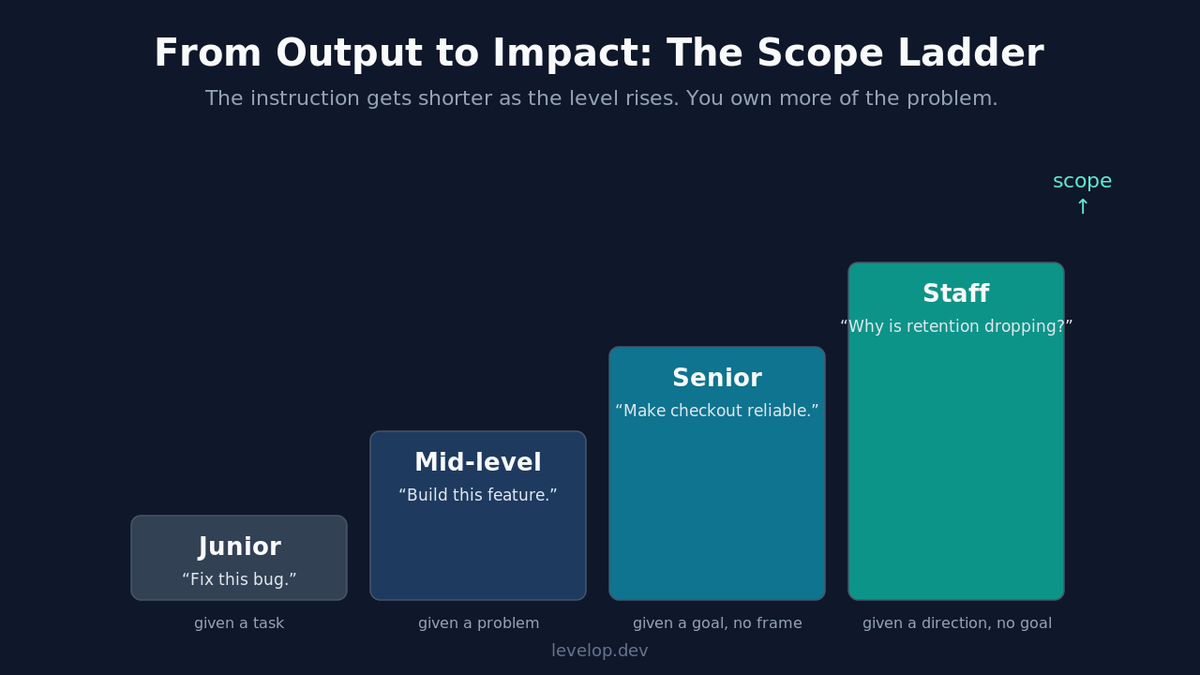
Here is what scope looks like in practice at each rung.
Junior     "Fix this bug."                -> given a task
Mid-level  "Build this feature."          -> given a problem
Senior     "Make checkout reliable."      -> given a goal, no frame
Staff      "Why is retention dropping?"   -> given a direction, no goal
Notice that the instruction gets shorter and less specific as you go up. That is not laziness from the people above you. It is the whole point. The higher you go, the more of the problem definition you are trusted to own. A mid level software engineer who wants to get unstuck should read that ladder and ask one question about their current work: who is defining the problem I am solving? If the answer is always "someone else," that is the plateau, described in one sentence.
Signals you are actually stuck
It is easy to confuse being busy with being on track. These are the signals I have learned to watch for, in myself and in engineers I have worked with.
You can predict your entire week on Monday morning, and it looks exactly like last week. Your commits are all implementation and never definition. No one asks for your opinion before a project is scoped, only for your estimate after. When you describe your last six months, every sentence starts with "I built" and none start with "I noticed" or "I decided" or "I convinced." Your manager's feedback has quietly shifted from specific and forward-looking to warm and vague. And the newest signal, particularly in 2026: the tickets that used to be your bread and butter are increasingly the ones an AI coding assistant can draft in a few minutes, which means pure implementation throughput is worth less than it was even two years ago.
If three or more of those land, you are not underperforming. You are performing well at a level you have already outgrown.
How to break out
Breaking the plateau is not about working more hours or a clever project management trick. Your hours are already full. It is about changing what those hours are pointed at. Here are the moves that actually shifted things for me and for people I have watched climb.
Take problems, not tickets
The single highest-leverage change is to stop waiting for work to be broken down and start volunteering to do the breaking down. The next time something ambiguous lands in your team's lap, a flaky pipeline, an unowned service, a vague complaint from another team, put your hand up before it becomes a ticket. Owning the messy middle, figuring out what the actual problem is and how to frame it, is literally the senior skill. You do not need a title to start practicing it.
Multiply through other people
At mid-level your impact is bounded by your own two hands. The senior move is to make your team members better, because that scales past what you can personally type, whether you work in full stack or on a single service. Review pull requests with an eye on teaching, not just gatekeeping. Write the design doc that saves three people a week of confusion. Pair with the junior who is stuck instead of just fixing their bug for them. When your manager sees that a technical project went smoothly because you quietly de-risked it for four other people, that reads as impact in a way that your personal commit count never will.
Communicate in terms of impact, not activity
Mid-level engineers report what they did. Senior engineers report what changed because of what they did. "I migrated the auth service to the new token format" is activity. "I cut login failures by 30 percent and unblocked the mobile team's launch" is impact. Same work, completely different sentence. This is not spin. It is the discipline of always connecting your work back to the outcome it produced, and it is a habit you can start building today. I wrote more about the mechanics of this in the senior engineer promotion playbook.
Get the rubric and self-assess honestly
Almost every company has a leveling rubric, even the ones that pretend they do not. Ask your manager for it directly. Then read the senior column and grade yourself line by line, brutally. The gap between where you are and what that column describes is your actual roadmap, and it is far more useful than any generic advice, including this post. If you want a map of what those columns tend to contain across the industry, we broke down the whole ladder from L3 to Staff in the software engineer career ladder guide.
Pick a direction before you pick a title
At some point the ladder forks. You can keep going as an individual contributor toward staff and principal engineer, or you can move toward management. Neither is a promotion over the other, and picking based on prestige is how people end up miserable. Charity Majors described this beautifully in The Engineer/Manager Pendulum, and it is worth reading before you assume management is the only way up. We also mapped the tradeoffs in detail in staff engineer versus engineering manager.
A concrete before and after
Let me make this less abstract. Here is the same engineer, at the same company, looking at the same failing test suite, thinking at two different levels.
Mid-level response:
  - Test flakes ~10% of runs.
  - I added a retry and a longer timeout.
  - Suite is green again. Ticket closed.

Senior response:
  - Test flakes ~10% of runs, and three other suites
    show the same signature.
  - Root cause is a shared test DB with no isolation
    between parallel runs.
  - I fixed the isolation, wrote up the pattern, and
    added a lint rule so new tests cannot reintroduce it.
  - Flakiness across all suites dropped to near zero and
    CI time fell 8 minutes for the whole team.
The mid-level response is not wrong. It is correct, fast, and complete for the ticket as written. The senior response redefined the problem, widened the scope on purpose, and left the system better for everyone. That difference, repeated across a year, is the entire distance between the two levels. You do not need permission to start giving the second kind of answer.
Common mistakes on the way out
I made most of these, so I can describe them from the inside rather than as warnings from above.
I confused visibility with self-promotion and avoided both, which meant genuinely good work sat invisible. Making your impact legible is not bragging, it is basic communication, and staying quiet mostly just slows you down.
I treated the plateau as my manager's problem to solve. It is not. Your manager can advocate for you, but they cannot manufacture scope you have not demonstrably taken. Waiting to be handed a bigger role is the mid-level move that keeps you at mid-level.
I job-hopped once purely to escape a plateau, and I brought the plateau with me, because the plateau was a habit, not a place. Changing companies can absolutely help when you are genuinely blocked by a frozen ladder or a manager who will not sponsor you. But if the pattern is that you always execute and never define, a new logo on your badge does not change that pattern by itself.
How long does breaking out take
Honest answer: usually somewhere between six and eighteen months of deliberately operating one level up, not a weekend of reading career blogs. Promotion committees look for a track record, which by definition takes time to build. The good news is that the clock only starts when you change what you are optimizing for. Every month you spend closing tickets faster is a month that does not count toward the case. Every month you spend taking ambiguous problems, multiplying your team members, and framing your work as impact is a month that does. A mid level engineer who does that consistently becomes a senior software engineer on the record, not just in self-image. Start the clock.
Frequently asked questions
What is a mid level software engineer?
A mid level software engineer is an engineer who can independently own and ship well-defined features without supervision, typically with two to five years of experience. In most leveling systems this maps to L4, SDE II, or Engineer II. The defining trait is reliable execution on problems that someone else has already scoped.
Why do mid level software engineers feel stuck in their career?
Because the skill that earned the mid-level promotion, fast execution on defined tasks, is not the skill that earns the next one. Senior levels are measured by scope and impact rather than output. Many engineers keep optimizing throughput and see no movement, because they are improving on an axis that stopped mattering for advancement.
How do I get promoted from mid-level to senior software engineer?
Start operating at the senior level before the title arrives. Take ambiguous, unscoped problems and own them end to end, multiply your impact by making other engineers more effective, communicate your work in terms of outcomes rather than activity, and get your company's leveling rubric so you can self-assess against the senior column honestly.
Is the mid-level plateau caused by AI coding tools?
AI did not create the plateau, but in 2026 it is making it steeper. When an assistant can draft routine implementation in minutes, pure ticket-closing throughput is worth less, and the gap between execution and judgment is what companies increasingly pay for. That raises the value of the exact senior skills, problem framing and scope, that break the plateau.
Should I change jobs to escape a mid-level plateau?
Sometimes. A switch helps when you are blocked by a frozen ladder, a non-sponsoring manager, or a team with no room to grow. It does not help when the plateau is a personal habit of always executing and never defining, because that habit travels with you. Diagnose which one you have before you update your resume.
Where to go next
If you want to keep pulling this thread, the natural next reads are the full career ladder from L3 to Staff, the senior promotion playbook, and if you are weighing the fork, staff engineer versus engineering manager. For the compensation side of the mid-level question, we ran the numbers in the mid-level software engineer salary breakdown. You can find all of it on the Levelop blog, and the leveling and interview practice that shaped a lot of this thinking lives on Levelop.
The plateau is real, but it is not a wall. It is a signpost telling you the rules of the game just changed. Once you see the new rules, you can start playing by them today, with the exact job you already have.