

Scope: The Software Engineer Career Progression Metric
You did everything right this cycle. You shipped features. You closed tickets faster than anyone on the team. Your code review turnaround was the best on the board. And then your manager said the words that make senior engineers quietly update their resumes: "You're doing great, but you're not operating at the next level yet."
Here is the part nobody explains clearly. Promotion in engineering is not about how much you do. It is about the size of the problem you own. That size has a name, and the name is scope. If you want to understand software engineer career progression at any serious company, you have to stop counting output and start measuring the blast radius of your decisions. Scope, not activity, is the engine of software engineering career progression.
This post breaks down what scope really is, why it beats every other metric a promotion committee looks at, and how to grow it on purpose instead of waiting for someone to hand it to you.
The metric hiding behind every promotion decision
Most engineers think they are being measured on productivity. They are not. Productivity is the price of admission, not the thing that gets you promoted. Two engineers can write the same amount of code in a quarter and be on completely different trajectories, because one is solving a problem the size of a function and the other is solving a problem the size of a system.
Scope is the answer to a single question: how much of the org's uncertainty do you personally absorb? A junior engineer absorbs the uncertainty of a task. Someone hands them a well-defined ticket and they turn it into working code. A senior engineer absorbs the uncertainty of a feature or a service. Nobody hands them a spec, because they write the spec. A staff engineer absorbs the uncertainty of a problem that crosses teams, where even the question is unclear until they define it. Described in career path in software industry terms, an engineer in entry level positions, a junior software engineer, a senior software engineer, and eventually engineering managers or a chief technology officer (CTO) are separated less by years of experience or the programming languages they know than by the amount of uncertainty each one absorbs.
That is why scope is the real currency. When a promotion committee debates whether to level you up, they are not asking "did this person work hard?" They are asking "is this person already operating at the next level's scope?" The uncomfortable truth is that the promotion is a lagging indicator. You get the title after you have been doing the work, not before.
If you want the full map of how these levels stack up, we wrote a companion piece on the software engineer career ladder from L3 to Staff. This post zooms into the single variable that moves you between those rungs.
Scope has three dimensions, not one
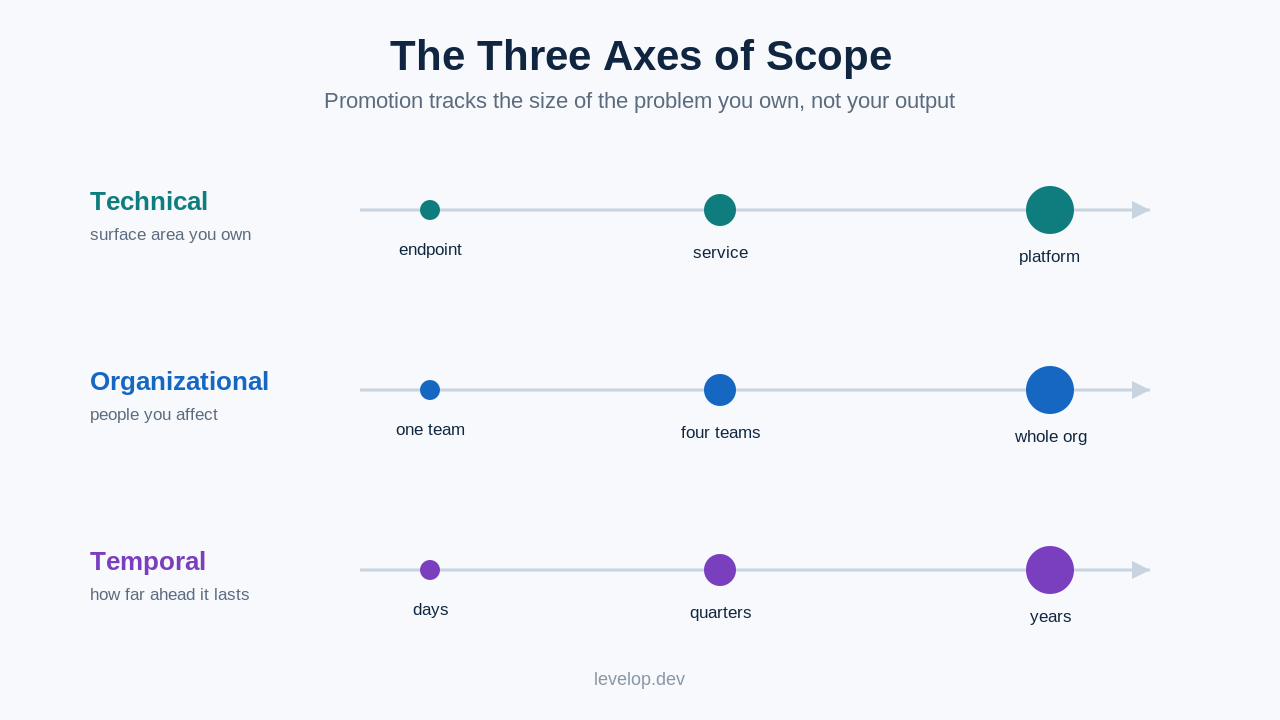
People talk about scope like it is a single slider from "small" to "big." It is not. It has three independent axes, and strong engineers grow along all three at different rates.
Technical scope: the surface area of what you own
This is the axis most engineers think about first. It is the size of the technical thing you are responsible for. A single endpoint is small. A service is bigger. A platform that ten other teams build on top of is bigger still. Technical scope grows when the systems you touch get larger, more critical, and harder to reason about.
The trap here is confusing complexity with scope. Writing a very clever algorithm, or knowing three operating systems cold, does not increase your scope on its own. Deep technical expertise in developing software is table stakes at the senior level, not a differentiator. Owning the reliability of a system that processes millions of requests a day does, even if the code itself is boring. Promotion committees reward the boring, critical thing over the clever, isolated thing almost every time.
Organizational scope: how many people your work touches
This is the axis that separates senior engineers from staff engineers, and it is the one most technical people underinvest in. Organizational scope is the number of teams, functions, and humans whose work depends on your decisions. Every team member downstream of your decisions is part of your scope, and the soft skills to align them are as load-bearing as the code. When you fix a bug, you affect one team. When you define an API contract that four teams build against, you affect four teams. When you set a standard the whole engineering org adopts, you affect everyone.
Organizational scope is why "I did great technical work but got passed over" happens so often. The work was real. It just did not touch enough of the organization to register as the next level. We go deep on this exact wall in the mid-level plateau: why year 3-5 engineers feel stuck.
Temporal scope: how far into the future your decisions reach
The third axis is time. Junior work is measured in days and weeks. Senior work is measured in quarters. Staff and principal work is measured in years. Temporal scope is about how long your decisions stay load-bearing.
When you pick a database schema that a team lives with for two years, you are operating at a longer temporal scope than someone shipping a UI tweak that gets redesigned next sprint. The further out your decisions ripple, the more the org has to trust your judgment, and trust at that horizon is exactly what a promotion to staff is buying.
Why scope beats every other promotion metric
Let us be direct about the metrics engineers obsess over and why they lose to scope every time.
Lines of code, tickets closed, and story points are measures of activity, not impact. They can go up while your scope stays flat. An engineer who closes forty small tickets is not more promotable than one who closed five, if all forty tickets lived inside the same tiny corner of the codebase. Activity metrics reward staying busy inside your current scope. They actively distract from the thing that gets you leveled up.
Code quality matters, but it is a floor, not a ceiling. Clean code and fluency across programming languages are expected at every level. Nobody gets promoted to staff for writing tidy functions or for the raw hours they spend writing code. They get promoted for making architectural calls that keep an entire system maintainable as it scales. Quality is how you keep your current scope. Scope is how you grow.
Even "impact," the word every performance review loves, is really just scope wearing a nicer outfit. When people say your work had impact, what they mean is that your decisions touched something large, affected many people, or paid off over a long time. That is the three-axis definition of scope again. Impact is the output; scope is the input that produces it.
This is why chasing metrics other than scope feels like running on a treadmill. You get faster, you get more efficient, and you stay at the same level, because efficiency inside a fixed scope does not change the size of the problem you own. If you are grinding and not moving, this is usually why. Our playbook on getting promoted to senior engineer unpacks how to break that loop deliberately.
How to grow your scope on purpose
Here is the good news. Scope is not doled out by luck or seniority. It is claimed. The engineers who level up fastest are the ones who take scope before it is officially theirs, then get the title as recognition. Here is how they do it.
Volunteer for the ambiguous problem
Scope lives inside ambiguity. A well-defined ticket has no scope to claim, because the thinking is already done. The problem nobody wants, the one where even the requirements are fuzzy, is pure scope waiting for an owner. When a project shows up with no clear owner and an unclear definition of done, that is not a burden. That is an opening.
The engineers who wait for clean, well-scoped tickets are, by definition, letting someone else absorb the uncertainty. And absorbing uncertainty is the entire job at the next level.
Turn a task into a system
When you get a task, look one level up. Why does this task exist? What class of problems does it belong to? Instead of solving the single instance, ask whether you should solve the category. Fixing one flaky test is a task. Building the pattern that stops that whole class of test from being flaky is scope.
This reframing is the single highest-leverage habit for growing technical scope. You are not doing more work. You are choosing a bigger problem to point the same work at.
Make your work legible to the org
Organizational scope only counts if the organization can see it. This is not self-promotion for its own sake. It is making sure the blast radius of your work is visible to the people who decide your level. Write the design doc. Present at the architecture review. Send the summary that helps three other teams avoid the mistake you just prevented.
Work that touches many teams but is invisible reads, to a committee, like work that touched one team. The reach has to be legible or it does not register.
Build a promotion packet as you go
Here is a concrete artifact that changes outcomes. Keep a running record of the scope you are absorbing, framed the way a committee thinks. Not "I did X," but "I owned the uncertainty of Y, which affected Z teams over N months."
SCOPE LOG (running)
Q3 - Owned the checkout latency problem end to end.
   Technical: redesigned the payment service's retry path.
   Organizational: aligned 3 teams (payments, mobile, fraud) on the contract.
   Temporal: the SLA I set is the team's target for the next 18 months.
   Outcome: p99 latency cut 40%, on-call pages down 60%.
That is what a next-level narrative looks like. Notice it names all three axes explicitly. When promotion season arrives, you are not scrambling to reconstruct a story. You have been writing it all along.
The scope traps that keep good engineers stuck
Three failure modes trap strong engineers for years. Learn to spot them.
The first is the hero who hoards. If you are the only person who understands a critical system and you keep it that way, you feel indispensable, but you have capped your scope. You cannot grow into a bigger problem because you are the single point of failure on your current one. Real scope growth requires making yourself replaceable on the thing you own so you can go absorb the next, larger uncertainty. The engineer who mentors three people onto their system has more scope than the one guarding it alone, not less.
The second is the perfectionist inside a small box. Endlessly polishing a component nobody else depends on feels productive. It is not scope. It is high effort aimed at a small problem. The polish is real, but the box is the problem.
The third is the specialist who never crosses a boundary. Deep expertise is valuable, but if your work never touches another team, your organizational scope is structurally capped. At some point you have to decide whether to make a lateral move into broader problems. If that fork sounds familiar, we mapped it in staff engineer vs engineering manager, because both paths are ultimately about growing scope in different directions.
Scope is the map for the whole climb
Once you see promotion through the lens of scope, the entire career path for software engineer roles stops looking like a mystery and starts looking like a map. Every level is just a larger amount of uncertainty you are trusted to absorb, across bigger systems, more teams, and longer time horizons. Whether you entered through a degree in computer science or a bootcamp, the senior level and beyond reward the same thing, and the best career paths for software engineers compound scope rather than collect titles.
The engineers who understand this stop asking "how do I get promoted?" and start asking "what is the biggest problem I can credibly own next?" The title follows the scope. It always has, and it is the clearest model of software engineering career progression you will find.
If you are working on that climb, that is exactly what we build tools for at Levelop. And if you want the rest of the career-leveling series, the full library lives on the Levelop blog.
Frequently asked questions
What is scope in software engineering?
Scope is the size of the problem you personally own, measured across three axes: technical surface area (how large and critical the systems are), organizational reach (how many teams and people your decisions affect), and time horizon (how far into the future your decisions stay load-bearing). It is the core variable that determines your level, which is why software engineer career progression hinges on it rather than on raw output.
Why do I keep getting passed over for promotion despite strong output?
Because output is measured inside your current scope, and promotion is about growing scope. Closing more tickets or writing cleaner code faster makes you more efficient at the level you are already at. It does not signal that you are ready to own a bigger, more ambiguous problem. Committees promote people already operating at the next level's scope, so activity metrics alone will not move you.
How is scope different from impact?
They are closely related, but scope is the input and impact is the output. Impact is what happens when your decisions touch large systems, many teams, or long time horizons. That combination is the definition of scope. When a review says your work "had impact," it is really describing the scope of the problem you owned.
Can I increase my scope without becoming a manager?
Yes. Management grows organizational scope through people leadership, but the individual contributor track grows scope through technical and cross-team ownership. Staff and principal engineers operate at very large scope without managing anyone. The three axes apply on both tracks; management is one route to organizational scope, not the only one.
What is the fastest way to grow my scope?
Volunteer for ambiguous, unowned problems and reframe tasks into systems. Ambiguity is where uncorrelated scope lives, because absorbing uncertainty is the next-level job. Then make that work legible through design docs and reviews so the organization can see the reach. Doing more small, well-defined tasks will not grow scope no matter how many you finish.