

How to Become a Senior Software Engineer: The Promotion Playbook
Most engineers assume the path to senior is simple: write good code for a few years, and the title shows up. Then year four arrives, the title does not, and nobody can tell you what is missing. The criteria feel vague, and the people who got promoted seem to have done the same work you are doing.
The vague part is real, but it is not a conspiracy. Promotion is a judgment call made by people who need evidence, and most engineers never learn to produce that evidence on purpose. This is the playbook: what senior means, and the concrete steps that get you there. For the full map of levels, our guide on the software engineer career ladder from L3 to staff covers every rung.
What Does a Senior Software Engineer Do
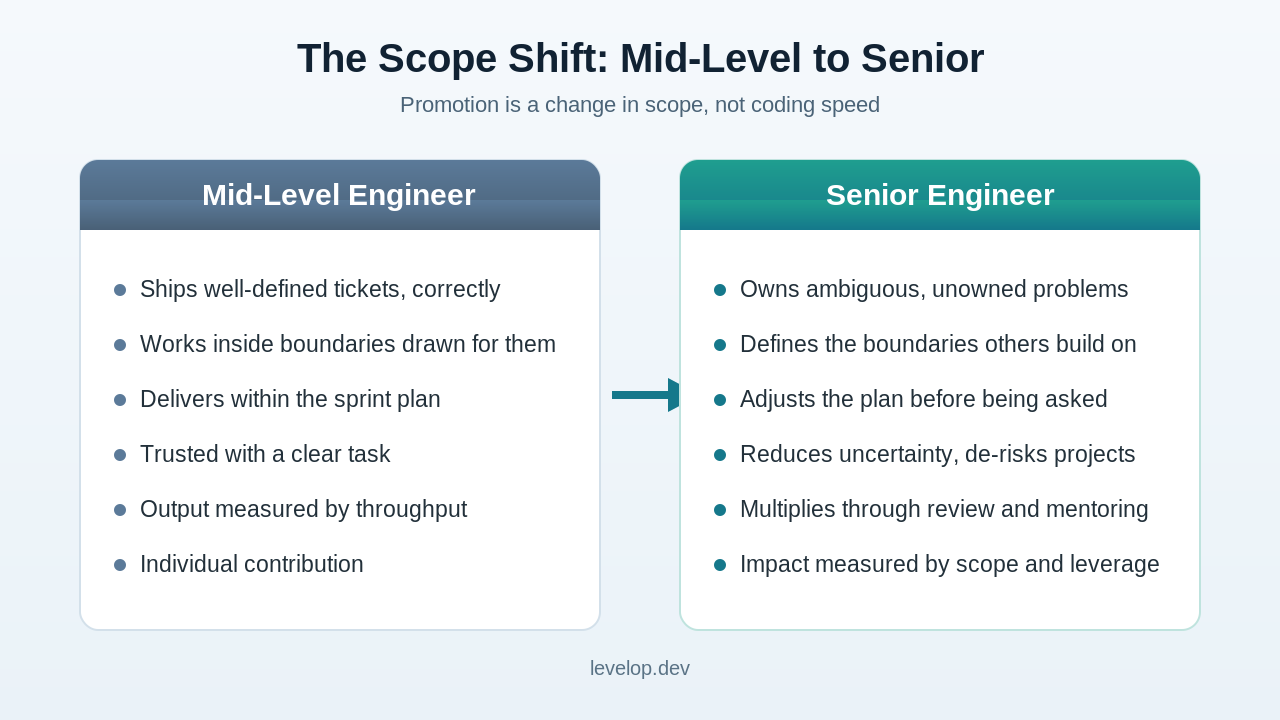
Ask five companies what does a senior software engineer do and you get five rubrics, but they rhyme. The shift from mid-level to senior is a shift in scope, not coding speed. A mid-level engineer is trusted to take a well-defined task and ship it. A senior engineer is trusted to take an ambiguous problem, define it, and deliver a solution others can build on.
Three capabilities show up in almost every rubric. You own outcomes, not tickets: you notice when the tickets do not add up to the outcome the business needs, and adjust before anyone asks. You reduce uncertainty: when a project is scary because nobody knows if the approach works, you build the spike and turn it into a boring one. And you make other engineers better through review, design feedback, and mentoring.
How Long to Become a Senior Software Engineer
The honest answer to how long to become a senior software engineer is three to five years for most people, but the number is misleading. Time is a proxy, not a requirement. Companies use years of experience as a filter because it correlates with the scope of problems you have seen, not because a clock unlocks the title.
That is why some engineers hit senior in three years and others stall at six. The fast ones deliberately sought larger scope: they volunteered for the ambiguous project and owned an incident end to end. So the better question than how many years to become a senior software engineer is: what scope have I actually owned? If the honest answer is well-defined tickets, done well, the clock will not save you.
The Evidence Problem
Here is the mechanism that trips people up. Promotion is usually decided by a committee or a manager plus skip-level, based on a written case. Your manager cannot say they feel senior. They need specific, attributable examples of impact.
So you can be doing senior-level work and still not get promoted, because the work was invisible. You debugged the 2am outage, but the writeup credited the team. The impact was real. The evidence was not captured.
The fix is unglamorous: keep a brag document. It is a running log of what you did, the impact, and who can vouch for it. Update it every couple of weeks, and at promotion season your manager writes your case in an hour instead of reconstructing a year from memory.
## Brag Doc: <Your Name>  (Q3 2026)

**Owned: Checkout latency regression**
- Problem: p99 checkout latency +40% after payments migration; no owner.
- Action: trace-based repro, isolated the N+1, shipped fix, added alert.
- Impact: p99 back under 300ms; ~$XXk/mo recovered (data: PM Priya).
- Witnesses: Priya (PM), Sam (staff eng).
- Scope signal: took an ambiguous, unowned problem to done.
Notice the structure: problem, action, impact, witnesses, scope signal. That last line does the committee's translation work for them.
The Five Moves That Compress the Timeline
If you want to become a senior software engineer fast, or at least faster than tenure alone allows, these are the moves that correlate with early promotions. None are about grinding more hours.
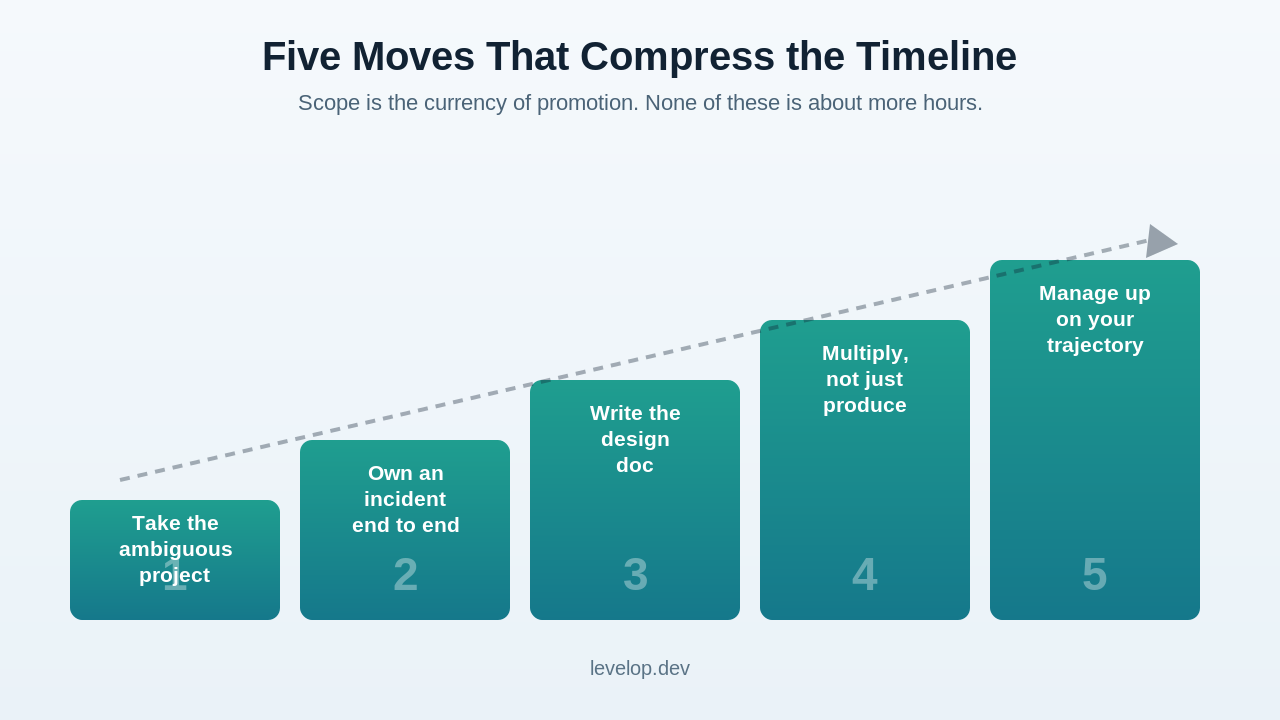
1. Take the ambiguous project nobody wants
Scope is the currency of promotion, and ambiguity is where scope lives. The messy project, where requirements are fuzzy and the path is unclear, is where you demonstrate the senior skill of turning chaos into a plan. Volunteer for it, then over-communicate your plan so your judgment is visible.
2. Own an incident end to end
Nothing demonstrates senior judgment like calmly owning a production incident: diagnosing under pressure, coordinating the response, and writing the blameless postmortem. It is a compressed, high-visibility demonstration of exactly what a committee looks for. When something breaks, run toward it.
3. Write the design doc
Writing is thinking made visible, and senior engineers think in public. A clear design doc laying out the problem, options, tradeoffs, and a recommendation is a durable artifact of judgment. It circulates, it attaches your name to a decision, and it survives to promotion season.
4. Multiply, do not just produce
Your individual output has a ceiling; your influence on the team does not. Give the review that catches the design flaw. Mentor the junior engineer until they are unblocked. This is the difference between a senior software engineer career and a very productive mid-level one.
5. Manage up on your trajectory
Do not wait for promotion season to discover the bar. Ask your manager directly what they would need to see to write your case for senior. Turn the answer into a plan and review it in your one-on-ones. Managers advocate hardest for people who make advocacy easy.
Common Traps on the Way to Senior
The counter-patterns are as informative as the moves. The hero trap: being the person who personally fixes everything reads as a bottleneck, and promoting you creates a single point of failure. The invisible-excellence trap: assuming great work will be noticed on its own. The tenure trap: believing the title is owed after N years, when it is argued for, not owed. The lateral trap: chasing the shiniest new project instead of the one that grows your scope.
If these traps and a general sense of being stuck sound familiar, that plateau is common. Our guide to the first 90 days as a software engineer covers how to build visibility early rather than manufacturing it under pressure.
What Happens After the Title
Senior is a milestone, not a destination. From here the ladder forks: keep growing scope toward staff and principal, or move toward people management. These are different jobs, and our breakdown of staff engineer versus engineering manager covers the tradeoffs. A promotion is also the best moment to revisit pay, and the salary negotiation script we published applies to internal promotions too.
Becoming a senior software engineer is less about a hidden bar and more about a visible one you were never handed. Start this week: open a brag document, write down the last three things you owned, and ask your manager what they need to see. Then go take the ambiguous project.
Frequently asked questions
How long does it take to become a senior software engineer?
For most engineers it takes three to five years, but the range is wide because time is a proxy for scope, not a requirement. Engineers who deliberately own ambiguous, high-impact projects often reach senior in three years, while narrowly-scoped work can stall past six. The better question is how much scope you have owned, not how many years you have logged.
How many years to become a senior software engineer at big companies?
At companies like Google, Meta, or Amazon, the mid-level to senior jump commonly takes three to five years, and these companies publish explicit rubrics tied to scope and impact rather than tenure. Big-company committees require strong written evidence, so capturing your impact in a brag document matters even more there.
What does a senior software engineer do that a mid-level one does not?
A senior software engineer owns ambiguous problems rather than well-defined tickets, reduces uncertainty by de-risking scary projects, and multiplies other engineers through review and mentoring. The core distinction is scope: mid-level engineers deliver within boundaries someone else drew, while senior engineers define the boundaries.
How can I become a senior software engineer fast?
The fastest realistic path is to increase your scope on purpose: volunteer for the ambiguous project, own a production incident end to end, write the design docs that make your judgment visible, mentor to multiply your impact, and ask your manager what evidence they need. Speed comes from seeking larger-scope work, not from working more hours.
Do I need to switch companies to get promoted to senior?
Not usually. Internal promotion is often faster and lower-risk than job hopping if your company has clear levels and your scope is growing. Switching helps if promotion is genuinely blocked or an outside offer resets your level and pay. If promoted internally, treat it as a compensation checkpoint and negotiate.
Levelop helps engineers build the judgment that promotion committees reward, through 12 core patterns instead of endless problem grinding. Explore more on the Levelop blog.