

The first 90 days as a software engineer: a survival guide
Back with another one in the series where I break down the things I wish someone had explained before I learned them the expensive way. This one is not about an algorithm; it is about the most disorienting stretch of any engineering career, and why the first 90 days in a new job run on rules nobody bothers to write down.
The engineers who struggle in a new role are almost never the ones who lack skill. They are the ones who treat the first 90 days like an ordinary work period when it obeys a completely different set of incentives, and the onboarding rulebook that would explain them does not exist.
The gap nobody warns you about
Here is what tripped me up my first time. I assumed the hard part of a new job was the interview process, which I had already passed, so I figured week one would amount to coding at an unfamiliar desk. Then I opened the codebase and could not find where anything lived, had no idea who to ask, and was quietly terrified that asking anything would confirm they had hired the wrong person. The job description said "software developer," but nothing in it prepared me for the disorientation of an unfamiliar system.
That fear, rather than the code itself, is the real enemy of the first 90 days at a new job, because the code is eventually learnable while the anxiety is corrosive from day one. You were hired for your trajectory, not for some magical ability to comprehend a system you have never seen, and once that reframing clicked the entire period became far more manageable. So treat what follows as a first 90 days plan you are free to steal.
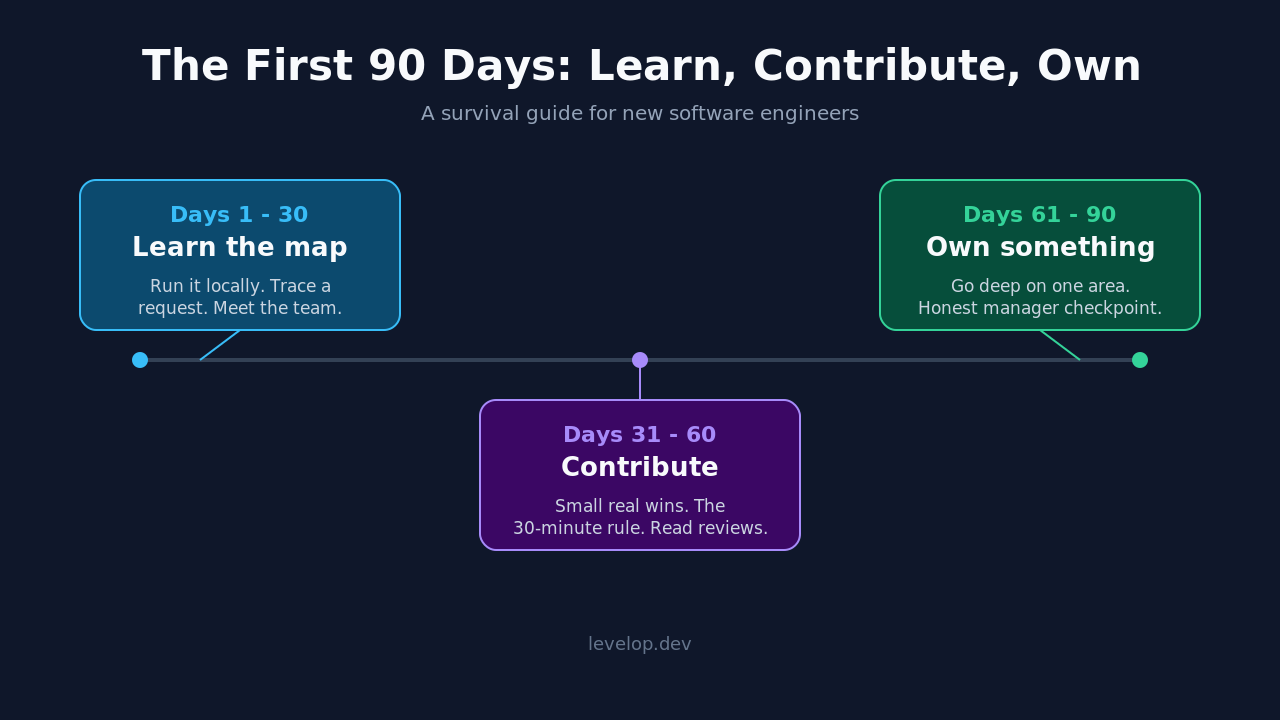
Days 1 to 30: learn, do not prove
The instinct on day one is to ship something impressive immediately, and resisting it is the single most useful thing you can do, because the first 30 days are for absorbing rather than performing.
Your real job in month one is to build an accurate map: where the code lives, how a request flows through the system, how code travels from your laptop to production, and who genuinely owns what. I have watched talented engineers push a supposedly clever change in week two that quietly broke three things they never realized were connected, precisely because they optimized for looking productive instead of understanding the terrain. Get the project running locally on day one even if it consumes the entire day, and keep a running document of every setup step that was broken or undocumented, because that document quietly becomes your first meaningful contribution.
# Day 1: get it running, no matter what
git clone <repo> && cd <repo>
make setup      # write down every step where the README lies
make test       # confirm the suite is green BEFORE you touch anything
# Day 2-5: trace one real request end to end
#   route -> controller -> service -> database -> response
The other purpose of month one is relationships, so set up short conversations with the team members you will work alongside and identify the key stakeholders whose work touches yours. The single highest-leverage question you can ask is some version of "what surprised you about this codebase when you joined," because people enjoy answering it and the answers are consistently pure gold.
Days 31 to 60: contribute and find your footing
By month two the map is taking recognizable shape, so you shift from absorbing to contributing, and the objective becomes momentum built from small but real wins.
Resist the temptation to hunt for the glamorous flagship project, and instead find the small, unglamorous, genuinely useful work everyone else avoids: the flaky test people silently rerun, the confusing error message, the documentation three versions out of date. Tasks like these teach you the codebase while producing a visible contribution to the company, and they build a reputation for reliably finishing what you start. This is also the phase where the onboarding document from month one should graduate into a real pull request that helps every future hire.
The most expensive mistake I made here, more than once, was staying stuck too long out of misplaced pride. The rule I eventually adopted is the 30-minute rule: struggle with a problem independently for thirty minutes, document exactly what you tried, and only then ask, because the write-up makes your question specific and shows you did the work. Nobody respects the engineer who stays silently blocked for two days, and everybody respects the one who asks a sharp, well-scoped question after a genuine attempt. Read the reviews on other people's pull requests too, since that is the fastest way to absorb the team's unwritten standards.
Days 61 to 90: own something
By the final month you should be migrating from "I complete the tasks people assign me" toward "I own a piece of this," because ownership is the quiet dividing line between someone still onboarding and someone who has genuinely joined the team.
Ownership does not require a giant project; it means there exists some area, however modest, where you are demonstrably the person who understands it best and other people, including key stakeholders, begin routing their questions to you. Pick it deliberately, go deep, and become the acknowledged go-to person, because that is how you convert three months of scattered effort into a durable, long term place on the team. This is also the moment for an honest checkpoint conversation with your manager or engineering leader: return to how you agreed to define success on day one and ask directly whether you are on track and where the remaining gap sits.
The traps that quietly sink people
A few traps are worth naming directly. Trying to change everything at once fails because almost every apparently obvious mistake carries a history you cannot yet see, so earn context before you campaign for change. Comparing your inside to everyone else's outside fails because you are measuring your day twenty against their day six hundred, and that is a time gap, not a talent gap. Going silent when overwhelmed is the most dangerous, since struggling quietly reads as disengagement even when it is anxiety, so over-communicate instead. And never neglect the human layer, because the person who is pleasant to work with and communicates clearly consistently receives more help and more interesting work than the isolated genius who is hard to talk to.
What to focus on next
Nail your communication habits first, because clear written updates and sharp questions compound faster than any purely technical skill in a new role. If you are still job hunting, our breakdown of job search strategies that get callbacks pairs naturally with this. Then understand the staff engineer versus engineering manager fork so you can aim your first 90 days deliberately, and get compensation right early with our guide to evaluating a tech compensation package beyond the base salary. If you are earlier in the journey, structured practice on Levelop is how a lot of engineers I know built the confidence to walk in ready, and you can browse more write-ups on the Levelop blog.