

Distinguished Engineer: The IC Career Path Beyond Staff
Most software engineer career ladders you find online stop at Staff. You get L3, senior, then staff, and the article ends with a confident "and beyond." That "beyond" was a black box for me for a long time. I knew Principal existed. I had heard Distinguished thrown around. Fellow sounded like something you got named after you invented a database. But what those titles actually mean, what the day looks like, and how anyone gets there stayed fuzzy.
So I did the thing I do when a concept refuses to sit still: I pulled apart every public career ladder I could find, read what Staff-plus engineers say about their own jobs, and cross-checked the compensation numbers against public data. This is what the individual contributor path, the part of the engineer career path that begins beyond staff, looks like once the usual map runs out. If you are a senior or staff engineer staring at the ceiling and wondering whether there is a real ladder above you or just marketing, this is for you.
The part nobody explains clearly
Here is what tripped me up. The titles above staff are not standardized. One company's Principal is another company's Staff. Some companies have Distinguished Engineer and no Fellow. Some have Fellow and no Distinguished. The salary ranges overlap in confusing ways, and the promotion criteria are written in language so vague it reads like a horoscope.
The confusion is real, and it is not your fault. Below staff, the ladder is legible because the whole industry roughly agrees on what a senior engineer does. Above staff, the sample size is tiny. A company with two thousand engineers might have thirty principals, five distinguished engineers, and one fellow. Nobody writes a clean tutorial for a job that thirty people in the building hold, so the knowledge lives in hallway conversations and internal promo docs.
The ladder, all the way up
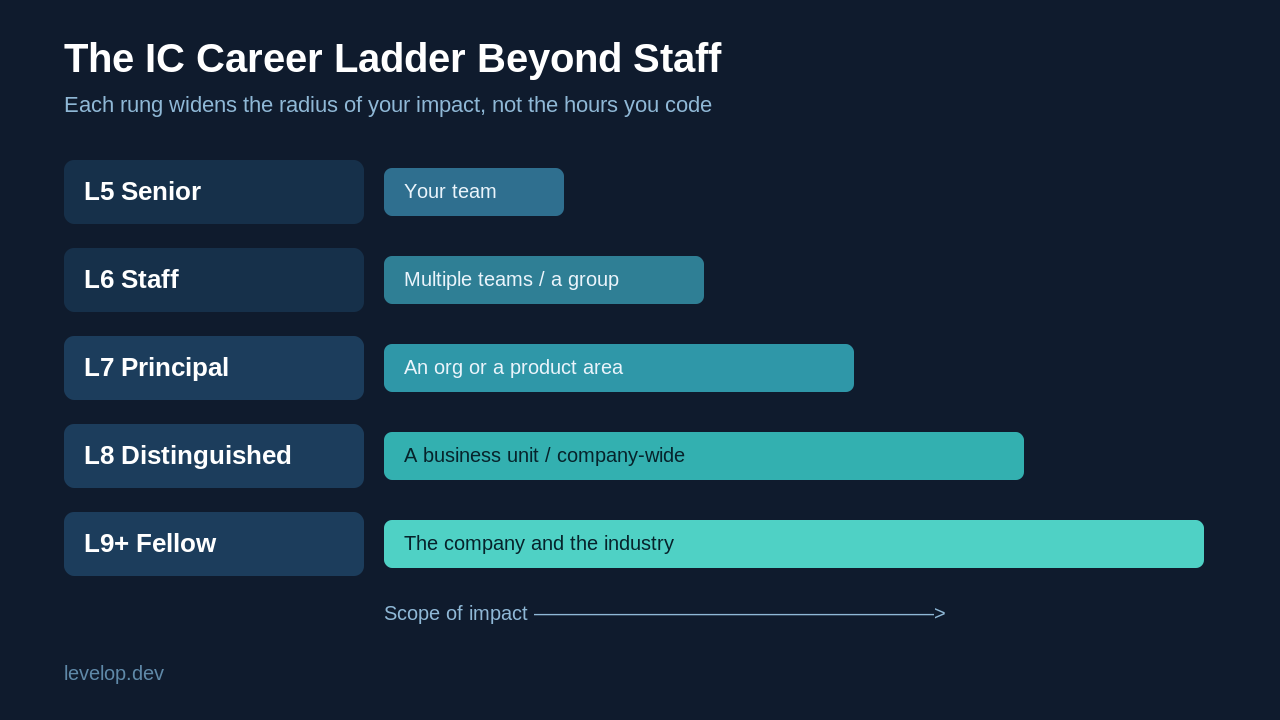
Start with the shape. A typical individual contributor ladder at a large tech company looks like this, from bottom to top: entry level, then mid-level, then senior, then staff, then principal, then distinguished, then fellow. The exact level numbers differ, but the rungs above senior tend to map like this.
IC ladder (common big-tech mapping)
--------------------------------------------
Level        Title                Scope of impact
L3           Entry / Junior       Your own tasks
L4           Mid-level (SDE II)   Your own projects
L5           Senior               Your team
L6           Staff                Multiple teams / a group
L7           Senior Staff / Principal   An org or a product area
L8           Distinguished        A whole business unit / company-wide
L9/L10       Fellow               The company and often the industry
--------------------------------------------
If you want the full breakdown of the rungs from L3 up to Staff, I wrote that one separately in the software engineer career ladder from L3 to staff post. This article picks up where that map ends.
The single most useful idea for understanding engineering levels titles above staff is this: each rung is defined by the radius of your impact, not by how much code you write. A senior engineer owns the outcomes of a team. A staff engineer owns outcomes across several teams. Above that, the radius keeps widening, and the amount of code you personally write usually goes down, not up.
What actually changes above staff
Below staff, getting promoted mostly means getting better at the craft. You write cleaner code, you design better systems, you handle bigger projects. It is a continuous curve, and effort maps fairly well to progress.
Above staff, the game changes. The question stops being "how good are you" and becomes "how much of the organization moves because you exist." That is a different skill. You can be a phenomenal coder and never make principal, because principal is about leverage. Your job is to make hundreds of other engineers more effective, to prevent expensive mistakes before they happen, and to set technical direction that plays out over years.
I found the clearest way to think about it is the multiplier framing. A senior engineer adds their own output. A staff-plus engineer multiplies the output of everyone around them. When you read a principal engineer's actual accomplishments, they rarely sound like "shipped feature X." They sound like "identified that three teams were about to build the same thing and unified it," or "caught an architectural dead end a year before it would have cost us a rewrite." That is scope working through other people. If the word scope keeps coming up, it is because scope is the promotion metric that actually matters, and it matters even more the higher you climb.
Principal engineer: the first rung past staff
Principal is where the individual contributor path stops being a curve and becomes a cliff you have to be pulled up. This is the first real stop on the principal engineer career path, and a principal engineer typically owns the technical strategy for an entire engineering organization or a major product area. Think dozens to low hundreds of engineers whose work is shaped by the technical decisions the principal makes or influences. Day to day, the role looks less like coding and more like steering: reviewing designs, unblocking an engineering team, and working closely with directors on where the architecture goes next.
The staff vs principal engineer distinction confuses people because the jobs rhyme. Both operate across teams. The difference is altitude and time horizon. The staff engineer role tends to cover problems solved across a few teams over quarters. Principal engineer roles cover problems that span an org over years, and they are not defined by years of experience so much as by the size of the problems you are trusted with. Principals spend a real chunk of their time on things that are not code at all: aligning leaders, writing strategy documents, mentoring the staff engineers below them, and being the person executives trust to give a straight technical answer.
A concrete way to see it: when a company is deciding whether to bet the roadmap on a new platform, the principal engineer is in the room. When something breaks in a way that threatens the business, the principal is who leadership looks to. The role is as much about judgment and trust as it is about technical depth.
On compensation, the numbers get large. According to public data on levels.fyi, principal-level total compensation at large US tech companies commonly lands in the mid six figures, often somewhere between roughly $450,000 and $750,000 per year when you add base, bonus, and equity, with wide variation by company and location. Treat those as rough public estimates, not guarantees. The spread is enormous because so much of it is equity that depends on stock performance.
Distinguished engineer: rare air
So what is a distinguished engineer? A distinguished engineer operates at the level of an entire business unit or the whole company. Where a principal shapes an org, a distinguished engineer shapes technical direction across many orgs, and their reputation usually extends outside the company walls. At this altitude raw technical expertise is assumed, and what stands out is judgment plus the communication skills to move a large engineering organization with a single well-argued document.
These are the people whose names show up on influential papers, foundational internal systems, or widely adopted open source projects. A google distinguished engineer, for example, is often someone who built or led something that a large fraction of the company now depends on. The title is not handed out for tenure. It is recognition that your technical judgment has company-wide weight.
Distinguished engineers are genuinely rare. Big companies might have a few dozen across tens of thousands of engineers. The senior vs principal engineer gap felt large to me until I looked at the principal to distinguished gap, which is larger still. You do not get here by being the best coder in the building. You get here by having repeatedly been right about the technical direction of the company in ways that mattered, and by having built the credibility that makes leaders defer to you.
On distinguished engineer salary, public reports on levels.fyi and similar sources put total compensation frequently in the high six figures and sometimes into seven figures at the largest companies, again heavily weighted toward equity. I want to be careful here: these figures come from self-reported public data, the sample is small, and individual packages vary a lot. Use them as a directional signal, not a number to quote in a negotiation.
Fellow: the top of the ladder
Fellow is the summit, and there is not much above it. A fellow's impact is measured at the level of the company and often the entire industry. These are people who have shaped how software gets built more broadly, sometimes over decades. A large company may have only a handful of fellows, and some have none.
The honest thing to say about Fellow is that you do not plan for it. Principal and even distinguished can be goals you work toward deliberately. Fellow tends to be the accumulated result of a career of outsized technical contribution that the industry already recognizes. If you get there, you will not need an article to tell you what it means.
The shift from doing to leverage
The thread running through all of these levels is a steady handoff from doing the work to creating the conditions for good work. This is the same shift that shows up lower on the ladder, just amplified. When engineers feel stuck around year three to five, it is often because they are still optimizing their own output when the next level rewards multiplying others, a trap I dug into in the mid-level plateau piece.
Above staff, that same lesson keeps compounding. The higher you go, the less your value comes from your keyboard and the more it comes from your judgment, your ability to align people, and your track record of being right about hard technical calls.
Here is a rough self-check I put together while trying to understand the difference between the rungs:
Am I operating above staff? A rough self-check
-----------------------------------------------
- Do teams change direction based on my technical opinion,
  even teams I am not on?
- Have I prevented an expensive mistake that leadership
  can point to?
- Do other senior engineers seek me out for judgment,
  not just code review?
- Is my name attached to decisions that play out over
  years, not sprints?
- Would a director stake their own credibility on my
  promotion?
-----------------------------------------------
If most answers are "not yet," the gap is scope and
sponsorship, not raw skill.
The mistakes I made thinking about this
The first mistake was assuming these levels are about being a better programmer. They are not. Past staff, coding ability is table stakes. What separates the rungs is the radius of impact and the trust you have accumulated. I spent too long assuming the path up was just "keep getting better at building things."
The second mistake was comparing titles across companies as if they meant the same thing. They do not. A Principal at a five-hundred-person startup and a Principal at a hundred-thousand-person company are doing very different jobs at very different scopes. When you read engineering levels titles, always anchor them to scope and company size, not to the word itself.
The third was treating the IC path as obviously better or worse than management. It is neither. The individual contributor track past staff and the management track are two different ways to have large impact. The staff engineer versus engineering manager fork is a real decision, and the right answer depends on what kind of work energizes you, not on which one has a higher ceiling. Both ceilings are very high.
How to actually grow toward it
If principal is a realistic next step for you, the work is less about skill and more about visible, org-level impact. Start solving problems that no single team owns. Write the strategy document nobody asked for but everyone needed. Become the person who works closely with other teams and unblocks them. Build a track record that a senior leader would happily vouch for, because sponsorship is not optional at these levels.
And get the fundamentals of getting promoted right first, because the mechanics do not disappear at the top. The same principles from the senior engineer promotion playbook still apply: make your impact legible, get it in front of the people who decide, and stop waiting to be noticed.
If you want to keep building the depth that all of this rests on, that is exactly what we focus on at Levelop, and there is more in the same series over on the Levelop blog.
Frequently asked questions
What is a distinguished engineer?
A distinguished engineer is a senior individual contributor whose technical impact spans an entire business unit or company, usually with a reputation that extends beyond the company. They set direction across many teams, and the title recognizes a track record of company-wide technical judgment rather than tenure or coding speed. It sits above principal and below fellow on most IC ladders.
What is the distinguished engineer salary?
Public self-reported data on levels.fyi puts distinguished engineer total compensation frequently in the high six figures and sometimes into seven figures at the largest tech companies, heavily weighted toward equity. The sample size is small and packages vary widely, so treat any single figure as a rough public estimate rather than a fixed number.
Staff vs principal engineer: what is the difference?
Both work across multiple teams, but they operate at different altitudes. A staff engineer solves problems spanning a few teams over quarters. A principal engineer owns technical strategy for an entire organization over years and spends significant time on alignment, strategy, and mentoring rather than only writing code. Principal is a wider scope and a longer time horizon than staff.
Is the IC career path better than becoming a manager?
Neither is objectively better. The individual contributor path beyond staff and the management path are two routes to large impact, and both have very high ceilings. The right choice depends on whether you are energized by deep technical work and judgment or by growing and leading people directly.
How do you get promoted above staff?
Impact and sponsorship, in that order. You need a track record of org-level or company-level technical impact that other senior leaders will actively vouch for. Coding ability is assumed at this point; what gets you promoted is visible scope, sound judgment on hard calls, and a director willing to stake their credibility on you.