

Software Engineer Levels: The Career Ladder From L3 to Staff
If you have ever stared at a job title like "Software Engineer II" or "L5" and wondered what actually separates it from the level above, you are not alone. Software engineer levels are one of the most opaque parts of a tech career. They control your pay, your scope, and how far your decisions reach, yet almost nobody explains them clearly when you are hired.
This guide breaks down software engineer levels from entry (often called L3) all the way to Staff and beyond. We will look at what each level really measures, how the ladder works, how titles map across companies like Google, Meta, and Amazon, and what it takes to move up. By the end you should be able to place yourself on the ladder and see the next rung with far less guesswork.
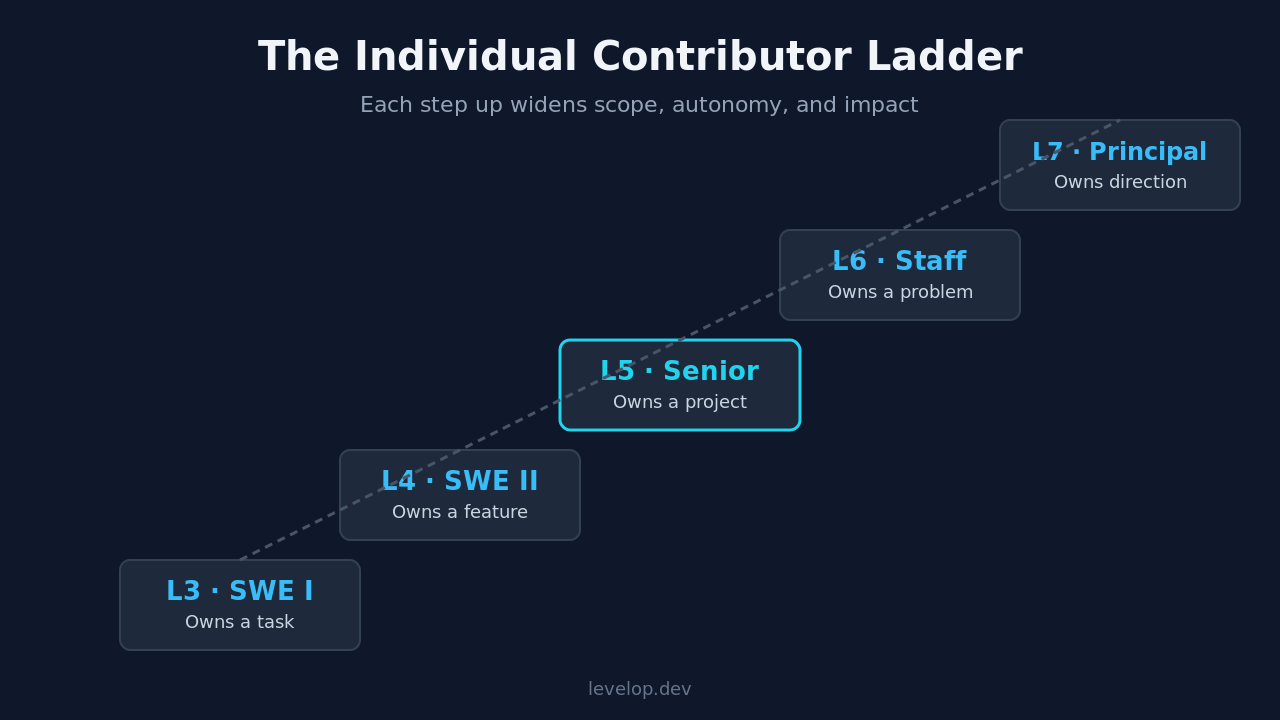
What software engineer levels actually measure
The first thing to understand is that levels are not about how many years you have coded or how many languages you know. Software engineering levels measure three things: scope, autonomy, and impact.
Scope is the size of the problem you own. A junior engineer owns a task. A senior engineer owns a project. A Staff engineer owns a problem that spans several teams. Autonomy is how much direction you need. Early on, someone breaks work into tickets for you. Later, you are the one turning a vague goal into a plan other people can follow. Impact is how far the results of your work travel, from a single feature to the technical direction of an entire organization.
The individual contributor ladder, level by level
Most companies run two parallel tracks after a certain point: the individual contributor (IC) track and the management track. The IC ladder is where you stay technical and grow your influence without managing people. Here is how the levels of software engineer roles typically progress on that track.
L3: Software Engineer I (entry level or junior)
This is where most new graduates start. At L3 you are learning how professional software is built: reading a large codebase, writing tests, getting through code review, and shipping small, well defined changes. Your manager or a senior teammate breaks work into pieces for you, and success means completing those pieces correctly and asking good questions. Nobody expects you to design systems yet. They expect you to become reliable.
L4: Software Engineer II (mid level)
At L4 you own features end to end. You can take a loosely defined task, figure out the details, and deliver it without someone checking every step. This is the level where you stop needing your work pre chewed. You still operate mostly inside one team, but you are a dependable contributor who other people can hand ambiguity to. If you want to understand what mid level really demands, our guide on the bootcamp to mid-level journey walks through the transition in detail.
L5: Senior engineer
The senior level is the anchor of the whole ladder. It is considered the "career level," meaning you can stay here indefinitely without being seen as underperforming. A senior engineer owns projects, not just features. You design systems, coordinate across a couple of teams, mentor junior engineers, and are trusted to make technical calls that stick. Crucially, you are measured on the outcome of a project, not the volume of code you personally wrote.
L6: Staff engineer
Staff is the first level where your impact is expected to reach beyond your immediate team. A Staff engineer owns problems, not projects. You might set the technical direction for an area, unblock several teams at once, or lead an effort that no single team could finish alone. Much of the work becomes influence: writing the design document everyone aligns on, or spotting the architectural risk before it becomes an outage. We will look at the senior to Staff jump more closely below, because it is the hardest transition on the ladder.
Beyond Staff: Senior Staff, Principal, and Distinguished
Above Staff, the levels get rarer and the scope keeps widening. Senior Staff and Principal engineers shape the technical strategy of an entire organization or product line, and Distinguished Engineer or Fellow roles operate at the level of the whole company. Very few engineers reach these levels, and the jobs look less like coding and more like setting direction, resolving the hardest technical disagreements, and representing the company's engineering thinking. The core skill is still judgment, applied at enormous scale.
Staff engineer vs senior engineer: the biggest jump
So what is a Staff software engineer, really, and how is the role different from senior? This is the question that trips up the most people, so it deserves its own section.
The senior to Staff jump is the point where the rules of promotion change. Getting to senior is largely about becoming excellent at delivery: you ship solid projects, you make good technical decisions, you are reliable. Getting to Staff is about impact that you often cannot achieve by writing more code. A Staff engineer multiplies the output of others.
In the staff engineer vs senior engineer comparison, the clearest difference is the unit of work. A senior engineer is judged on projects they lead. A Staff engineer is judged on problems they resolve across boundaries, often problems nobody explicitly assigned them. Senior engineers answer the question "how do we build this?" Staff engineers frequently answer the question "should we build this at all, and what is the thing we are missing?" The book length treatment of this transition at StaffEng is worth reading if you are aiming for it.
How software engineer levels map across companies
One reason the topic is so confusing is that every company uses its own numbers. A level number at one company means almost nothing at another. The mapping below lines up the individual contributor ladder across a few well known companies, based on public data from sites like Levels.fyi.
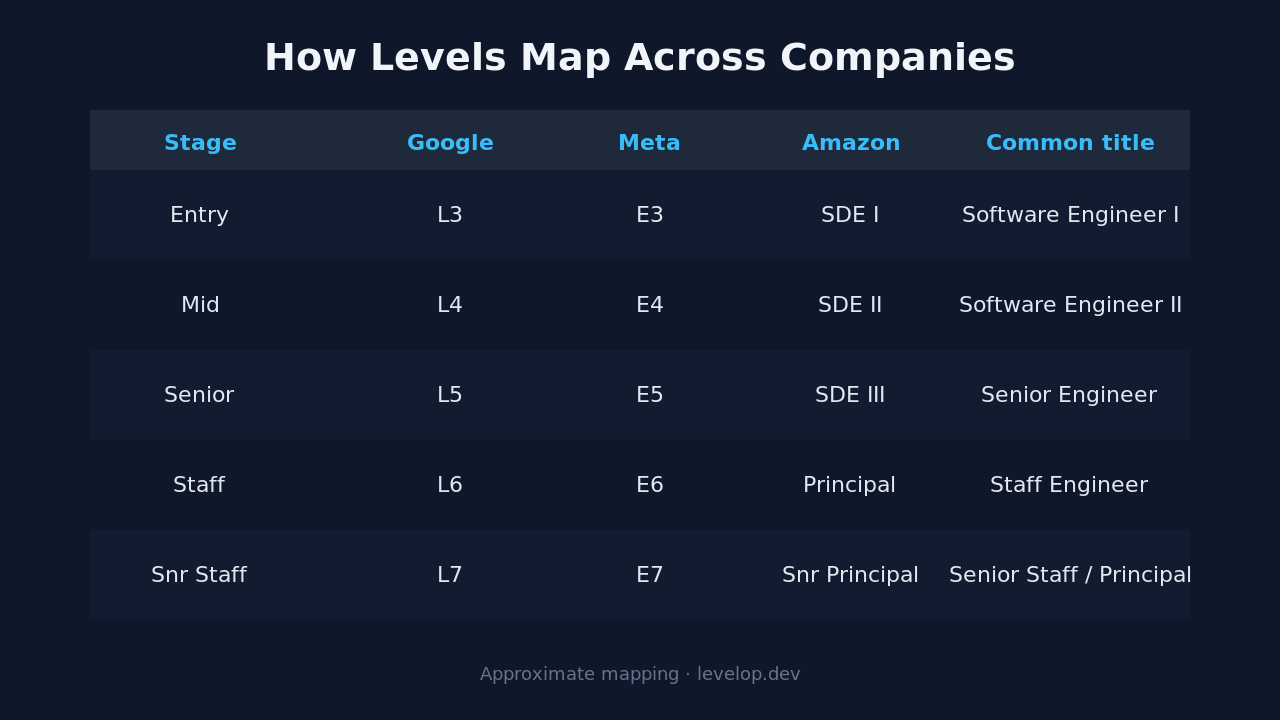
Two things are worth noting. First, Amazon compresses its ladder: the jump from SDE II to SDE III covers what other companies split across more steps, and Amazon's "Principal" sits where Google's Staff (L6) does, which confuses a lot of cross company comparisons. Second, the same number can mean different things, so "I am an L5" only makes sense once you say which company you mean.
How to actually get promoted between levels
Knowing the levels is one thing. Moving up is another. The single most important idea is this: you get promoted for already operating at the next level, not for being promised it. Promotion is usually a recognition of what you have been doing, not a bet on what you might do.
That means the path is to find work at the scope of the level above and do it visibly. If you are an L4 aiming for senior, stop waiting for larger projects to be handed to you and start owning a project's ambiguity yourself. If you are a senior aiming for Staff, look for the cross team problem that everyone complains about and nobody owns.
The other half is documentation. Managers advocate for your promotion in a committee, and they need evidence. Keeping a running record of your scope and impact makes their case for you. A simple template looks like this.
# Promotion Packet: <Your Name> -> <Target Level>

## Scope of ownership
- Project / problem: <what you owned and how big it was>
- Ambiguity handled: <what was undefined that you defined>

## Impact (with numbers)
- Business or technical result: <metric moved, outage avoided, time saved>
- Reach: <how many teams / users / systems it affected>

## Leadership and multiplier effect
- Who you unblocked, mentored, or aligned
- Documents or decisions others now build on
Fill this in every quarter, not the week before review season. For the first version of this in a new role, our guide on the first 90 days as a software engineer pairs well with it.
When the ladder forks: IC versus management
At the senior and Staff levels, the career ladder splits. You can keep climbing the individual contributor track, or you can move into engineering management. Neither is a promotion over the other at most companies; a Staff engineer and an engineering manager are typically considered peers.
The decision matters because the day to day work is completely different. One path keeps you close to the technical problems and the systems. The other trades that for growing people, running teams, and owning outcomes through others. We wrote a full breakdown of this decision in our piece on Staff engineer versus engineering manager, because choosing the wrong fork is one of the most common mid career regrets in software.
Where to go from here
Software engineer levels reward scope, autonomy, and impact, not tenure. Wherever you sit today, the way forward is the same: find the work that looks like the next level, do it where people can see it, and keep a clear record of the results. That is true whether you are moving from L3 to L4 or making the hard jump from senior to Staff.
For more on navigating each stage of an engineering career, explore the Levelop blog, or see how Levelop helps engineers prepare for the interviews and decisions that move them up the ladder.
Frequently asked questions
What are the levels of a software engineer?
The typical individual contributor ladder runs from entry level (often L3 or Software Engineer I), to mid level (L4 or Software Engineer II), to senior (L5), to Staff (L6), and then to rarer levels like Senior Staff, Principal, and Distinguished Engineer. Each step up reflects a wider scope of ownership and more impact, not simply more years on the job.
What is the difference between a senior and a Staff engineer?
A senior engineer owns projects and is judged on delivering them well. A Staff engineer owns problems that cross team boundaries and is judged on impact they often cannot achieve by writing more code. The senior to Staff jump requires visible, cross team technical leadership rather than just excellent individual delivery.
How many years does it take to reach senior software engineer?
There is no fixed number, because levels measure scope and impact rather than time. Many engineers reach senior somewhere around five to eight years, but people who consistently take on larger scope can get there faster, and staying at senior indefinitely is completely normal since it is considered a terminal career level.
Do software engineer levels mean the same thing at every company?
No. A Google L5, a Meta E5, and an Amazon SDE III are roughly comparable seniors, but the raw numbers do not transfer. Amazon in particular compresses its ladder, so its Principal sits close to where other companies place Staff. Always specify the company when you talk about a level number.
Is it better to become a Staff engineer or an engineering manager?
Neither is objectively better; at most companies they are peer levels on two different tracks. A Staff engineer stays technical and grows influence through architecture and decisions, while an engineering manager grows impact through people and teams. The right choice depends on which kind of work energizes you rather than which title sounds more senior.