

Mid-Level Software Engineer Salary: The Bootcamp-to-Mid Journey and What the Numbers Actually Say
Everyone talks about the first job. Almost nobody talks about the two years after it, which is exactly the stretch where your pay changes the most. The jump from a fresh bootcamp grad to a mid-level software engineer salary is the single biggest percentage raise most engineers will ever get, and it happens quietly, without a viral offer screenshot or a LinkedIn announcement.
This guide walks through that journey with real market data, not hallway rumors. We will look at what a junior actually earns, what a mid-level software engineer salary looks like across the broad market and at big tech, and the specific things that move you from one band to the next. If you are staring down your first two years in the industry, this is the map nobody handed you.
Why the mid-level jump matters more than the first offer
New engineers obsess over the starting number. It is understandable, since it is the first time anyone has offered you real money to write code. But the starting offer is the least negotiable and least durable number in your career. You have zero leverage, no track record, and the company knows it.
The mid-level transition is different. By the time you are pushing toward mid, you have shipped features, survived on-call, and closed real bugs in production. That track record is leverage, and leverage is what converts into salary. The progression from junior to mid is where compounding starts, because every raise after this point builds off a higher base.
Here is the blunt version: a strong first two years can permanently reset your earning trajectory. A passive first two years can leave you underpaid for a decade, because raises anchor to your current number and it is hard to un-anchor.
What a junior software engineer actually earns
Let us start at the bottom of the ladder, because the bootcamp-to-mid journey begins there.
The U.S. Bureau of Labor Statistics reported a median annual wage of $133,080 for software developers as of May 2024, with the lowest 10 percent earning under $79,850. That lowest decile is where most bootcamp grads and self-taught juniors actually land in their first role, especially outside major tech hubs. Do not let the $133,080 median fool you into thinking that is a starting number. It is a mid-career figure that includes senior and staff engineers pulling the average up.
The reality splits into two very different worlds. The broad market, which is most companies in most cities, pays new engineers roughly $70,000 to $100,000. This covers agencies, banks, healthcare systems, insurance firms, and the thousands of ordinary companies that employ the majority of developers.
Big tech and well-funded startups are a separate universe. According to levels.fyi data, new-grad total compensation at large tech companies runs around $140,000, combining a base near $110,000 to $130,000 with a signing bonus and a four-year stock grant. That is nearly double the broad-market junior number, and it is why the same title can mean wildly different pay. Neither world is the number. Which one you are in depends on company type far more than on your skill level in year one.
The mid-level software engineer salary: what the numbers say
Now the target. Once you cross into mid-level, typically at two to five years of experience, the bands shift up meaningfully.
In the broad market, a mid-level software engineer salary usually sits around the BLS median, roughly $100,000 to $140,000 depending on location and company. This is the point where you cross from below median to at or above median for the profession, which is a real milestone.
At big tech, mid-level engineers, often labeled L4 or the lower end of L5, command substantially higher total compensation. Public-company mid and senior total comp commonly lands in the $180,000 to $250,000 range and climbs from there, with base salaries frequently between $150,000 and $210,000 and the remainder in equity.
The chart below summarizes the progression. Treat these as market ranges, not guarantees, since geography and company tier swing them hard.
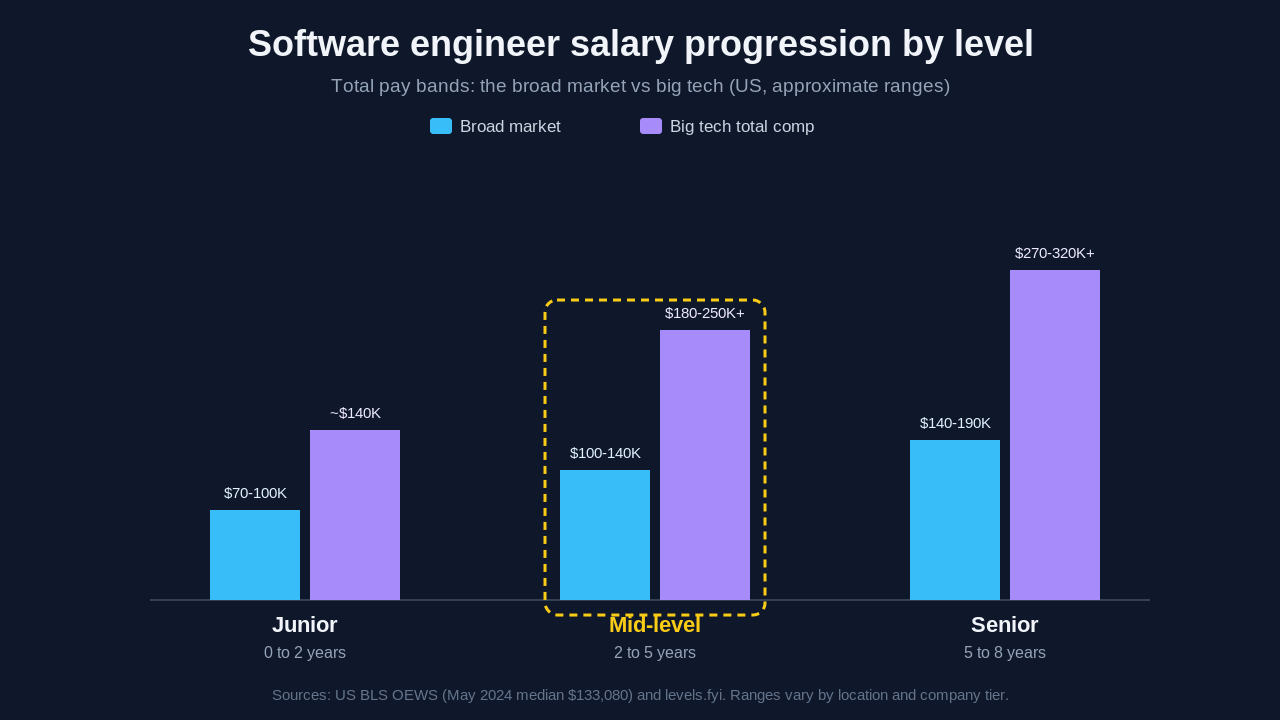
The pattern to notice is that the gap between broad market and big tech widens as you climb, because equity becomes a larger share of the package. A junior's total comp might be 10 to 15 percent above base, while a senior big-tech engineer's stock can rival or exceed their base salary.
The five things that actually move you from junior to mid
Titles do not promote themselves. Here is what genuinely drives software engineer salary progression in the first two years.
1. Shipping features end to end, not just tickets
Juniors close tickets. Mid-level engineers own outcomes. The moment you can take a vague product idea, break it into tasks, build it, test it, and ship it without a senior holding your hand at every step, you are functionally mid-level. Comp usually follows function with a lag.
2. Reducing the load on senior engineers
Your manager quietly tracks one thing: how much senior time you consume versus how much you free up. When you start unblocking yourself and then unblocking others, you flip from a cost center to a force multiplier. That flip is the strongest internal case for a raise.
3. Owning a domain
Pick a part of the system and become the person people ask about it. Payments, search, the deployment pipeline, whatever it is. Domain ownership is visible, it holds up at review time, and it is hard to replace, which is exactly what leverage is made of.
4. Communicating like an engineer, not a coder
Mid-level engineers write clear pull request descriptions, explain tradeoffs in plain language, and disagree without drama. Behavioral and communication skills are not soft add-ons at this stage. They are the difference between a good coder and someone the team wants to keep and pay more.
5. Interviewing while employed
The uncomfortable truth is that the fastest way to reset your band is often to change companies, because external offers benchmark to current market rates while internal raises benchmark to your existing salary. Even if you stay, a competing offer is the single most effective negotiation tool that exists.
A simple way to model your own progression
You do not need a spreadsheet consultant to project your trajectory. A rough compounding model tells you most of what you need to know.
# Estimate salary progression from a starting base
def project_salary(start_base, annual_raise_pct, jump_at_mid_pct, years):
    salary = start_base
    for year in range(1, years + 1):
        # Standard merit raise each year
        salary *= (1 + annual_raise_pct / 100)
        # The mid-level jump typically lands around year 2-3
        if year == 3:
            salary *= (1 + jump_at_mid_pct / 100)
        print(f"Year {year}: ${salary:,.0f}")
    return salary

# Broad-market junior starting at $85K,
# 4% annual merit raises, 20% bump at the mid-level jump
project_salary(start_base=85000, annual_raise_pct=4, jump_at_mid_pct=20, years=5)
Run that and you will see the mid-level jump in year three do more work than three years of merit raises combined. That is the whole point. Merit raises keep pace with inflation. The level jump is where your real income growth lives, which is why front-loading the skills that trigger it pays off more than any other career move in your first two years.
What nobody tells you about the first two years
A few honest notes that rarely make it into salary guides. Your title lags your ability, sometimes by a year. You will be doing mid-level work before anyone updates your title or your pay. This lag is normal, but it is also the exact window where a competing offer or a direct conversation with your manager pays off most.
Location still matters, even in the remote era. The broad-market and big-tech gap is partly a location story. If you can access remote roles that pay on a national or Bay Area band while living somewhere cheaper, the math changes dramatically. We covered this in depth in our piece on remote salary arbitrage.
Equity is not salary. A big-tech offer that looks huge on paper can shrink fast if the stock does not perform or if you leave before it vests. Understanding the difference between base, bonus, and equity is essential before you compare two offers, which is why evaluating the full compensation package matters more than chasing the biggest headline number.
The interview is a separate skill from the job. You can be a genuinely strong mid-level engineer and still bomb interviews, because interviewing rewards a specific, trainable skill set. In the current market, that skill set is shifting fast as AI reshapes how coding interviews work, so preparing deliberately matters more than ever.
How Levelop thinks about this
At Levelop, we build tools that help engineers get from where they are to the next level faster, whether that is landing the first job or making the jump to mid and beyond. The through-line across our work is that career progression is a skill you can practice, not a lottery you enter.
If you are early in the journey, the highest-leverage move is deliberate practice on the fundamentals that senior engineers evaluate you on. That is why we teach 12 core patterns instead of grinding 2,500 random problems, and why we focus on the reasoning that transfers to real work. When your skills visibly outpace your title, the salary conversation gets a lot easier. Explore more on the Levelop blog.
Frequently asked questions
What is the average mid-level software engineer salary in the US?
The average mid-level software engineer salary in the broad U.S. market sits roughly around the BLS median of $133,080 for software developers, with most mid-level roles ranging from about $100,000 to $140,000. At large tech companies, mid-level total compensation is substantially higher, often $180,000 to $250,000 or more once equity is included.
How long does it take to go from junior to mid-level?
For most engineers it takes about two to five years, though it depends far more on the scope of work you take on than on time served. Engineers who ship features end to end and reduce the load on senior teammates often reach mid-level function well before the typical timeline, and their pay usually catches up shortly after.
Do bootcamp grads earn less than computer science graduates?
In the first role, sometimes yes, because a degree can open doors at companies that filter on credentials. But that gap tends to close quickly. By the mid-level stage, your track record of shipped work matters far more than how you learned to code, and many bootcamp grads out-earn degree holders who stopped growing.
Is it better to switch companies or wait for an internal promotion?
Switching companies often produces a larger salary jump because external offers benchmark to current market rates, while internal raises anchor to your existing salary. That said, staying can be worth it if you are learning fast and building domain ownership. Even then, a competing offer is the most effective way to accelerate an internal raise.
How much does location affect a mid-level software engineer salary?
A lot. The same mid-level role can pay 30 to 50 percent more in a major tech hub than in a smaller market. Remote roles blur this line, since some companies pay national or hub-level bands regardless of where you live, which is the core idea behind remote salary arbitrage.
The bottom line
The bootcamp-to-mid journey is where your earning power is actually decided. The first offer is a starting line, not a verdict. Focus your first two years on shipping real work, owning a domain, and building the track record that makes the level jump obvious. The mid-level software engineer salary you are aiming for is not a matter of luck. It is the predictable result of becoming the kind of engineer companies compete to keep.