
How the AI Coding Interview Broke: What Replaced It
For fifteen years, the coding interview rested on a single quiet assumption: that a human typing a correct algorithm into an editor, under time pressure, told you something real about whether that person could build software. Grind enough LeetCode, the logic went, and you would show the raw problem-solving muscle that engineering demands.
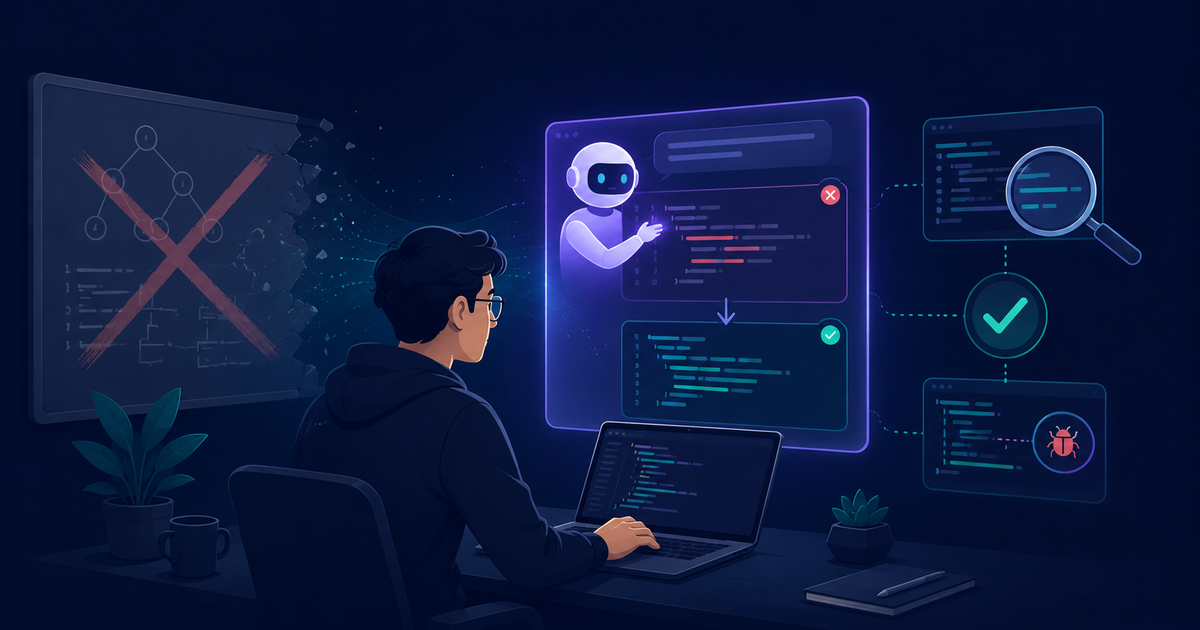
That assumption is now broken. It is not merely strained, but completely broken. When a free chat assistant can produce an optimal, commented solution to a LeetCode Hard in eight seconds, the thing the interview was measuring stopped being a reliable signal. This is the story of how AI breaking coding interviews in 2026 became the defining hiring problem in our industry. It covers what companies are doing to recover the signal. More usefully, it covers what skills now actually get tested. If you have been asking whether the AI coding interview is a fad or the new normal, or whether coding interviews are changing for good, the short version is this: the interview is not dying. It is being rebuilt around the things AI cannot fake.
What the coding interview was actually testing
Before we talk about what broke, it is worth being honest about what the traditional format was for. The whiteboard-and-algorithm interview was a proxy. Nobody at a real job implements Dijkstra from memory on a Tuesday. The interview used algorithmic puzzles as a stand-in for things that are hard to observe directly: can you decompose a vague problem, reason about correctness, reason about cost (time and space), and translate a mental model into working code?
For a long time, that proxy held up reasonably well. It was gameable, the entire LeetCode-grind industry is proof, but grinding 300 problems still forced you to absorb patterns, and pattern recognition is a real problem solving skill. Technical interviews leaned on it because it correlated, loosely, with whether a software engineer could reason about a data structure under pressure. The system leaked signal, but it did not hemorrhage it.
Then the proxy and the tool collapsed into each other.
How AI broke it
The break has three distinct fractures, and understanding them separately matters because companies are patching each one differently.
The remote-screen problem
The first fracture is the most obvious: the unproctored remote screen is now trivially defeated. A candidate on a video call can run an interview copilot in a side window that listens to the question, reads the shared editor, and feeds them an optimal solution in real time. An entire micro-industry of these tools now exists, marketed openly as ways to pass any coding interview. The classic phone screen, one engineer, one shared CoderPad, forty-five minutes, was designed in a world where the candidate's only tools were their own brain and a search engine. That world no longer exists.
The take-home problem
The second fracture is the take-home assignment. Take-homes were supposed to be the humane alternative to whiteboarding: do it on your own time, in your own environment, like real work. But your own environment now includes an agentic coding assistant that can scaffold the entire project, write the tests, and polish the README. A take-home no longer distinguishes the candidate who can build from the candidate who can prompt. Both submit clean, working repos. If you want a sense of how capable these assistants have become, our breakdown of AI coding agents covers exactly what they can now do unsupervised.
The signal problem
The third fracture is the deepest. Even in a fair, AI-free setting, the content of the test lost meaning. If 75% of production code at a company like Google is now AI-generated and reviewed by humans (a figure its own CEO put on record in 2026) then asking a candidate to write a binary search from scratch with no help measures a task that has largely left the daily job. You were optimizing candidates for a skill the company itself had partly automated away.
How companies are recovering the signal
Here is the part that surprised people who assumed AI would make interviews easier. The response has strongly gone the other way. Companies are not lowering the bar, they are redesigning the interview process, moving it in several directions at once. The whole technical interview is being rebuilt around what AI tools cannot do for you.
Letting AI in, then watching how you use it
The most significant shift is the AI coding interview run in the open, the AI-enabled format. Instead of pretending the assistant does not exist, leading companies now hand it to you on purpose. Meta began piloting exactly this format in late 2025: a 60-minute session in a CoderPad environment with a built-in AI assistant, your choice of frontier models like GPT-5 or Claude Sonnet 4.5, wrapped around a single extended problem with three escalating phases. Google rolled out a closely related code-comprehension round with Gemini in the editor, which I broke down in detail in Google's 2026 interview changes.
The question is no longer whether you can solve this. It is whether you can drive an AI to a correct solution, catch the places where it is confidently wrong, and explain every line you ship. Candidates often report this is harder than a medium LeetCode problem, not easier. The expected output is larger (north of 100 lines), and the assistant will happily hand you plausible code with a broken edge case or an O(n^2) routine where O(n) was available. Your job is to notice. The interviewer is watching how you collaborate, not whether you do.
Code review and explain this code
A second move: flip the direction. Instead of writing code that solves X, you are handed existing, unfamiliar, slightly-wrong code and asked to understand it, find the bug, and improve it. This maps directly onto what the job has become, reading and reviewing the output of AI assistants far more than authoring from a blank file. It is fast becoming the default screen for any software engineer role, from new grad to senior engineer. It is also very hard to fake, because you cannot pre-memorize a codebase you have never seen, and a copilot whispering in your ear cannot substitute for actually reasoning out loud about someone else's design.
Here is the kind of snippet that shows up in this format. It looks correct at first glance, yet it is not.
def find_first_duplicate(nums):
    """Return the first value that appears more than once, else -1."""
    seen = []
    for n in nums:
        if n in seen:        # O(n) membership check on a list
            return n
        seen.append(n)
    return -1
The interviewer does not want you to rewrite it from scratch. They want you to see it: the logic is correct, but n in seen on a list makes this quietly O(n^2), and the fix is a one-word change from a list to a set. Spotting that, explaining the cost, and knowing the fix is exactly the judgment that pattern practice builds, and that a copilot cannot perform on your behalf while you sit there silently.
Proctoring and the return of the room
The third move is blunter: lock the environment back down. Proctored video, microphone monitoring, second-camera setups, and behavior-analysis tooling designed to flag the tell-tale rhythm of someone reading off a hidden screen are all back in fashion. So is the on-site loop. After a decade of going remote for convenience, a lot of teams have decided that the only way to trust a high-stakes signal is to control the room it is collected in.
Weighting up the things AI is worst at
Finally, companies are simply rebalancing. System design, which is open-ended, judgment-heavy, and conversational, carries more weight now, because it resists copy-paste solutions. Behavioral rounds got more technical and more pointed: instead of memorized STAR stories, you are asked to defend the real trade-offs in a system you actually built. The bar moved up on depth, communication, and scope, all at once.
What actually gets tested now: the skills that can't be faked
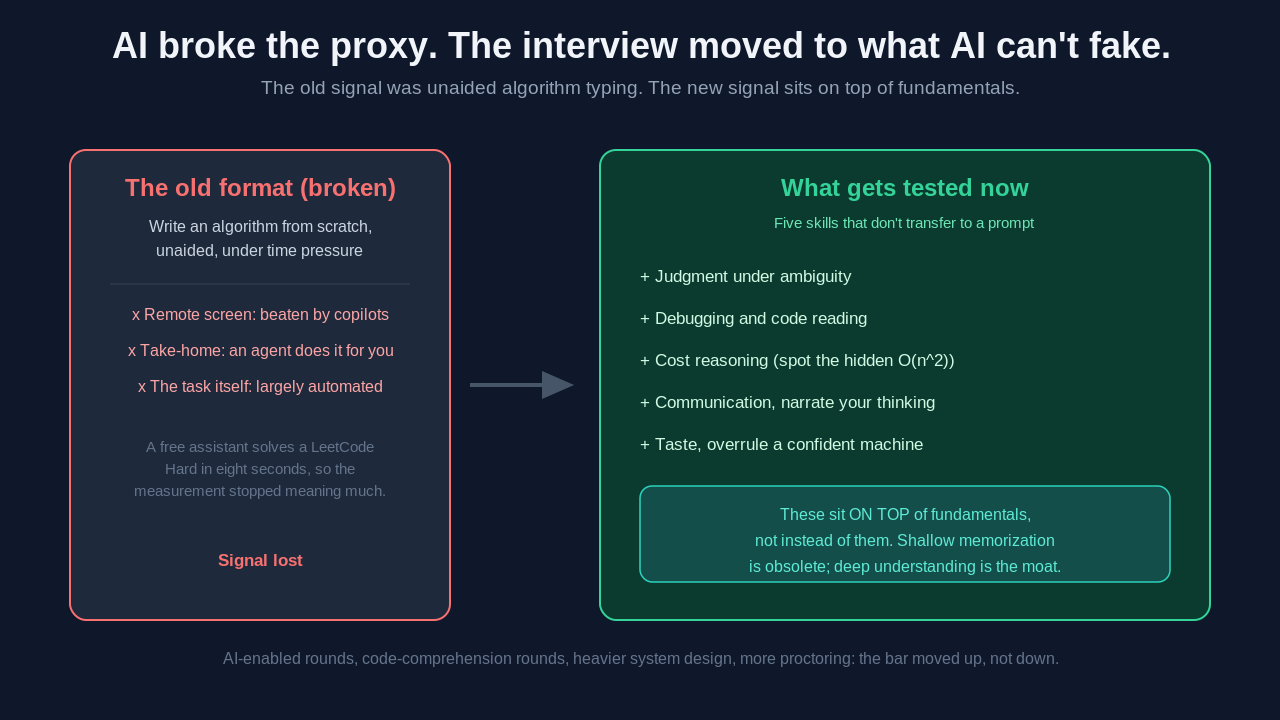
Strip away the format changes and a clear pattern emerges. The interview is converging on the small set of abilities that do not transfer to a prompt:
Judgment under ambiguity. Choosing the right approach, naming the trade-offs, and knowing when good enough beats optimal. AI will generate an answer, but it will not tell you it solved the wrong problem.
Debugging and code reading. Finding the defect in working-looking code, reasoning about why it fails, and validating a fix. This is now the median engineering activity, and it is the median interview activity too.
Cost reasoning. Recognizing the hidden O(n^2), the N+1 query, the memory blowup. A model can recite Big-O; the interview tests whether you can spot the cost in front of you and explain the cheaper path.
Communication. Explaining your reasoning so a colleague, or an interviewer, can follow and trust it.
Taste. Knowing which AI suggestion to accept, which to reject, and which to rewrite. This is the genuinely new skill, and it is the hardest to grind for, because it only comes from understanding the fundamentals well enough to overrule a confident machine.
Notice what all five have in common: they sit on top of fundamentals, not instead of them. This is the part the DSA is dead crowd gets exactly backwards. AI did not make fundamentals obsolete. It made shallow fundamentals obsolete and put a premium on deep ones.
How to prepare for the AI-era interview
The grind-300-problems strategy was always inefficient; now it is actively misaligned. Effective interview prep in the AI era looks different. Here is what compounds instead.
Learn patterns, not problems. The point was never the 300 problems, it was the dozen or so underlying patterns they share. When you understand the sliding window or the two-pointer technique deeply, you can recognize the shape of a problem an AI is mishandling, which is exactly what the new formats reward. This pattern-first approach is the entire premise behind how we teach at Levelop: a small number of transferable patterns beats a giant pile of memorized solutions, and that has never been more true than it is now.
Practice explaining out loud. Solve a problem, then narrate your reasoning as if an interviewer were listening: the trade-offs, the costs, why this approach over that one. The AI-enabled formats are won and lost on narration.
Build real things, with and without AI. Ship a project end to end using an assistant, then audit every line and ask whether you could defend it in a review. That audit is the interview now. Our guide to what vibe coding actually is is a useful frame for doing this deliberately rather than passively.
Practice reading broken code. Pull up unfamiliar repos, find bugs, reason about performance. Make code comprehension a regular drill, not an afterthought. Rehearse with realistic ai coding interview questions: code-review prompts, explain this function exercises, and intentionally buggy snippets, because that is the exact shape the new rounds take.
Learn the tools the interviewer hands you. The coding interview AI assistants you will face in an AI-enabled round behave differently from the chatbot you use at your desk; practice with the same class of frontier model so its failure modes are familiar rather than surprising.
Learn to collaborate with AI, on purpose. Treat the assistant like a fast, confident, occasionally-wrong junior engineer. Delegate clearly, review critically, course-correct quickly. That posture is now a scored skill.
The interview isn't dying. It's growing up.
It is tempting to read all this as decline, another beloved institution wrecked by AI. I read it the opposite way. The whiteboard algorithm interview was always a flawed proxy that rewarded memorization and punished people who simply had not ground enough puzzles. AI broke the proxy, and in breaking it, forced the industry to measure the things that actually matter: judgment, debugging, cost reasoning, communication, and taste. Those are harder to fake, harder to game, and far closer to the real job. That is not a downgrade. That is the interview finally testing the right thing.
If you want more on how this is playing out company by company, start with the Google deep-dive and browse the rest of the Levelop blog for the pattern-by-pattern breakdowns that map onto exactly what the new formats reward.
Frequently asked questions
Is the coding interview going away because of AI?
No. The traditional unproctored, algorithm-from-scratch format is fading, but the interview itself is expanding, not disappearing. Companies are adding AI-enabled coding rounds, code-comprehension rounds, heavier system design, and more proctoring. The volume and difficulty of evaluation has gone up, not down.
Can I use AI tools during a real coding interview now?
Increasingly, yes, but only where the company explicitly provides them. In a sanctioned AI coding interview, such as Meta's AI-enabled round or Google's code-comprehension round, the assistant is part of the test. Using a hidden interview copilot in a round that has not sanctioned it is cheating and is exactly what the new proctoring and behavior-analysis tooling is built to catch. When AI is allowed, you are judged on how well you use it, which is a higher bar than solving alone.
Does this mean LeetCode and data structures don't matter anymore?
The opposite. Fundamentals matter more, not less, they are just no longer sufficient on their own. You cannot catch an AI's broken edge case or overrule a bad suggestion without understanding the underlying data structures and algorithms. What is obsolete is shallow memorization, not deep understanding. Learn the patterns, not just the problems.
What's the single best way to prepare for an AI coding interview?
Practice explaining your reasoning out loud while solving, and practice reading and debugging unfamiliar code. Those two habits cover the judgment, communication, and code-comprehension skills that every new format converges on. Pattern-based study beats problem-count grinding for both.
Why are companies making interviews harder if engineers now have AI to help?
Because giving everyone the same tool does not level the field, it raises it. When the AI handles the boilerplate, the differentiator becomes everything the AI cannot do: spotting its mistakes, making good architectural calls, and explaining decisions. So the bar moves to those higher-order skills, and the interview gets harder, not easier.
I have been building Levelop to help engineers learn the durable skills behind modern interviews. Grinding problems gets you yesterday's signal; learning to reason, debug, and collaborate with AI is what the new rounds actually reward. Browse the Levelop blog for the pattern-by-pattern guides.