

AI Interview Preparation: Skills That Can't Be Faked
The coding interview did not die when AI got good. It changed shape. A candidate who walks in to recite a memorized two-pointer template now faces an interviewer who assumes the model already knows that template too. The questions that survive are the ones a chatbot cannot answer for you in the moment: why this approach, what breaks at scale, how you would explain the tradeoff to a teammate who disagrees.
This is a practical guide to ai interview preparation for engineers who want to stop competing with the model and start showing what it cannot. It covers what changed in 2026, the four skills that hold up under pressure, and a six-week plan. If your search for how to prepare for an ai interview returned only tool roundups, this is the missing half: an AI era interview preparation strategy built on judgment.
What Changed in 2026
Two shifts matter most. First, several large companies stopped pretending AI is not in the room. Google now pilots an AI-assisted coding round where candidates use an approved assistant for junior and mid-level roles, and the pattern is human-led thinking with AI-assisted execution. Meta added an AI-enabled coding interview in late 2025 that replaced one of two traditional rounds, where candidates write prompts, guide the model, and challenge wrong output.
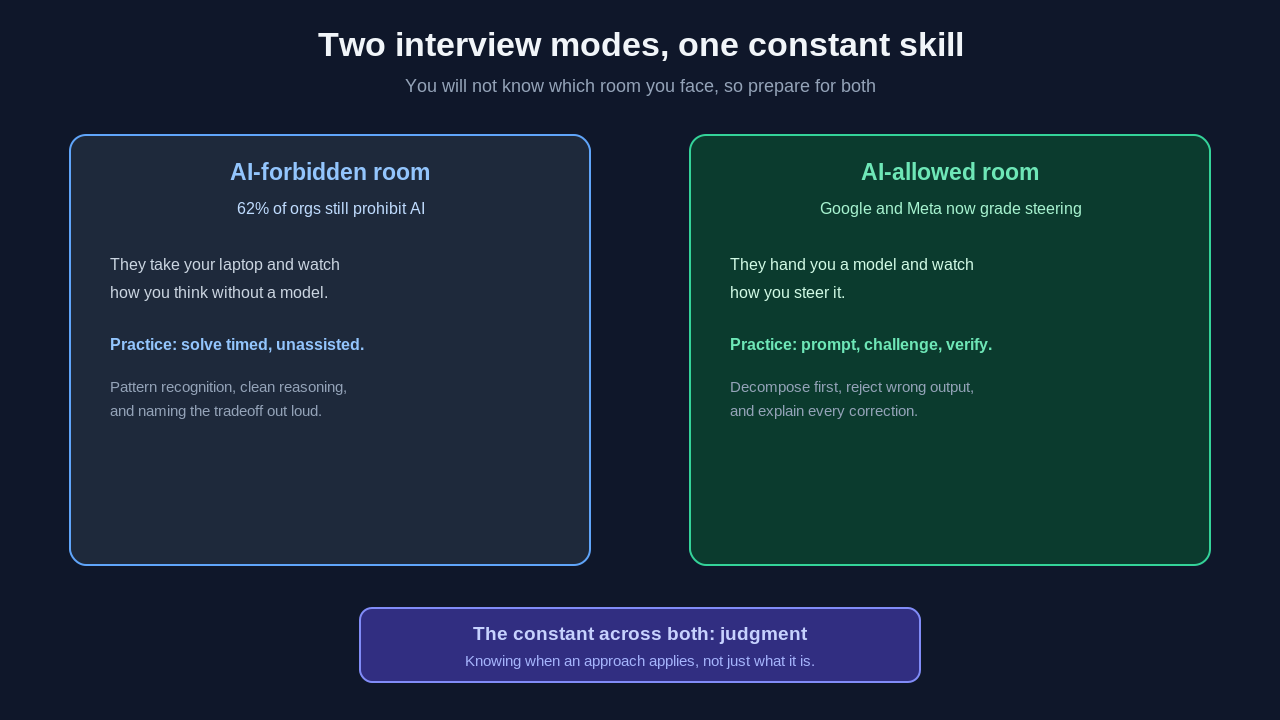
Second, the rest of the industry is split. A CoderPad survey found roughly 42 percent of organizations now use AI somewhere in technical assessment, while about 62 percent still prohibit it during a live job interview. You will not know which room you face, so prepare for both: the room that hands you a model and grades how you steer it, and the room that takes your laptop and watches how you think.
The Skills That Can't Be Faked
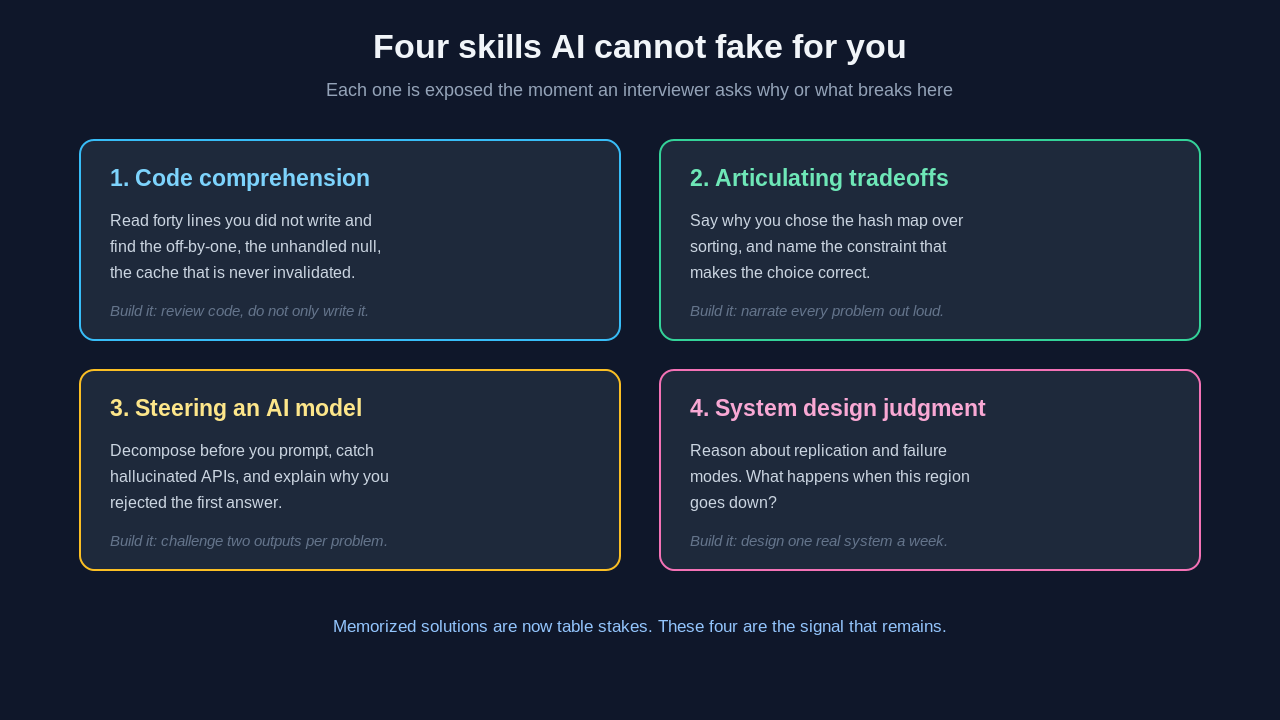
A skill that can be faked is one an AI produces on demand: a clean implementation of a known algorithm, a textbook definition, a correct function. A skill that cannot be faked lives in the gap between knowing the words and knowing when they apply. Four separate offers from rejections in 2026.
1. Code comprehension under time pressure
The fastest-growing format is not "write this function." It is "here is a function, tell me what is wrong with it." When the model generates code in seconds, the bottleneck moves to reading it. Can you scan forty lines you did not write, find the off-by-one, spot the unhandled null, and notice the cache is never invalidated?
This is the skill behind the shift we covered in why companies move from solve this problem to explain this code. The follow-up question always exposes it. The interviewer points at a line and asks what happens if the list is empty, and either you traced the code or you did not.
To build it, stop only solving problems and start reviewing them. Take an AI-generated solution, then find three things that could break before you trust it. Read pull requests and predict the review comments before you scroll down.
2. Articulating tradeoffs out loud
A model will give you a hash map solution and a sorting solution. It will not, in the pressured silence of a job interview, say "I would use the hash map here because reads dominate and we can afford the memory, but on an embedded device I would sort in place." That single sentence bundles a judgment, a constraint, and a communication act, and it is the most reliable senior-versus-junior signal interviewers report.
def two_sum_hashmap(nums, target):
    seen = {}                      # O(n) time, O(n) extra space
    for i, n in enumerate(nums):
        if target - n in seen:     # trades memory for one pass
            return [seen[target - n], i]
        seen[n] = i
    return []
The point of the snippet is the comment, not the code. In the AI era you earn credit for the second sentence, not the first. To build it, narrate every practice problem out loud and finish the sentence "I am choosing X over Y because the constraint is Z." If you cannot name the constraint, you do not understand the problem yet.
3. Prompting and steering an AI model
In the AI-allowed rooms, the interview is partly about whether you can drive the tool. This is a gradable skill, and 45 percent of job seekers who claim AI fluency get caught in follow-ups because they have used a chatbot but never steered one under scrutiny.
Steering means you decompose the problem before you prompt, ask for the approach before the code, catch the model when it invents an API, and explain why you rejected its first answer. The interviewer watches whether you treat an ai powered assistant as an oracle (junior) or as a fast, sometimes wrong pair programmer (senior).
To build it, solve a problem with an assistant but challenge at least two of its outputs and explain each correction. This is where ai interview preparation tools earn their keep: use them to generate practice problems, then interrogate the output rather than copy it.
4. System design judgment
When implementation is cheap, architecture carries the signal. You cannot prompt your way through "what happens when this region goes down" if you have never reasoned about replication and failure modes. The fundamentals stay evergreen: caching, load balancing, partitioning, and consistency tradeoffs. Our breakdown of caching strategies and their failure modes models the reasoning these rounds reward, because it explains when each pattern breaks. To build it, design one real system a week end to end, then ask an AI to critique it and defend each decision.
A Six-Week AI Era Interview Preparation Strategy
Skills are nouns. Preparation is a verb. This plan builds the four skills above at roughly ten hours a week.
Weeks 1 to 2: patterns, not problems
Do not grind 300 problems. Learn the small set of patterns most questions reduce to, then practice recognizing which pattern a new problem belongs to. That philosophy drives why we teach 12 patterns instead of 2,500 problems at Levelop. For each pattern, implement the template once from memory, solve two problems, then read one AI-generated solution and critique it.
Weeks 3 to 4: add the AI layer
Now bring the model into practice. Run two passes per problem. Solve it yourself, timed, to keep the AI-forbidden room sharp. Then solve a fresh problem with an assistant, prompting for the approach first and narrating why. Keep a one-line log: the pattern, the tradeoff you named, and one thing the AI got wrong.
Weeks 5 to 6: pressure and communication
Comprehension collapses under nerves, so the last two weeks make your reasoning audible with a clock running. Do mock interviews, ideally with a human. The goal is not harder problems. It is steady, clear reasoning when your palms are sweaty.
How to Talk About AI Without Getting Caught
One trap sinks otherwise strong candidates. When you mention AI experience, expect a technical follow-up: "Tell me about a time it gave you wrong code and how you caught it." A vague answer downgrades both your AI claim and your honesty. The fix is not a trick. Use the tools on real work, learn their failure modes, and keep two or three concrete stories ready. The candidates who pass can say exactly where the model helped and exactly where it lied. That specificity cannot be faked.
The AI era did not make interview prep easier or harder. It moved the target, a shift IEEE-USA tracks across the whole industry. Memorized solutions are now table stakes the model provides for free, so the interview rewards what is left: reading code you did not write, naming the tradeoff out loud, steering the model instead of trusting it, and reasoning about systems not yet built. Build those four, practice both modes, and you walk into either room ready. For a structured path through the patterns and mock practice, start with the Levelop blog.
Frequently asked questions
Are coding interviews going away because of AI?
No. They are changing format, not disappearing. About 62 percent of organizations still prohibit AI in a live job interview, while a growing group including Google and Meta now allow it and grade how you steer the model. Judgment is the constant, which is why a pattern-based approach to ai interview preparation still works.
Should I prepare to use AI during the interview or not?
Prepare for both. Practice solving problems unassisted and timed, and separately with an assistant where you prompt for the approach, challenge the output, and explain corrections. Good interview preparation ai practice covers both modes because they reinforce the same fundamentals.
What skills can AI not fake in an interview?
Code comprehension under time pressure, articulating tradeoffs out loud, steering an AI model, and system design judgment. Each is exposed the moment an interviewer asks why or what breaks here. Map these to the job description you are targeting so your examples stay relevant.
How long does AI-era interview prep take?
A focused six-week plan at about ten hours a week suits most engineers with fundamentals: two weeks on patterns, two adding deliberate AI practice, and two on mock interviews. Consistency matters more than total hours.
Which ai interview preparation tools should I use?
Use any capable assistant such as Claude, ChatGPT, or Copilot to generate practice problems, simulate mock interviews, and critique your designs. The value is not the tool itself but how you use it: generate a draft, then interrogate the output, challenge wrong answers, and explain your corrections out loud, because that steering is exactly what an AI-allowed interview grades.