Apple Interview Questions in 2026: What to Expect
Most engineers walk into an Apple loop expecting a carbon copy of the Google or Meta process. It is not. Apple runs one of the most team-specific interview processes in big tech, and the apple interview questions you face depend heavily on which organization you are talking to. A role on the camera software team looks nothing like a role on the Maps backend team, and the two interview loops can feel like they belong to different companies.
This guide breaks down what Apple interview questions actually look like in 2026, with a heavy focus on the coding rounds, because that is where most candidates lose the offer. If you want the broader picture across companies first, start with our complete coding interview preparation guide, then come back here for the Apple-specific details. By the end you will know the shape of the interview process, the data structures and algorithms Apple tends to test, how the behavioral and system design interviews work, and a realistic plan to prepare for an Apple loop without burning out.
How the Apple interview process works in 2026
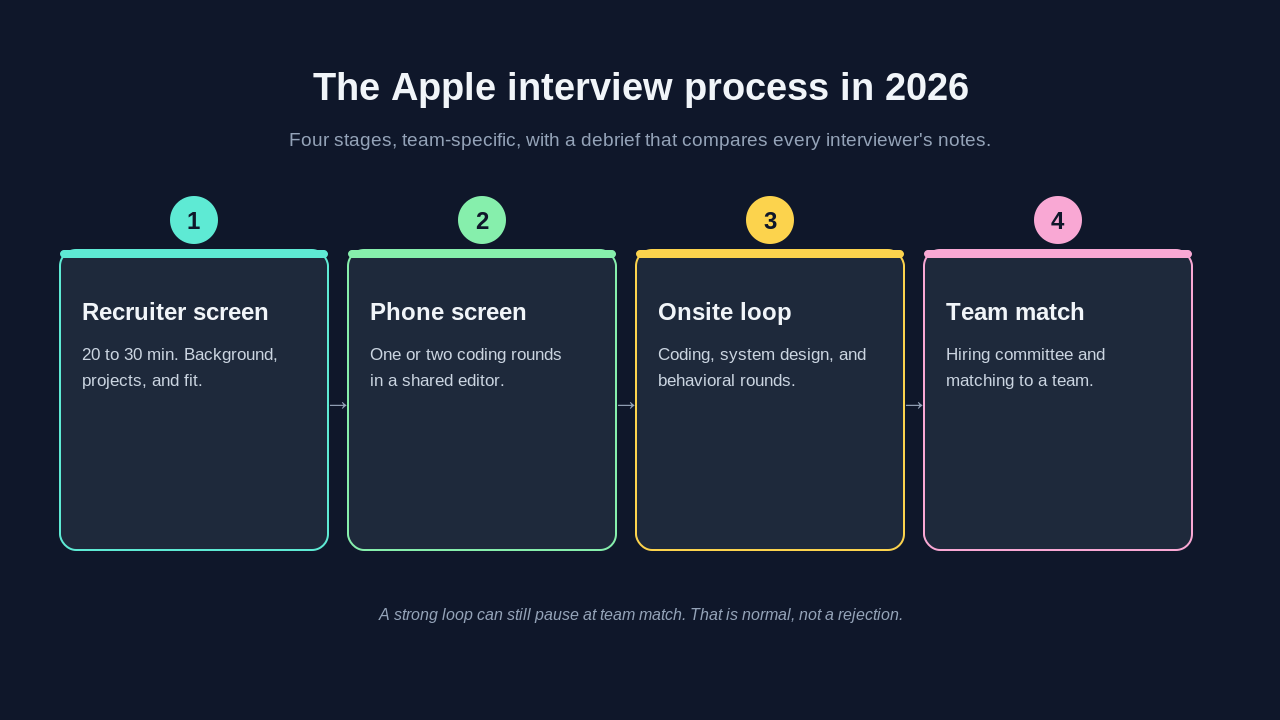
Apple's process has stayed remarkably stable while other tech companies have overhauled theirs. A typical loop for a software engineering role runs through four stages, and understanding each one helps you calibrate where to spend your interview prep time.
The recruiter screen comes first. This is a 20 to 30 minute call that is more substantive than the equivalent at most tech companies. Apple recruiters and hiring managers often ask specific questions about your background, the systems you have built, and why you want to be working at Apple in particular. Treat it as a real round, not a formality, and have a crisp two-minute summary of your most relevant project ready.
The technical phone screen follows. You get one or two 45 to 60 minute calls with an engineer on the hiring team. These are coding-heavy and usually run in a shared editor with no compiler, so practice writing code that runs correctly in your head. Expect one medium data structures problem and a follow-up that tweaks the constraints. This is where a lot of candidates who only practiced easy problems get filtered out.
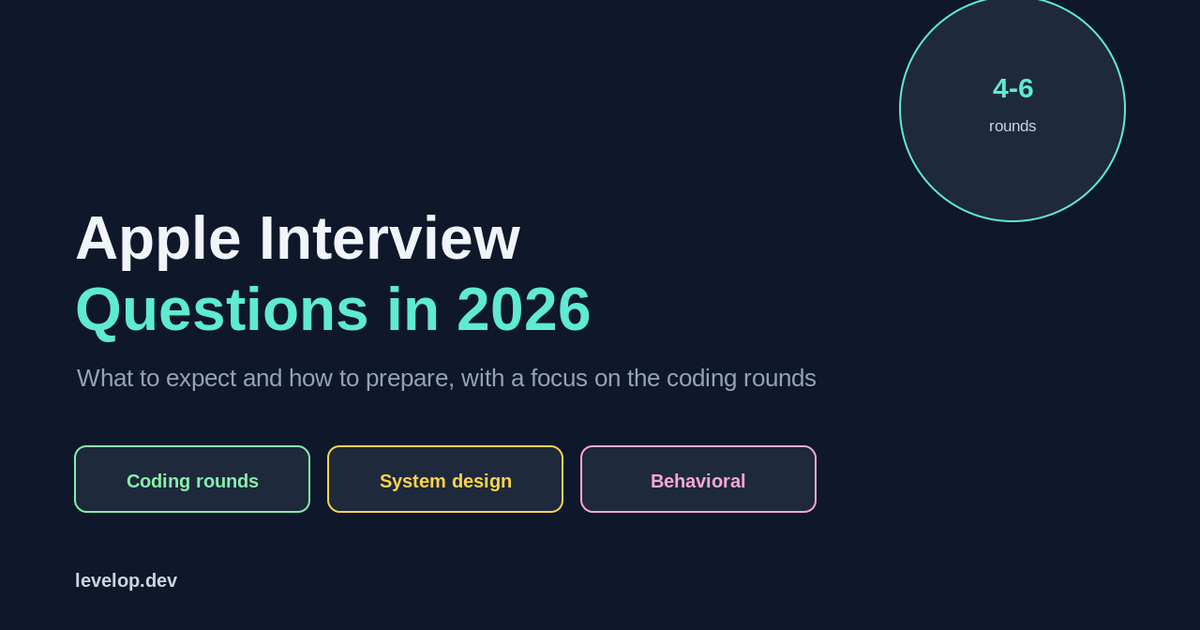
The onsite loop is the core of the process. In 2026 this is still often a mix of virtual and in-person rounds, typically four to six interviews. You will see two or three coding rounds, one or two system design interviews or domain rounds depending on seniority, and one or two behavioral conversations. Apple famously has each interviewer dig into a different dimension, and they compare notes afterward in a debrief led by the hiring manager. No single interviewer can sink you, but no single strong round can carry you either.
The team match and hiring committee step closes things out. Because Apple hires to a specific team rather than a general pool, a strong loop can still stall if the team headcount changes. This is normal and rarely a reflection of your performance. If you have a great onsite and then hear nothing for two weeks, it usually means the recruiter is working the team-match process behind the scenes, not that you failed.
Working at Apple: how the org shapes your interview
One thing that surprises candidates is how much the org they are interviewing for changes the questions. Apple is not a monolith. The company ships an enormous range of apple products, from silicon and operating systems to cloud services and machine learning frameworks, and each product organization interviews for the skills it actually needs.
Hardware-adjacent and systems teams lean into low-level knowledge: memory management, concurrency, and performance. Application and services teams focus on data structures and algorithms, API design, and product thinking. Machine learning teams add math and modeling questions on top of the standard coding question set. If you are interviewing at Apple for an iOS role, expect framework internals. If you are interviewing for a backend services role, expect distributed systems and system design interviews that look more like what you would see at other tech companies.
The practical lesson is to align your preparation with the org. Read about the products the team ships, understand the problems they solve, and be ready to explain why working at Apple on that specific product excites you. Generic enthusiasm about Tim Cook keynotes will not carry a technical loop, but genuine, specific interest in the team's product does help in the behavioral rounds.
Apple coding interview questions: what to expect
The coding rounds are where offers are won and lost. The apple coding interview leans toward practical, no-gimmick problems. You are less likely to get an obscure competitive-programming puzzle and more likely to get a coding question that resembles something a real apple software engineer might build, then get pushed on edge cases and memory usage.
Three themes show up again and again, and your problem solving approach matters as much as the final answer.
Arrays and strings dominate the phone screens. Two pointer and sliding window problems are common because they test whether you can reason about time and space without reaching for a heavyweight data structure. If those patterns feel shaky, our breakdown of every two pointer variation seen in interviews is a good tune-up before your loop.
Trees and graphs appear in the onsite. Apple interviewers like to see clean recursion and an honest discussion of the iterative alternative. Traversals, lowest common ancestor, and connected-components problems are all fair game, and they reward candidates who can reason about the space cost of the call stack.
Design-flavored coding rounds are increasingly common for mid and senior candidates. You might be asked to implement an LRU cache, a rate limiter, or a small in-memory data store, then extend it under new requirements. These blur the line between a coding question and a design question, and they test whether your data structures and algorithms knowledge holds up when the problem is open-ended.
Here is the kind of problem you should be able to solve cleanly and then optimize. Apple loves memory-conscious solutions, so the follow-up is almost always whether you can do this in constant extra space.
def move_zeros(nums):
    # Move all zeros to the end while keeping the order
    # of non-zero elements. In-place, O(1) extra space.
    insert_at = 0
    for read in range(len(nums)):
        if nums[read] != 0:
            nums[insert_at], nums[read] = nums[read], nums[insert_at]
            insert_at += 1
    return nums
The code is the easy part. What Apple grades is how you narrate the tradeoff between writes, reads, and clarity, and whether you catch the empty-array and all-zeros edge cases before the interviewer points them out. Strong candidates state their assumptions, name the time and space complexity up front, and test their own solution on a small example before declaring it done.
Data structures and algorithms Apple tests most
If you are short on time, prioritize the patterns that show up most often in the apple coding interview. Hash maps and sets for lookups and deduplication. Two pointers and sliding windows for array and string manipulation. Stacks and queues, including monotonic stacks for range problems. Binary search, not just on sorted arrays but on answer spaces. Trees, including binary search trees and balanced-tree reasoning. Graphs with breadth-first and depth-first search. And a working knowledge of dynamic programming, even if Apple asks it less often than some other tech companies.
You do not need to memorize a thousand problems. You need to recognize which pattern a coding question maps to within the first minute, because that recognition is what separates candidates who finish from candidates who freeze. Practice categorizing problems by pattern rather than by problem number.
System design and domain rounds
For mid-level and senior roles, expect at least one round that goes deep on design. There are two flavors, and which one you get depends on the team.
The classic system design round asks you to design a scalable service, something like a notification system, a photo storage backend, or a feed. The evaluation for these system design interviews is standard: requirements gathering, high-level architecture, data modeling, and how you handle scale and failure. Apple wants to see that you ask clarifying questions before drawing boxes, that you can estimate load, and that you reason about tradeoffs rather than reciting a memorized diagram. If your system design fundamentals need work, the same principles that show up at other tech companies apply, and you can compare notes with our writeup on what changed in Google coding interviews.
The domain round is where Apple differs from most software engineer interview processes. If you are interviewing for an embedded or systems role, you may get low-level design questions about memory management, concurrency, or how a specific subsystem works. iOS candidates get grilled on the framework internals they claim to know. The lesson is simple: do not list a technology on your resume unless you can defend it under pressure, because the domain round is designed to find the gap between what you wrote and what you understand.
Behavioral questions Apple actually asks
Apple's behavioral rounds are not fluff. The company cares about collaboration, attention to detail, and genuine product enthusiasm, and the hiring managers weigh these rounds heavily. Common behavioral interview questions in this bucket include why you want to be working at Apple specifically, a time you disagreed with a teammate and how it resolved, a project you are proud of and your exact contribution to it, and a time you failed and what you learned.
The strongest answers are specific and honest. Apple engineers can tell when you are reciting a rehearsed story, and the tell-me-about-a-failure question is designed to surface whether you can reflect without deflecting. Use the STAR method as a scaffold, not a script: describe the situation, the task, the action you personally took, and the measurable result. Prepare four or five real stories that you can flex to answer different specific questions, and make sure at least one of them shows you handling conflict and one shows you owning a mistake.
A subtle point that trips up experienced engineers: Apple wants your individual contribution, not your team's. When you say we, an interviewer will often stop you and ask what you did specifically. Practice telling your stories in the first person so that your role is unambiguous.
Apple compared to other tech companies
It helps to know how the apple software engineer loop compares to the rest of big tech, because it changes how you allocate your interview prep.
Compared to Google, Apple's coding problems are usually a notch more practical and a notch less algorithm-trivia heavy, but the communication bar is just as high. Compared to Meta, Apple moves more slowly and cares less about raw speed, so you have a little more room to think out loud. Compared to Amazon, Apple's behavioral rounds are less rigidly tied to a written list of leadership principles, though the underlying traits of ownership and collaboration still matter.
The through-line is that Apple rewards depth and craft over breadth and speed. That should shape your preparation: fewer problems, understood deeply, beats a huge count of problems skimmed. It also means that polishing how you communicate a solution pays off more at Apple than grinding one more medium problem.
An 8-week plan to prepare for an Apple interview
You do not need six months. You need eight focused weeks and a plan you actually follow.
- Weeks 1 to 2, build the base: arrays, strings, hash maps, and two pointers. Solve two problems a day and review the pattern behind each rather than memorizing solutions.
- Weeks 3 to 4, expand coverage: trees, graphs, recursion, and dynamic programming. Start doing problems out loud to build the narration habit Apple grades so heavily.
- Weeks 5 to 6, add design and mocks: one system design study block per day and at least two mock interviews a week. Rotate between coding and design so you stay sharp on both.
- Weeks 7 to 8, go Apple-specific: research your target team and its apple products, rehearse your behavioral stories with the STAR method, and taper your coding to stay warm without burning out.
For the full structured version of this plan across all companies, our 30-day interview sprint compresses the same ideas when you are short on time.
Common mistakes that sink Apple loops
A few patterns show up in almost every rejection debrief, and most of them are avoidable.
Coding in silence is the biggest one. Apple interviewers need to hear your problem solving process, and a correct solution delivered without explanation still scores poorly. Narrate your thinking even when you are stuck, because how you handle being stuck is itself a signal.
Overclaiming on the resume is a close second. If you say you are an expert in a framework, the domain round will test it, and a shaky answer there damages the whole loop. List what you genuinely know and be honest about the edges of your knowledge.
Ignoring edge cases loses points that are easy to keep. Apple's practical bent means memory limits, empty inputs, integer overflow, and concurrency hazards come up constantly. Build the habit of enumerating edge cases out loud before you finish.
Treating the behavioral round as a warmup is another common error. At Apple it carries real weight, and a flat why Apple answer can tank an otherwise strong day. Prepare it with the same seriousness you bring to the coding question rounds. Finally, failing to ask clarifying questions in the design round signals inexperience, since the interviewer is often deliberately vague to see whether you pin down the requirements first.
Where to go next
Apple interview questions reward depth over breadth. Pick the fundamentals that matter, practice narrating your thinking, and tailor the last two weeks to the specific team you are joining. If you want a structured path with pattern-based practice, explore the full library on the Levelop blog or start at levelop.dev. The most reliable way to prepare for an Apple loop is deliberate, pattern-based practice combined with honest mock interviews, not a last-minute grind.
For external, authoritative context while you prepare, three sources are worth bookmarking: Apple's official careers site for role descriptions and team pages, Levels.fyi for compensation and level benchmarks, and the LeetCode company-tagged problem sets for pattern frequency.
Frequently asked questions
How hard are Apple coding interviews compared to Google or Meta?
The raw algorithm difficulty is similar, usually LeetCode medium with occasional hard follow-ups. Apple problems tend to be more practical and less puzzle-like, but the bar on communication and edge-case handling is at least as high as at any other tech company. The apple coding interview rewards clarity and craft over speed.
What programming language should I use in an Apple interview?
Use the language you are most fluent in. Python, Java, C++, and Swift are all fine. For systems and embedded roles, C or C++ fluency helps because the domain round may go low-level. Do not switch to an unfamiliar language just because it sounds impressive to the hiring managers.
Does Apple ask system design questions?
Yes, for mid-level and senior roles. Expect one round that is either a classic scalable-system design or a domain-specific deep dive, depending on the team. Junior candidates usually get coding and behavioral rounds instead of full system design interviews.
How long does the Apple interview process take?
From recruiter screen to offer, most loops run two to five weeks. Team-match delays can extend this, especially if headcount shifts. A pause after a strong onsite is common and usually not a bad sign about your performance.
How should I prepare for the behavioral round at Apple?
Prepare four or five specific stories using the STAR method, covering conflict, failure, leadership, and a project you are proud of. Practice telling them in the first person so your individual contribution is clear, and connect at least one story to why you want to be working at Apple.
How many rounds are in an Apple onsite?
Typically four to six interviews: two or three coding rounds, one design or domain round, and one or two behavioral conversations, followed by an internal debrief among the interviewers and the hiring manager.
References
- Apple, Careers and how we hire, apple.com/careers.
- Levels.fyi, Apple compensation and level benchmarks, levels.fyi.
- LeetCode, Apple company-tagged problem set, leetcode.com.