
Coding Interview Preparation in 2026: The Complete Guide
Back with another one in the series where I break down the parts of interviewing that took me too long to figure out. This one is the big picture: how coding interview preparation actually works once you stop treating it like a problem-counting contest.
I failed four FAANG interviews before this clicked. I had solved hundreds of problems and could recognize a two pointers setup in my sleep. I still froze, because I had confused "I have seen this problem" with "I know how to solve problems I have never seen." Most coding interview preparation quietly optimizes for the wrong one.
What coding interview preparation actually looks like in 2026
The interview itself has not changed much. You get a problem, you write code, you talk through your reasoning while a stranger watches. What changed is the noise around it: more tools, more "one weird trick" content, and now AI in the room on both sides.
Strip it back and coding interview preparation is three abilities. Reading a problem and mapping it to a known shape. Writing correct code under mild time pressure without a compiler. Explaining what you are doing so the interviewer trusts your thinking. Everything useful feeds one of those three. If an activity does not sharpen pattern recognition, coding fluency, or communication, it is optional.
The mistake almost everyone makes
The default advice is to grind: pick a list of 300 or 2500 problems and do them until interviews arrive. I did exactly this. It felt productive because the number went up. It was mostly wasted.
Interview problems are not memorization targets, they are variations on a small set of underlying patterns. Grind by volume and you learn to recognize specific problems instead of the pattern beneath them. Change one constraint and the surface looks unfamiliar. I wrote more about this in why Levelop teaches 12 patterns instead of 2500 problems. Coverage is an illusion. You cannot see every problem, but you can learn every pattern.
The data structures and algorithms patterns that carry most interviews
If you are figuring out how to prepare for coding interview rounds efficiently, start here: learn to recognize and implement a compact set of patterns and you cover the large majority of what gets asked. These earned their place for me.
Two pointers, sliding window, and binary search
When a problem mentions a contiguous subarray, a sorted array, or "find a pair that sums to," reach for two pointers. The sliding window variant handles the longest substring or subarray that satisfies a constraint. And any sorted input where you need to find the middle fast is a binary search tell. The signal is a linear or sorted structure plus a constraint you can tighten.
Hash maps as the support structure
Half of all clean solutions have a hash map doing the heavy lifting: counting, deduping, remembering "have I seen this," mapping value to index. It is rarely the headline, but when you think "I wish I could look this up in constant time," reach for it.
Breadth first search and depth first search
Grids, a binary tree, dependency ordering, shortest path in an unweighted graph. If the problem has nodes and connections, traversal is the tool. Use breadth first search (BFS) when the shortest path or level matters, and depth first search (DFS) when you need to explore every branch or backtrack.
Heaps and intervals
Any phrasing like "k largest," "k closest," or "give me the best one repeatedly in log time" is a heap. And when a problem hands you ranges, sort by start and scan: that is how you merge intervals or count overlaps.
Dynamic programming for overlapping choices
The scary one. But dynamic programming is just "this problem breaks into smaller versions of itself, and I keep recomputing the same subproblems, so I store them." When choices compound and subproblems repeat, that is DP knocking. I broke down how I stopped fearing it in the dynamic programming patterns write-up. Notice how few coding interview patterns there are. That is the point.
A realistic preparation timeline
How long does coding interview preparation take? It depends on your baseline, but a working engineer with rusty fundamentals can get ready in about eight weeks of focused effort.
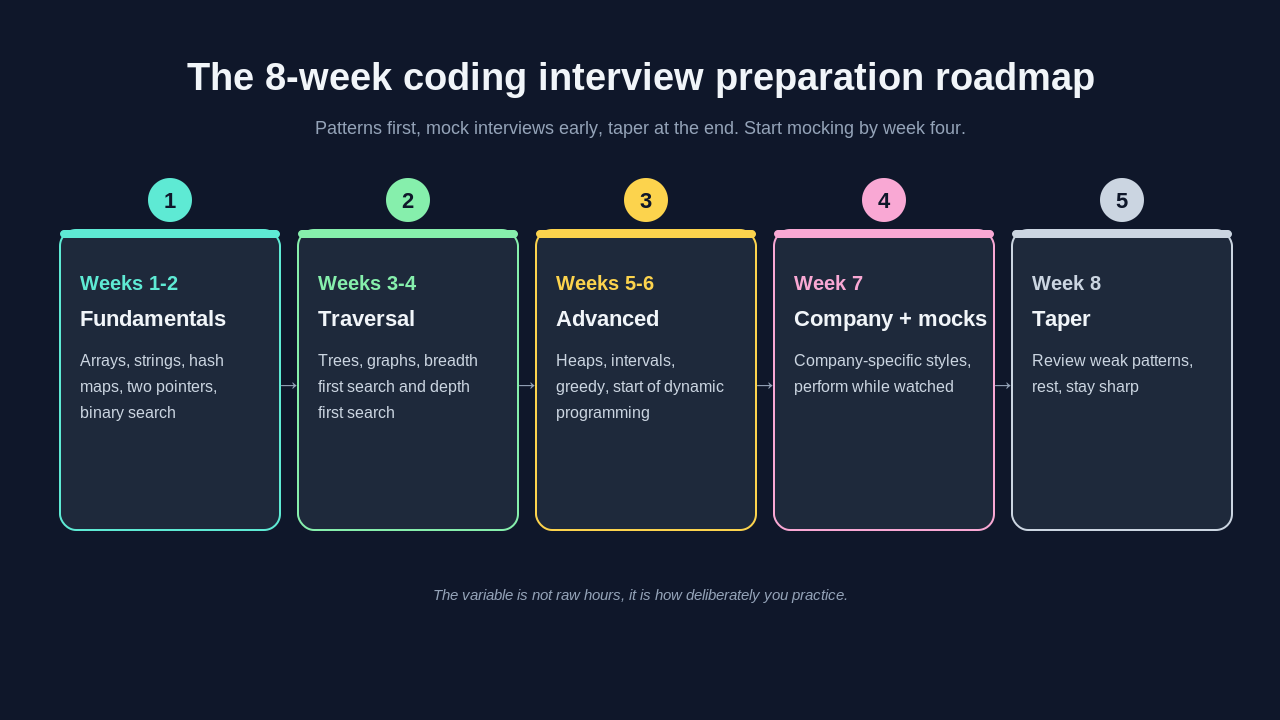
- Weeks 1 to 2, fundamentals: arrays, strings, hash maps, two pointers, binary search. Done when you can implement each from scratch without lookup.
- Weeks 3 to 4, traversal: trees, graphs, breadth first search and depth first search. Done when you can traverse any structure and explain the choice.
- Weeks 5 to 6, advanced: heaps, intervals, greedy, and the start of dynamic programming. Done when you recognize the pattern before you code.
- Week 7, company-specific styles and mock interviews. Done when you can perform under someone watching.
- Week 8, review weak patterns, rest, light practice. Done when you are sharp, not fried.
The most common scheduling mistake is backloading mock interviews. The gap between solving a problem alone and solving it while narrating to a human is enormous, and reps are the only way to close it. Start mocking by week four even if you feel unready.
How to actually practice a problem
Solving is not the same as practicing. When I just solved, I got the answer, felt good, and learned almost nothing. The version that worked: give yourself 25 to 35 minutes, try the problem cold, and if you are still stuck read only the approach, not the code. Two days later, re-solve from a blank editor. If you cannot, you recognized it, you did not learn it.
Here is the two pointers template I drilled until it was automatic, so the skeleton frees my attention for the actual problem:
def two_sum_sorted(nums, target):
    left, right = 0, len(nums) - 1
    while left < right:
        current = nums[left] + nums[right]
        if current == target:
            return [left, right]
        elif current < target:
            left += 1   # need a bigger sum
        else:
            right -= 1  # need a smaller sum
    return []
And the BFS skeleton, which shows up constantly on grids and trees:
from collections import deque

def bfs(start, neighbors):
    queue = deque([start])
    seen = {start}
    while queue:
        node = queue.popleft()
        for nxt in neighbors(node):
            if nxt not in seen:
                seen.add(nxt)     # mark on enqueue, not dequeue
                queue.append(nxt)
    return seen
Marking seen on enqueue rather than dequeue was a real bug I shipped in an interview, adding the same node to the queue twice. Small detail, wrong answer.
Company-specific preparation
Once fundamentals are solid, the last two weeks are about the specific company. The patterns are the same everywhere, but the emphasis is not. Some companies reward raw speed and better time complexity, some reward how you communicate tradeoffs.
For Google, the bar is clean problem solving with clear communication, and the process has some 2026 wrinkles worth knowing. I covered them in Google coding interviews in 2026. If Google or Apple is your target, read the company breakdowns close to your interview date so details are fresh. Know the format, know how many rounds, and do at least two mocks in that company's style.
What genuinely changed in 2026: AI in the room
This is the real shift. AI assistants can solve most standard interview problems instantly, which pushed companies to adapt: more live collaboration, more follow-ups that probe whether you understand your own solution, more emphasis on the parts a model cannot fake. I wrote about it in how AI is breaking the coding interview.
The takeaway for your preparation: use AI as a study partner, not a crutch. Have it critique your approach, generate pattern variations, or quiz you on edge cases. But do your first attempt cold, because the skill being tested is the one you build when nobody is helping. I reviewed which tools actually help in AI mock interview tools.
Common mistakes I made so you do not have to
I ignored communication until my third failed interview. I would go quiet, solve the whole thing in my head, then write it silently. Silence reads as lost.
I optimized prematurely, jumping for the clever solution and running out of time, when stating the brute force first would have shown structured thinking and left me a fallback.
I skipped edge cases: empty input, single element, duplicates, negatives. I lost problems I had solved correctly because I never tested the boundary the interviewer was waiting for.
And the big one: I confused activity with progress. Do not measure your coding interview preparation by problems touched. Measure it by patterns you can implement cold and explain clearly.
Frequently asked questions
How long does coding interview preparation take?
For a working engineer with a computer science foundation but rusty skills, about eight weeks of focused, consistent effort is realistic. Starting from little algorithmic background, plan for three to four months. The variable is not raw hours, it is how deliberately you practice.
How many problems should I solve?
Fewer than you think, practiced more deeply. A well-chosen set of 100 to 150 problems, re-solved from scratch until the patterns are automatic, beats blasting through 500 once. If you can implement the core data structures and algorithms patterns from a blank editor and explain them, you are ready.
Is LeetCode grinding still worth it in 2026?
Practicing real problems is worth it. Grinding by raw count is not. Use a problem bank to drill patterns and build fluency, but organize practice around patterns rather than a linear list, and always re-solve rather than just recognizing.
Do I need to prepare differently because of AI interviews?
Somewhat. The fundamentals are unchanged: patterns, clean code, clear communication. What is elevated is the human-only part, reasoning out loud and adapting when a problem shifts. Use AI to critique and quiz you, but attempt problems cold first.
What should I do the week before the interview?
Taper. Review weak patterns, do one or two light mocks, and re-solve a handful of problems you already know to keep them warm. Do not cram new material. Walking in sharp and rested beats walking in exhausted.
Where to go from here
If you want the pattern-first structure this guide describes, that is exactly how the practice tracks on Levelop are built, a small set of patterns taught deeply. You can browse the rest of the interview writing on the Levelop blog, including the company breakdowns and AI-era pieces linked above.
The whole thing reduces to three skills and a handful of patterns. Pick the timeline, drill the patterns cold, mock early, and talk while you code. That is coding interview preparation that survives contact with a real interview.
References
- Gayle Laakmann McDowell, Cracking the Coding Interview, careercup.com.
- LeetCode, problem bank and patterns, leetcode.com.
- Google Careers, how we hire and interview guidance, google.com/about/careers.
- NeetCode, curated pattern-based problem roadmap, neetcode.io.