
How to Prepare for Google Coding Interview Questions in 2026
Most people who ask how to prepare for a Google coding interview start by grinding a random list of 300 problems and hoping something sticks. That approach burns you out by week three and still leaves gaps in the patterns Google actually tests. There is a better way, and it fits in eight focused weeks.
This guide lays out a realistic, week-by-week plan to prepare for the google coding interview questions you will actually face in 2026, built around patterns instead of problem counts. If you want the wider view across companies first, start with our complete coding interview preparation guide, then come back here for the Google-specific plan. By the end you will know what Google grades, how to structure your study weeks, how to run mock interviews that actually move the needle, and the mistakes that quietly sink strong engineers.
What the Google coding interview actually tests in 2026
Before you plan how to prepare, you need to know what you are preparing for. Google has refined its process over the years, but the core has stayed stable even as the questions get harder to game. For the full breakdown of what shifted this year, read our writeup on what changed in Google coding interviews. The short version is that Google is testing four signals, and every round is designed to surface at least one of them. The specific google coding interview questions change constantly, but those four signals do not, which is why preparing for the signals beats memorizing a question bank.
The first signal is general cognitive ability, which in practice means how you break down an ambiguous problem. The second is coding, meaning whether you can translate an idea into clean, correct code under time pressure. The third is your grasp of data structures and algorithms, the raw toolkit. The fourth is what Google calls "Googleyness and leadership," surfaced mostly in the behavioral round but also in how you collaborate with the interviewer during coding.
The practical consequence is that raw volume matters far less than most candidates believe. A person who has solved 120 problems and can explain the pattern behind each one will outperform someone who has rushed through 400 and remembers none of them. That is the entire premise of the plan below.
Before you start: an honest self-assessment
Eight weeks is enough time only if you spend it on the right things. Spend an hour before week one taking stock. Can you implement a hash map based two-sum without looking anything up? Can you write a clean breadth-first search on a graph from memory? Can you explain the time and space complexity of your own solution without hedging?
If most of those feel shaky, you are starting from foundations, and that is fine. The plan accounts for it. If they feel comfortable, you can compress the first two weeks and spend the extra time on mock interviews, which is where most of the real improvement happens anyway.
Be honest here. The most common reason people fail to prepare well for a Google coding interview is that they overestimate where they are starting from, skip the fundamentals, and then freeze on a medium problem in the real loop.
The 8-week plan at a glance
Here is the shape of the eight weeks before we go deep on each phase. Treat it as two hours on weekdays and a longer block on weekends, roughly 12 to 15 hours a week. If you have less time, stretch the plan to twelve weeks rather than cramming.
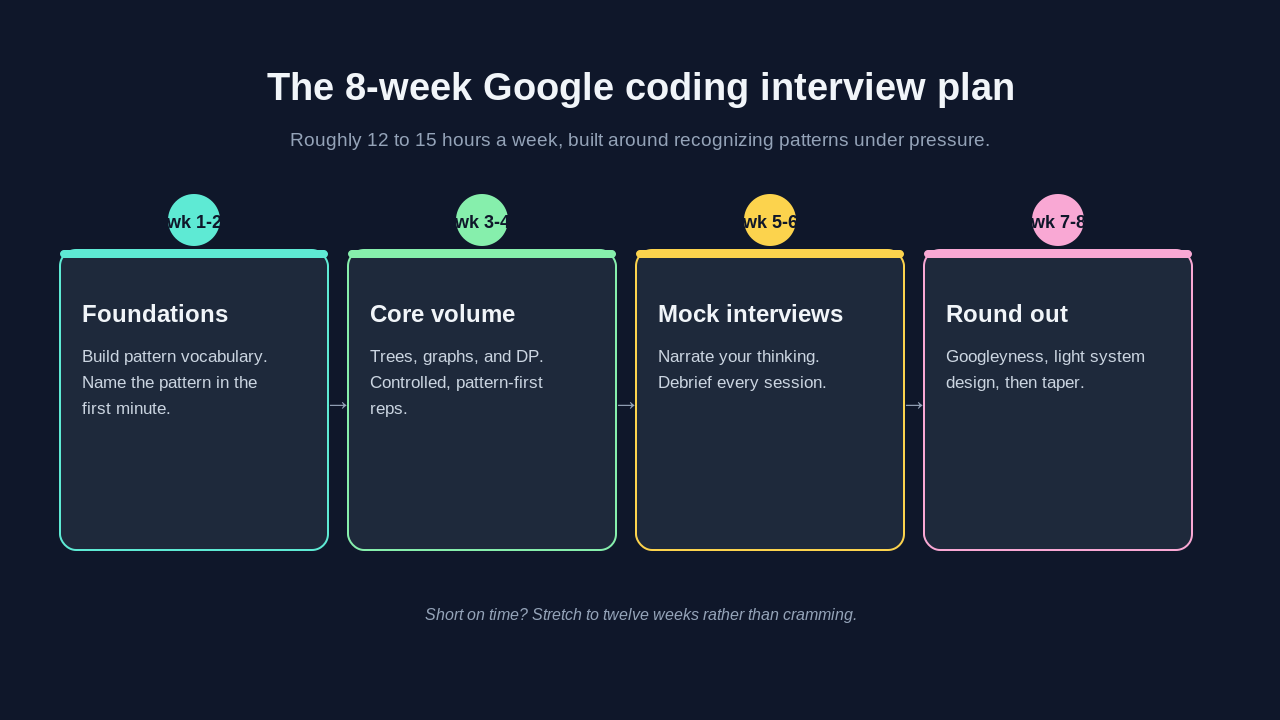
The first two weeks build your pattern vocabulary. Weeks three and four add volume across the core patterns. Weeks five and six shift the center of gravity to mock interviews and communication. The final two weeks cover Googleyness, a light pass on system design for the phone-screen-plus level, and a deliberate taper so you walk in sharp rather than fried.
Weeks 1 and 2: Foundations and pattern vocabulary
The goal of the first fortnight is not to solve hard problems. It is to build a mental index of patterns so that when you see a new problem, you can name the pattern within the first minute. That recognition is the single highest-leverage skill in the entire interview.
Spend these two weeks on the workhorse patterns: hash maps for lookups and deduplication, two pointers and sliding windows for arrays and strings, stacks and queues, binary search on both sorted arrays and answer spaces, and the two core graph traversals. If two pointers feel fuzzy, our breakdown of the two pointers pattern hiding inside every sorted-array problem is a fast way to get the templates into your hands.
For each pattern, solve three to five problems, but do it deliberately. After each one, write a single sentence explaining why that pattern fit the problem. That sentence is worth more than the solution.
def longest_unique_substring(s):
    """Longest substring without repeating characters.
    Classic sliding window: expand right, shrink left on a
    duplicate. O(n) time, O(k) space for the window set."""
    seen = {}
    left = 0
    best = 0
    for right, ch in enumerate(s):
        if ch in seen and seen[ch] >= left:
            left = seen[ch] + 1
        seen[ch] = right
        best = max(best, right - left + 1)
    return best
The code above is less important than the narration you practice alongside it. In a Google coding interview you are graded on whether you can explain why the window never moves backward, not just on whether it runs.
Weeks 3 and 4: Core patterns and controlled volume
Now you add volume, but stay pattern-first. These two weeks cover trees and recursion, backtracking, heaps and priority queues, intervals, and an introduction to dynamic programming. Google leans on trees, graphs, and dynamic programming more than most companies, so give them extra reps.
Aim for four to six problems on weekdays and a longer weekend session that mixes patterns so you practice recognition under uncertainty. The mixing matters. In the real loop nobody tells you the category, so practicing a block of twenty tree problems back to back builds false confidence. Shuffle them.
Dynamic programming deserves special attention because it is where candidates panic. You do not need to master every variant. You need to recognize when a problem has overlapping subproblems and optimal substructure, define the state clearly, and write the recurrence. If you can do that reliably on medium problems, you are ahead of most of the field.
By the end of week four you should be able to look at a fresh medium, name the pattern, sketch an approach out loud, and code a clean solution in about 25 minutes. If you are not there yet, spend a few extra days here before moving on. The next phase assumes this baseline.
Weeks 5 and 6: Mock interviews and communication
This is the phase that separates candidates who get the offer from candidates who "knew the answer but bombed the interview." Solving problems alone at your desk is a different skill from solving them while narrating your thinking to a stranger who is judging you. You have to practice the second thing directly.
Run at least two full mock interviews a week, ideally with a real person or a strong AI mock partner. If you use AI tools for this, our guide on AI-first interview prep covers how to use Claude or ChatGPT as a practice partner without letting them do the thinking for you. In each mock, force yourself to follow a fixed structure so it becomes automatic under stress.
Start by restating the problem and asking clarifying questions. State your assumptions. Talk through a brute-force idea and its complexity before optimizing. Only then write code, narrating as you go. Test your solution on a small example, including an edge case, before you declare it done. Google interviewers weight communication heavily, and this loop is exactly what they are looking for.
The debrief after each mock is where the growth happens. Write down the one moment you got stuck and why. Was it a pattern you did not recognize, a bug you did not catch, or nerves that made you go quiet? Patterns in your failures tell you where to spend week seven.
Weeks 7 and 8: Googleyness, light system design, and taper
The last stretch is about rounding out the profile and arriving sharp. Google's behavioral round, sometimes framed around Googleyness and leadership, is not a throwaway. Prepare three or four concrete stories using a simple structure: the situation, what you did specifically, and the measurable result. Cover a conflict with a teammate, a time you failed and what you learned, and a project you drove. Vague, rehearsed answers are easy to spot, so keep them specific and true.
If you are interviewing for a level where system design appears, do a light pass rather than a deep dive. For most early and mid roles the coding rounds decide the outcome, so do not let a system design rabbit hole eat your final week. Know the basics of load estimation, data modeling, and a few common architectures, and be ready to ask clarifying questions before drawing anything.
Then taper. In the final three or four days, stop learning new material. Re-solve a handful of problems you have already seen to rebuild confidence, review your pattern journal, and get your sleep in order. Walking in rested and calm beats squeezing in two more hard problems the night before.
# taper checklist
- Re-solve 5 mediums you already know cold
- Review the one-page pattern journal
- Rehearse 3 behavioral stories out loud, once each
- Prep your questions for the interviewer
- Sleep 8 hours the two nights before
How Google grades you: the four signals in practice
It helps to picture the scorecard your interviewers fill out. After each round they rate you on problem solving, coding, and communication, and they write concrete evidence for each. A "strong hire" needs consistent signal across rounds, not one brilliant round and three quiet ones.
This is why recovery matters more than perfection. If your first approach is wrong and you notice it, talk through why, and pivot to a better one, that is a positive signal, not a negative one. Interviewers see hundreds of candidates who freeze when their plan breaks. Being the person who stays calm and adapts is exactly the differentiator Google is looking for.
Common mistakes when preparing for a Google coding interview
A few failure modes show up again and again, and all of them are avoidable. The first is grinding volume without reflection, which builds a large pile of half-remembered solutions and no transferable pattern recognition. The second is practicing in silence, then being surprised that narrating your thinking feels alien in the real loop. The third is neglecting the behavioral round until the last minute, then improvising stories that land flat.
The fourth, and maybe the most common, is starting too many hard problems too early. It feels productive and it is mostly ego. Google's real rounds are dominated by mediums with a twist, so a candidate who owns mediums cold is better prepared than one who has struggled through a stack of hards.
The fifth is skipping the honest self-assessment and building a plan on top of shaky foundations. If you cannot write a clean breadth-first search from memory, no amount of hard dynamic programming practice will save you when the interviewer asks for one.
Tools and resources worth using
You do not need a shelf of books. A single structured problem source, a way to run realistic mocks, and a pattern-first study method will carry you further than any subscription. Cracking the Coding Interview remains a solid reference for fundamentals, and Google's own interview preparation guidance on its careers site is worth reading straight from the source so you calibrate to what they actually say they want.
For structured, pattern-based practice and realistic mock interviews, that is exactly what we built Levelop around, and you can find more interview strategy on the Levelop blog. Whatever tools you pick, the method matters more than the platform: patterns over volume, mocks over silent solving, and an honest debrief after every session.
Frequently asked questions
How long does it take to prepare for a Google coding interview?
For most working engineers, eight to twelve focused weeks is realistic. If you are rusty on fundamentals, lean toward twelve. If your data structures and algorithms are already sharp, you can compress to six by front-loading mock interviews. The number of weeks matters less than doing pattern-first study rather than mindless volume.
What are the most common google coding interview questions?
Google leans on arrays and strings, hash maps, trees and graphs, and dynamic programming, usually at the medium difficulty level with a twist. Rather than memorizing a list, learn to recognize which pattern a problem maps to, because the specific google coding interview questions rotate but the underlying patterns stay the same.
How many LeetCode problems should I solve to prepare for Google?
There is no magic number, and chasing one is a trap. Roughly 120 to 150 problems that you fully understand and can explain by pattern will serve you better than 400 you rushed. Depth of understanding beats raw count every time in a Google coding interview.
Is the Google coding interview harder than other companies?
Google leans a little more on trees, graphs, and dynamic programming, and it weights communication and problem decomposition heavily. It is not necessarily harder, but it is less forgiving of candidates who reach the answer without explaining their reasoning. Preparation that emphasizes narration and pattern recognition maps well to Google's process.
What programming language should I use for a Google coding interview?
Use the language you are fastest and cleanest in. Python is popular for its brevity, but Java, C++, and Go are all fine. Google cares about correct, readable code and clear reasoning, not the language on the screen. Pick one and know its standard library cold.
Do I need to prepare for system design for a Google coding interview?
It depends on the level. Entry and early-mid roles are decided mostly by coding rounds, so a light pass on system design basics is enough. Senior and staff loops include dedicated design rounds that deserve real preparation. Match your effort to the level you are targeting rather than over-investing early.
Where to go next
The plan above is deliberately simple: build pattern vocabulary, add controlled volume, drill mock interviews and communication, then round out and taper. Follow it honestly for eight weeks and you will walk into your Google coding interview prepared for how they actually grade, not just for the problems you happened to see. For the company-by-company view and the patterns that transfer everywhere, keep working through our coding interview preparation guide, and browse the rest of the interview writing on the Levelop blog.
References
- Google Careers, how we hire and interview guidance, google.com/about/careers.
- Gayle Laakmann McDowell, Cracking the Coding Interview, careercup.com.
- LeetCode, problem bank and pattern practice, leetcode.com.
- NeetCode, curated pattern-based problem roadmap, neetcode.io.