
AI Interview Prep: How to Use Claude and ChatGPT as Your Study Partner
Most people use AI for interview prep the wrong way. They paste a problem. They copy the answer. They feel productive. They learn almost nothing. Then they freeze in the real interview, because the model that solved every LeetCode problem is not sitting next to them at the whiteboard.
There is a better way. It has nothing to do with getting answers. Used well, a large language model becomes the study partner most candidates never had. It is available at 2am. It is patient. It will quiz you a hundred times. This guide is a practical playbook for AI interview prep that actually builds skill, using AI tools to run practice interviews rather than as a shortcut.
For the bigger picture on which human abilities still matter most, read our companion piece on the interview skills that cannot be faked. This post is the how-to underneath it.
Why an AI study partner beats grinding alone
Solo prep has a quiet failure mode. You read a solution. You nod along. You mistake recognition for recall. Learning science has a fix, and it is called retrieval practice. Pulling an idea out of your own memory beats re-reading it. Karpicke and Roediger showed that testing yourself builds far more durable learning than review, even though review feels easier. You can read a plain summary at retrievalpractice.org.
A model is a perfect retrieval partner. It can generate endless interview questions at your level. Then it checks your answers and gives concrete suggestions for improvement. Solo, you run out of questions, and you cannot grade your own explanation. With an AI partner, the loop tightens. You attempt. You get feedback. You attempt again.
That tight loop is the core of deliberate practice. Anders Ericsson described the framework in his research on experts. His summary for a general reader, The Making of an Expert, is worth reading first. The point is simple. AI does not know more than you. It turns passive studying into active rehearsal, and rehearsal is where skill grows.
Set the ground rules first
Before your first drill, tell the model how to behave. A default assistant is too eager. It hands you answers, which is exactly what you do not want. Fix that with a reusable system prompt.
You are my technical interview coach. Rules:
1. Never give a full solution unless I say "show me the answer."
2. When I am stuck, give ONE small hint, then wait.
3. After I attempt a problem, critique my approach: correctness,
   time and space complexity, edge cases, and how clearly I
   explained it out loud.
4. Ask me to state my approach in words before I write code.
5. Be direct. Point out sloppy reasoning. Do not flatter me.
Paste this at the start of a session. Or save it as a custom instruction so every chat starts in coaching mode. Both Claude and ChatGPT support saved instructions. Anthropic's prompt engineering guide helps if you want to tune the wording.
Drill 1: Concept explanation and the Feynman loop
Start each topic by explaining it back, out loud or in writing. Then let the model find the holes. This is the Feynman technique with an automated critic.
Pick a concept. Try "why does a hash map give amortized constant time lookups." Explain it in your own words. Ask the model to grade you, flag anything vague, and ask one sharp follow-up. A good follow-up here is "so what happens during a resize, and why is it still amortized constant." If you cannot answer, you just found a gap. You found it now, not in the room.
Run this loop for every pattern on your list. Sliding window. Two pointers. Monotonic stack. Union find. Topological sort. Dynamic programming. The goal is not to memorize solutions. The goal is to reason out loud under mild pressure. That is what interviewers score.
Drill 2: Mock coding rounds with a thinking partner
Here is where most people misuse AI. Do not ask for the solution. Ask the model to run the round like an interviewer.
Tell it: "Give me a medium array problem. Do not tell me the optimal approach. Let me talk through my thinking. Interrupt only to ask clarifying questions." Then solve it live. Restate the problem. State constraints. Propose a brute force. Then optimize. Ask for role specific problems that match the job description you are targeting, so your practice interviews map to the real interview questions you will face.
When you write code, paste it and ask for a critique, not a fix:
# Your attempt at "two sum"
def two_sum(nums, target):
    for i in range(len(nums)):
        for j in range(i + 1, len(nums)):
            if nums[i] + nums[j] == target:
                return [i, j]
    return []
Then ask: "What is the complexity, and where would a senior interviewer push me?" The model should walk you to the hash map through questions. It should not just rewrite the function. If it hands you the answer, remind it of rule one. The value is you closing the gap yourself while thinking out loud, because that narration is the skill.
For an honest look at dedicated tools, see our review of AI mock interview tools that actually prepare you.
Drill 3: System design rehearsal with AI as interviewer
System design suits an AI partner well. The format is a conversation, and there is no single right answer. Prompt the model to play interviewer: "Give me a system design prompt at the mid-level bar. Ask me to clarify requirements first. Push back when my estimates are vague. Do not design it for me."
Then run the round. Clarify functional and non-functional requirements. Estimate scale. Sketch the components. Defend your storage and caching choices out loud. When you say "I will add a cache," a sharp interviewer asks about your eviction policy and your cache invalidation plan. An AI partner will ask the same thing, as many times as you need.
This works for the same reason the coding drill works. You are rehearsing the narration and the tradeoffs. Reading a design doc teaches you the answer. Defending a design out loud teaches you the skill.
Drill 4: Behavioral prep and STAR refinement
Almost everyone underprepares behavioral rounds. They are easy to rehearse with a model. Feed it a rough story about a conflict or a failure. Ask it to restructure the story into STAR format: situation, task, action, result. Then ask it to probe like a bar raiser with specific questions. What was your specific contribution? What would you do differently? What was the measurable outcome?
There is a trap. Do not let the model write your stories. Invented achievements collapse the moment an interviewer probes for detail. Use the model to sharpen real experiences. Tighten the structure. Cut the rambling. Surface the metric you forgot. Keep every fact yours.
The line you do not cross
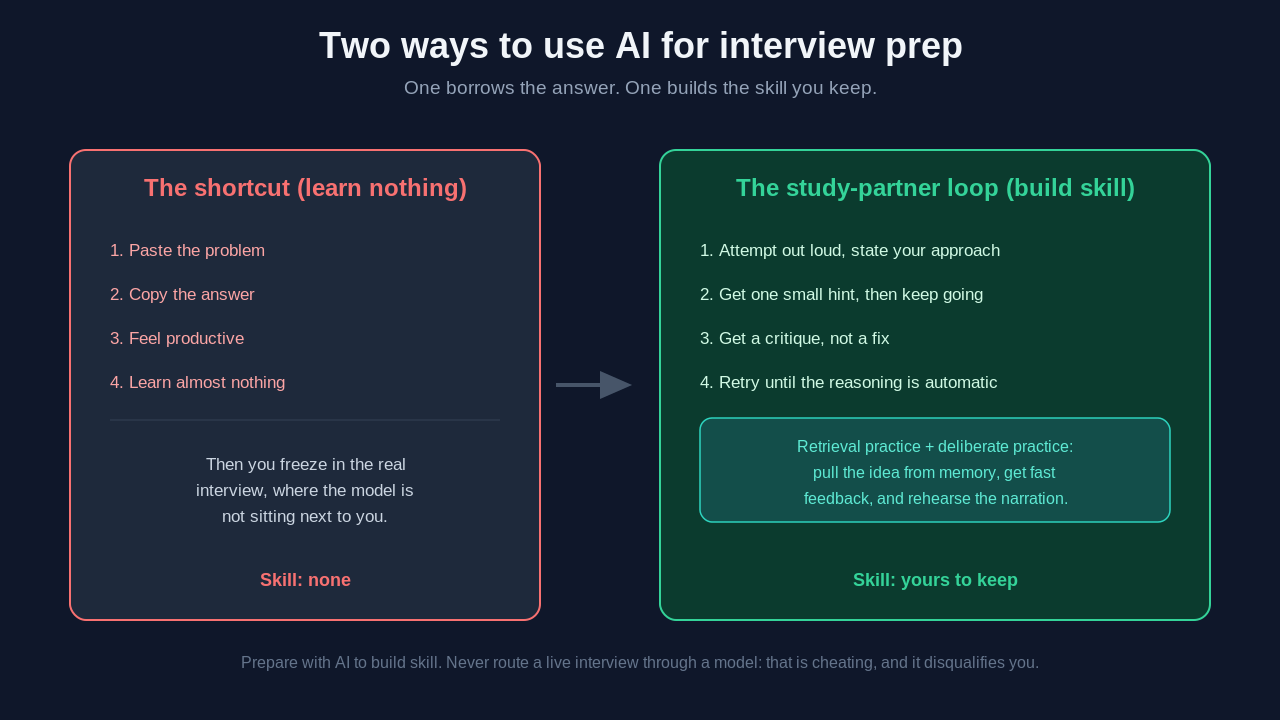
There is a bright line between AI interview preparation and cheating. It is thinner than many people admit. Preparing means building skill you keep after the tools are gone. Cheating means routing a live interview through a model in real time. That breaks the rules of nearly every process. It is also a bet that you will never do the job you are interviewing for.
We hold a clear stance at Levelop: augment the learner, do not replace the struggle. The struggle of working a problem to the edge of your ability is not a bug. It is the mechanism that builds skill. A partner that removes the struggle is quietly disqualifying you. If you want to see how far the cheating side has gone, we covered the AI interview arms race in depth.
The good news is that the honest path is also the effective one. Retrieval practice, deliberate practice, and out-loud rehearsal are exactly what a study partner is best at. None of them require crossing the line.
A one-week AI-assisted study plan
A model can pack a lot of practice into a focused week. Here is a structure you can adapt, one to two hours a day.
Day one: pick your five weakest patterns. Run the concept drill on each. Log every gap.
Day two and three: two mock coding rounds a day. Use the interviewer prompt. Narrate out loud. Attempt before asking for a critique.
Day four: system design. Run one full mock. Then redo the same prompt faster and cleaner.
Day five: behavioral. Turn three real stories into tight STAR structures. Have the model stress-test each one.
Day six: mixed simulation. Ask for a realistic loop of one coding round, one design chat, and one behavioral question. Take feedback only at the end.
Day seven: review your gap log. Re-drill only the shaky items. This final retrieval pass locks in the learning. After each real round, run a short post interview review with the model and turn its notes into interview tips for next time.
Where AI still falls short
An honest guide names the limits. A model does not know the exact bar of the company you are targeting. Its "mid-level prompt" is an average. It can be confidently wrong on complexity and edge cases, so you verify. It cannot read the room or feel the pressure of a live panel. It will also let you drill the wrong things efficiently if your plan is bad.
Use it for volume, feedback, and rehearsal. Use human mock interviews and structured platforms to calibrate against the real bar and the current job market. To see how the interview itself is shifting, read our piece on how AI is breaking the coding interview.
Frequently asked questions
Is ChatGPT interview prep considered cheating?
No. Preparing with AI is not cheating. Cheating is using a model during a live interview to generate answers. Using one beforehand to quiz yourself and rehearse is normal study. It is no different from a textbook or a practice partner.
Which is better for interview prep, Claude or ChatGPT?
Both are strong. How you prompt them matters more than which you pick. Set clear coaching rules first. A well-run session on either beats a lazy session on the better one. Try both. Keep the one whose explanations land for you.
How do I stop the AI from just giving me the answer?
Put it in the system prompt. Forbid full solutions unless you type a trigger phrase. Require one hint, then a pause. Make it ask for your verbal approach before any code. If it slips, remind it of the rule.
Can AI replace human mock interviews?
Not fully. AI is unmatched for volume and instant feedback. It cannot replicate live pressure or match a specific company's bar. Use AI for daily reps. Use humans for calibration. The combination is stronger than either alone.
How far ahead should I start AI interview preparation?
Start two to three weeks out. Retrieval practice needs time to build durable memory. Run a compressed daily plan in the final week. Cramming still beats nothing, but spaced retrieval over weeks holds up best under pressure.
Start building the skill, not borrowing the answer
AI interview prep is not about faster solutions. It is about turning a patient partner into a retrieval machine that makes you explain, attempt, and defend your reasoning until it is automatic. Set the rules. Run the drills. Respect the line between preparing and cheating. Use these AI tools to prepare for job interviews the honest way, and you will walk into the room with a skill you own, not a tool you hope to smuggle in.
Want a structured environment built around augmenting the learner? Explore what we are building at Levelop and read more on the Levelop blog.