AI Interview Cheating in 2026: Tools vs Detection
AI interview cheating went from a fringe trick to a real industry in about a year. Two markets now feed on the same fear.
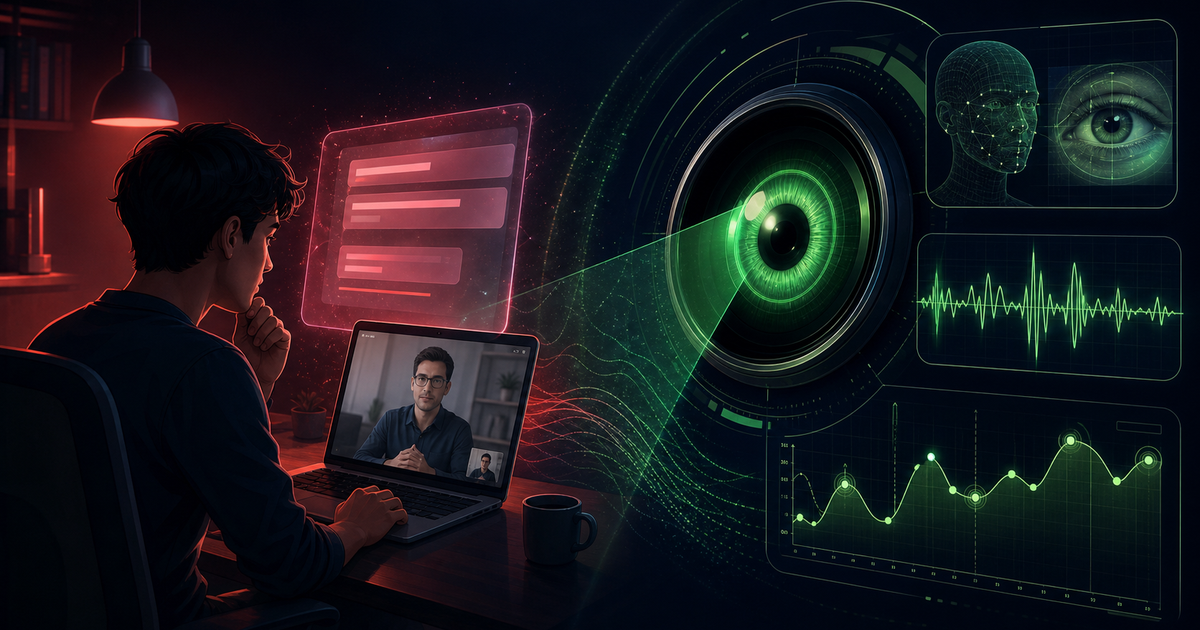
One sells software that whispers answers into a candidate's ear during a live coding interview. The other sells software that watches the candidate's eyes, voice, and typing to catch them.
Both raised real money. Both make big claims. And both make the interview worse for the honest engineer in the middle. Here is how each side works, and the one position that beats both.
The cheating side: how AI interview cheating tools work
In early 2025, a Columbia student named Roy Lee built Interview Coder, a hidden desktop app that fed AI answers to LeetCode problems during live interviews. He used it to land an Amazon internship, then wrote about it. Columbia moved to discipline him.
He did not stop. He rebranded the app as Cluely, gave it the tagline "Cheat on Everything," and raised a $5.3 million seed round plus a $15 million Series A from Andreessen Horowitz, per TechCrunch.
The numbers explain the panic. Fabric studied 19,368 interviews and found the cheating rate hit 38.5% in 2026, up from under 10% in mid-2025. When a third of candidates fake their answers, teams rebuild the whole process. I covered that collapse of trust in how the AI coding interview broke.
These coding-focused AI interview assistants all rely on one trick: the invisible overlay.
The new tools hook into the operating system's graphics pipeline. They draw the AI's answer onto the screen at a depth that screen-sharing software cannot capture.
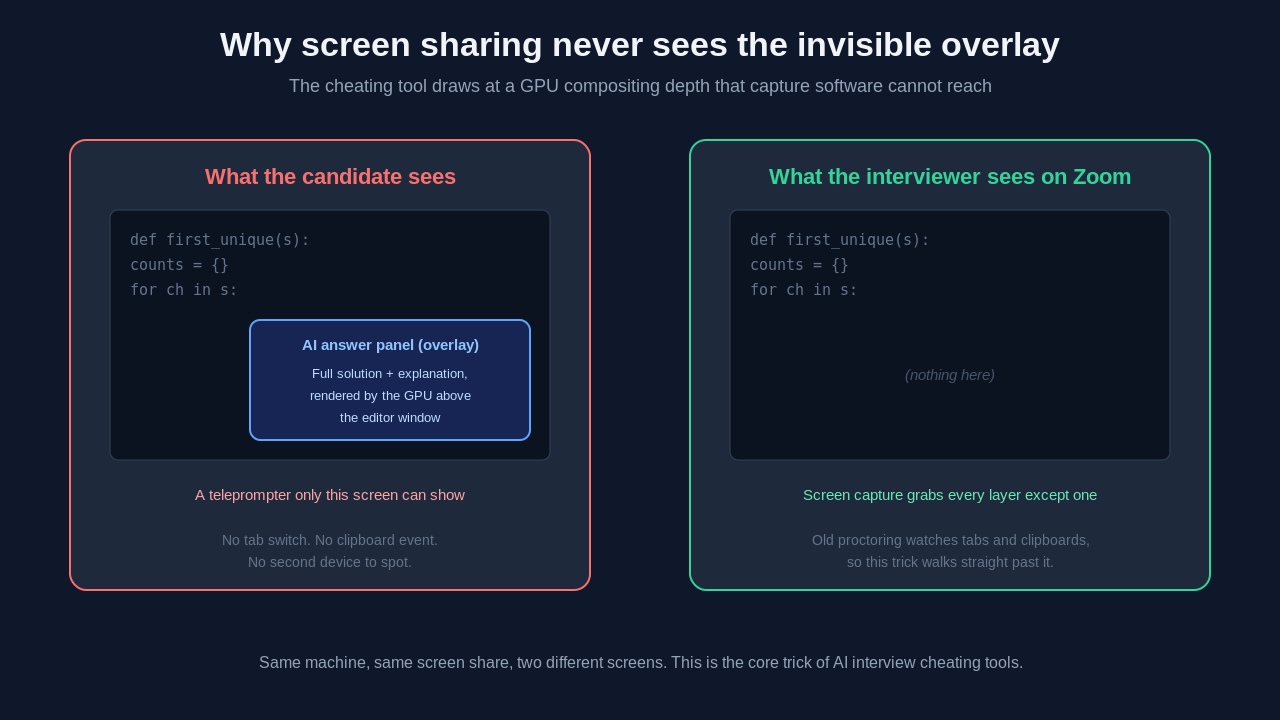
So the candidate sees a floating panel with the full solution. But when they share their screen on Zoom, the capture grabs everything except that panel. The interviewer sees a clean editor. The candidate reads off a teleprompter.
This is why old proctoring fails. It watches for tab switches and copy-paste events, and an AI interview assistant triggers neither.
Nothing switched tabs. Nothing hit the clipboard. The "second device" is a layer on the same machine.
The detection side: how AI interview cheating detection works
If you cannot catch the software, you watch the person. That is where 2026 detection lives. Some firms even add an AI interviewer for the first screen, then put a human on the follow-ups.
Modern online proctoring platforms stack several signals: eye-gaze tracking, screen-activity monitoring, audio analysis, and typing rhythm. The online proctoring vendors that InCruiter surveyed claim accuracy above 90% and flag risky moments for a human to review.
One signal beats all the others, and no overlay can hide it: timing. Thinking takes uneven time, and a hard sub-problem makes you pause longer than an easy one.
An AI tool answers at a steady speed, so a cheater shows the same four-second pause before an easy warm-up and a brutal optimization. That flat response time is the tell.
Then comes the move that breaks everything: the live follow-up. Picture a candidate who just produced this:
def first_unique(s):
    counts = {}
    for ch in s:
        counts[ch] = counts.get(ch, 0) + 1
    for i, ch in enumerate(s):
        if counts[ch] == 1:
            return i
    return -1
The code works. An overlay wrote it in seconds. Now the interviewer asks: why two passes? What breaks if the input is a stream you read once? If you did not reason your way there, you freeze. As SpaceComplexity puts it, if you cannot explain line seven, you did not write line seven. That one move turns a coding interview into a comprehension interview.
The escalation: bans and the return of the onsite
When detection gets costly, big companies change the venue.
Amazon now lets recruiters disqualify candidates caught using AI for real-time answers. Amazon and Google have both floated pulling key rounds back in person. A whiteboard in a conference room is the one place an overlay cannot render.
That fix costs everyone. Remote interviews opened doors for people who could not fly to Seattle on spec. Rolling them back punishes the honest remote candidate to stop the dishonest one.
The false positives hurt too. A 90% accuracy claim still flags real people. And the misses are not random: webcam-based online proctoring flags candidates with darker skin tones and certain disabilities more often, as reporting on these tools notes. Anxiety mimics the timing tell. A shared room mimics the second-voice flag.
So if you run hiring, build the hiring process so any flag prompts human review, never an automatic reject.
Why understanding is the only safe bet
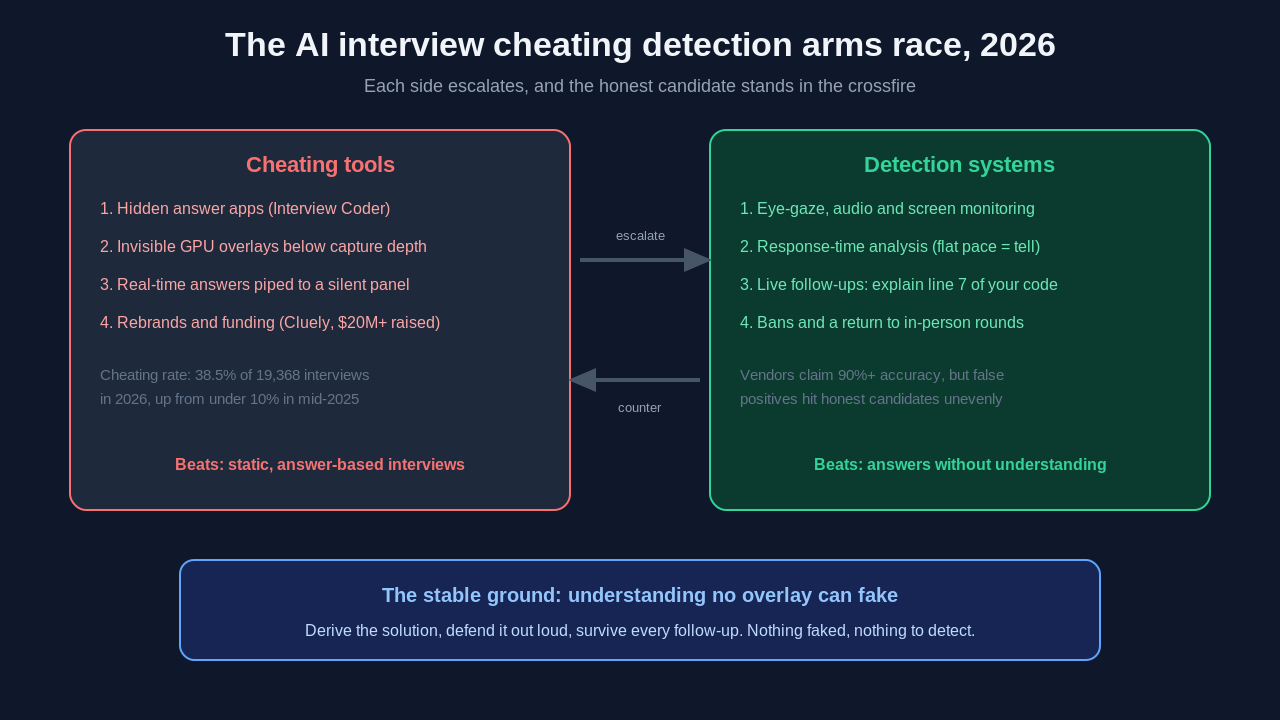
Look at the whole board. The cheating tools beat static, answer-based interviews. The detection tools beat people who cannot explain their own code. Both failures share one root: an answer without the reasoning.
So every escalation raises the value of real understanding. The follow-up layer is cheap, fair, and overlay-proof. An engineer who can derive a sliding-window solution and defend the tradeoff out loud is invisible to this whole fight. Nothing is faked, so there is nothing to detect.
This is why I reject the claim that patterns are dead in the AI era. The opposite holds. When the bar moves from "produce the answer" to "defend it live," pattern fluency matters more. AI can hand you code in agentic coding tools or a vibe-coding session, which is great for shipping real-world software and systems design work, and useless in a comprehension interview if you cannot read it.
To prepare, do three things. Explain every solution out loud, as if someone is probing it. Build pattern fluency in the core data structures, so you can read interview questions and spot the pattern fast, instead of the way most software engineers grind problem count. And run an AI mock interview that quizzes you on your own code, the honest mirror of the cheating tools. This kind of interview preparation pays off across all your job interviews, including the behavioral questions that round out most loops. That habit is what the Levelop blog is built around.
Frequently asked questions
What is the AI interview cheating detection arms race?
It is the race between tools that help candidates use AI in secret during live interviews and the detection systems that try to catch them. Each side adapts to the other, so the tactics change every few months.
How do companies detect AI cheating in coding interviews in 2026?
They blend signals: eye-gaze tracking, audio analysis, screen monitoring, and response-time analysis that spots an AI tool's steady pace. The strongest method is not software. It is the live follow-up question, where you must explain or change the code you supposedly wrote.
Are AI interview cheating tools like Cluely worth the risk?
For technical roles, no. A flag can mean instant rejection and a lasting mark in a company's hiring system. The tools also give answers without understanding, so you fail the follow-ups and struggle in the actual job.
Can honest candidates get falsely flagged?
Yes. Anxiety, slow internet, a shared room, or naturally looking away can all trip the signals. False-positive rates run higher for some groups, which is why a flag should trigger human review, not an auto-reject.
Will interviews go back to in-person?
Partly. Amazon and Google have discussed in-person or tightly controlled rounds because an overlay cannot render in a real room. Expect a hybrid: more onsite finals and more AI-resistant remote formats built on live code comprehension.
Want to interview well without playing the arms race? The Levelop blog teaches the 12 core patterns and the explain-out-loud habit that make you genuinely, unfakeably good.