
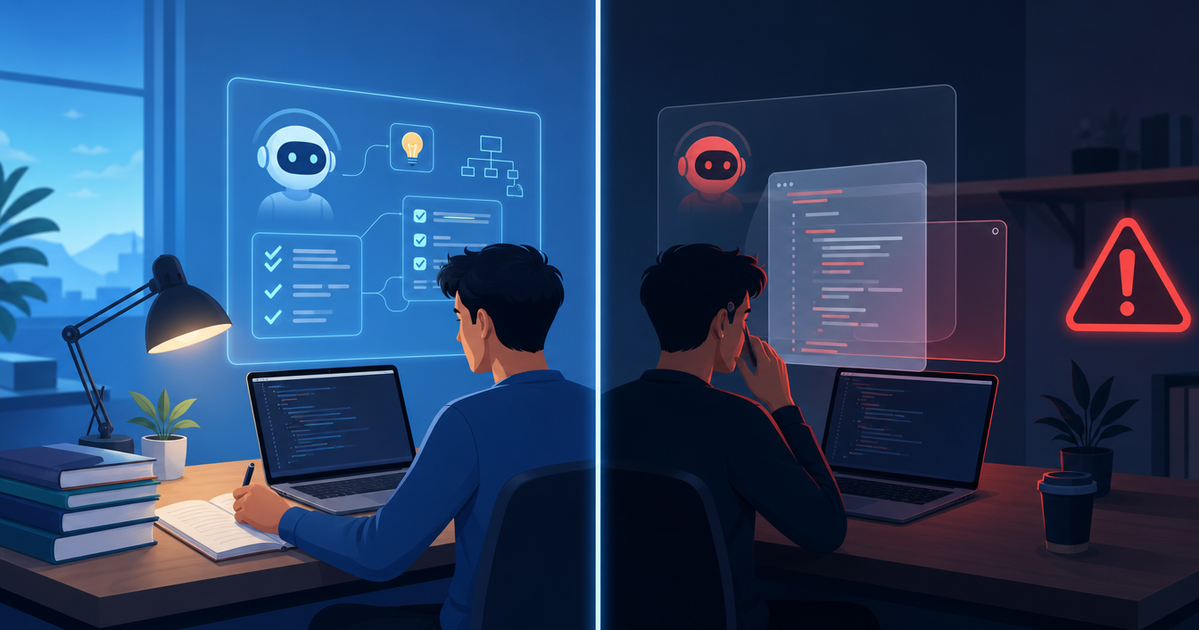
Using AI to prep for interviews vs using AI to cheat: the line is thinner than you think
Back with another one in the series, and this time it is less about an algorithm and more about a question I keep getting asked in DMs and over coffee: is using AI to get ready for interviews cheating? A lot of people ask it like they already feel guilty. They have been leaning on ChatGPT to drill problems, and somewhere in the back of their head a voice says maybe this is not allowed.
I have spent the last year building interview tooling at Levelop and watching how candidates actually study. So I want to walk through where I think the line sits, because the line between AI interview prep and AI interview cheating is thinner than most people realize, and getting it wrong can cost you an offer or your reputation.
The question everyone is quietly avoiding
Here is what makes this hard. The same tool that makes you a stronger engineer can also do your thinking for you, and the difference is not the tool. It is when you use it and what you do with the output.
Nobody blinks when you use a textbook to study. Nobody calls it cheating when you watch a lecture, or when you ask a senior engineer to review your approach. But paste the exact same request into an AI model and suddenly it feels murky. The murkiness is not really about AI. It is about the fact that AI collapses the distance between “help me understand this” and “do this for me” down to a single prompt. You can cross from one to the other without noticing.
So instead of asking whether AI is allowed, the better question is: are you building a skill you will still have when the tool is taken away, or are you renting an answer you cannot reproduce on your own?
What legitimate AI interview prep looks like
Let me start with the stuff I think is completely fine, because there is a lot of it and the fear around AI makes people forget that.
Using AI for interview prep is, at its core, having a tireless study partner. You are preparing on your own time, before anyone is evaluating you, and the goal is to walk into the room more capable than you walked out of your last one. A few concrete uses I would defend to anyone:
Explaining a concept you keep tripping over. If you never quite understood why a monotonic stack works, asking an AI to explain it three different ways until one clicks is exactly what a good tutor does.
Generating practice problems. “Give me five medium sliding window problems that are not on LeetCode’s front page” is a great prompt. You still have to solve them.
Reviewing your solution after you have written it. This is the big one. Solve the problem yourself, get it working or get stuck, and then ask the AI to critique your approach, point out edge cases you missed, or suggest a cleaner pattern. You did the reasoning. The AI graded it.
Mock behavioral rounds. Feeding an AI your STAR stories and asking it to poke holes in them is genuinely useful. So is rehearsing common behavioral interview questions like “tell me about a time you disagreed with your manager” out loud, then getting structured feedback on how you answer them.
The through-line in all of these is that you are the one doing the cognitive work. The AI is a mirror, a critic, or a problem generator. It is not the candidate.
Where it crosses into cheating
Now the other side. AI interview cheating is not a fuzzy concept once you see it clearly. It has a specific shape: using AI to misrepresent your ability during an actual evaluation.
Real-time answer feeding during a live interview. There is now a whole paid software category built for exactly this. Tools like Interview Coder, LockedIn AI, Cluely, and Leetcode Wizard run silently on a candidate’s laptop, listen to the interviewer through system audio, and surface answers on a transparent overlay the candidate reads while looking at the camera. This is not prep. This is impersonation.
Having AI write your take-home while you take credit for it. A take-home project is supposed to show how you think and build. If the commit history is really a transcript of prompts, you are shipping someone else’s judgment under your name.
Undisclosed AI in a live coding round where the interviewer expects your own work. The keyword is undisclosed. Some companies now hand you an AI and say use it. That is a different game with different rules, and I will come back to it.
The reason these are cheating and the study cases are not comes down to one word: representation. In prep, you are becoming more capable in private. In these cases, you are claiming a capability in a moment where someone is deciding whether it is real.
The gray zone is real, and it is where people get hurt
If it were only “study alone, good” versus “feed answers live, bad,” nobody would need an article. The trouble lives in the middle. Here is the spectrum I use when I am unsure.
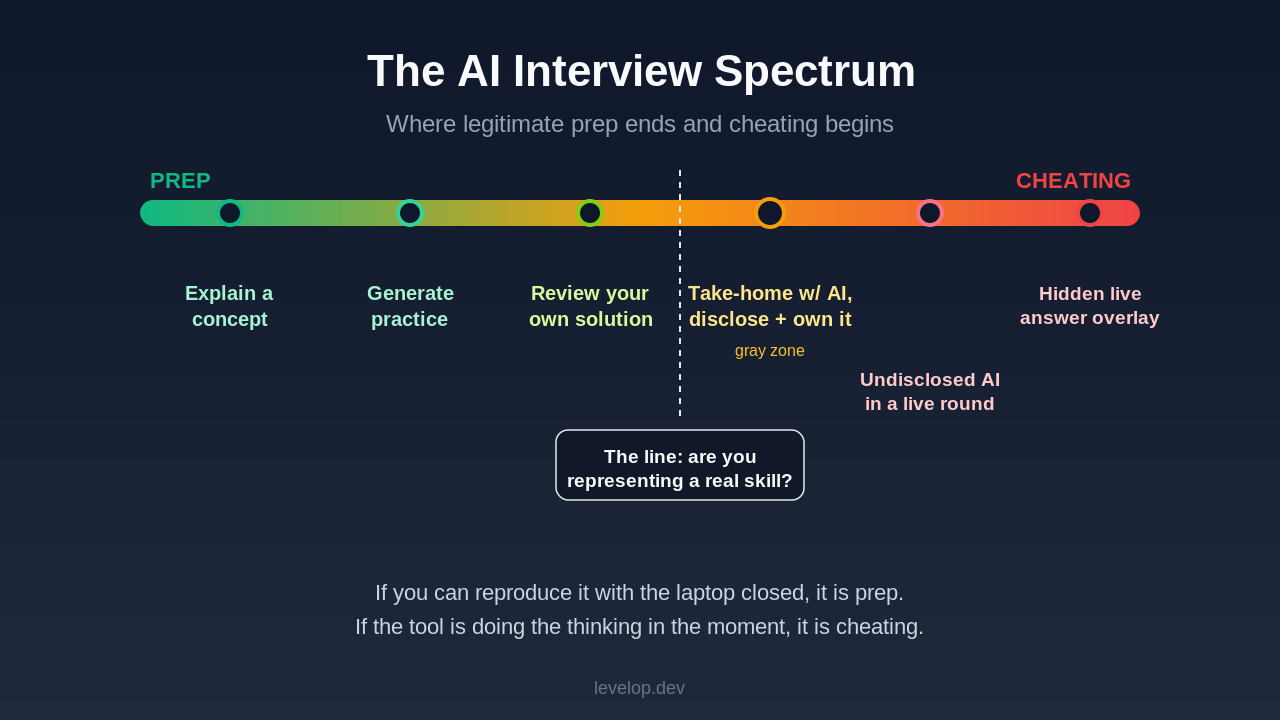
- Ask AI to explain a concept before the interview: clearly prep.
- Ask AI to generate practice problems you solve yourself: clearly prep.
- Ask AI to review a solution you already wrote: prep.
- Use AI on a take-home, then rewrite and fully understand every line: gray, so disclose it.
- Use AI on a take-home and submit output you cannot explain: cheating.
- Use AI in a live round without saying so: cheating.
- Feed live answers through a hidden overlay: cheating, and getting caught is likely.
The gray row is the important one. Using AI on a take-home is increasingly normal, and plenty of companies now expect it, because that is how the job actually gets done. The failure mode is not touching AI. It is submitting work you cannot defend. If an interviewer asks “walk me through why you structured it this way” and your honest answer is “the model did that part,” you are done.
So the safe move in the gray zone is disclosure plus comprehension. Tell them you used AI, which is often fine, and make sure you can explain and modify every line as if you wrote it, because in the follow-up you effectively will have to.
Why the distinction actually matters to you
It would be easy to read all this as a rules lecture. That is not the point. The point is self-interested, and it is the thing I wish more people internalized.
The interview process is a proxy. The company is not trying to find out whether you can produce a correct binary search in a vacuum, or whether your resume happens to match the job description, it is trying to predict whether you can actually do the job once you are hired. If AI passes the interview for you, the job is still yours to do on Monday, and now the gap between the signal you sent and the skill you have is your problem to live with.
I have watched this play out. The engineer who used AI honestly to prep shows up able to reason through a novel problem in a design review. The one who let AI carry the interview freezes the first time a senior asks “what happens if this region goes down?” because they never actually built the muscle. The interview was never the finish line. It was a checkpoint that was supposed to mean something.
There is also a plain integrity cost. Whether is using AI cheating in a given moment is partly a question about the rules and partly a question about who you want to be under pressure. The rules will keep shifting. The habit of representing yourself honestly is more durable, and it compounds.
How to use AI for interview prep the right way
Here is the workflow I actually recommend, the one that builds skill instead of borrowing it. The trick is to always solve first and let AI grade second, never the reverse.
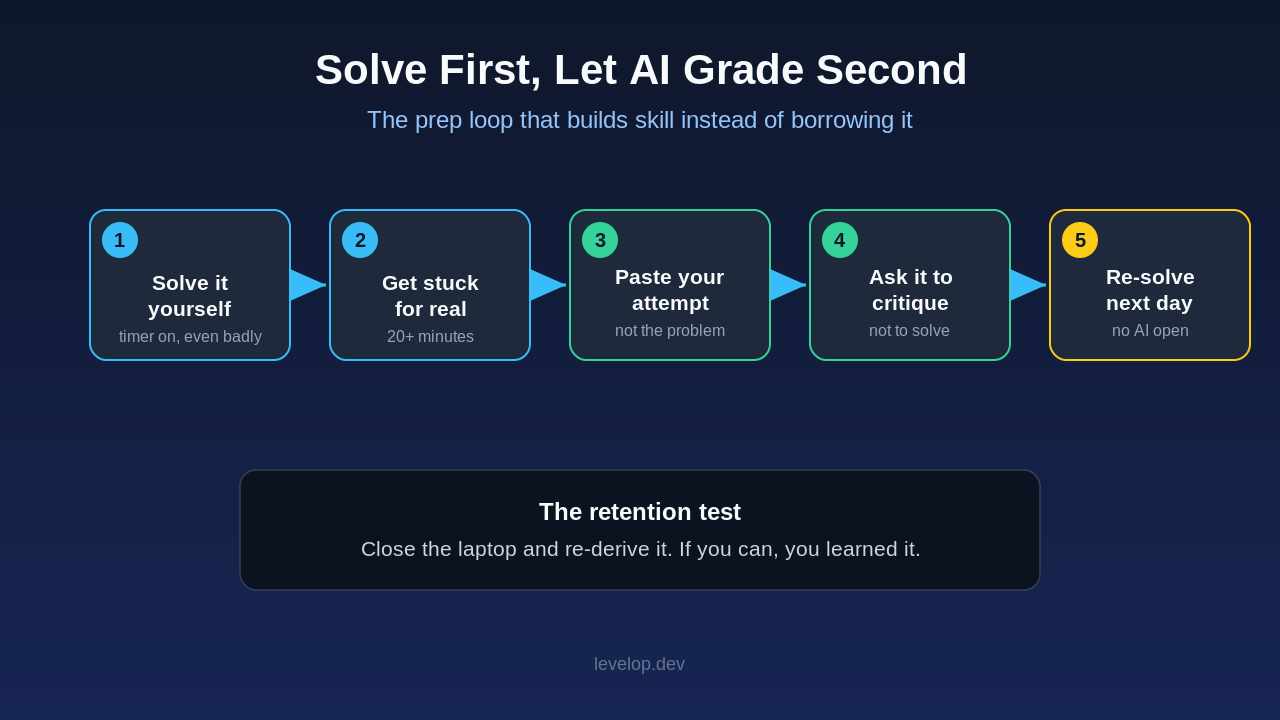
1. Read the problem. Set a timer. Solve it yourself, even badly.
2. Get it working, or get genuinely stuck for 20+ minutes.
3. NOW open the AI. Paste your attempt, not the problem.
4. Ask it to critique, not to solve.
5. Re-solve from scratch the next day with no AI open.
The prompts matter. Compare these two.
Solve this: given an array, find the longest substring
without repeating characters.Here is my solution to the longest-substring problem.
It passes the basic cases but times out on large inputs.
Do not rewrite it. Tell me which part is O(n^2) and
what pattern would make it O(n), and let me try again.The first prompt hands you a finished answer you will forget by Thursday. The second one forces you to do the hard part, the recognition that a nested loop is the bottleneck and a sliding window fixes it, while using AI only to point the flashlight. That is the entire difference between using AI for interview prep and using AI to skip it.
One more habit. After AI helps you fix something, delete the chat and re-derive it. If you cannot, you have found a genuine gap, which is a gift, because you found it in practice instead of on stage.
What companies are doing about it
You should know the landscape, because it shapes what you can get away with even if you wanted to, and it is moving fast.
The detection side has grown up. Modern proctoring no longer just watches for tab switches, which never caught the graphics-layer overlay tools anyway. The reliable tells now are response latency, eye-movement patterns, a mismatch between how someone writes code and how they talk about it, and inconsistencies that surface when an interviewer digs into follow-ups the candidate could not have pre-loaded. A lot of teams have simply rebuilt the interview process around conversational, deeply interactive rounds, precisely because a copilot cannot fake real-time reasoning when the follow-up interview questions keep coming.
Company policies are all over the map, which is why you should always ask. Goldman Sachs told campus applicants not to use any external AI in interviews and enforces short answer timers. Amazon added guidance in late 2025 instructing recruiters to disqualify candidates caught using generative AI. On the other end, Shopify tells candidates to bring their own AI pair programmer, and Meta ran a sixty-minute AI-assisted coding round. The lesson is not “AI is banned” or “AI is fine.” It is that the rules are set per company and often per round, and assuming is how good candidates get burned.
I wrote a deeper breakdown of the detection tools and the cat-and-mouse dynamic in our piece on the AI interview arms race, if you want the full picture of how it is evolving.
What to do next
If you take one thing from this, let it be the reframe. Stop asking whether AI is allowed and start asking whether you are building a skill or renting an answer. Then a few concrete moves.
Audit your current prep. For each way you use AI this week, ask whether you could reproduce the result with the laptop closed. Keep the uses that pass. Fix the ones that do not.
Always ask about the AI policy for each specific interview, ideally before the round. Recruiters expect this question now, and it protects you.
Practice the follow-up, not just the solve. Have a friend or an AI grill you on “why did you do it this way” until explaining your reasoning is automatic. That is the skill that survives contact with a real interviewer.
If you want structured practice that trains reasoning instead of memorization, that is exactly what we have been building over at Levelop. You can browse more of these breakdowns on the Levelop blog, and if you are comparing study tools, our honest review of AI mock interview tools covers what actually helps.
Sources and further reading
The 2026 cheating-rate figures come from Fabric’s state of interview cheating report. For how the hiring process is shifting under AI pressure, see CNN Business on AI and software interviews and HR Dive on candidates walking away from AI interviews.
Frequently asked questions
Is using AI to prepare for interviews cheating?
No. Preparing with AI on your own time, before anyone is evaluating you, is no different from studying with a book or a tutor. It becomes a problem only when you use AI to misrepresent your ability during the actual evaluation. The test is whether you can reproduce the skill without the tool.
Is using AI cheating if I do it on a take-home project?
It depends on disclosure and comprehension. Many companies now expect you to use AI on take-homes because that reflects real work. The line is crossed when you submit code you cannot explain or modify. If you used AI, be ready to defend every design decision in the follow-up, and disclose it if asked.
Can companies actually detect AI interview cheating?
Increasingly, yes. Traditional proctoring missed the newest overlay tools, but detection has shifted to behavioral signals like response latency, eye movement, and mismatches between how a candidate writes code and how they reason about it under follow-up questions. Many teams have also moved to conversational rounds that are hard to fake in real time.
What is the safest way to do ChatGPT interview prep?
Solve first, then let the model critique. Attempt the problem yourself, get stuck, and only then paste your attempt and ask for feedback rather than a solution. Re-derive it later with no AI open. If the knowledge sticks in your head instead of your chat history, the prep worked.
Will using AI in interviews hurt my career even if I do not get caught?
Often, yes, in a quieter way. The interview is a proxy for the job. If AI passes the interview but you did not build the skill, the gap shows up in your first design review or on-call incident. You inherit the difference between the signal you sent and the ability you actually have.