
"Tell Me About a Time You Failed": How to Answer Without Sounding Incompetent
Every candidate dreads the moment. The interviewer leans back, glances at their notes, and says it: "Tell me about a time you failed." Your stomach drops. Do you admit a real failure and look incompetent? Do you dodge with a fake one and look evasive? Do you blame a teammate and look like someone nobody wants to work with?
At Levelop, we have watched thousands of engineers prepare for interviews, and this single question trips up more strong candidates than almost any coding problem. The reason is simple. Nobody teaches you how to talk about failure. You spend years learning to project confidence, and then a hiring manager asks you to do the opposite on command.
Here is the good news. The failure question is one of the most predictable and most learnable parts of any interview. Once you understand what the interviewer is actually testing, "tell me about a time you failed" stops being a trap and becomes one of your best chances to stand out. This guide walks through exactly what to say, what to avoid, and how to build an answer you can deliver without your voice shaking.
What the interviewer is really asking
Interviewers do not ask about failure because they want to catch you in a weak moment. They ask because failure is where character shows up. A polished story about a project that went perfectly tells them nothing. A story about something that went wrong tells them how you think, how you recover, and whether you take responsibility.
When a hiring manager asks "tell me about a time you failed," they are quietly checking three things. First, self-awareness: can you recognize your own mistakes without someone forcing you to? Second, accountability: do you own the outcome, or do you reach for excuses? Third, growth: did the experience change how you work, or did you file it away and move on unchanged? Guidance from the Tech Interview Handbook makes the same point: behavioral answers are scored on judgment and self-reflection, not on how smoothly you talk.
Notice that none of those three things is "did you fail." The failure itself is the setup, not the point. Candidates who understand this shift their energy away from minimizing the mistake and toward showing what they learned. That is the entire game.
There is a fourth thing being tested that most guides miss: emotional maturity under pressure. The question is uncomfortable on purpose. How you handle discomfort in the room is a preview of how you will handle it on the team. Stay calm, stay honest, and you have already passed half the test.
Why the honest answer usually wins
Many candidates try to game the question. The two classic dodges are the fake weakness ("I work too hard and care too much") and the non-failure ("I once set a goal that was slightly too ambitious"). Both fail for the same reason. Experienced interviewers have heard them hundreds of times, and both signal that you are either not self-aware or not willing to be honest.
A genuine, well-chosen failure does the opposite. It signals confidence. Only someone secure in their abilities can calmly describe a real mistake and what came after it. Counterintuitively, admitting a real failure makes you look more competent, not less, because it shows you have enough perspective to learn from setbacks rather than hide them.
The framework: STAR, adapted for failure
Most people know the STAR method for behavioral questions: Situation, Task, Action, Result. It works well for success stories. For failure stories, it needs one adjustment. The most important part is not the Result. It is what you did after the result went wrong.
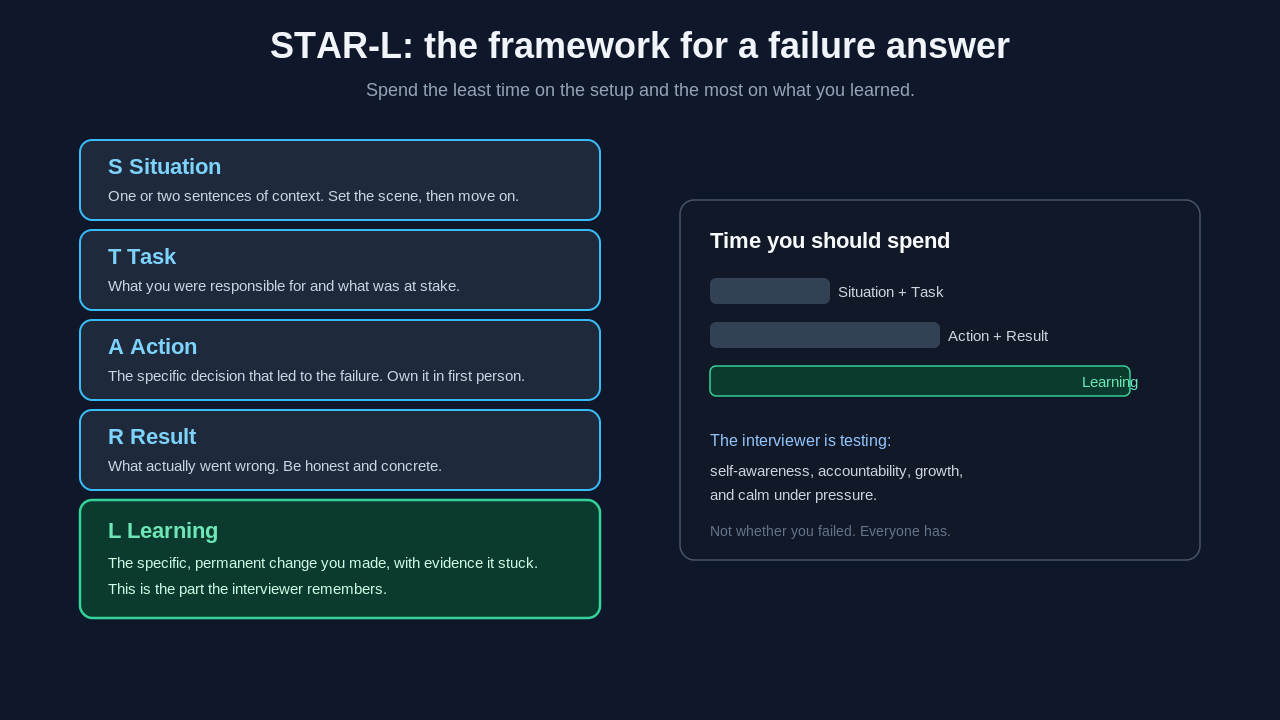
We teach a version we call STAR-L, where the L stands for Learning. Here is the shape of a strong failure answer:
Situation:  Briefly set the scene. One or two sentences.
Task:       What you were responsible for and what was at stake.
Action:     What you did, including the specific decision that led to the failure.
Result:     What actually went wrong. Be honest and concrete.
Learning:   What you changed, and proof the change stuck.
The proportions matter. Spend the least time on Situation and Task, a moderate amount on Action and Result, and the most energy on Learning. A common mistake is to over-explain the setup and then rush the lesson. Flip that. The interviewer remembers how your story ends.
Here is what the Learning section looks like when it lands. You do not just say "I learned to communicate better." You say "After that, I started sending a written scope summary before starting any cross-team task, and in the following quarter we shipped three integrations with zero rollbacks." Specific, measurable, and clearly a permanent change. That is the difference between a candidate who reflects and one who just says reflective-sounding words.
How to choose the right failure
The story you pick matters as much as how you tell it. A great delivery of a bad example still fails. Use these filters when selecting your "tell me about a time you failed" story.
Pick a failure that is real and recent enough to be credible, but not so recent that it looks unresolved. A mistake from two or three years ago that you clearly grew from is ideal. A mistake from last week that you are still cleaning up suggests you have not learned anything yet.
Pick a failure where you were genuinely responsible. Stories where the failure was entirely someone else's fault do not work, because the whole point is to see you take accountability. If your honest answer is "my manager gave me bad requirements," reframe it around what you could have done differently, such as asking clarifying questions earlier.
Avoid failures that reveal a dealbreaker. Do not choose a story about missing a deadline because you were disorganized, breaking production because you skipped testing on purpose, or a conflict where you behaved unprofessionally. The failure should be a lapse in judgment or skill that you have since fixed, not a character flaw the interviewer should worry about.
Finally, choose a failure with a clean, provable recovery. The strongest stories end with evidence: a process you introduced, a metric that improved, a second chance where you got it right. That evidence is what turns "I failed" into "I am someone who turns failures into systems."
A worked example
Let me show you the difference between a weak answer and a strong one to the exact same prompt.
Here is a weak answer. "Tell me about a time you failed? Honestly I do not fail often, but I guess one time I took on too many projects and got a little overwhelmed. I learned to manage my time better." This is vague, it minimizes the failure, and the lesson is a cliche. The interviewer learns nothing and moves on unimpressed.
Now a strong sample answer to the same question, using STAR-L. This is the kind of example answer you can model your own story on:
Situation: In my second year, I owned the payments service for a
           mid-size fintech product.

Task:      I was asked to ship a refund feature before a partner launch.

Action:    To hit the date, I skipped writing integration tests for the
           edge case where a refund exceeded the original charge. I
           assumed it could not happen.

Result:    It happened in production within a week. A rounding bug let
           refunds overshoot, and we issued about forty incorrect
           refunds before we caught it. I had to lead the cleanup and
           tell the partner what went wrong.

Learning:  I owned it in the postmortem instead of deflecting. I added a
           test gate that blocks any payment change without edge-case
           coverage, and I now treat "it cannot happen" as a signal to
           write the test, not skip it. We have not had a refund
           incident since.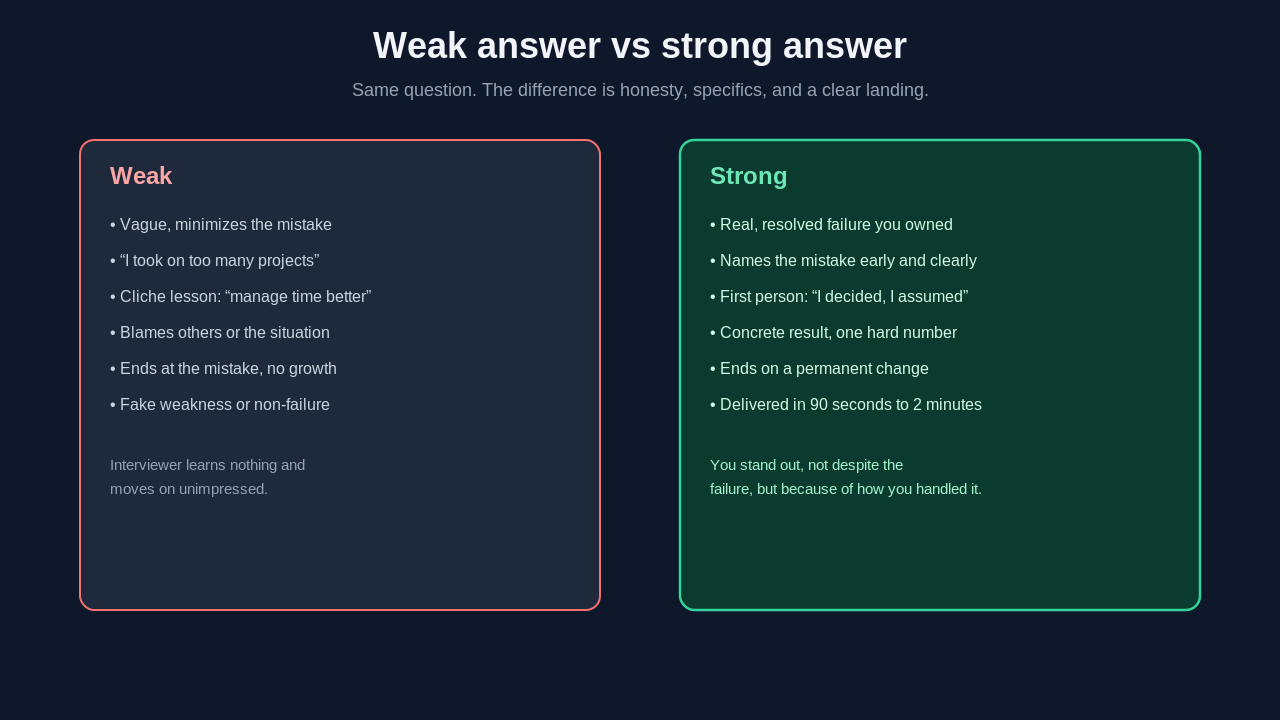
Read those two answers back to back. The strong one is not more polished or more confident sounding. It is more honest, more specific, and it ends with a permanent change backed by a result. That is what a hiring manager wants to hear when they ask you to talk about failure.
Delivering the answer in the room
Content is half the battle. Delivery is the other half. A strong story told with a shaky, apologetic voice loses much of its power. Here is how to deliver a failure answer so it lands.
Keep it tight. Aim for ninety seconds to two minutes. Rambling makes it sound like you are still processing the failure rather than reflecting on it from a place of growth. Practice out loud until you can hit the beats without notes.
Own it early. Do not bury the failure at the end or soften it into oblivion. Name it clearly near the start. "I shipped a feature that caused a production incident" is a stronger opening than three minutes of context before you admit anything went wrong. Owning it fast reads as confidence.
Do not over-apologize. You are describing a past event you have resolved, not confessing a sin. Say what happened, say what you learned, and stop. Excessive guilt makes the interviewer uncomfortable and shifts the focus away from your growth.
Watch your language. Say "I decided," "I assumed," "I missed," not "the team dropped the ball" or "it kind of just happened." Active, first-person, accountable language is the single clearest signal of maturity in a failure answer.
Common mistakes that sink good candidates
Even strong engineers make predictable errors on this question. The most common is the humblebrag failure, where the "failure" is secretly a strength. "I failed because I set impossibly high standards for the team." Interviewers see straight through it, and it costs you credibility.
The second is the blame shift. The moment your story becomes about what someone else did wrong, you have lost. Even if the failure genuinely involved others, keep your answer focused on your piece of it.
The third is the unresolved failure. If your story ends at the Result and never reaches a real Learning, the interviewer is left wondering whether you have grown at all. Always land the plane on what changed.
Practice makes the difference
Reading about the failure question is not the same as being ready to answer it. The gap between knowing the framework and delivering a calm, credible answer under pressure only closes with reps. This is exactly the kind of behavioral round we help engineers rehearse at Levelop, where realistic mock interviews and structured feedback turn a scary question into a rehearsed strength. If you want proof it works, read the story of how we failed four FAANG interviews and then built a platform to fix the process.
Before your next interview, write out two failure stories using STAR-L. Two, not one, so you have a backup if the interviewer asks a follow-up or if your first story does not fit the role. Practice each out loud at least five times. Record yourself if you can. You are listening for tightness, ownership, and a clear landing on what you learned.
If you want to go deeper on the behavioral round overall, our guide on the behavioral questions you will face in every FAANG interview covers the full set, and our piece on why behavioral interviews eliminate senior candidates explains why this round carries more weight than most engineers expect. For company-specific prep, the Meta coding interview guide breaks down how behavioral and technical rounds connect.
The failure question rewards preparation more than almost any other. Most candidates wing it. If you show up with a real, well-chosen story delivered with calm ownership, you will stand out, not despite the failure, but because of how you handled it.
Frequently asked questions
How to answer "tell me about a time you failed" in an interview?
Learning how to answer "tell me about a time you failed" comes down to one framework. Use the STAR-L method: briefly set the Situation and Task, describe the Action that led to the failure, state the Result honestly, then spend the most time on the Learning, including a specific, permanent change you made and evidence that it stuck. Pick a real, resolved failure where you were genuinely responsible, and deliver it in ninety seconds to two minutes with calm, first-person ownership.
Should I give a real failure or a made-up safe one?
Give a real one. Experienced interviewers immediately recognize fake weaknesses and non-failures like "I work too hard," and both signal a lack of self-awareness or honesty. A genuine, well-chosen failure that ends in clear growth actually makes you look more competent, because it shows the confidence to reflect on setbacks rather than hide them.
What failures should I avoid mentioning in an interview?
Avoid failures that reveal a dealbreaker, such as skipping testing on purpose, missing deadlines from disorganization, or unprofessional conflict. Also avoid failures that were entirely someone else's fault, since the point is to show accountability. Choose a lapse in judgment or skill that you have clearly fixed, not a character flaw the interviewer should worry about.
How long should my failure answer be?
Aim for ninety seconds to two minutes. Spend the least time on the setup, a moderate amount on what you did and what went wrong, and the most energy on what you learned and changed. Rambling suggests you are still processing the failure rather than reflecting on it, so practice out loud until you can hit each beat without notes.
How many failure stories should I prepare?
Prepare at least two. Having a second story gives you a backup if the interviewer asks a follow-up, if your first example does not fit the role, or if a related question comes up in the same round. Write both using STAR-L and rehearse each several times out loud so you can deliver them calmly under pressure.
Sources and further reading
- Tech Interview Handbook, Behavioral interviews for software engineers, techinterviewhandbook.org.
- interviewing.io, How behavioral interviews are evaluated at top companies, interviewing.io.
- The Muse, How to answer what is your greatest failure, themuse.com.
- Levelop, The 20 behavioral questions you will face in every FAANG interview, levelop.dev/blog.