

System Design Interview Questions: What They Actually Test (Hint: It's Not Just Architecture)
Most candidates walk into a system design interview and start drawing boxes. Load balancer here, three app servers there, a database with a read replica, maybe a cache in front. Fifteen minutes later the whiteboard is full, the diagram looks impressive, and the interviewer writes "no hire."
The problem is not the diagram. The problem is that the diagram was never what was being scored. System design interview questions are open-ended on purpose, and the architecture you draw is only the visible surface of a much deeper evaluation. Interviewers are watching how you think, not what you memorized. This guide breaks down what these interviews actually measure, why the "perfect architecture" myth costs strong engineers offers, and how to prepare so the right signals come through under time pressure.
What is a system design interview, really?
A system design interview is an open-ended conversation where you are asked to design a large-scale system: a URL shortener, a news feed, a ride-hailing dispatch service, a chat app. There is no single correct answer and no autograder. You get a vague prompt, roughly 35 to 50 minutes, and an interviewer who plays the role of a skeptical teammate.
That format is the whole point. Real engineering work is ambiguous. Requirements are incomplete, constraints conflict, and the "right" choice depends on tradeoffs nobody handed you in advance. The interview is a compressed simulation of that reality. When people ask what is a system design interview testing, the honest answer is that it is testing whether you can turn an underspecified problem into a defensible design while thinking out loud the entire time.
That is why two candidates can draw nearly identical diagrams and get opposite results. One narrated the reasoning, surfaced assumptions, and defended tradeoffs. The other silently reproduced a diagram they had seen before. The architecture matched. The evaluation did not.
The five things system design interview questions actually test
Interviewers at most companies score along a small number of dimensions. The exact rubric varies, but the underlying signals are remarkably consistent.
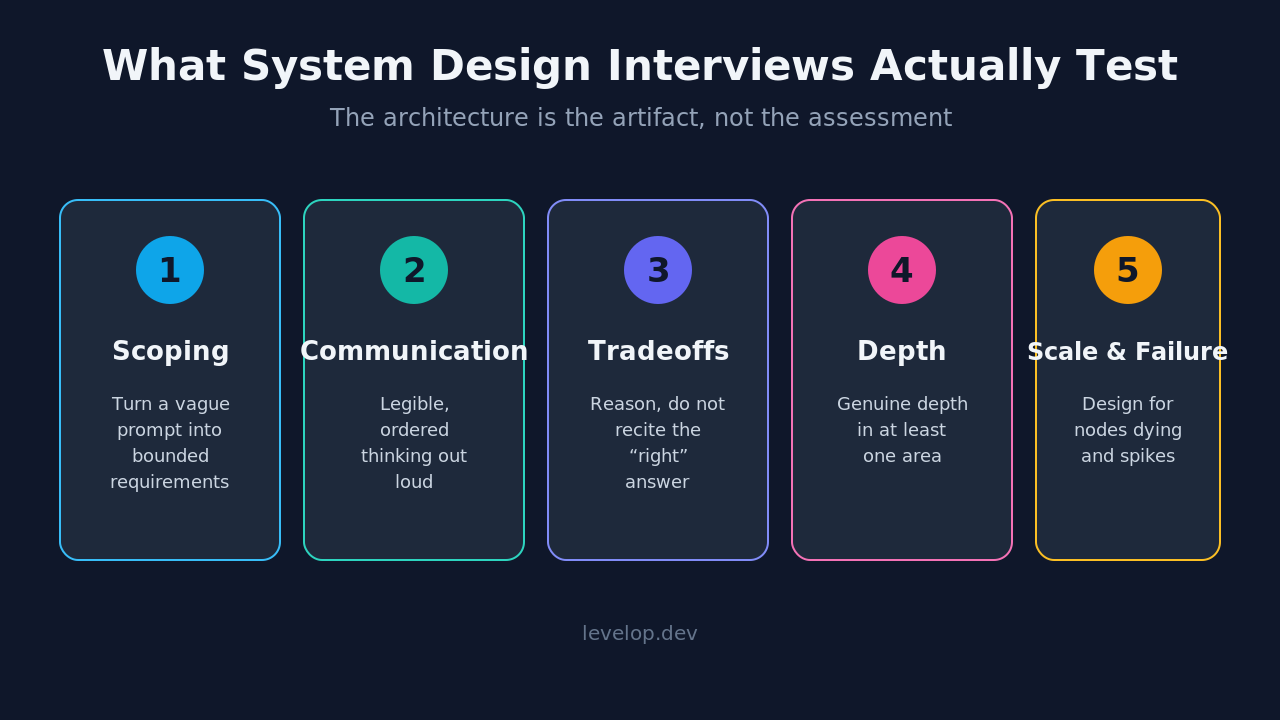
1. Requirements clarification and problem scoping
The first thing measured happens before you draw anything. When you hear "design Twitter," a strong candidate does not start building. They ask questions. Are we designing the read path, the write path, or both? What is the scale: ten thousand users or two hundred million? Do we need the timeline in real time, or is a few seconds of delay acceptable? Is this a take-home style deep dive or a breadth exercise?
Scoping is the single most predictive early signal. Engineers who scope well are the ones who, on the job, do not spend two sprints building the wrong thing. Interviewers reward candidates who convert a vague prompt into a bounded problem with explicit functional requirements (what the system does) and non-functional requirements (how well it does it: latency, availability, consistency, durability).
2. Structured thinking and communication
The interviewer cannot read your mind, so unspoken brilliance scores zero. What gets credited is a legible thought process: state the requirements, estimate the scale, sketch the high-level design, then drill into components one at a time. A candidate who jumps randomly between the database schema and the CDN and the rate limiter reads as disorganized, even if every individual point is correct.
Communication is not a soft add-on here. It is a core competency, because senior engineering is mostly the work of aligning other people around a design. If you cannot walk one interviewer through your reasoning in a calm, ordered way, the signal is that you will struggle to align a team of eight.
3. Tradeoff reasoning instead of "right" answers
This is where the "not just architecture" hint lands hardest. There is no correct database. There is only "SQL gives you strong consistency and transactions, NoSQL gives you horizontal scale and flexible schemas, and here is why I would choose one for this workload." Every meaningful decision in system design is a tradeoff, and the interview is essentially a tradeoff-reasoning exam wearing an architecture costume.
Consider the consistency question. Choosing between strong and eventual consistency is not about knowing which is "better." It is about recognizing that a banking ledger cannot tolerate stale reads while a like counter happily can, and articulating that difference. The CAP theorem is famous precisely because it forces a tradeoff: under a network partition you pick availability or consistency, not both. Interviewers want to hear you make that choice deliberately and justify it against the requirements you scoped.
4. Technical depth in at least one area
Breadth gets you through the high-level design. Depth is what separates a senior signal from a junior one. Interviewers almost always push on one component: "How does your cache stay consistent with the database?" or "What happens when this queue backs up?" They are probing whether you have real depth somewhere, or whether your knowledge is a thin veneer of buzzwords.
You do not need to be an expert in everything. You need to be genuinely deep in something and honest about the edges of your knowledge. A candidate who says "I have not run Kafka at that scale, but here is how I reason about partitioning and consumer lag" scores far better than one who name-drops five technologies and cannot explain any of them.
5. Handling scale, bottlenecks, and failure
Finally, the interview tests whether you design for the real world, where machines die, networks partition, and traffic spikes. Good candidates proactively ask what happens when a node fails, when the primary database goes down, when a celebrity user with fifty million followers posts. They introduce replication, sharding, redundancy, and graceful degradation not as vocabulary but as answers to failure modes they identified themselves.
This is the dimension most junior candidates skip entirely. They design the happy path and stop. The moment an interviewer asks "and if this server dies mid-request?", the gap shows.
What system design interviews are NOT testing
It is just as useful to name the myths, because chasing them is how prepared candidates still fail.
They are not testing whether you memorized a reference architecture. Reproducing the canonical "design Instagram" diagram from a course, beat for beat, without adapting it to the specific prompt, reads as pattern matching rather than thinking. Interviewers change the constraints precisely to catch this.
They are not testing buzzword density. Saying "microservices, Kubernetes, event-driven, eventual consistency, CQRS" in one breath does not demonstrate understanding. It usually invites a depth question you cannot answer.
They are not testing whether you produce the one true optimal system. There is no such thing in 45 minutes. A defensible, well-reasoned design with acknowledged tradeoffs beats a "perfect" design you cannot explain.
And they are not testing whether you can code the thing. This is a design conversation. Implementation detail matters only when it illustrates a tradeoff.
A worked example: designing a URL shortener
Watch how the signals show up in a concrete prompt. Suppose you are asked to design a URL shortener like Bitly.
A weak start draws seven boxes immediately. A strong start scopes first: "Let me confirm the requirements. We need to shorten a long URL to a short code, redirect users from the short code to the original, and I assume we want analytics on clicks. For scale, are we talking about a hundred million new URLs a month? And reads will heavily outnumber writes, since one short link gets clicked many times, correct?"
Then comes a back-of-the-envelope estimate, which signals that you design against numbers, not vibes:
# capacity estimation for the URL shortener
writes_per_month = 100_000_000          # new short URLs
read_write_ratio = 100                  # reads dominate
reads_per_month = writes_per_month * read_write_ratio

seconds_per_month = 30 * 24 * 3600      # ~2.6M seconds
write_qps = writes_per_month / seconds_per_month   # ~38 writes/sec
read_qps  = reads_per_month  / seconds_per_month   # ~3,800 reads/sec

# 5 years of URLs, ~500 bytes each
storage_bytes = writes_per_month * 12 * 5 * 500     # ~3 TB
Those numbers drive every later decision. A read-heavy 100:1 ratio at roughly 3,800 reads per second means the redirect path must be cache-first, so you put the short-code-to-URL mapping in an in-memory cache and treat the database as the source of truth behind it. The write path is modest at 38 per second, so the interesting question there is not throughput but how you generate short codes without collisions: a counter encoded in base62, or a hash with collision handling. Each of those is a tradeoff you can defend.
The point of the example is not the specific answer. It is that scoping, estimation, a cache-first read path, and an honest discussion of code generation tradeoffs hit four of the five scoring dimensions without a single buzzword.
How to prepare for a system design interview
Preparation that targets the real rubric looks different from memorizing architectures. A focused routine over a few weeks works better than a frantic weekend of watching design videos.
Start by internalizing the fundamentals rather than the diagrams: what a load balancer actually does, how caching and cache invalidation behave, the real difference between SQL and NoSQL workloads, how replication and sharding trade off, and what consistency models cost you. These are the vocabulary of tradeoffs, and you cannot reason about tradeoffs you do not understand.
Then practice the format out loud. Pick a handful of classic prompts, a URL shortener, a news feed, a chat system, a rate limiter, and design each one end to end while narrating, ideally to another person or a recording. The habit you are building is legible thinking, and it only develops under something close to interview conditions. When people ask how to prepare for a system design interview, this is the part they skip: they read passively instead of designing actively.
Finally, build a repeatable framework so you are never staring at a blank whiteboard: clarify requirements, estimate scale, define the API, sketch the high-level design, deep-dive one component, then address bottlenecks and failure. A framework is not a script to recite; it is a scaffold that frees your attention for the actual reasoning. If you want structured, pattern-based practice for the coding rounds that usually sit alongside system design, the Levelop interview prep platform is built around exactly this kind of deliberate, feedback-driven repetition.
Demonstrating the signals under time pressure
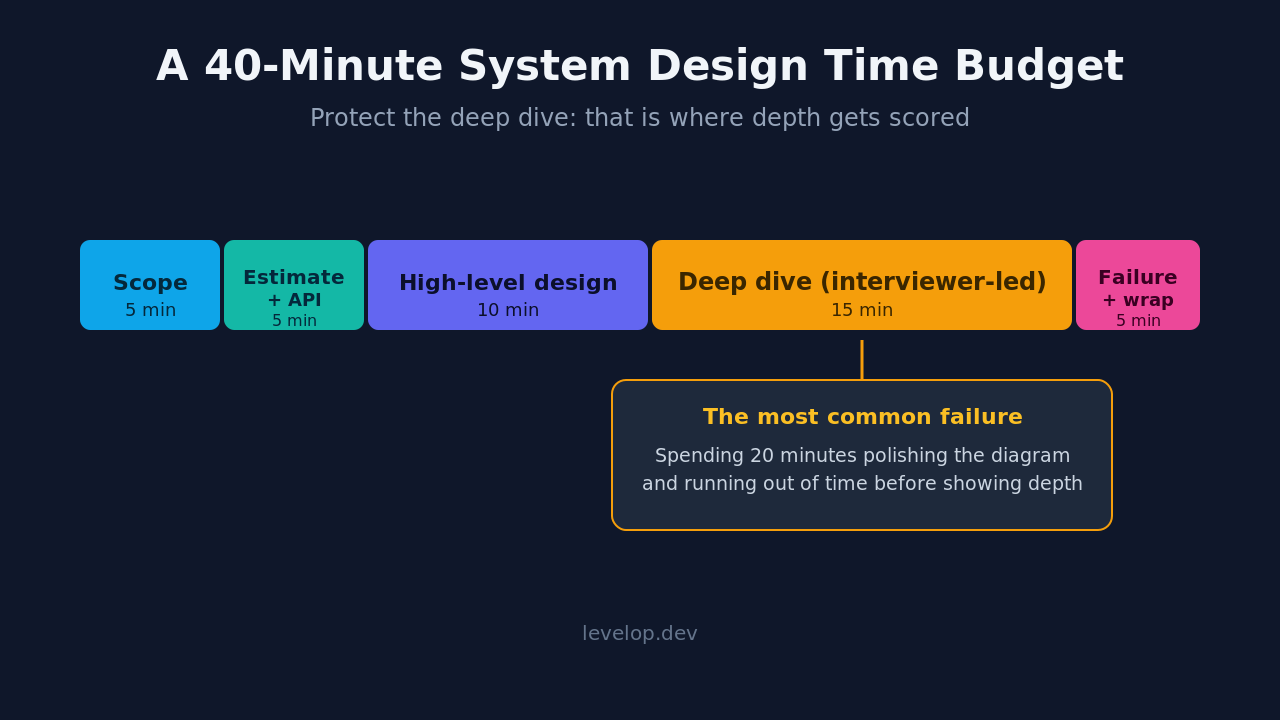
Knowing the rubric is worthless if the clock erases it. With 40 minutes, budget them: about 5 minutes to scope, 5 to estimate and define the API, 10 for the high-level design, 15 for the deep dive the interviewer steers you toward, and 5 for failure modes and wrap-up. Spending 20 minutes perfecting the high-level diagram is the most common way strong candidates run out of time before they ever show depth.
Keep narrating even when you pause to think. Silence reads as being stuck. A quick "let me weigh two options here" keeps the communication signal alive while you reason. And treat the interviewer as a collaborator, not an examiner. When they push back, they are usually handing you the exact area they want to score. Following that thread is how you convert a question into a chance to show depth.
For the coding rounds that typically bracket a system design loop, the same principle holds: process beats memorization. Our guides on the coding interview edge-case cheat sheet and what to do when you are stuck on a problem go deeper on communicating your reasoning. And if you are interviewing at the senior or staff level, system design weight only grows, which is why we cover the IC career path beyond staff and, for company-specific loops, the Meta system design and behavioral guide. You can find more interview breakdowns on the Levelop blog.
Frequently asked questions
What do system design interviews actually test?
They test five things: how you clarify vague requirements, how clearly and methodically you communicate, whether you reason about tradeoffs instead of reciting "right" answers, whether you have genuine depth in at least one area, and whether you design for scale and failure rather than just the happy path. The architecture diagram is where those signals show up, but the diagram itself is not the score.
Do I need to memorize system architectures to pass?
No, and memorization often backfires. Interviewers change the prompt's constraints specifically to catch candidates who reproduce a canonical diagram without adapting it. What you should internalize instead are the building blocks (caching, load balancing, replication, sharding, consistency models) and a framework for applying them, so you can reason from first principles about whatever prompt you get.
How long should I prepare for a system design interview?
For most mid-level to senior engineers, two to four weeks of focused, active practice is enough if you already have production experience. The bottleneck is rarely reading time; it is reps of designing out loud. A few complete, narrated designs per week beats many hours of passive video watching.
What is the most common mistake candidates make?
Jumping straight to the architecture without scoping the problem, then spending too long polishing the high-level diagram and running out of time before showing any depth. The fix is to always clarify requirements first and to budget your time so the interviewer-led deep dive gets its 15 minutes.
Is a system design interview the same as a coding interview?
No. A coding interview tests algorithmic problem-solving with a concrete, usually gradable answer. A system design interview is open-ended, has no single correct solution, and evaluates architectural judgment, tradeoff reasoning, and communication. Senior loops typically include both, and system design weight increases as the level rises.
How important is communication compared to the technical design?
Communication is roughly half the evaluation at most companies. A technically sound design that you cannot explain clearly will lose to a slightly simpler design that you scope, narrate, and defend well, because senior engineering is fundamentally about aligning other people around technical decisions.