

Meta Coding Interview Questions: A 2026 Prep Guide
If you are preparing for a software engineering role at Meta this year, you have probably noticed that the advice online is a mess. Half of it describes a process that stopped existing in 2023, and the other half is generic "grind LeetCode" filler that ignores what actually makes Meta different. The reality is that Meta coding interview questions follow a tighter, more predictable pattern than most candidates expect, and the loop rewards speed and communication in ways that Google or Amazon do not.
This guide breaks down what the 2026 Meta loop actually tests, the exact question patterns that show up most often, and how to prepare so that you walk in ready instead of hoping to get lucky. It sits alongside our broader breakdown of how coding interviews changed in 2026, and if you are interviewing at more than one company, it pairs well with our Apple interview questions guide.
What the Meta loop looks like in 2026
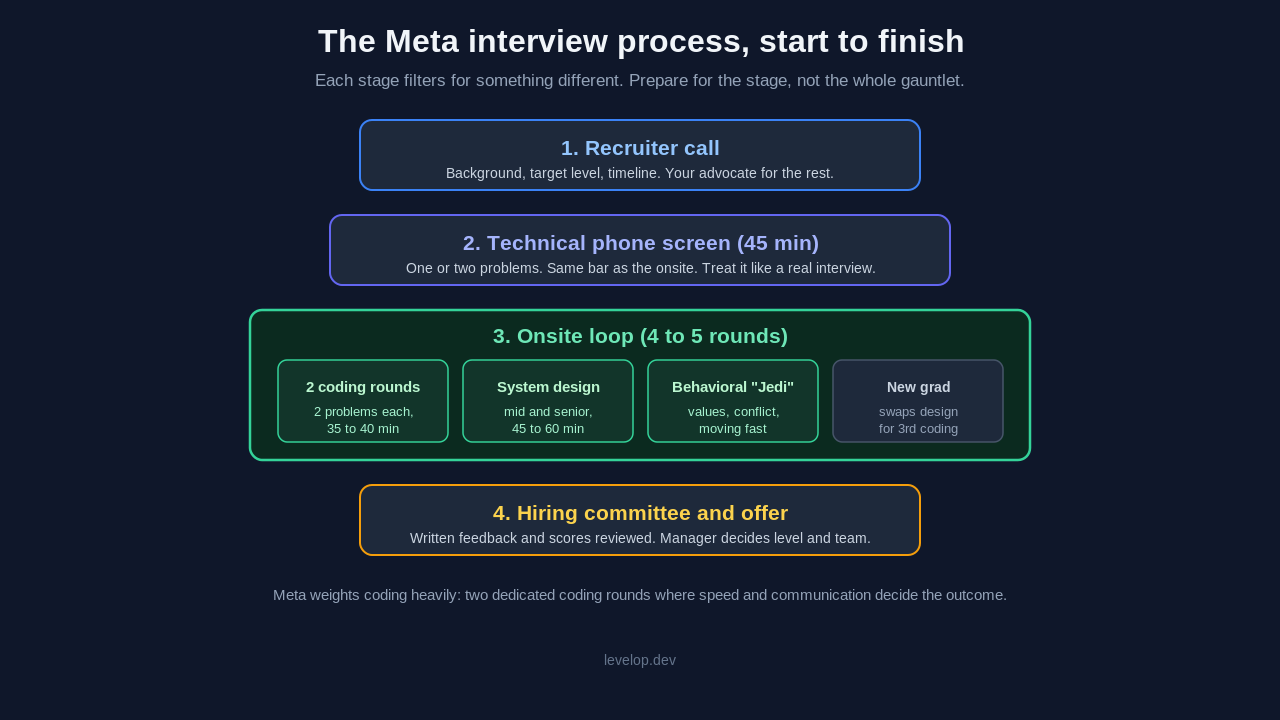
A standard Meta software engineer loop still runs four to five rounds. For most product engineering roles you get two coding rounds, one system design round (for mid and senior levels), and one behavioral round that Meta calls "Jedi." New-grad and lower-level loops usually drop the design round and add a second coding session instead.
The structure matters because it tells you where to spend your time. Meta weights coding heavily. Two of your rounds are pure algorithms, and each one asks you to solve two problems in about 35 to 40 minutes total. That is roughly 15 to 20 minutes per problem, including the time you spend talking through your approach. Speed is not a bonus at Meta. It is the bar.
The AI-assisted format that spread across the industry in 2025 reached Meta too. Some loops now let you use an AI helper for boilerplate, but the interviewer watches how you direct it and whether you can debug what it produces. We covered this shift in detail in our piece on how the AI coding interview broke and what replaced it. The short version: the tools changed, the underlying skill being tested did not. You still need to recognize patterns instantly and reason about correctness out loud.
The Meta interview process from first call to offer
Before you ever touch a whiteboard, it helps to understand the full interview process end to end, because each stage filters for something different. Like most large tech companies, Meta runs a multi-stage funnel, and knowing what each stage is really testing lets you prepare deliberately instead of treating every conversation the same way.
It usually starts with a recruiter call. This is not a technical screen. The recruiter confirms your background, your target level, and your timeline, and they often share a prep guide. Take this call seriously, because the recruiter is your advocate through the rest of the process and can tell you exactly which round types your loop will include.
Next comes the technical phone screen, a single 45-minute coding session over a shared editor. You will typically solve one or two problems, and the bar is the same as the onsite: clean code, clear communication, and correct reasoning about time and space complexity. Many candidates underprepare for the phone screen because it feels informal, then get filtered out before the onsite even happens. Treat it like a real interview, because it is.
If you pass, you reach the onsite loop, which is the set of four to five rounds described above. For a software engineering role, that means the two coding rounds, the possible system design round, and the behavioral Jedi round. After the loop, your interviewers submit written feedback and scores, and a hiring committee reviews the packet. A hiring manager or engineering manager then works with the recruiter on level and team placement. Understanding this pipeline step by step keeps you calm: each stage is a discrete, learnable challenge, not one giant unknowable gauntlet.
The question patterns that dominate Meta coding rounds
Meta pulls from a surprisingly narrow set of patterns. Once you have done enough of their rounds, the questions start to feel like variations on a theme. Here are the ones that show up over and over.
Arrays, hashing, and two pointers
This is the bread and butter. Expect at least one problem that reduces to a hash map lookup or a two-pointer scan. Meta loves problems where the naive solution is quadratic and the interviewer wants to see you get to linear time. Classic examples include finding pairs that sum to a target, merging sorted intervals, and subarray problems with a running window.
The reason Meta favors these is that they are fast to state, fast to solve, and they separate candidates who see the pattern from those who brute force. If you spend more than two minutes staring at an array problem without reaching for a hash map or two pointers, you are probably overthinking it.
Trees and graphs
The second most common bucket. Binary tree traversals, lowest common ancestor, and level-order problems appear constantly. On the graph side, expect breadth-first search on a grid or an adjacency list. Meta rarely asks for exotic graph algorithms like max flow. They want clean BFS and DFS, correct visited-set handling, and the ability to talk about time complexity in terms of nodes and edges.
from collections import deque

def bfs_shortest_path(grid, start, target):
    rows, cols = len(grid), len(grid[0])
    queue = deque([(start, 0)])
    visited = {start}
    while queue:
        (r, c), dist = queue.popleft()
        if (r, c) == target:
            return dist
        for dr, dc in ((1, 0), (-1, 0), (0, 1), (0, -1)):
            nr, nc = r + dr, c + dc
            if 0 <= nr < rows and 0 <= nc < cols and (nr, nc) not in visited and grid[nr][nc] == 0:
                visited.add((nr, nc))
                queue.append(((nr, nc), dist + 1))
    return -1
If you can write a clean BFS like this from memory and adapt it under pressure, you have covered a large slice of Meta's graph questions.
Strings
String manipulation problems are a Meta staple, partly because so much of Meta's real work touches text. Expect anagram grouping, substring search, valid parentheses, and encoding or decoding problems. The trick with Meta string questions is that they often hide a hash map or a stack inside a problem that looks like pure string work.
Intervals and sorting
A meaningful fraction of Meta problems start with a sort. Merge intervals, meeting rooms, and "insert interval" variants are common. The senior insight the interviewer wants is that sorting by start time turns an ugly problem into a linear scan. If you catch yourself about to write nested loops over intervals, stop and ask whether sorting first collapses the problem.
A worked example, step by step
To make this concrete, walk through how a strong candidate handles a typical Meta array problem step by step. Suppose the interviewer asks you to return the indices of the two numbers in an array that add up to a target. At a high level, you start by restating the problem and asking clarifying questions: can the array contain duplicates, can numbers be negative, is exactly one solution guaranteed? These questions show you think like a working software engineer, not just a puzzle solver.
Then you state the brute-force approach out loud, two nested loops in quadratic time, and immediately note that a hash map collapses it to linear time by remembering each value you have seen. You write the linear solution, narrating as you go. When you finish, you do not stop. You pick a concrete test case, say an array of four elements, and trace the variables one iteration at a time to confirm the output. You mention the time and space complexity explicitly: linear time and linear extra space for the hash map.
This is also where knowing your core data structures and algorithms cold pays off. You are not deriving the hash map trick on the spot; you are recognizing a pattern you have drilled dozens of times and deploying it fast. The interviewer sees a candidate who reasons at a high level, communicates continuously, and verifies with a real test case. That is a strong hire signal, and it took maybe twelve minutes, leaving room for the second problem.
How Meta scores you, and why speed wins
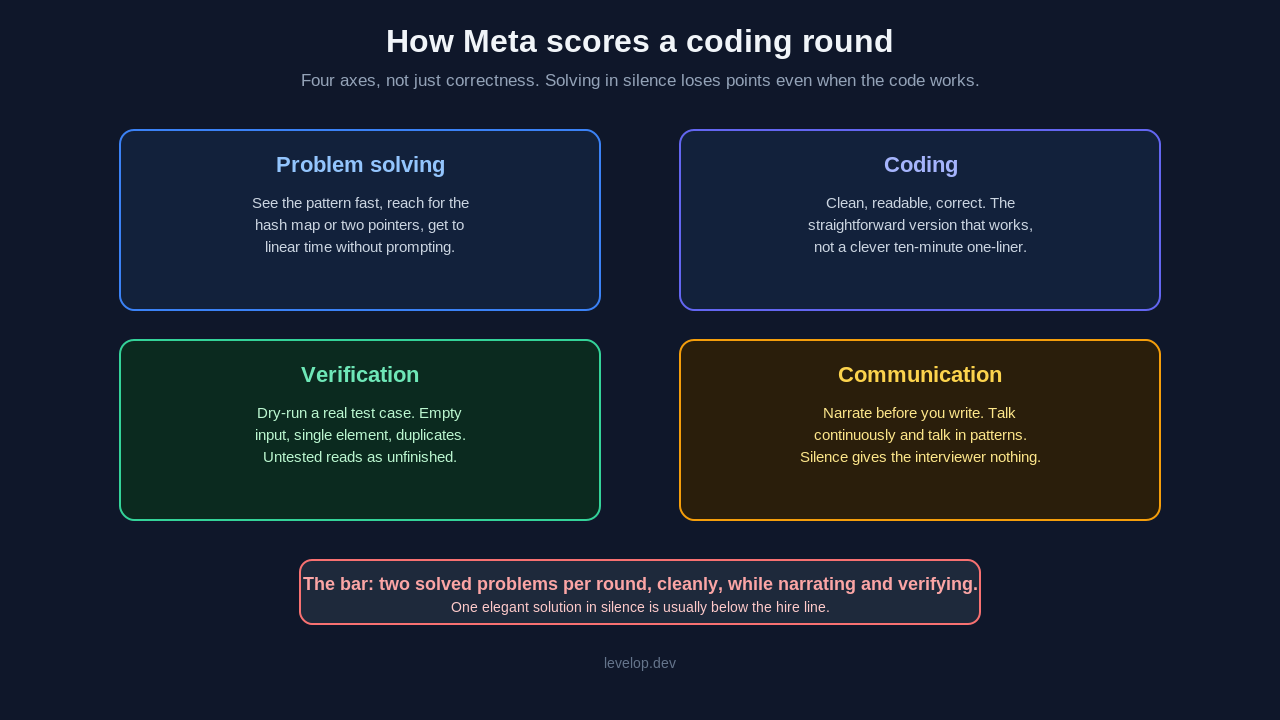
Meta interviewers fill out a rubric after each round, and coding rounds are graded on four axes: problem solving, coding, verification, and communication. Notice that raw correctness is only one part. You can solve both problems and still get a weak signal if you never explained your thinking or never tested your code.
Communication is where a lot of strong coders lose points at Meta specifically. The interviewer is not a mind reader. If you go silent for five minutes and emerge with a working solution, they cannot rate your problem solving because they did not see it happen. Narrate your approach before you write, state your assumptions, and call out the time and space complexity without being asked. Our breakdown of what changed in coding interviews in 2026 goes deeper on why communication is weighted so heavily now, but the Meta-specific version is simple: talk continuously, and talk in patterns.
Verification is the axis candidates forget entirely. After you finish coding, walk through your solution with a concrete example. Trace the variables. Check the edge cases: empty input, single element, duplicates, negative numbers. Meta interviewers explicitly look for candidates who test their own code before saying "I'm done." Skipping this step reads as carelessness, which is a red flag for a company that ships to billions of users.
Think of verification as writing quick unit tests in your head. You do not have a test harness in the room, but you can still name the cases you would cover: the empty input, the single-element input, the case with duplicates, and one normal test case that exercises the happy path. Talking through those test cases out loud does double duty. It catches bugs before the interviewer does, and it signals the disciplined habits Meta wants in a software engineer who will ship code to production.
The same discipline applies in a Meta AI coding interview where an AI assistant is available. When you lean on an AI tool for boilerplate, you still own correctness. Read the AI suggestions critically, reject the ones that do not fit, and verify the generated code against your own test cases. Interviewers can tell the difference between a candidate who blindly pastes AI output and one who directs the tool like a senior engineer directing a junior.
A four-week preparation plan for Meta
You do not need six months. You need a focused month if you already know the fundamentals. Here is how to structure it.
Week one: pattern coverage
Spend the first week making sure you have a working template for every core pattern: two pointers, sliding window, BFS, DFS, backtracking, binary search, heap, and dynamic programming basics. Do not aim to solve hundreds of problems. Aim to solve two or three problems per pattern until the template is automatic. The goal is recognition speed, not volume. If you want a structured path, our complete 2026 coding interview preparation guide lays out a pattern-first curriculum you can follow.
Week two: Meta-tagged problems under time pressure
Now narrow to Meta's actual question distribution. Work through arrays, trees, graphs, and strings, but do them on a timer. Give yourself 20 minutes per problem, including talking out loud as if an interviewer were present. This is the single most important habit for Meta because the loop is genuinely time-constrained. If you can only solve mediums slowly, you will run out of time when it counts.
Week three: mock interviews and communication
Book real mock interviews, ideally with someone who has interviewed at Meta. Practice narrating your approach, handling hints gracefully, and verifying your code. Record yourself if you have no partner. The gap between "can solve alone in silence" and "can solve while explaining to a skeptical listener" is where most Meta rejections happen.
The point of mock interviews is to reproduce real interview conditions, not just to solve more problems. Solve on a shared editor with no autocomplete, keep a timer visible, and force yourself to talk the entire time. If you can find a partner who has sat on the other side of the table at a large tech company, ask them to interrupt you with hints and edge cases the way a real interviewer would. The discomfort of being watched is exactly the variable you are training against, and it does not go away by grinding problems alone.
Week four: system design and behavioral
If your level includes a design round, spend this week on the fundamentals: load balancing, caching, database sharding, and designing a news feed or messaging system, since Meta loves those. Practice sketching a clean data model early in the design, because interviewers use your schema to probe scaling questions later. For the behavioral Jedi round, prepare five to seven strong stories using the situation-task-action-result structure. Meta's core values map to questions about conflict, ambition, and moving fast, so pick stories that show impact and speed. If you are interviewing at the senior level, expect an engineering manager to join at least one round and press on scope, trade-offs, and how you influence teams without authority.
Meta versus other FAANG loops
It helps to know how Meta differs from its peers, because the same person interviews at several companies and the preparation is not identical.
Compared to Google, Meta is faster and less focused on deep algorithmic novelty. Google will sometimes hand you a genuinely hard problem and watch you struggle productively for 45 minutes. Meta wants two clean solutions in the same time. Compared to Amazon, Meta cares far less about leadership principles woven into your technical answers. Amazon's bar raiser round explicitly tests behavioral signals during and around the coding. Meta separates those concerns: code in the coding round, values in the Jedi round.
The practical implication is that if you are optimizing for Meta, you should over-index on pace and pattern recognition. If you are optimizing for Google, add harder problems and deeper follow-ups. If you are optimizing for Amazon, weave leadership stories into everything. One preparation plan does not fit all three, even though the underlying data structures overlap.
Common mistakes that sink Meta candidates
The most frequent failure is running out of time on the second problem. Candidates spend 25 minutes making the first solution perfect and then rush the second. Budget your time explicitly. Aim to finish the first problem in 15 to 18 minutes so you have room for the second.
The second mistake is going silent. As covered above, Meta grades communication directly. Silence during problem solving is the fastest way to get a "no signal" rating even when your code works.
The third is ignoring edge cases until the interviewer points them out. If they have to prompt you to handle an empty array, you lost the verification signal. Get there first.
The fourth is over-engineering. Meta wants a correct, readable solution, not a clever one-liner that takes ten minutes to debug. Write the straightforward version, get it working, and only optimize if there is time and the interviewer asks.
Putting it together
Meta coding interview questions are learnable because they are predictable. The company pulls from a narrow set of patterns, tests them under time pressure, and rewards clear communication and self-verification as much as raw correctness. If you build automatic templates for the core patterns, practice at Meta's actual pace, and train yourself to narrate and verify, you will walk into the loop with a real edge.
The candidates who struggle are almost never the ones who lack knowledge. They are the ones who knew the material but could not deploy it fast enough, or who solved silently and gave the interviewer nothing to grade. Fix those two things and the rest is repetition.
Start with the pattern-first curriculum in our coding interview preparation guide, then narrow to Meta's distribution in your final weeks. If you want the tooling that makes pattern practice faster, that is exactly what we build at Levelop.
Frequently asked questions
How many coding rounds does Meta have in 2026?
Most Meta software engineer loops include two dedicated coding rounds, each asking you to solve two problems in roughly 35 to 40 minutes. Mid and senior loops add a system design round, and every loop includes a behavioral round Meta calls "Jedi." New-grad loops often replace the design round with a third coding session.
What programming language should I use for a Meta coding interview?
Use the language you are fastest and most fluent in. Python is popular at Meta interviews because it is concise and reduces the time spent on syntax, which matters given the tight time limits. That said, Meta accepts any mainstream language, so do not switch to Python just for the interview if you are stronger in Java or C++.
How hard are Meta coding interview questions?
Most Meta coding questions are LeetCode medium difficulty, with the occasional easy or hard mixed in. The difficulty comes less from any single problem and more from the pace: you need to solve two mediums cleanly in one round while communicating throughout. Consistent medium-level speed matters more than the ability to crack rare hard problems.
Does Meta allow AI tools during coding interviews?
Some 2026 Meta loops permit an AI assistant for boilerplate, but the interviewer evaluates how well you direct and debug it. The tools do not remove the need for pattern recognition or correctness reasoning. You are judged on whether you understand the solution, not just whether code appears on the screen.
How long should I prepare for a Meta interview?
If you already know the core data structures and algorithms, a focused four-week plan is usually enough: one week on pattern templates, one week on Meta-tagged problems under time pressure, one week on mock interviews and communication, and one week on system design and behavioral stories. Candidates starting from weaker fundamentals should budget two to three months.
What is the Meta system design interview like?
At mid and senior levels, Meta includes a system design round that usually runs about 45 to 60 minutes. You are asked to design a large-scale system such as a news feed, a messaging service, or a rate limiter. The interviewer wants a clear high-level architecture first, then a sensible data model, then a discussion of trade-offs as they push on scale. Talk through capacity estimates, storage choices, and how you would handle failures.