
Amazon Bar Raiser Interview: What to Expect
If you have interviewed at Amazon, you have probably met an amazon bar raiser without knowing it. They were the interviewer who did not seem to work on your team, asked questions a level harder than the rest, and pushed on your answers long after you thought you had finished. That was not an accident. The amazon bar raiser interview is one of the most misunderstood parts of big tech hiring, and knowing what it measures can be the difference between an offer and a rejection.
This guide covers what the amazon bar raiser interview round is, how the same guardrail shows up at Google and Meta, and what these interviewers are trained to look for. Type bar raiser amazon into any search engine and you will find pages of anxious candidate threads, so here is the clear version.
What the Amazon Bar Raiser Round Is
Amazon built the bar raiser program in the early 2000s to fix one problem: hiring managers under pressure to fill a seat lower their standards. A team that needs a person now talks itself into a good-enough candidate. Over thousands of hires, that drift erodes the quality of the whole org.
The bar raiser is the structural fix. A bar raiser is an experienced amazon interviewer from outside the hiring team who has passed extensive calibration training. They sit on your loop but do not report to the hiring manager and have no stake in filling the role quickly. Critically, they hold veto power. If the amazon bar raiser is not convinced, the hire does not happen, even when the hiring manager wants you.
Their mandate is simple to state and hard to satisfy: every new hire should be better than at least half of current employees in the same role and level. They are not asking whether you are good enough for us today. They are asking whether you will raise the average two years from now. That framing changes how you should approach the round.
Why the Bar Raiser Has Veto Power
Interview loops fail in predictable ways. Interviewers anchor on first impressions, reward candidates who remind them of themselves, and pass someone merely competent because the team is drowning in work. Each decision feels reasonable. The aggregate outcome is a slow decline in hiring quality.
The bar raiser breaks that loop with independence and authority. Independence, because they have no incentive to fill the seat. Authority, because a recommendation without teeth gets overruled the moment it is inconvenient. The veto is what makes the program work. For you, the implication is direct: you cannot charm your way past the amazon bar raiser or lean on the hiring manager. You have to clear an objective bar on the dimensions they are trained to evaluate.
The Google and Meta Equivalents
Amazon named the concept, but Google and Meta run structurally similar guardrails. If you interview across these companies, see the pattern instead of memorizing three playbooks.
At Google, the safeguard is the independent hiring committee. Your interviewers do not make the decision. They write detailed feedback with scores and evidence, and that packet goes to a committee of senior engineers who never met you. You can read how Google describes this in its own how we hire guidance. The committee enforces one consistent bar across the whole company, so the signal you optimize for is the quality of the written evidence your interviewers can produce about you.
At Meta, calibration happens through experienced interviewers and a review that compares you against a company-wide standard rather than the local needs of one team. Across all three, the goal is the same: stop one motivated team from lowering the company standard. Whether it is called a bar raiser, a hiring committee, or a calibration review, you are measured against the company, not the immediate opening.
What the Bar Raiser Is Really Looking For
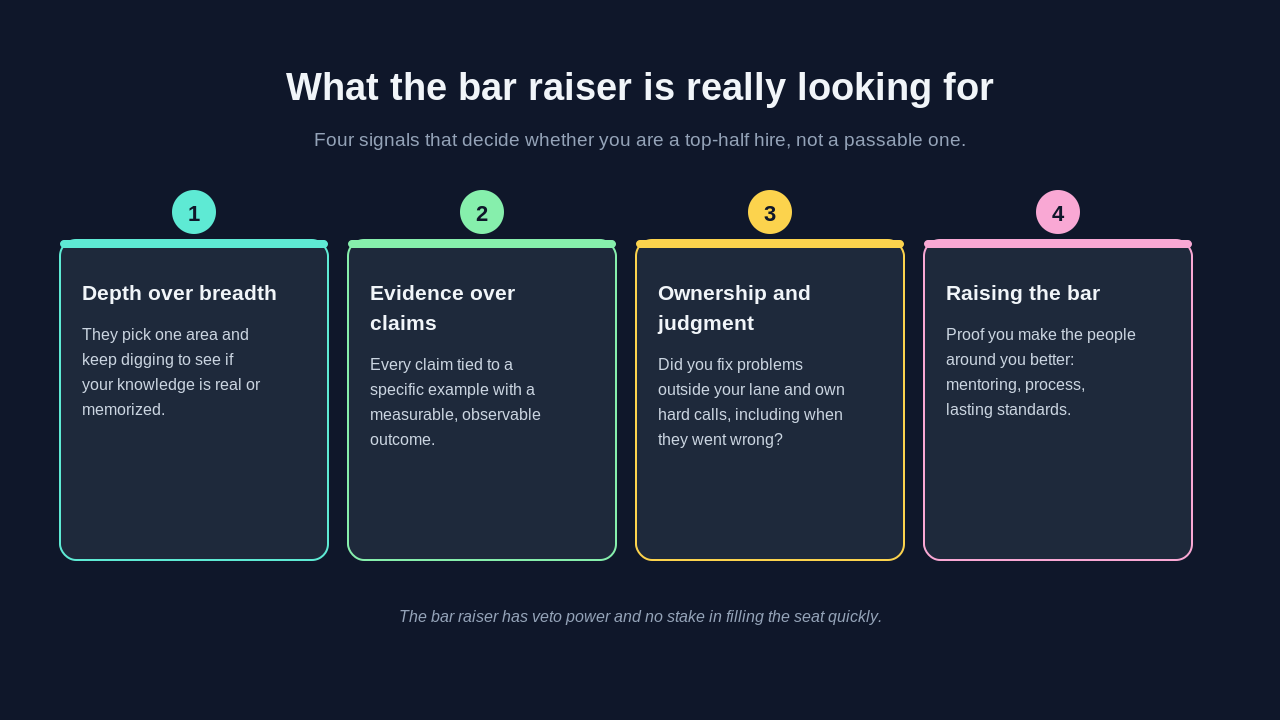
Interviewers in this role are trained to evaluate signal, not vibes. Here is what they probe for underneath the surface questions.
Depth over breadth
A bar raiser picks one area and keeps digging to test whether your knowledge is real or memorized. Candidates who did the work go three or four layers deep and explain the tradeoffs they lived through. Candidates who studied for the interview hit a wall fast. When an interviewer keeps asking why and what would you do if, they are calibrating the depth of your understanding.
Evidence over claims
Saying you are a strong collaborator is worthless. Describing a specific conflict between two teams, what you did, and how it turned out is evidence. The bar raiser is trained to discount adjectives and reward specifics. Every claim should come attached to a concrete example with a measurable outcome.
Ownership and judgment
Amazon's 16 leadership principles are baked into the evaluation, so interviewers look for whether you took real ownership or just did assigned tasks. Did you fix a problem outside your lane? Did you make a hard call with incomplete information and own the result, including when it went wrong? Judgment under uncertainty is hard to fake and highly valued.
Raising the bar on others
The best signal an amazon bar raiser can find is evidence that you make the people around you better. Did you mentor someone, improve a process, or set a standard that outlasted you? A candidate who only makes themselves productive is a good hire. A candidate who lifts the whole team is exactly what the program is named for.
How to Prepare for the Round
You cannot study your way to depth you do not have, but you can prepare so the depth you have comes through under pressure. Start by auditing your stories. Pick six to eight projects that show range: a technical deep dive, a failure you owned, a conflict you navigated, a time you influenced without authority, and a moment you raised the standard for others. For each, be able to go deep, because the bar raiser keeps pulling the thread.
Use a structured format so answers do not wander. The STAR method (Situation, Task, Action, Result) is the standard scaffold, but the part most candidates neglect is the Result and their reflection on it. A prep template looks like this:
story_id: cross_team_migration
principle: Ownership, Dive Deep
situation: Two teams shipped conflicting schema changes, prod was failing.
task: Nobody owned the boundary. I picked it up.
action: Built a compatibility layer, drove alignment across both teams.
result: Cut incident rate 60%, wrote the migration standard we still use.
reflection: I escalated too slowly early. Next time I raise it day one.
signals: ownership beyond my lane, technical depth, raising the bar.
The reflection shows judgment, and the signal mapping forces you to check that each story demonstrates something the bar raiser cares about. If a story does not map to depth, ownership, evidence, or lifting others, replace it.
Then practice being pushed. Most candidates rehearse the first thirty seconds and fall apart when the interviewer keeps probing. Have a mock interviewer keep asking why did you do it that way until you run out of prepared material, because that is what the real round does. Working through problems interactively beats passively reviewing notes.
Common Mistakes That Sink Candidates
The most common failure is staying shallow: a clean, rehearsed answer with no depth when pushed. The fix is to only tell stories you lived, so there is always another layer. The second is taking credit for team work without ever saying I. Bar raisers need to know what you specifically did, and constant we language makes it impossible to evaluate you. The third is treating the round as a conversation to win rather than evidence to provide. Give the interviewer concrete material they can write down and defend in a debrief. The fourth is neglecting failure and conflict stories, then freezing when asked about a time you were wrong. Those questions are the core of the ownership evaluation, not traps.
Bringing It Together
The amazon bar raiser interview, and its cousins at Google and Meta, all answer one question: will hiring you make this company better than it is today. The deep probing, the demand for specifics, and the failure questions all ladder up to that. Seen through that lens, preparation stops being about memorizing answers and becomes about assembling real evidence that you belong in the top half.
To go deeper on the full loop, our guide to the complete software engineer interview process in 2026 walks through every stage. For company-specific prep, the breakdowns of Google coding interviews in 2026 and the behavioral questions you will face in every FAANG interview pair well with this one. Find more on the Levelop blog.
Frequently Asked Questions
What is the bar raiser interview round at Amazon?
It is an interview run by a specially trained amazon interviewer from outside the hiring team who holds veto power over the hire. Their job is to ensure every new hire raises the average quality of the team, meaning you should be better than at least half of current employees at the same role and level. Because they are independent of the hiring manager, they cannot be overruled by a team that just wants to fill a seat.
How do I know if my interviewer is the bar raiser?
Amazon usually does not tell you, and you should not guess. The amazon bar raiser is often someone who does not appear to work on your team, asks harder or more probing questions, and pushes deeper on your answers. Treat every interviewer as if they might be the bar raiser and give each strong, evidence-backed answers.
Do Google and Meta have a bar raiser?
Not by that name, but both run equivalent safeguards. Google uses an independent hiring committee that reviews written feedback and decides separately from your interviewers. Meta uses experienced interviewers and a calibration review against a company-wide standard. All three exist to stop one motivated team from lowering the company bar.
Can the bar raiser reject me if the team wants to hire me?
Yes. Veto power is the entire point. If the bar raiser is not convinced you clear the bar, the hire does not proceed even when the hiring manager is enthusiastic. This removes the incentive to lower standards under hiring pressure, so rapport with the team cannot carry a weak performance in that round.
How should I prepare for the amazon bar raiser interview?
Focus on depth and evidence over breadth. Prepare six to eight real stories showing technical depth, ownership beyond your assigned work, a failure you owned, and times you raised the standard for others. Use STAR, but invest most in the result and your reflection. Then practice being probed repeatedly, because how far the interviewer digs is the defining feature of the round.
References
- Amazon Jobs, interviewing at Amazon and the bar raiser, amazon.jobs.
- Amazon, our leadership principles, amazon.jobs.
- Google Careers, how we hire and the hiring committee, google.com/about/careers.