

The 20 Behavioral Interview Questions FAANG Always Asks
Back with another one in the series where I break down the parts of the interview process that quietly decide outcomes. This time it is not an algorithm.
It is the round most engineers underprepare for and then blame on bad luck: the behavioral interview.
I used to think behavioral rounds were a formality. You solve the hard problems, you pass. The behavioral chat is just HR making sure you are not a jerk, right?
Then I watched a friend with cleaner code than mine get rejected at the final stage. The recruiter feedback was one line: "concerns about ownership and collaboration." Nobody questioned his code. They questioned his stories.
That is when it clicked for me. At FAANG companies the behavioral round is not a vibe check.
It is a structured, rubric-scored evaluation, and the people running it are trained to find specific signals in how you answer behavioral interview questions. If you wing it, you lose to a software engineer who prepared, even if your engineering is stronger.
The gap I was stuck on
Here is exactly what confused me for a long time. I knew the advice "use the STAR method." I could recite it: Situation, Task, Action, Result.
But knowing the format did nothing for me, because my answers still felt thin. I would describe a project, the interviewer would nod, and the conversation would just deflate.
The thing nobody told me is that STAR is a container, not content. A clean container with a weak story inside still scores low.
What actually moves the needle is which story you pick, how much of it is you versus your team, and whether you can name the result with a number. The format was never the hard part. Choosing and shaping the story was.
So this post is the thing I wish I had. It is the 20 behavioral interview questions that show up again and again, grouped by the signal they test, plus the framework I now use to build answers that do not deflate.
Why the behavioral round eliminates people
A coding round mostly tests one axis: can you solve the problem. The behavioral round tests four or five axes at once, from communication skills to judgment, and each one is a place you can quietly fail.
Interviewers are usually scoring you against a rubric. The dimensions are things like ownership, dealing with ambiguity, conflict resolution, bias for action, and impact.
At Amazon these are literally the Leadership Principles, and every interviewer is assigned a subset to probe. At Google the language is "googleyness and leadership." At Meta it is "drive" and working through ambiguity.
Different vocabulary, same idea. They want evidence, drawn from your real past, that you behave the way a strong engineer behaves under pressure.
The reason strong candidates fail here is that they treat the round as conversation instead of evidence. A story that wanders, has no measurable outcome, or credits "we" for everything gives the interviewer nothing to write down.
And if there is nothing to write in the rubric, the default score is not neutral. It is low.
The framework: STAR, plus the two upgrades nobody mentions
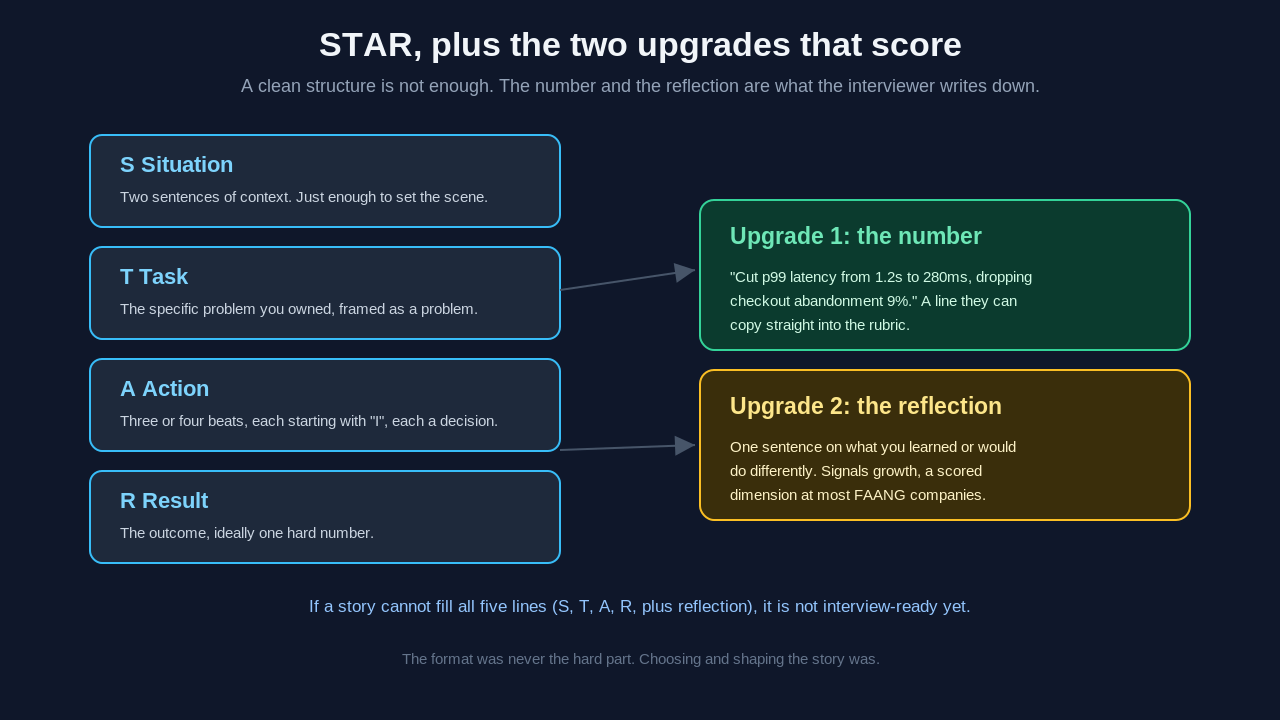
STAR is still the backbone, and it is how you structure your answers under pressure. If you want a refresher on the base format, The Muse breaks down the STAR method well. The fix is to add two things most people skip.
The base structure stays the same. Situation sets the context in two sentences. Task is the specific problem you owned.
Action is what you did, step by step, with the decisions you made. Result is the outcome, ideally quantified.
Upgrade one is the result with a number. "We shipped it and it went well" is invisible.
"Cut p99 latency from 1.2 seconds to 280 milliseconds, which dropped checkout abandonment by 9 percent" is a sentence the interviewer can copy straight into the rubric. If you genuinely cannot measure it, estimate honestly and say how you estimated.
Upgrade two is the reflection. After the result, add one sentence on what you learned or would do differently.
This signals self-awareness and growth, which is its own scored dimension at most of these companies. It also makes you sound like someone who improves, not someone who got lucky once.
Here is the template I keep in my notes and fill in for each story before an interview.
SITUATION   two sentences of context
TASK        the specific thing I owned, framed as a problem
ACTION      3-4 beats, each starting with "I", each showing a decision and my thought process
RESULT      one number, plus business impact
REFLECTION  one sentence on what I learned or changed
If a story cannot fill all five lines, it is not interview-ready yet. That single rule fixed more of my answers than any amount of rephrasing.
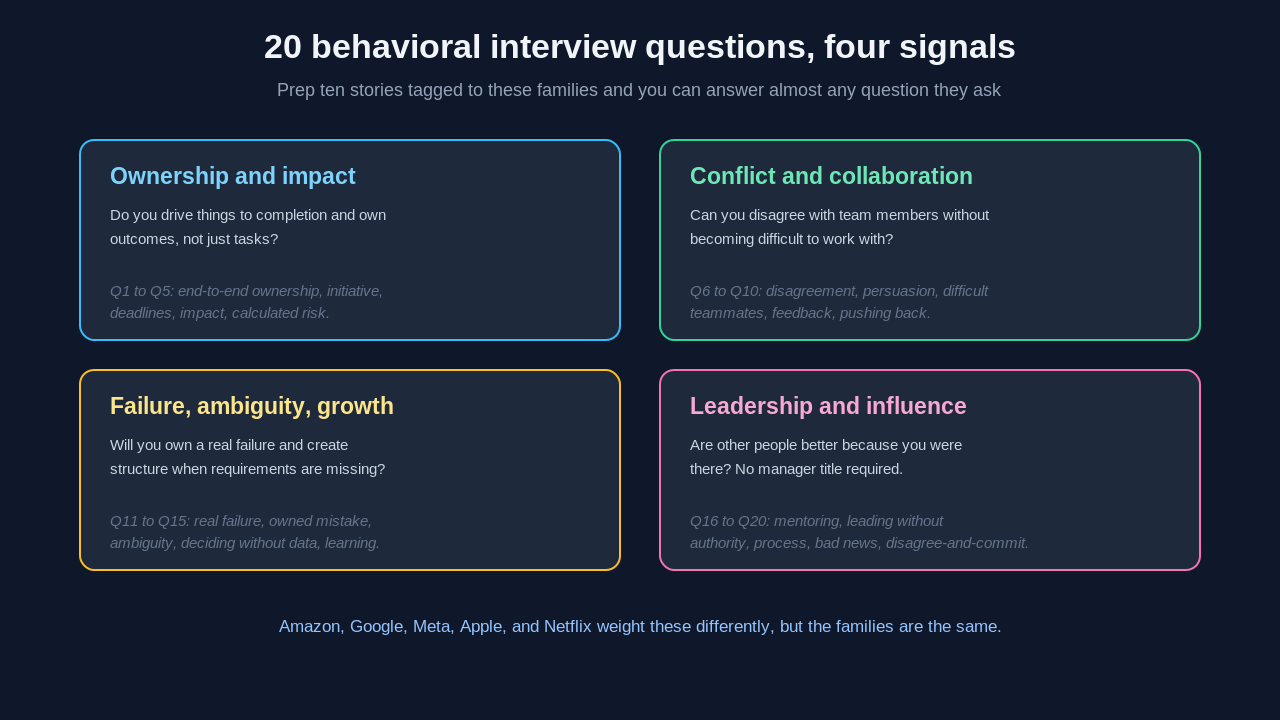
The 20 behavioral interview questions, grouped by signal
These cluster into four families. The exact wording changes, but if you have strong stories for each family, you can map almost any of these behavioral interview questions to one you have already prepared. These FAANG behavioral interview questions repeat across Amazon, Google, Meta, Apple, and Netflix.
Ownership and impact
This family tests whether you drive things to completion and take responsibility for outcomes, not just tasks.
1. Tell me about a project you owned end to end. They want scope and accountability, so pick something where you were the person it would have failed without.
2. Describe a time you went beyond what was asked of you. The signal is initiative. Show the moment you noticed a gap nobody assigned you and closed it anyway.
3. Tell me about a time you delivered under a tight deadline. They are probing prioritization. The strong version names what you cut and why, not just that you worked hard.
4. Describe the most impactful thing you have built. Lead with the impact, then the build. If you start with the technology you have already lost them.
5. Tell me about a time you took a calculated risk. The word "calculated" is the test. Show the data behind the bet, not just that it worked out.
Conflict and collaboration
This family is where a lot of strong engineers get the "concerns about collaboration" line. It tests whether you can disagree with team members without becoming difficult to work with.
6. Tell me about a disagreement with a coworker. Never pick a story where you were simply right and they were wrong. Pick one where you genuinely heard the other side and the resolution was better for it.
7. Describe a time you had to convince someone to change their mind. The signal is influence without authority. Show how you used evidence, not how you wore them down.
8. Tell me about working with a difficult teammate. The trap is venting. Keep the blame off the other person and focus on what you did to keep the work environment functioning.
9. Describe a time you received tough or negative feedback. They want to see you take it without defensiveness. Name the feedback plainly, then show the change you made.
10. Tell me about a time you had to push back on your manager. This is the disagree-and-commit signal. Show that you raised your concern with data, and that you committed fully once the decision was made.
Failure, ambiguity, and growth
This family is the one people fear, and it is the one where honesty scores highest.
11. Tell me about a time you failed. The cardinal sin is a fake failure ("I cared too much"). Pick a real one with real consequences, then spend most of the answer on what you learned.
12. Describe a mistake that affected others. Ownership is the whole point. Do not soften your role. The strongest version owns the cleanup and the fix that prevented a repeat.
13. Tell me about an ambiguous problem with no clear requirements. They want to see how you create structure from nothing. Walk through how you scoped it and made assumptions explicit.
14. Describe a decision you made without all the information. The signal is bias for action balanced with judgment. Show the smallest reversible step you took to reduce uncertainty.
15. Tell me about something you learned recently and applied. This tests curiosity and growth. Pick something specific and recent, and connect it to real work.
Leadership and influence
You do not need a manager role for this family. They are testing whether other people are better because you were there.
16. Tell me about a time you mentored someone. Concrete beats warm. Name what the person could not do before and could do after.
17. Describe a time you led a project without formal authority. The signal is influence. Show how you aligned people who did not report to you.
18. Tell me about a time you improved a process. They want systems thinking. Show that you fixed the root cause, not just the symptom in front of you.
19. Describe delivering bad news or a hard tradeoff to stakeholders. This tests your communication skills and the trust you build. Show that you were direct, early, and came with options.
20. Tell me about a time you disagreed with a decision but supported it anyway. This is disagree-and-commit from the other side. Show that once the call was made, you executed without quietly sabotaging it.
How FAANG companies weight these differently
The questions overlap, but the scoring emphasis does not. Knowing the local accent helps you pick which stories to lead with.
The Amazon behavioral interview questions are the most explicit of the bunch. Every question maps to a Leadership Principle, and interviewers are assigned specific ones like Ownership, Customer Obsession, or Dive Deep.
Expect rapid follow-up questions that drill into your thought process. Amazon interviewers are trained to verify that the story is real and that you, specifically, did the things you claim. Vague answers fall apart fast here.
Google scores "googleyness and leadership" and tends to value how you think and collaborate over raw outcomes. They like comfort with ambiguity and intellectual humility. Stories where you changed your mind in the face of new evidence land well.
Meta moves fast and weights drive, impact, and the ability to operate without a lot of structure. Outcomes and speed matter. Stories where you cut scope to ship something real, then iterated, fit their culture.
Apple and Netflix care a lot about depth and judgment. Netflix in particular prizes candor and a high performance bar, so stories about high-trust, high-ownership decisions resonate.
You do not need a different story bank per company. You need to know which of your existing stories to put first, and which rubric word the interviewer is silently filling in.
The mistakes that tank otherwise strong answers
I made most of these before I figured them out.
The "we" trap is the most common. You describe a great project but never separate your contribution from the team's. The interviewer cannot score the team. They can only score you.
Say "I" when it was you, even if it feels uncomfortable, and reserve "we" for genuinely shared work.
The wandering story is the second. With no structure, a two-minute answer becomes five minutes and the result gets buried. The STAR template exists to prevent exactly this and to help you structure your answers on the fly.
The missing number is the third. An answer with no measurable result is a story, not evidence. Even a rough metric ("roughly halved the build time") beats none.
The fake failure is the fourth, and it is fatal in the failure questions. Interviewers have heard "I work too hard" a thousand times and it reads as evasion. A real, owned failure with a real lesson scores far higher.
The blamed teammate is the fifth. The moment you make the other person the villain, you have shown the interviewer how you will talk about your future coworkers. Keep the blame off everyone and focus on your own actions.
How to prepare for behavioral interviews: build a story bank
Here is the prep system that finally worked for me when I needed to prepare for behavioral interviews. It takes a weekend, not a month. There is no shortcut list of behavioral interview questions and answers that works for everyone, so you build your own.
Start by re-reading the job description and noting the qualities it asks for, because those are the rubric words the interviewer will probe.
Then list every meaningful project, incident, and collaboration from the last few years. Aim for ten to twelve raw stories. For each one, fill in the five-line template until it is complete, especially the result and the reflection lines.
Then tag each story with the signals it can serve. A single strong story often covers three or four questions.
The project where you owned a risky migration might serve ownership, calculated risk, ambiguity, and bad-news communication all at once. Once tagged, you will find that ten stories comfortably cover all twenty questions.
Practice answering behavioral questions out loud, not in your head. Saying a story reveals where it wanders in a way silent rehearsal never does. If you have access to a mock interviewer or an AI study partner that asks follow-ups, use it, because the follow-ups are where unprepared answers break.
The goal is not twenty scripted answers. It is a small set of stories you know so well that you can reshape any of them to fit whatever the interviewer actually asks.
Frequently asked questions
How many behavioral interview questions should I actually prepare for?
You do not prepare per question. About ten to twelve well-developed stories, each tagged to multiple signals, comfortably covers the twenty common behavioral interview questions. One sharp story that serves four questions beats four thin stories.
Is the STAR method still the best approach for FAANG behavioral interviews?
Yes, as a structure. STAR keeps your answers organized and easy to score. Just add a quantified result and a one-sentence reflection on what you learned, because those two additions separate a memorable answer from a forgettable one.
How long should a behavioral answer be?
Aim for roughly two to three minutes. Long enough to cover all the STAR beats with a real result, short enough that the interviewer stays engaged. Leave room for follow-up questions, because the follow-ups are often where the real evaluation happens.
What is the most common behavioral interview mistake?
Saying "we" when you mean "I." The interviewer can only score your individual contribution, so an answer that never separates your work from the team's gives them nothing to write down.
Do behavioral interviews matter as much as the coding rounds?
At FAANG companies, yes. The behavioral round is a rubric-scored evaluation with real weight, and strong coders are rejected on it every cycle. A bar-raiser concern about ownership or collaboration can sink an otherwise strong loop.
Should I tailor my stories to each company?
You do not need different stories, but you should reframe the same stories against each company's values and the job description. The same story reads as Amazon Ownership, Meta drive, or Google googleyness depending on how you frame the opening line.
I have been mapping out the full FAANG interview loop while building and using Levelop, and the behavioral round kept coming up as the most underestimated stage. If you want the rest of the picture, the complete software engineer interview process guide on the Levelop blog walks through every round, and the piece on preparing for AI-era interviews covers the skills that still cannot be faked.