
Recruiter Phone Screen: Tips for Software Engineers
The recruiter phone screen is the most underrated 30 minutes in the software engineering interview process. Most candidates treat this recruiter call as a formality. That assumption costs people offers before they ever open an IDE. This first conversation sets your compensation band, your interview loop difficulty, and the story the recruiter tells the hiring committee about you. These recruiter phone screen tips for software engineers cover what recruiters evaluate, the recruiter interview questions you will get, and how to talk about money without giving away leverage.
What the recruiter phone screen actually is
A recruiter phone screen, sometimes called a phone screening or recruiter phone interview, is a 20 to 40 minute call, usually the first live step after your application gets picked up. The recruiter is not testing your algorithms. They are checking that you are a coherent candidate, that your experience matches the level, that your salary expectations fit the band, and that your timeline works.
That sounds low stakes. It is not. The recruiter is your advocate for the rest of the process. They schedule your loops, brief the interviewers, and often sit in the room when the hiring committee debates your packet.
Preparing in 20 minutes
Know the company and the role. Read the job description twice and skim the engineering blog so you can reference something specific about the product and the company culture, signaling that you are genuinely interested in this particular team. Know your own story: a 60 to 90 second summary of who you are and why this role. Know your numbers: your target range, clear in your head before the call.
The recruiter interview questions you will get
Recruiter phone screens are surprisingly scripted. The recruiter interview questions barely change between companies, so you can prepare deliberate answers.
For "tell me about yourself," give the 60 to 90 second version: present role, a signature accomplishment with a number, one sentence on why this company. For "why are you looking to leave," stay positive and frame it as moving toward something. For "why this company," reference the specific product or team, because generic praise tells them you say this to everyone. For "what are you looking for," align your answer with the actual job. For "what is your timeline," be honest but strategic, since a candidate with competing interest moves faster through the pipeline.
The compensation conversation
This is the highest leverage moment of the call. The recruiter will almost always ask about your salary expectations, and how you handle this part of the phone interview can swing your final offer by tens of thousands of dollars.
The core principle: get information before you commit to a number. When they ask, redirect to their band. Say, "I want to make sure we are in the same range before we invest a lot of time. What is the budgeted range for this level?" Many recruiters, especially where pay transparency laws apply, will tell you. If pushed to go first, give a researched range and anchor slightly high, then add that you are flexible depending on the overall package.
Avoid three mistakes. Do not disclose your current salary if you can avoid it. Do not give a single number that becomes your ceiling. Do not negotiate against yourself.
For more on separating base from total compensation, see the Levelop blog.
The questions you should ask
When the recruiter asks if you have questions, that is data, not a courtesy. Ask about the interview process itself: "Can you walk me through the stages and what each focuses on?" Ask about format and tools for the coding rounds. Ask about timeline and next steps. If there is time, ask which team the role sits on, who is the hiring manager, and what success in the first six months looks like, because you are evaluating whether this is a good fit for you too. What you learn here directly shapes where you spend your prep hours.
A simple structure for the call
RECRUITER CALL: THE 4-BEAT STRUCTURE
1. WARM OPEN (2-3 min): friendly hello, let them set the agenda
2. YOUR STORY (5-8 min): 60-90s about me, answer scripted questions concisely
3. LOGISTICS + COMP (5-10 min): ask their band first, give a researched RANGE,
   clarify base vs. total compensation, share timeline honestly
4. YOUR QUESTIONS (5-8 min): process, format, timeline, team and scope
CLOSE: confirm next steps + thank them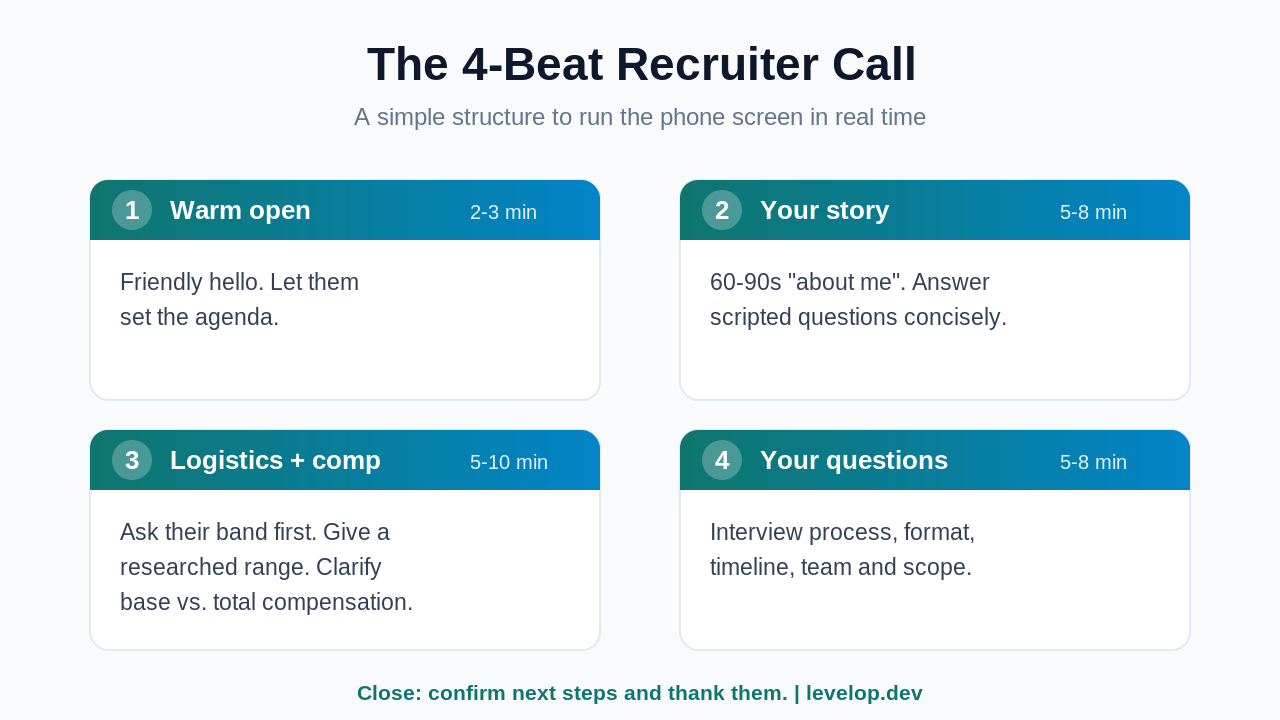
After the call
Send a short thank you email within a few hours: thank them, restate your interest, confirm the next step. Then debrief for yourself, writing down what you learned about the loop, the band, and the timeline. If the recruiter mentioned specific stages, start planning immediately. A structured coach can turn that intelligence into a concrete study plan, which is exactly the gap Levelop is built to close.
Common mistakes
The patterns that sink candidates are consistent. Treating the recruiter as beneath you and acting dismissive gets remembered. Rambling reads as poor communication, a real evaluation criterion for engineers. Blurting a comp number gives away leverage you cannot recover. Having no questions reads as low interest. Being vague about logistics makes the recruiter's scheduling job harder.
The key takeaways are simple. In a competitive job search, the candidates who treat the recruiter phone screen as a real interview round, prepare their story and their salary expectations, ask sharp interview questions, and follow up well are the ones who consistently come across as a good fit and move forward.
Frequently asked questions
How long does a recruiter phone screen last for a software engineer?
Most recruiter phone screens run 20 to 40 minutes. Shorter calls are pure logistics and comp alignment; longer ones include more behavioral discussion. Prepare for 30 minutes.
Should I tell the recruiter my current salary?
You generally do not have to, and in many locations recruiters are legally prohibited from asking. Share a researched target range instead. Leading with your current salary can anchor your offer to your past pay rather than the market rate for the new role.
What questions should I ask the recruiter during the call?
Ask about the interview process and stages, the format and tools in coding rounds, the timeline, and the team and scope. These questions signal genuine interest and give you what you need to prepare for the technical rounds.
Is the recruiter phone screen technical?
No. The recruiter phone screen is not assessing your coding ability, unlike a later technical phone screen interview with an engineer. It confirms fit, level, compensation alignment, and logistics.
What should I do immediately after the recruiter call?
Send a brief thank you email, then write down everything you learned about the interview stages, compensation band, and timeline. Use that to plan your preparation for the specific rounds described.
For structured interview preparation that turns recruiter call intelligence into a plan, explore more guides on the Levelop blog.