

Microsoft Coding Interviews in 2026: The Problem-Solving Conversation
Back with another one in the series where I break down the things that confused me until they finally clicked. This time it is not an algorithm. It is Microsoft's interview loop, which I spent a long time misreading.
For years I prepped for Microsoft the way I prepped for everyone else: grind problems, memorize patterns, walk in, dump the optimal solution, walk out. I bombed a Microsoft loop early in my career doing exactly that. I solved the problem. I still got the rejection. It took me a while to understand why, and the answer changed how I think about Microsoft interviews specifically.
What I got wrong about Microsoft
I treated the coding round as a test with a right answer. You either produce the working solution or you do not. Pass or fail.
Microsoft does not run it that way, and in 2026 the gap is wider than ever. The interviewer is not grading your final code against a hidden answer key. They are sitting in a conversation with you, trying to figure out one thing: what is it like to solve a problem next to this person? Most Microsoft interview questions are deliberately open enough that the path matters more than the destination. That sounds soft until you realize it is the entire reason strong coders still get rejected.
The format, concretely
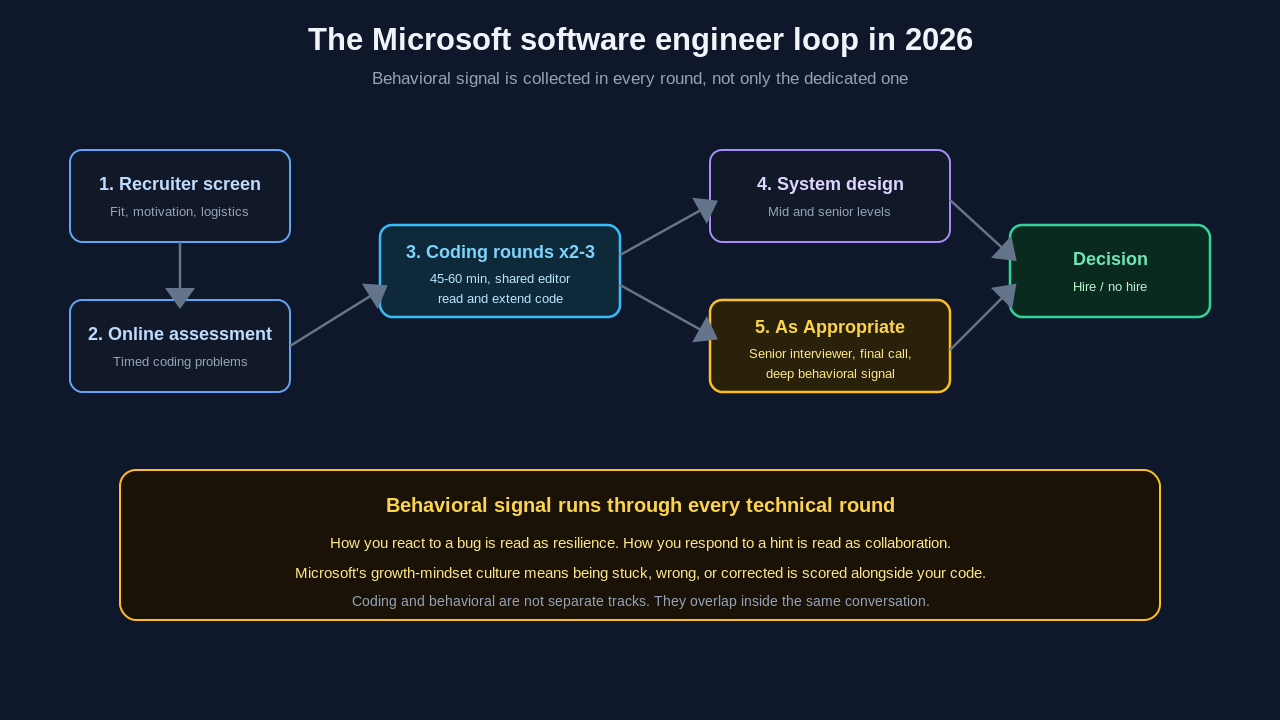
A standard Microsoft software engineer loop in 2026 is four to five rounds after the recruiter screen and an online assessment. You will usually see two or three coding rounds, one system design round for mid and senior levels, and the "As Appropriate" round, which is Microsoft's name for the senior interviewer who makes the final call and digs into behavioral signal.
The coding rounds are 45 to 60 minutes. You share a screen or a collaborative editor. There is no autocomplete safety net, and since the shift away from pure "solve this problem" formats, more interviewers ask you to read or extend code rather than write it from scratch. I wrote about that broader industry move in why companies are moving from solve-this-problem to explain-this-code, and Microsoft has leaned into it harder than most.
Why the conversation is the actual test
Here is the part that took me too long to internalize. When the interviewer asks "what is your first instinct here?" they are not making small talk while they wait for you to start typing. That answer is data.
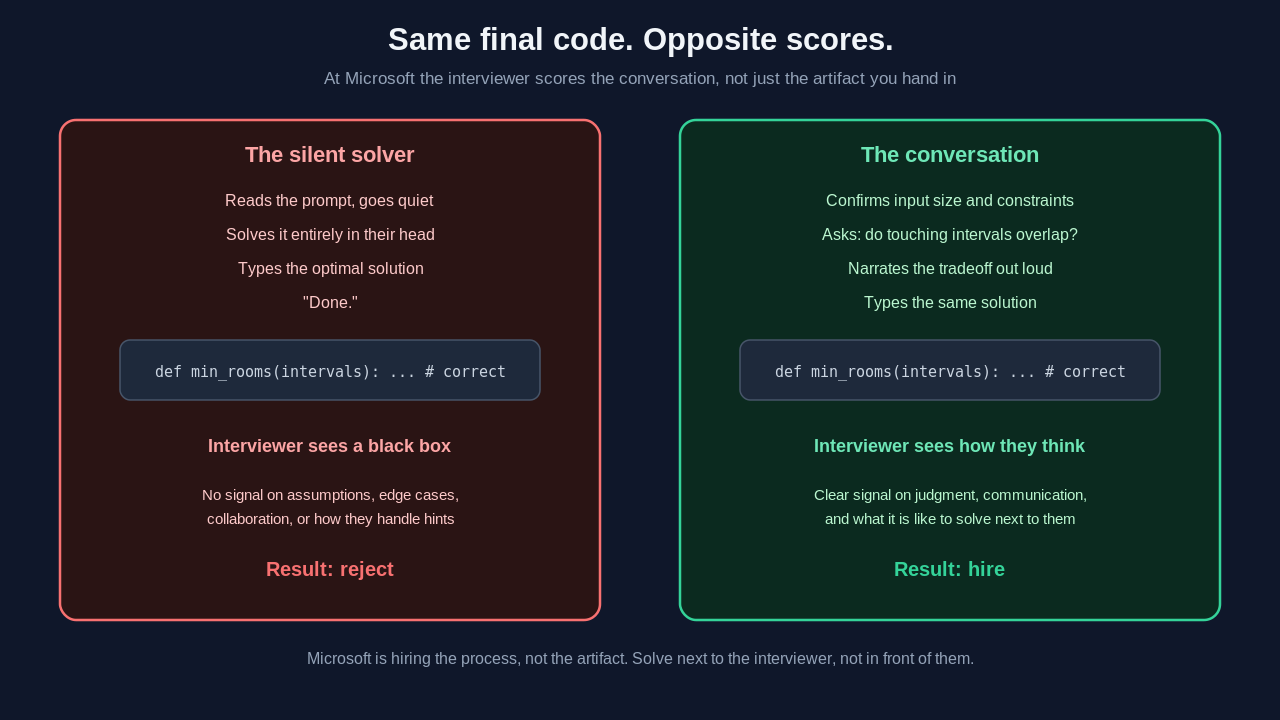
They want to see whether you state your assumptions out loud. Whether you ask about input size before you reach for a data structure. Whether you notice the edge case in the prompt or get blindsided by it later. Two candidates can submit identical final code and get opposite scores, because one narrated a clean problem-solving process and the other went silent for twenty minutes and then revealed a finished answer like a magic trick.
A worked example of the conversation
Take a common prompt: given a list of meeting time intervals, find the minimum number of rooms required. A lot of Microsoft coding interview questions look like this, deceptively small with a clean optimal answer.
The silent approach is to recognize it as a sweep-line problem, write the heap solution, and announce you are done. The conversation approach sounds like this:
def min_rooms(intervals):
    if not intervals:
        return 0
    # First, confirm the input shape and constraints out loud:
    # Are intervals sorted? Do touching meetings (end == start) overlap?
    # How large can the list get? That decides if O(n log n) is fine.
    starts = sorted(s for s, e in intervals)
    ends = sorted(e for s, e in intervals)
    rooms = max_rooms = 0
    s = e = 0
    while s < len(starts):
        if starts[s] < ends[e]:   # a start before the next end means a new room
            rooms += 1
            max_rooms = max(max_rooms, rooms)
            s += 1
        else:
            rooms -= 1
            e += 1
    return max_rooms
The code is the same code anyone would write. What earns the score is the three lines of comments before it, spoken out loud, and the moment where you ask whether a meeting ending at 10:00 and another starting at 10:00 count as overlapping. That single clarifying question tells the interviewer you have actually shipped software, because that ambiguity is exactly the kind of thing that becomes a production bug.
The behavioral signal runs through everything
People split Microsoft prep into "coding" and "behavioral" as if they are separate tracks. They are not, and the most common Microsoft behavioral interview questions show up inside the coding round whether or not anyone announces them.
When you hit a bug and the interviewer watches how you react, that is a behavioral signal about resilience. When they suggest an approach you disagree with, how you push back is a signal about collaboration. Microsoft cares a lot about its growth-mindset framing, and the coding round is where they watch for it in real time, not just in the dedicated "tell me about a time" questions.
The dedicated behavioral round still happens, usually in the As Appropriate slot. Prepare real stories with specific outcomes. If you want a structure for that, the twenty behavioral questions you will face in every FAANG interview post lays out answer frameworks that map cleanly to Microsoft's loop.
What changed in 2026
The biggest shift is the assumption that you have AI tools in your daily workflow. Microsoft, like most companies, stopped pretending engineers code without assistance. So the interview adapted. Instead of testing whether you can produce code from memory, more rounds test whether you can reason about code, spot what is wrong with a generated solution, and explain tradeoffs.
This is good news if you have actually built things and bad news if you only practiced typing out memorized templates. I dug into the skills that survive this shift in how to prep for AI-era interviews, and the short version is that judgment is now the scarce signal. Anyone can generate a function. Far fewer people can look at a function and say precisely why it will fall over at scale.
How I prep for Microsoft now
I changed my prep in three ways after that early rejection.
First, I practice out loud, alone, narrating every decision as if someone is listening. It feels ridiculous talking to an empty room. It also rebuilds the habit so that under pressure, narration is your default instead of silence.
Second, I front-load clarifying questions. Before writing anything, I ask about input size, edge cases, and what "correct" even means for this problem. At Microsoft this is not stalling. It is the exact behavior they are scoring.
Third, I practice being wrong gracefully. I intentionally pick problems slightly above my level so I get stuck, and I practice the recovery: restate what I know, propose a brute force, then optimize. The recovery is more impressive than never getting stuck.
Common mistakes I see
- Optimizing for the final answer instead of the visible process. Solving it in your head then transcribing reads as a black box, and black boxes are scary to hire.
- Arguing with the interviewer's hint instead of using it. A Microsoft hint is usually an attempt to help you score better, not a trap. Treat it as a gift, integrate it, and say what it changed about your approach.
- Treating system design as a coding round. If you reach the design round, slow down. They want structured thinking about scale, tradeoffs, and failure modes, not a rush to draw boxes.
If you want to see how the design round fits into everything else, the complete software engineer interview process in 2026 walks through the whole loop end to end.
What to practice next
If you are prepping for Microsoft specifically, here is the order I would work through.
- Interval and heap problems like meeting rooms and merge intervals, because they reward the clarifying-question habit.
- Graph traversal, where narrating your state out loud matters most.
- A few "find the bug in this code" exercises, since Microsoft leans on these now.
- Five behavioral stories with concrete numbers and outcomes, rehearsed until they sound like memories instead of scripts.
The throughline is the same for all of it: solve next to the interviewer, not in front of them.
Frequently asked questions
What kind of questions does Microsoft ask in coding interviews?
Mostly medium-difficulty data structure and algorithm problems: arrays, strings, hash maps, trees, graphs, and intervals. The problems are rarely the hardest you have seen. The difficulty is in the conversation around them, including clarifying constraints, narrating tradeoffs, and handling hints.
Are Microsoft coding interviews harder than Google or Amazon?
The raw problems are usually a notch easier than Google's. What makes Microsoft distinct is how heavily it weights communication and collaboration during the coding round itself. A purely silent solver can pass an algorithm-heavy loop elsewhere and still fail at Microsoft.
How important are behavioral questions at Microsoft?
Very. Behavioral signal is collected both in a dedicated round and continuously during technical rounds. Microsoft's growth-mindset culture means how you handle being stuck, wrong, or corrected is scored alongside your code.
Can I use AI tools or autocomplete in a Microsoft interview?
Not during the live coding round, which still uses a plain shared editor. But interviews in 2026 increasingly assume you use AI day to day, so they test reasoning about code and spotting flawed solutions rather than memorized syntax.
How long should I prepare for a Microsoft software engineer interview?
Most candidates need four to eight weeks of consistent practice, less if you interview regularly. Spend at least half that time practicing out loud, since narration is the specific skill Microsoft scores that pure problem grinding never builds.
Where to go next
These pieces connect across the interview cluster. See why interviews are moving from solve-this-problem to explain-this-code, how to prep for AI-era interviews, the twenty behavioral questions you will face, and the complete interview process in 2026. For more, visit the Levelop blog or the Levelop home page.
I have been working through interview-style problems on Levelop, and the Microsoft loop is the one that finally taught me the difference between solving a problem and being someone worth solving problems with.