

FAANG Interview Prep: I Failed 4 Times, Then Built Levelop
I have a folder on my laptop called "rejections." It has four emails in it. Google, Meta, Amazon, and one more I will let you guess. Each one is polite, each one is short, and each one took me weeks of preparation to earn. I kept them on purpose. They are the reason Levelop exists.
This is the story of how four failed FAANG interviews stopped feeling like a personal verdict and started looking like a broken process. It is also the story of what I decided to build instead. If you are deep in coding interview preparation right now and quietly wondering whether you are just not smart enough, I wrote this for you. The short version: the problem was never you, and it was never really me either. The problem was the method everyone told us to use.
The four rejections, and what they actually taught me
The first rejection stung the most because I had done everything I was told. I ground through hundreds of LeetCode problems. I had a spreadsheet with a green cell for every problem I "solved." I felt ready. Then I sat in a Google onsite, got handed a variation I had not memorized, and froze. I knew I had seen something like it. I could not reconstruct why the solution worked, only that a solution existed somewhere in my history of green cells.
The second and third rejections taught me that my preparation had a shape, and the shape was wrong. I was optimizing for recognition, not understanding. When a problem matched one I had drilled, I flew. When it did not, I had nothing to fall back on, because I had never learned the underlying idea. I had learned 300 specific answers instead of the dozen ideas those answers were all built from.
The fourth rejection is the one that changed everything. It was a clean interview. The interviewer was kind. I still did not get the offer, and this time I was not even angry, I was curious. I went home and did something I should have done a year earlier. I took every problem I had ever practiced and asked one question of each: what is the actual technique here? Not the problem, the technique.
The pattern hiding under 2,500 problems
When I sorted my year of practice by technique instead of by problem, the list collapsed. Two pointers. Sliding window. Binary search on the answer. Dynamic programming with a clear state transition. Backtracking. Graph traversal. Monotonic stack. The list of genuinely distinct ideas was not 2,500 long. It was closer to a dozen. Those dozen are the coding interview patterns that show up again and again, just wearing new stories.
Every problem that had wrecked me in an interview was a recombination of patterns I already half-knew. The Google problem that froze me was a sliding window in a trench coat. The Amazon one was a graph problem I did not recognize because it was dressed up as a grid. I had been treating each as a unique monster when they were the same few animals wearing different costumes.
The memorization model:
  2,500 problems  ->  2,500 separate "solutions" to remember  ->  panic on #2,501

The pattern model:
  ~12 core patterns  ->  recognize the pattern  ->  derive the solution every time
This is the insight the whole industry gets backwards. We tell new engineers to "grind LeetCode" as if volume is the variable that matters. Volume is a proxy for the thing that matters, which is mastery of the core leetcode patterns. What actually transfers to a real interview is whether you can look at an unfamiliar problem, strip away the story, and see which pattern is underneath. That skill does not come from doing 2,500 problems. It comes from deeply understanding maybe twelve, and practicing the act of recognition until it is automatic.
If you want to see what I mean in concrete terms, look at how a single template solves a whole family of problems in this breakdown of three DP problems with one template, or how two pointers quietly hides inside every sorted-array problem. Once you see the pattern, you cannot unsee it.
Why the standard advice fails so many good engineers
Here is the part that made me angry enough to build something. The grind-everything approach does not just waste time. It actively filters for the wrong trait. It rewards people who can tolerate hundreds of hours of repetitive drilling and punishes people who learn by understanding. Some of the best engineers I know are in the second group. The interview process was quietly telling them they did not belong, and they believed it.
Recognition is not understanding
Drilling builds recognition. You see a problem, you pattern-match to a memory, you reproduce the answer. It feels like competence. It collapses the moment the interviewer changes one constraint, because recognition has no fallback. Understanding does. When you understand why binary search works on a monotonic answer space, you can apply it to a problem you have never seen, including one the interviewer invented that morning.
The feedback loop is broken
The other failure is that LeetCode-style practice gives you almost no useful feedback. You get "accepted" or "wrong answer." You do not get told that your instinct to reach for DP was the slow path and greedy was cleaner, or that you recognized the pattern but implemented the boundary conditions wrong. I learned more from writing up five greedy problems where I first reached for DP than from a hundred green checkmarks, because the lesson was about judgment, not output.
What I decided to build instead
Levelop started as a reaction. I wanted the opposite of the grind, a pattern based interview prep system built on understanding. Instead of a problem set that rewards volume, I wanted a curriculum that taught the small number of patterns that actually generalize, and then drilled the one skill that matters in the room: recognizing which pattern a disguised problem belongs to.
The core bet is simple. Teach twelve patterns properly instead of throwing 2,500 problems at the wall. For each pattern, build genuine understanding first, the state transition, the invariant, the reason it works, and only then practice applying it across problems that look different on the surface but share the same skeleton.
The structure that came out of it
The platform is organized around recognition, not memorization. A learner moves through a pattern in three phases.
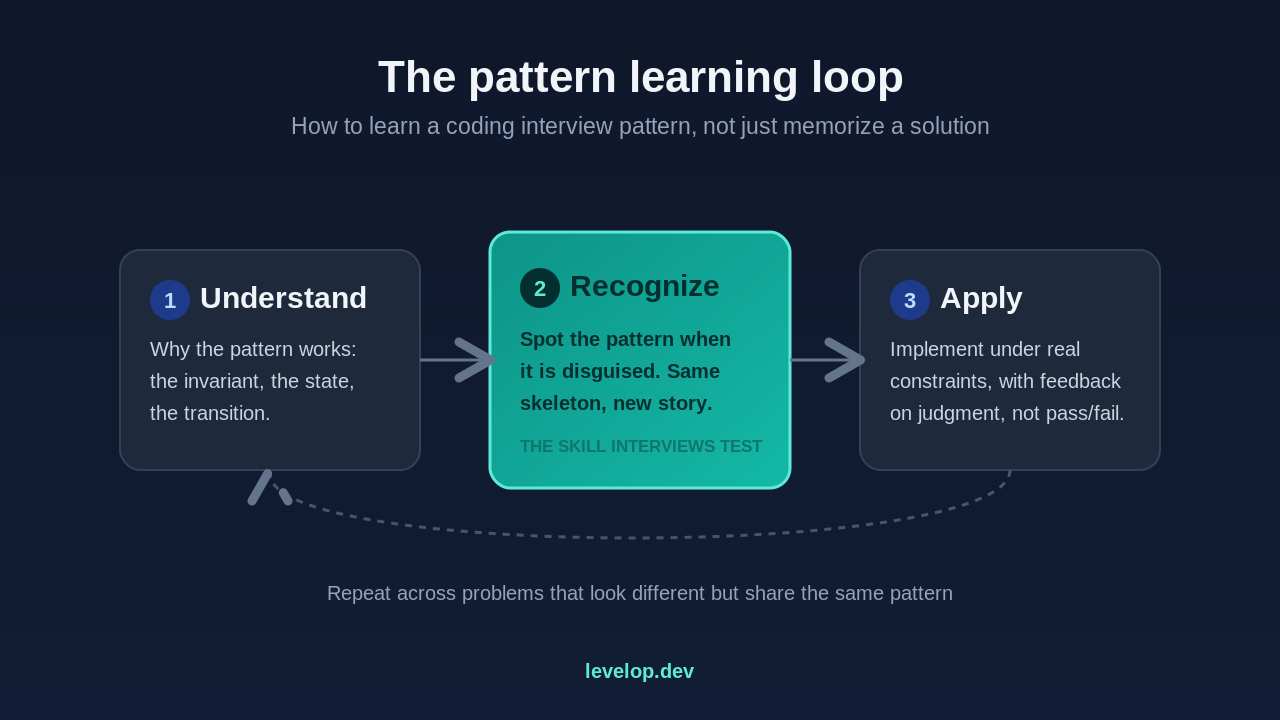
That middle phase, recognition, is the one the rest of the industry skips entirely, and it is the exact skill whose absence cost me four offers. You can see the philosophy threaded through the way we teach individual topics, like treating dynamic programming as state transition rather than memorization, or the sliding window pattern that turns O(n squared) into O(n).
The interview has changed, which makes patterns matter more
When I was failing my interviews, the format was mostly "solve this algorithm problem." That world is shifting fast. Companies are increasingly moving away from raw problem-solving toward formats that probe whether you actually understand what you are doing. A growing number now ask you to explain existing code instead of solving a fresh problem, and the whole software engineer interview process in 2026 rewards reasoning over recall.
This is good news if you learned patterns and terrible news if you memorized solutions. An AI assistant can produce a LeetCode answer in seconds, so memorizing answers has roughly the value it deserves, which is none. What it cannot fake for you, live, is the ability to reason out loud about why an approach fits. That is the durable skill, and it is exactly what prepping for AI-era interviews comes down to.
What I would tell the version of me with one rejection
If I could send one message back to the person who had just gotten that first Google email, it would be this. Stop counting problems. Start counting patterns you can derive from scratch, with the lights off, explaining each step to an imaginary interviewer. When that number hits twelve and every one is solid, you are more ready than the person who has "done" 800 problems and understood none of them.
The interview is not a memory test, even though the standard advice trains you for one. It is a reasoning test wearing a memory test's clothes. Once I understood that, the four rejections stopped being evidence that I was not good enough and started being a product spec. Every place the process had failed me became a thing to fix.
And there is a part of this that goes beyond the algorithm itself. Half of a FAANG loop is not coding at all. It is the behavioral round, and later, if you do get the offer, it is knowing how to negotiate the package you earned. The same principle holds across all of it. Understand the structure underneath, and you stop being at the mercy of whatever specific question shows up.
How to switch from grinding to patterns, starting today
You do not need a platform to begin changing your method. You need to change the question you ask after every problem. If you have been searching how to pass FAANG interview rounds, the honest answer is that it comes down to method, not volume. Here is the exact practice that pulled me out of the grind, and it costs nothing but discipline.
Stop asking "did it pass" and start asking "what was the technique"
After you solve any problem, before you move on, write one sentence naming the pattern and the reason it applied. Not the code. The idea. "This was binary search on the answer because the feasibility check is monotonic." If you cannot write that sentence, you did not actually learn the problem, you just got a green checkmark. Go back and find the idea.
Build a pattern journal, not a problem count
Replace your spreadsheet of solved problems with a short list of patterns. For each one, keep three things: a plain-language explanation of why it works, the tell-tale signs that a problem wants this pattern, and two or three problems that look completely different but use it. When that journal has a dozen well-understood entries, you are carrying more interview firepower than someone with a thousand solved problems and no journal.
Practice recognition deliberately
Once a week, take five random problems you have never seen and do not solve them. Just classify them. Name the pattern for each in under a minute. This trains the single skill that decides most interviews, the fast translation from an unfamiliar story to a known technique. It is uncomfortable at first because it strips away the comfort of grinding, and that discomfort is the point.
This is, in miniature, the loop the whole platform is built around. Understand, recognize, apply. You can run it by hand starting with your very next problem.
Where this goes next
Levelop is my attempt to make the thing I needed and could not find. Not a problem mill. A way to learn the small set of ideas that actually generalize, and to practice the recognition skill that turns a scary unfamiliar problem into a familiar one in disguise. If the grind has been making you feel slow or not cut out for this, I want to gently suggest that the method failed you, not the other way around.
You can see how we teach, browse the patterns, and read the rest of the Levelop blog to get a feel for the approach. Four rejection emails started this. I am genuinely glad I kept them.
Frequently asked questions
Is it really possible to prepare for FAANG interviews with only about 12 patterns?
Yes, with an important caveat. The twelve patterns cover the structure of the overwhelming majority of interview problems, things like two pointers, sliding window, binary search on the answer, dynamic programming, backtracking, and graph traversal. The goal is not to memorize twelve solutions but to understand each idea deeply enough to derive a solution for any problem built on it. Volume still has a place, but as practice at recognition, not as the goal itself.
Why did grinding hundreds of LeetCode problems not work for you?
Because I was optimizing for recognition instead of understanding. I could reproduce answers to problems I had seen, but I had never learned why those answers worked, so an unfamiliar variation left me with nothing to fall back on. Interviews are specifically designed to hand you variations you have not drilled, which is exactly where pure memorization collapses.
Does pattern-based prep still work now that interviews are changing?
It works better than ever. As companies shift toward formats that ask you to explain code or reason about trade-offs rather than reproduce a memorized solution, understanding becomes the only thing that transfers. An AI tool can output a LeetCode answer instantly, so memorized solutions have lost their value. The ability to reason about why a pattern fits is the durable, un-fakeable skill.
How is Levelop different from a normal problem-set platform?
Most platforms hand you a large catalog of problems and a pass or fail verdict. Levelop is organized around patterns and around the recognition skill specifically. You learn why a pattern works, practice spotting it when it is disguised, and apply it with feedback aimed at your judgment rather than just whether the test passed. The structure mirrors what interviews actually measure.
I have failed several interviews. Does that mean I am not cut out for engineering?
Almost certainly not. Failing interviews is far more often a signal that your preparation method trained the wrong skill than that you lack ability. The grind-everything approach filters for tolerance of repetition, not for engineering talent, and many excellent engineers learn by understanding rather than drilling. Changing the method, not changing yourself, is usually what closes the gap.