

How to Negotiate Salary: A Proven Script for Engineers
I've been writing about the technical side of engineering careers for a while. Coding patterns, system design, interview prep. But there's a skill that has nothing to do with algorithms that probably has the biggest impact on your career earnings: knowing how to negotiate salary when you get an offer.
My first job offer out of college, I said "yes" within 24 hours. No counter. No questions about equity or stock options. I later found out a colleague with identical qualifications negotiated $18,000 more in base salary. Same role, same team, same start date. The only difference was a 15-minute conversation I never had.
That experience changed how I approach every offer since. The script I've refined over multiple negotiation processes has consistently resulted in 20-35% increases over the initial number.
Why Most Engineers Don't Negotiate (and What It Costs)
Most engineers leave $30,000 to $80,000 on the table by not negotiating their offers. The gap compounds. If you start at $120,000 instead of $140,000, and both salaries grow at 5% annually, you've lost over $150,000 in total earnings within 5 years. That doesn't count the higher 401(k) matching, bigger bonus percentages, and higher equity refreshers tied to your base.
Why don't people negotiate? Usually one of three reasons:
They're afraid the offer will be rescinded. This almost never happens. Companies have invested thousands in recruiting and interviewing you. They're not starting over because you asked a question.
They feel grateful and don't want to seem greedy. Wrong frame. Salary negotiation is a professional conversation about aligning compensation with market value. According to Glassdoor research, 52% of employers start with a lower salary than they're actually prepared to pay, specifically to leave room for negotiation.
They don't know what to say. That's what this article fixes.
Before You Negotiate: Research Your Market Value
You need three numbers before you pick up the phone:
Your market value. Use Levels.fyi, Glassdoor, and LinkedIn Salary to find what people with your skill set earn for similar roles. For software engineers in 2026: entry-level (0-2 years) $75,000 to $92,000, mid-level (2-5 years) $95,000 to $140,000, senior (5+ years) $140,000 to $185,000 in base salary. Specializing in AI, cloud infrastructure, or security can push those numbers 10-30% higher.
Your BATNA (Best Alternative to Negotiated Agreement). Do you have other offers? Are you currently employed and willing to stay? The stronger your alternative, the more leverage you have. Even without one, you should still negotiate.
The company's compensation structure. Some companies have rigid pay bands. Others have flexibility. Startups might offer lower base but more stock options and equity. Knowing the structure tells you where there's room to push.
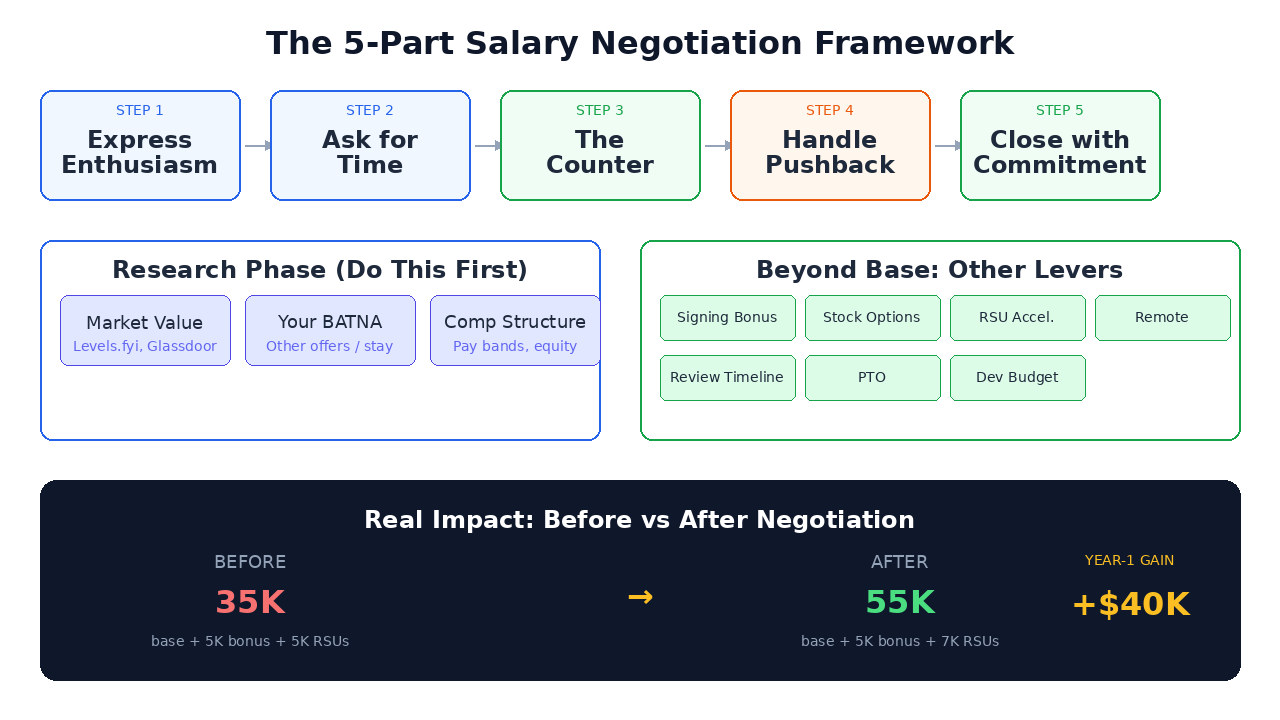
The 5-Part Salary Negotiation Script
This is the exact framework I've used across four successful negotiations. Each part maps to a specific moment in the negotiation processes. Adapt the words to your voice.
Part 1: Express Genuine Enthusiasm
When you receive the offer, your first response should signal excitement. This is not manipulation. It reminds the recruiter you're someone they want.
"Thank you for this offer. I'm excited about joining [Company] and contributing to [specific project]. The interviews gave me a clear picture of the problems I'd be working on."
Part 2: Ask for Time
Never negotiate on the spot. Adrenaline makes for bad decisions.
"I'd love to review the full compensation package. Could I have until [3-5 business days] to get back to you?"
Every legitimate company grants this. Pressure to accept immediately is a red flag.
Part 3: The Counter
This is where most people freeze. Come back with a specific number anchored in data.
"After researching compensation for similar roles, and considering my [X years of experience / specific skill set], I'd be more comfortable at $[target]. This aligns with market data for [role title] at [company stage] in [location]."
Name a specific number, not a range. If you say "$130,000 to $150,000," they hear $130,000. Anchor your ask to external data, not personal need. "Market data shows this role pays $X at comparable companies" gives the recruiter ammunition to get your number approved internally.
Part 4: Handle the Pushback
Most companies push back. Here are responses for common scenarios:
"That's at the top of our range": "I'm flexible on how we get there. Could we explore a signing bonus, additional stock options, or a guaranteed review at 6 months?"
"We can't move on base": "Are there other parts of the package with flexibility? Signing bonus, equity acceleration, remote work stipend, or additional PTO?"
"This is our final offer": "Before I decide, can you walk me through the equity structure and bonus calculations? I want to evaluate the total compensation picture."
Part 5: Close with Commitment
"If we can get to $[agreed number] with [discussed terms], I'm ready to sign today."
The phrase "I'm ready to sign today" removes uncertainty. The recruiter wants to close too. Give them a clear path to yes.
Salary Negotiation Email Template
When you need to know how to negotiate a job offer over email, this template works. Many negotiations happen over email at startups and for remote roles.
What to Negotiate Beyond Base Salary
When base is truly locked (common at large companies with strict pay bands), push on these levers:
Signing bonus. Often the easiest concession. $10,000 to $50,000 is common at mid-to-senior levels.
Stock options and RSU acceleration. More shares, or a front-loaded vesting schedule (40/30/20/10 instead of 25/25/25/25).
Performance review timeline. A guaranteed review at 6 months instead of 12, with a clear comp adjustment path.
Remote work flexibility. Real financial value through commute savings and geographic arbitrage.
Professional development budget. Conferences, learning stipends, and certification reimbursement cost the company little but have high value to you.
Real Numbers: What Negotiation Looks Like
Initial offer: $135,000 base, $15,000 signing bonus, 5,000 RSUs over 4 years.
After negotiation: $155,000 base, $25,000 signing bonus, 7,000 RSUs with accelerated vesting.
First-year impact: roughly $35,000-$40,000 more. That was a 15-minute phone call and two emails.
According to Levels.fyi, their negotiation coaching processed over 650 successful negotiations in 2025, with average compensation increases of 21% for mid-level engineers and 24% for staff engineers.
Three Salary Negotiation Tips That Prevent Common Mistakes
Don't negotiate against yourself. You say "$150,000... but I'd be OK with $140,000." Stop. State your number. Wait for their response. Silence is your ally.
Keep it professional, not personal. "I need this salary because my mortgage is $X" shifts the conversation from your market value to your personal finances. The recruiter can't take that to the compensation committee.
Take at least 24 hours. Even if the first counter is good, give yourself time to evaluate. I've caught equity vesting cliffs and non-compete terms that I would have missed signing on the phone.
Engineer-Specific Negotiation Strategies
Levels matter more than titles. At Google, a Senior SWE (L5) and a Staff SWE (L6) differ by $150,000+ in total comp. If salary won't budge, ask about leveling.
Competing offers are your strongest lever. If you're interviewing at multiple companies, a competing offer is the most effective salary negotiation tool. You don't need to bluff.
Value your skill set accurately. Specializing in high-demand areas (AI/ML, platform engineering, security) commands 10-30% premium over generalist roles. Use this in your negotiation.
Remote changes the math. Some companies adjust salary by location. Others pay market rate regardless. Know which type you're dealing with before you negotiate.
I've been building Levelop to help engineers prepare for coding interviews and system design. The technical prep is half the equation. Knowing how to negotiate what you're worth is the other half.