

How to Negotiate Your First Salary With No Leverage
Most salary negotiation advice assumes you have leverage. A competing offer. Years of experience. A specialized skill three companies are fighting over.
That advice is useless when you are staring at your first job offer with no other options. The company could walk away and barely notice.
I know that spot because I was in it. First job out of school, one offer, no backup, and a quiet panic that asking for anything would cost me the offer letter. So I took the number.
A year later I learned a classmate with the same degree and worse interviews had started $14,000 higher. Same title, same team. The only difference was that she sent one email and I sent none.
This is the guide I wish I had when I was learning how to negotiate my first salary. Not the “leverage your three competing offers” version. This is salary negotiation with no leverage, written for the new grad or entry level engineer who still needs to negotiate. That first job offer is exactly where most engineers leave the most money on the table. Getting the salary for your first job right sets the trajectory for everything after.
The Myth That You Have No Leverage
The first thing to fix is the belief itself. You feel like you have zero leverage, but “zero” is almost never accurate. What you have is leverage you cannot see yet.
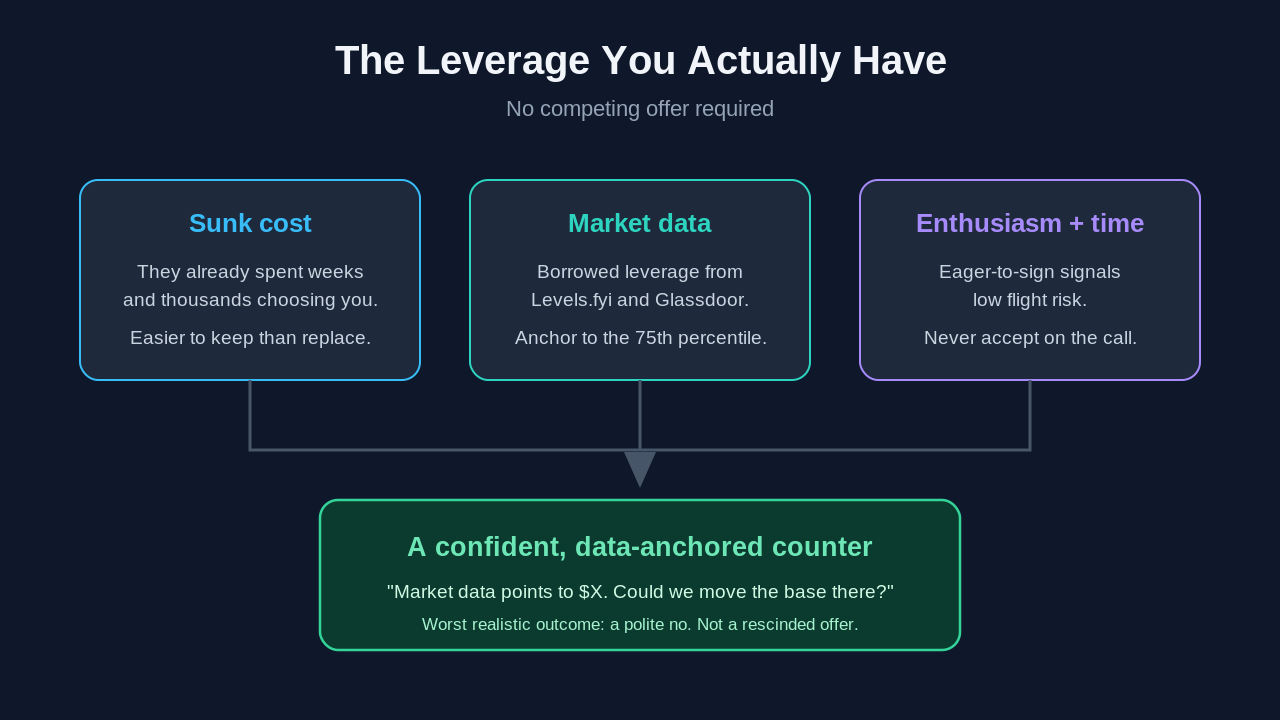
Think about what the company has already spent to reach the offer stage. Recruiter hours, multiple engineers pulled off their work for the interview process, scheduling, and internal debriefs. By the time an offer lands in your inbox, a potential employer has usually spent thousands of dollars and weeks on you.
They have also, quietly, decided you are the person. Reopening the search means going back to a pile of resumes and restarting the interview process. The hiring manager does not want that.
That sunk cost is your leverage. Not a competing offer. The simple fact that you are easier to keep than to replace. A polite, well reasoned counter does not threaten that. It is a normal step the company expects.
Why “I'll Just Be Grateful” Costs So Much
The gratitude trap is the one that got me. You feel lucky to have a job offer at all, and asking for a higher salary feels greedy or risky. But the math on accepting silently is brutal, and it is easy to miss.
Say two engineers start the same year. One accepts a starting salary of $110,000. The other negotiates to $122,000. Assume both get the same 4% annual raises.
After ten years, the gap between them is not $12,000. It is closer to $140,000 in total earnings, before you count the larger bonuses, 401(k) match, and equity refreshers that all scale with base. Your starting salary is the seed every future number grows from.
According to PayScale's salary negotiation research, a large share of workers who ask for more get at least part of it, yet most people never ask. The U.S. Bureau of Labor Statistics also tracks how median weekly earnings climb with experience, and that curve rises fastest for people whose base started higher. Gratitude is a fine feeling. It is a poor negotiating strategy.
Build Leverage You Actually Have
You can build more leverage than you think in the days before you respond. None of it requires a competing offer.
Market data is borrowed leverage
When you do not have a number of your own to anchor to, you borrow the market's. Spend an evening on Levels.fyi and Glassdoor pulling real pay for your exact role, level, and city.
Write down the median and the 75th percentile of the salary range. The 75th percentile is your target, because that is where a well prepared candidate lands, not the average of everyone who never negotiated.
For entry level software engineers in 2026, the entry level salary generally runs from the high $70,000s to low $100,000s depending on city and company tier. Specialized roles in AI, infrastructure, and security sit higher.
Get the specific numbers for similar positions in your area, and match them to your own skills and experience. “Market data for this role in this city shows X” is a sentence the recruiter can carry to the hiring manager. “I think I'm worth more” is not.
Your enthusiasm is leverage too
This sounds soft, but it is real. Recruiters and hiring managers want to close. A candidate who is clearly excited and ready to sign is far more likely to get an exception approved than one who seems lukewarm.
Enthusiasm signals low flight risk, which makes the internal case for a higher salary easy. You are not begging. You are making it obvious you are worth fighting for.
Time is leverage
Never accept on the call. The reflex to say yes right away, especially with no other options, is the single most expensive habit in this whole process.
Asking for a few business days to review costs you nothing and signals that you are thoughtful, not desperate. It also gives you room to do the research above.
The Script for the Leverage-Free Negotiation
Here is the actual sequence. It is built for the case where you have one offer and nothing else, so every line leans on data and enthusiasm rather than alternatives. Adapt the wording to sound like you.
Step 1: Receive warmly, commit to nothing
When the offer comes, your job in that moment is to be glad and to buy time. Nothing else.
Every real company says yes to this. If a recruiter pressures you to accept on the spot, that pressure is the most useful piece of information you will get all week.
Step 2: Anchor on data, not need
When you come back, lead with one specific number anchored to the market, not a range. Recruiters hear a salary range at its low end.
Notice what is missing. No mention of rent, loans, or what you “need.” Personal need shifts the conversation away from your value, and the recruiter cannot take “their rent is high” to a compensation committee. Market data, they can.
Step 3: Handle the pushback you'll probably get
With no competing offer, expect resistance. The point is to stay in the conversation, not to win every line.
When they say the base is fixed: “I understand the base may be set. Is there flexibility on a signing bonus, or a performance review at six months with a defined raise path?”
When they say you are junior: “That is fair, and I am eager to grow fast. Could we tie a pay review to clear milestones in my first six months?”
When they say it is their best offer: “I appreciate that. Before I decide, could you walk me through the equity and bonus details so I am looking at the full picture?”
Step 4: Close cleanly
Give them an easy yes.
“I'm ready to sign” is the phrase that gets exceptions approved. It tells the recruiter that one more push on their side ends the search.
When Base Won't Move, Negotiate Everything Else
At big companies with rigid pay bands, the base may truly be locked for your level. That does not end the negotiation. It moves it. These levers often have more give than salary, and they add up.
A signing bonus is usually the easiest win because it does not affect the pay band or set a precedent for future years. Even at entry level, a few thousand dollars here is common and worth asking for.
Equity matters more than new grads realize, and it is worth understanding before you sign. Ask how vesting is structured and whether the grant has any room. If you want to read an offer letter properly rather than react to the base number, I wrote a full breakdown in how to evaluate a tech compensation package beyond the base salary.
An early performance review, a learning and conference budget, extra vacation days, or remote working all carry real value. Remote especially can beat a raise once you account for commute, time, and cost of living. I dug into that math in remote salary arbitrage.
Here is how this plays out. Say the recruiter holds firm at a $112,000 base because that is the top of the band for your level. Instead of accepting, you ask about the levers around it.
You land a $6,000 signing bonus, get the equity grant bumped to the next tier, and secure a written pay review at six months tied to clear goals. None of those touched the base the recruiter said was fixed, yet together they are worth several thousand dollars in year one. When one door is locked, you stop pushing on it and start counting the other doors in the room.
One of the most underrated salary negotiation tips for a new graduate is to ask the recruiter directly which parts of the package have flexibility. Recruiters negotiate offers all day. Most will tell you where the give is if you ask politely.
The Mistakes I Made So You Don't Have To
I negotiated against myself constantly the first few times. I would name a number and then, scared of the silence, soften it right away. “I was thinking $115,000, but I'm flexible, whatever works.” Stop talking after you state your number. Silence is uncomfortable, and that discomfort is doing your work for you.
I also made it personal. I once said I “really needed” a certain salary because of my situation. The recruiter was kind about it, but it changed nothing, because need is not a number a company can justify internally. Value is.
And early on, I answered the “what are your salary expectations?” question honestly and far too low, before I had any data. If you get asked before you are ready, deflect: “I'd like to understand the role and level better first, but I'm sure we can find a number that works.” Let them anchor first whenever you can.
A Realistic Before-and-After
Here is a composite that mirrors several first job negotiations I have seen up close, the kind with no competing offer in hand.
Initial offer: $108,000 base, no signing bonus, standard four year equity vest.
After one email and one call: $116,000 base, a $7,000 signing bonus, and a written six month review. No bluffing, no other offer, just market data and a calm ask.
First-year difference: around $15,000. The conversation took maybe twenty minutes of actual talking spread over a few days. That is the highest hourly rate you will ever earn.
Entry Level Salary Negotiation Is Its Own Skill
A few things are specific to entry level salary negotiation that the general advice glosses over. Knowing them keeps you from quietly sabotaging yourself before the conversation even starts.
First, your title and level matter more than the exact dollar figure. The same role often has a band, and where you land in it is sometimes more negotiable than the number. If the recruiter says base is fixed for your level, it is fair to ask, “Is there room to come in at the next level up given my background?” Leveling moves total pay far more than a few thousand on base ever will.
Second, the “what are your salary expectations” question is where new graduates most often lose. Answer it too early and too low and you have anchored against yourself. Until you have a written job offer and real market data, you do not owe anyone a number. Deflect, research, then respond.
Third, internships and return offers are negotiable too, even though almost nobody treats them that way. A return offer is still an offer, and the company already knows your work. That is leverage you built without realizing it. The same first job salary negotiation script applies.
The thread running through all of this is simple. Being early in your career is not the same as having no value. Your leverage is just quieter, and you have to be the one who points to it.
What to Do Next
If you are early in the job search, like most job seekers, the best leverage is the kind you build before any offer exists. Interview at more than one place when you can, even for practice, because a real alternative changes everything. Keep notes on the pay data you find so you are not researching in a panic the night before you respond.
When you do get the offer and want to start negotiating with the full, leverage-rich playbook, including the email templates and the deeper script, see the salary negotiation script that got a 35% higher offer. For more on engineering careers, interview prep, and system design, the rest of the Levelop blog goes deep on the technical side of getting hired.
Frequently asked questions
Should I negotiate if I have no other offers?
Yes. No competing offer does not mean no leverage. The company has already invested heavily in choosing you, and replacing you is more expensive than meeting a reasonable counter. Anchor your ask to market data instead of alternatives, and a respectful counter is almost always met with a counter, not a withdrawal.
Can a company really rescind an offer because I negotiated?
It is very rare. Companies expect candidates to negotiate and budget for it. If an employer pulls an offer because you asked, politely and backed by data, for fair pay, that is a serious red flag about how they will treat you once you are inside.
How much should I counter on my first job offer?
A common starting point is 10 to 15 percent above the initial offer, anchored to real market data for your role, level, and city from Levels.fyi or PayScale. State one specific number rather than a salary range, since ranges tend to be heard at the bottom.
What if the recruiter asks my salary expectations before I'm ready?
Deflect politely. Say you would like to understand the role and level better first, and that you are confident you can find a number that works. The party that names a number first usually anchors lower, so let them go first whenever you can.
What can I negotiate if the base salary is fixed?
Plenty. Signing bonuses are often the easiest win because they do not touch the pay band. You can also push on equity, an early performance review with a defined raise path, a learning budget, extra vacation days, tuition reimbursements, or remote working. These add real value even when base will not move.
Is it better to negotiate over email or phone?
Both work. Phone is faster and more personal. Email gives you time to choose your words and leaves a written record the recruiter can take to a compensation committee. For a first negotiation, many people find email less stressful and just as effective.
I've been building Levelop to help engineers prepare for coding interviews and system design. The technical prep gets you the offer. Knowing how to negotiate your first salary, even with no leverage, is how you make sure that offer is worth what you actually are.