

Startup Equity: When It's Worthless and When It's Gold
A recruiter once told me an offer came with "$400,000 in equity." I almost said yes on the spot. Then I asked four questions, and the real number turned out to be closer to zero. Same grant, same paperwork, and the gap between those two numbers is the entire subject of this post.
Startup equity, and startup stock options in particular, is the part of a job offer that engineers understand the least and weigh the most. We treat the headline grant like a second salary, when it is a bet with terms we rarely read. Sometimes that bet pays for a house. Far more often it pays for nothing. The hard part is telling the two apart before you sign.
This is the framework I use now. What startup equity is, the mechanics that decide whether it is worth anything, the specific situations where it goes to zero, the rarer situations where it turns into life-changing money, and the questions that separate the two before you accept.
How Does Equity Work in a Startup?
When a private company gives you equity, it is not handing you stock you can sell. It is giving you a claim on shares under a set of conditions. There are two main types of equity at a startup, and each type of equity compensation behaves like a completely different instrument.
Stock options are the right to buy shares at a fixed price, called the strike price or exercise price. If the company is worth more than your strike when you sell, you keep the difference. If it never grows past your strike, options are worth nothing. Most early employees get options, usually incentive stock options (ISOs) or non-qualified stock options (NSOs).
Restricted stock units (RSUs) are shares granted to you outright on a vesting schedule, with no purchase required. Late-stage private companies and all public companies use these, often alongside employee stock purchase plans that let staff buy discounted shares. At a startup, private RSUs still cannot be sold until there is a liquidity event, so they are not cash either.
Both vest over a period of time. The standard schedule is four years with a one-year cliff: you earn nothing for the first 12 months, then 25 percent unlocks, then the rest drips in monthly or quarterly. Leave before the cliff and you walk away with zero. This is the same vesting structure I covered in the tech compensation package guide, but at a startup the stakes are higher because the underlying shares are illiquid for years.
So when someone asks how do stock options work at a startup, the honest answer is: they give you the option to buy into a private company's future, on a timeline you do not control, at a price you need to understand before the number means anything.
The Five Numbers That Decide Everything
A grant headline like "10,000 shares" or "$400,000 in equity" tells you almost nothing on its own. Five numbers turn it into a real value.
Strike price. What you pay per share to exercise options. A low strike on an early grant is good. A strike set near the current valuation gives you little room to profit.
409A valuation. The IRS-required appraisal of a private company's fair market value, which sets the strike price for new option grants. Compare your strike to the latest 409A and to the price investors paid (the preferred price). The bigger the gap between what you pay and what the company is "worth," the more your options can be worth.
Total shares outstanding. "10,000 shares" means nothing without the denominator. 10,000 of 1 million is 1 percent. 10,000 of 100 million is 0.01 percent. Your ownership percentage, the real size of your stake in the company, not your raw share count, is what matters. If a company will not tell you the fully diluted share count, you cannot value the grant, and that refusal is itself a signal.
Preference stack. Investors usually hold preferred stock with a liquidation preference: they get their money back (sometimes a multiple of it) before common shareholders see a dollar. Employees hold common stock. In a modest exit, the preference stack can absorb the entire sale price and leave common holders with nothing.
Vesting and the exercise window. When shares unlock, and how long you have to exercise options after leaving the company. The default post-termination window is 90 days. Miss it and your vested options vanish.
Here is a rough expected-value calculator I keep around. It will not predict the future, but it forces every assumption into the open, which is the whole point of treating this like a startup equity calculator rather than a feeling.
# startup_equity_ev.py
def equity_expected_value(shares, total_shares, strike,
                          exit_valuation, pref_stack, p_exit):
    """Rough expected value of a startup option grant.
    pref_stack: $ that goes to preferred holders before common.
    p_exit: your honest probability of an exit at this valuation."""
    ownership = shares / total_shares
    common_pool = max(exit_valuation - pref_stack, 0)
    payout = ownership * common_pool
    cost_to_exercise = shares * strike
    net = payout - cost_to_exercise
    return net * p_exit

# 0.05% of a company, $0.50 strike, hoped-for $300M exit,
# $80M preference stack, and an honest 15% shot at that exit.
ev = equity_expected_value(
    shares=10_000, total_shares=20_000_000, strike=0.50,
    exit_valuation=300_000_000, pref_stack=80_000_000, p_exit=0.15
)
print(f"Expected value: ${ev:,.0f}")  # ~$15,000
The "$400,000 grant" I opened with assumed a clean exit at a high valuation with no preference stack and a certain outcome. Put realistic numbers in each field and the expected value collapses. That is not pessimism. It is arithmetic.
When Startup Equity Is Worth Nothing
Most startup equity ends in zero. Not because founders lie, but because the base rates are brutal and the structure favors investors. Here are the ways it happens.
The company fails. This is the simplest case. Most startups do not reach a meaningful exit. When the company shuts down or sells for less than it raised, common stock is worth nothing. Your vesting schedule, your strike, your share count, none of it matters once the equity behind it is worthless.
The preference stack eats the exit. A company raises $80 million, then sells for $70 million. That looks like a real outcome, and the press release will call it an acquisition. But preferred investors get paid first, and $70 million does not even cover their $80 million. Common shareholders, including every employee, get nothing. Acquisitions below the total raised are common, and they wipe out employee equity while still counting as "exits."
Dilution shrinks your slice. Every new funding round issues new shares, and your ownership percentage drops unless you have anti-dilution protection, which employees never do. The 0.5 percent you were granted at Series A can become 0.2 percent by the time of an exit. Your share count stays the same; the denominator grows underneath you.
You leave before the exit. Startups stay private far longer than they used to, frequently a decade or more. If you leave after four years with vested options, you face the 90-day exercise window. Exercising might cost tens of thousands of dollars out of pocket for shares you still cannot sell, in a company that may never have a liquidity event. Most people walk away rather than gamble that cash. Years of "equity compensation" evaporate at the exit door.
The AMT trap on exercise. Exercising ISOs while the company is private can force you to pay taxes under the alternative minimum tax on the paper gain between your strike and the 409A value, even though you have not sold anything and have no cash flow from the shares. People have owed five and six figures in tax on stock they could not sell and that later went to zero. The IRS explains the AMT and ISO interaction in its guidance, and it is worth reading before you exercise anything.
When Startup Equity Is Gold
Now the other side, because it is real. When startup equity pays, it pays in a way salary never will. The conditions that make it gold are specific and checkable.
You are early at a company that becomes a winner. The first 20 engineers at a company that reaches a multi-billion-dollar outcome can see equity worth more than a decade of salary. Low share count, low strike, large eventual valuation. This is the outcome everyone imagines, and it does happen. It is rare, and being early is the requirement that does most of the work.
Your strike is low relative to the exit price. If you joined when the 409A valuation was pennies per share and the company exits at dollars per share, the spread is your gain. The earlier you join a company that grows, the wider that spread. Late employees buy in near the eventual price and capture far less.
There is a clear, near-term path to liquidity. A company that is publicly filing to go public, or running regular tender offers that let employees sell shares, removes the worst risk: being stuck holding paper you cannot convert to money. Liquidity on a visible timeline is what turns a vested grant into actual wealth.
The terms are clean. A simple 1x non-participating preference, a reasonable total raised relative to the likely exit, and transparency about share counts and valuations. Clean terms mean that when the company does well, common shareholders share in it rather than watching the preference stack absorb the upside.
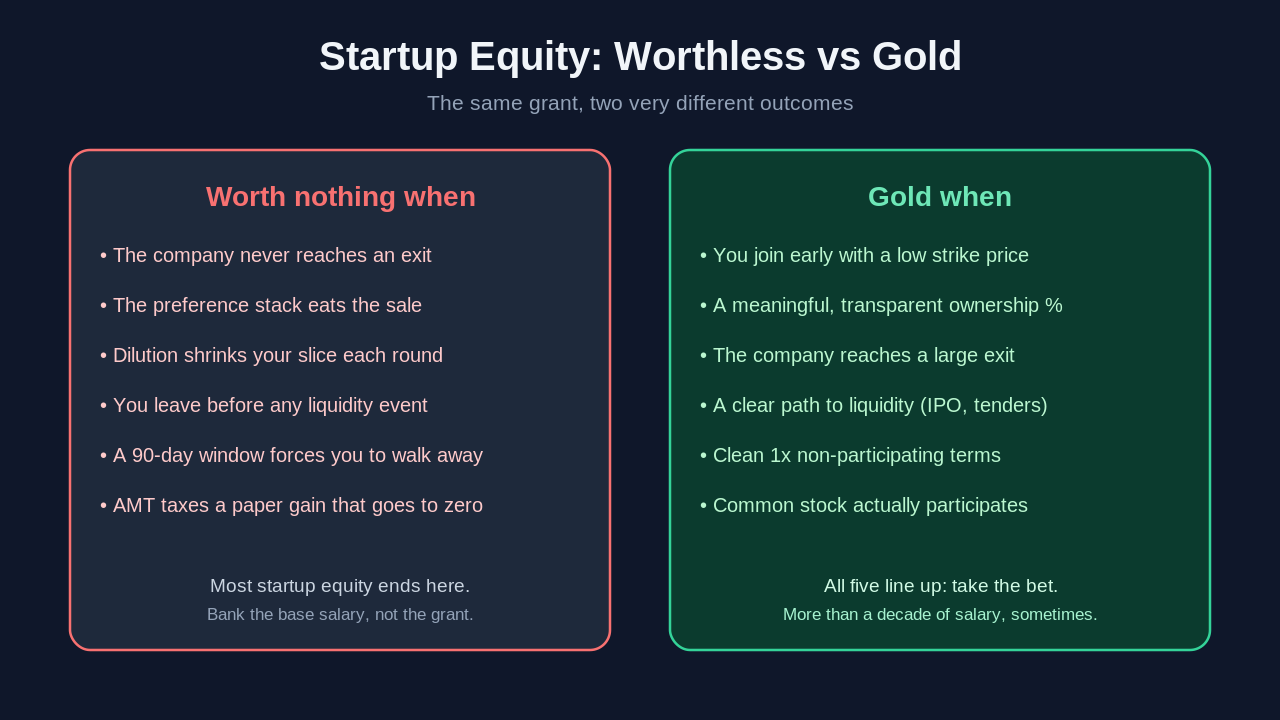
The honest version of "when is equity gold" is this: early enough, cheap enough, in a company good enough to reach a large liquid exit, with terms that let common stock participate. When all of those line up, the bet is worth taking even at some cost to base salary. When they do not, treat the equity as a lottery ticket and decide on the cash alone.
How to Evaluate a Startup Equity Offer
When a startup offer lands, I no longer react to the grant headline. I ask for the inputs and run the math. These are the questions that turn a marketing number into a decision.
- What percentage of the fully diluted company is this grant? Not share count. Percentage. If they will not say, that is your answer about transparency.
- What is the strike price, and what is the latest 409A valuation? The gap is your potential upside per share.
- How much has the company raised, and what is the preference stack? This tells you how big an exit has to be before common stock is worth anything.
- What is the vesting schedule and the post-termination exercise window? A longer-than-90-day window (some companies offer 7 to 10 years) dramatically reduces your risk of losing vested options.
- Is there any liquidity path? Tender offers, secondary sales, a planned IPO. If the only way to ever see money is a future acquisition that may never come, discount accordingly.
Then I do something uncomfortable: I assign an honest probability to a good outcome and compute an expected value, like the calculator above. For decision purposes I treat anything pre-Series A as zero and bank only the base salary, the same liquidity discount discipline from my salary negotiation framework. If the equity pays, it is a bonus. I refuse to pay rent with hypothetical money.
People ask how much equity should I ask for in a startup, or whether numbers like "is 5 percent equity in a startup good" hold up. The answer depends entirely on stage and the five numbers above. Five percent at a two-person pre-seed company and 0.1 percent at a 300-person Series D are not comparable, and neither is automatically good. Carta's equity data and Index Ventures' option plan guides give realistic ranges by stage, which beats negotiating against a number you invented.
Common Mistakes I Made
I valued the four-year grant as if it were one year's pay. A "$400,000 grant" over four years is $100,000 a year before any discount for the fact that it might be worth nothing. I mentally filed it next to a public company's liquid RSUs. They are not the same kind of money.
I never asked about the preference stack. My first startup offer looked great until I learned later how much had been raised on participating preferred terms. A mid-size exit would have paid investors several times over before employees saw a cent.
I assumed an acquisition meant a payout. Equity vs stock options at a startup both ride on the same underlying common stock, and an acquisition below the total raised pays neither. "We got acquired" and "employees made money" are different sentences.
I ignored the exercise window until I was leaving. Facing a 90-day clock and a five-figure exercise bill for shares I could not sell, I let vested options expire. Ask about the window on day one, not on your way out.
Frequently asked questions
How does equity work in a startup?
A startup grants you either stock options (the right to buy shares at a fixed strike price) or RSUs (shares given outright), which vest over time, typically four years with a one-year cliff. Because the company is private, you usually cannot sell the shares until a liquidity event like an acquisition or IPO. The grant's real value depends on your ownership percentage, the strike price, the preference stack, dilution, and whether the company ever reaches a liquid exit.
How much equity should I ask for in a startup?
It depends entirely on stage and role. Early engineers at a seed-stage company might receive 0.5 to 2 percent, while a similar role at a late-stage company might get 0.05 to 0.2 percent because the company is more valuable and less risky. Rather than fixating on a percentage, ask for the fully diluted share count, the strike price, the 409A valuation, and how much has been raised, then compute what the grant could be worth.
Is 5 percent equity in a startup good?
Five percent is a large grant that usually only appears at the earliest, riskiest stages (pre-seed or seed), often for founding or very early team members. At a funded, later-stage company, 5 percent would be extraordinary. Whether it is good depends on the company's odds of a meaningful exit and the terms: 5 percent of a company that fails is worth nothing, and 5 percent diluted down with a heavy preference stack can still pay little.
What is the difference between equity and stock options at a startup?
Stock options are the right to buy shares at a fixed strike price, so you only profit if the company's value rises above that strike, and exercising costs real money. Equity granted as RSUs gives you the shares without a purchase, but at a private startup you still cannot sell them until a liquidity event. Options carry more downside risk (they can expire worthless) but offer leverage if you join early and cheap.
When is startup equity worth real money?
Startup equity pays when you join early enough to get a low strike and meaningful ownership, the company grows into a large valuation, there is a clear path to liquidity (IPO or tender offers), and the terms let common shareholders participate rather than the preference stack absorbing the exit. When any of those is missing, the realistic value of the equity drops sharply, often to zero.
What to Do Next
Take any startup offer you have, real or hypothetical, and fill in the five numbers: ownership percentage, strike, 409A, total raised, and exercise window. Run the expected-value calculation with an honest probability. The exercise usually changes how you feel about the offer, and it always gives you a sharper negotiation: once you see the equity is a long shot, you negotiate the base salary instead.
I've been building Levelop to help engineers with the technical side of the job hunt, from coding patterns to system design. But the offer stage is where a lot of compensation is won or lost, and startup equity is the part most engineers misjudge. Reading the terms before you sign is the cheapest raise you will ever get.