

Remote Salary Arbitrage: The Real Geographic Arbitrage Math
Back with another one in the career series. This one covers the money questions engineers only ask each other in private.
Two years ago a friend of mine got two offers in the same week. One was $185,000 from a San Francisco company that required him in the office three days a week. The other was $148,000, fully remote, from a company that didn't care where he lived. He almost took the $185,000 because the number was bigger.
Then we sat down with a spreadsheet, and the spreadsheet said the smaller offer would leave him with more money every single month. That spreadsheet is what this post is about.
Remote salary arbitrage sounds like a hack. It isn't. Most engineers never run this arithmetic. Comparing salaries across locations feels harder than the ten minutes of work involved.
So let's do the real math on geographic arbitrage. Real numbers, an honest look at where it works, and the places where it quietly falls apart. Done right, it's the highest-leverage personal finance move in a software career.
What geographic arbitrage actually means
Geographic arbitrage, or geoarbitrage, is simple. You earn a salary set by a high cost of living market while your own living costs stay low. The classic version: get paid like a Bay Area engineer, live somewhere your rent is a quarter of San Francisco's.
The word arbitrage comes from finance, where it means profiting from a price difference between two markets. That's exactly what's happening here. The two markets are labor markets.
A senior engineer's output is worth about the same whether that engineer sits in San Jose or Porto. But the price of that engineer's life, housing, food, childcare, varies enormously. The gap between those two is the arbitrage.
What made this possible at scale is that remote work stopped being an exception. Buffer's State of Remote Work surveys show the same result every year: most remote workers want to stay remote for the rest of their careers. Companies responded with permanent remote policies, and a real market for location-flexible engineering roles now exists.
But here's the part that took me far too long to understand: not all remote jobs are arbitrage opportunities. It depends entirely on how the company sets pay. That's the first building block.
The three ways companies set remote pay
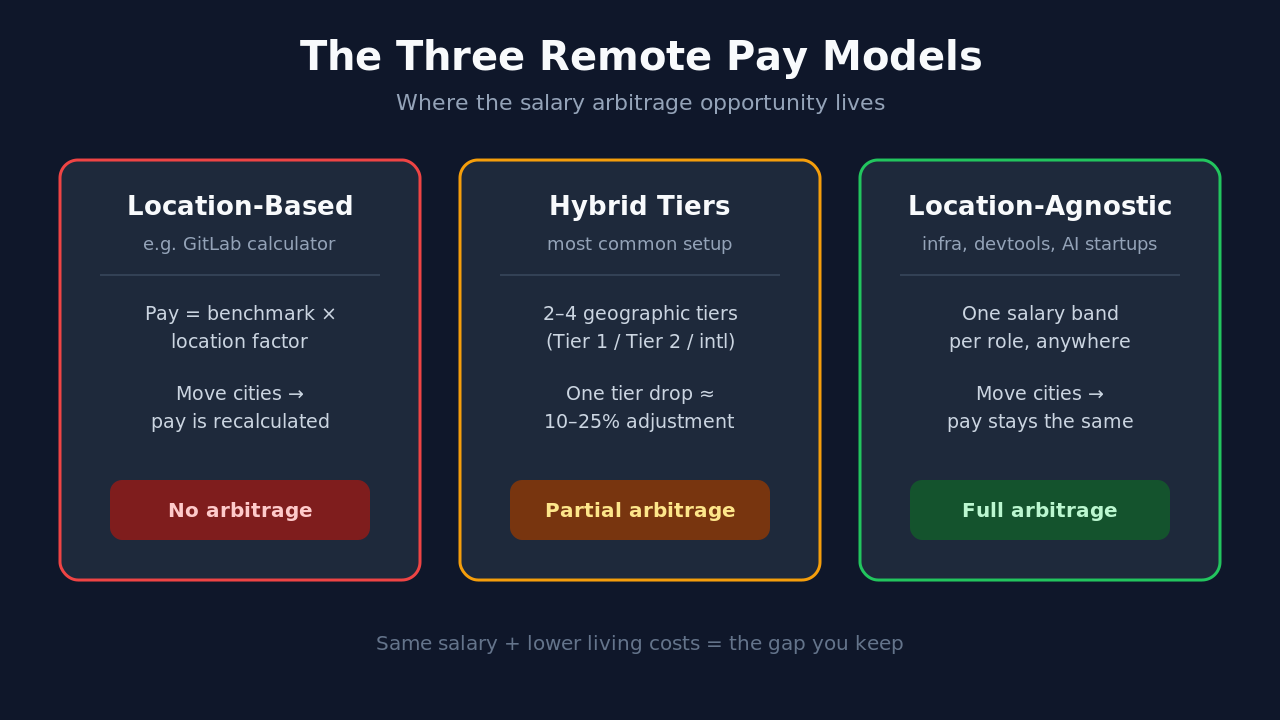
Every remote company answers one question differently: does your paycheck follow the company's market or your zip code? Companies give three common answers.
Location-based pay. The company benchmarks your salary to where you live. Move from San Francisco to Boise, and the company resets your pay. GitLab is the most transparent example. Their compensation calculator is public, and it multiplies a benchmark salary by a location factor. The same role can pay differently across cities, and they openly explain why: they pay local market rates, not San Francisco rates everywhere.
Location-agnostic pay. One salary band for a role, no matter where you sit (sometimes within a country, sometimes globally). Smaller startups and crypto/infra companies lean this way because a single band is simpler to administer and is itself a recruiting pitch.
Hybrid bands. The most common real-world setup. The company defines two to four geographic tiers. For example: US Tier 1 (SF, NYC, Seattle), US Tier 2 (everywhere else), and international. Your band depends on your tier, not your exact city.
Moving from San Francisco to Austin might drop you one tier and roughly 10 to 15 percent, not the 40 percent a strict cost-of-living formula would suggest.
The arbitrage opportunity lives in the second and third models. With location-agnostic pay you capture the full gap. With tiered bands you capture part of it. With strict location-based pay there's no arbitrage at all, you're just moving.
The real math: one salary, four cities
Numbers make this concrete. Take a senior remote software engineer salary of $170,000, which sits comfortably inside the average salaries you'll see for senior remote roles on Levels.fyi. For calibration, the U.S. Bureau of Labor Statistics puts median software developer pay around $133,000, so $170,000 is a realistic senior number, not a fantasy one.
Now hold that $170,000 constant and move the engineer to four cities. Rent figures are for a one-bedroom in a decent area, drawn from Numbeo cost-of-living data, rounded to keep the math honest but readable.
In San Francisco, rent runs about $3,400 a month. Add city-level expenses and California state income tax (top marginal rate above 9 percent for this income), and a single engineer might keep $2,500 a month after taxes, rent, and normal living costs.
In Austin, rent for a comparable place is about $1,700. Texas has no state income tax. Same salary, same standard of living, and the monthly surplus roughly doubles to around $5,200. You save money at twice the rate without changing anything about your work.
In Lisbon, that apartment is about $1,400. Even after accounting for the complexities of working internationally (more on that trap below), the raw spending-power gap is enormous. Numbeo's index puts consumer prices in Lisbon at roughly half of San Francisco's.
In a mid-size Indian city, rent for an equivalent apartment can be under $400. The same $170,000 produces savings rates north of 70 percent.
This is the version of arbitrage that makes the spreadsheet look fake. The numbers hold. The setup stays rare, though. Few companies pay full US salaries to engineers living in India, which brings us to the catches.
The point of the exercise isn't the exact figures, which drift every year.
The costs nobody puts in the spreadsheet
I almost titled this section "why I didn't move to Lisbon." The raw math above is real, but four hidden line items eat into it, and ignoring them is the most common way this strategy fails.
Taxes get complicated fast. Within the US, moving states is simple. Internationally, you're dealing with tax residency rules, cross-country tax treaties, and sometimes double taxation.
US citizens owe US taxes on worldwide income no matter where they live (the Foreign Earned Income Exclusion helps, but it has limits and paperwork). Most people in this situation need a cross-border accountant, and that costs real money.
Employment law limits who can hire you where. A US company usually can't just keep you on payroll while you live in Portugal. They either need a legal entity there, an employer-of-record service like Deel or Remote.com (which costs them several hundred dollars per month per employee), or they convert you to a contractor, which changes your benefits, equity treatment, and job security. Plenty of companies simply say no.
Time zones are a career tax. Working US Pacific hours from Europe means your meetings start at 6 PM and end at 2 AM. You can do it for a few months. Over the long term it quietly erodes your visibility, and visibility is what gets you promoted. I wrote about how scope and visibility drive promotions in the staff-vs-management context, and the dynamics are identical for remote workers: out of sight is out of the promotion conversation unless you actively fight it.
The salary band can follow you. If your company uses location-based pay and you tell them you moved, your pay adjusts. If you don't tell them, you're violating your employment agreement, and payroll tax filings will eventually surface it. The honest play is knowing your company's policy before you move, not after.
None of these kill the strategy. They just shrink the arbitrage from "300 percent more surplus" to something like "120 percent more surplus, after the accountant and the employer-of-record haircut." Which is still an absurdly good trade for changing nothing about your work.
How to actually find location-agnostic offers
The highest paying remote jobs cluster in predictable places. Knowing the pattern beats scrolling job boards at random, because remote employment opportunities are not spread evenly across the industry.
Infrastructure, developer tools, and database companies hire globally and pay aggressively because their talent pool is genuinely worldwide. Open-source-heavy companies fall in this bucket. Crypto and fintech infrastructure firms have historically run single global pay bands. AI tooling companies are the newest entrants, and many of them are remote-first by default.
Three practical filters when you're searching. First, check whether the company publishes salary bands in job posts. US pay transparency laws now force this for many postings, and a band that doesn't mention location tiers is a good sign.
Second, read the careers page for the words "pay the same regardless of location," which companies that do this tend to advertise loudly. Third, look the company up on Levels.fyi and compare data points from different cities for the same level. Flat numbers across cities mean location-agnostic pay in practice, whatever the policy page says.
And when you get an offer, evaluate the whole package, not the base number. I broke down how to do that in my post on base salary vs total compensation, and it matters double here because equity and benefits don't geo-adjust the way salary does.
Negotiating when the band is location-based
Suppose the company you want uses tiered bands and you live in a Tier 2 city. You're not stuck, you're just negotiating a different variable.
The leverage points that work: competing offers from location-agnostic companies (the strongest card you can hold), scarce skills that the company can't easily hire in any tier, and internal equity arguments when you can show your scope matches Tier 1 peers.
The script and counter-script dynamics are the same ones I covered in the salary negotiation post that got me a 35 percent higher offer. The only new move is this: negotiate the tier classification, not just the number inside the band. Tier assignments have more discretion behind them than companies admit, especially for senior candidates.
If you're early in your career with no competing offers, most of this leverage doesn't exist yet, and that's fine. I'm covering the zero-leverage version of negotiation in an upcoming post in this series.
Mistakes I've watched people make
A friend accepted a "fully remote" role, moved to Bali three months later without asking anyone, and got an awkward HR call when his IP address appeared in a payroll compliance review. The company's policy allowed remote work anywhere in the US. He'd never read it. He kept the job but flew home with a compliance warning and an expensive broken lease.
Another pattern: optimizing for the cheapest possible location and watching your quality of life collapse. The things that made life good (friends, gyms, food you like, a timezone your team works in) were quietly subsidizing your productivity. The spreadsheet measures rent. It doesn't measure loneliness, and loneliness reaches your performance review eventually.
The subtle one: taking a location-agnostic salary, moving somewhere cheap, and then letting lifestyle inflation eat the entire arbitrage within two years. The strategy only works if the surplus actually goes somewhere: index funds, a house, financial independence, runway for a startup. Arbitrage you spend is just a nicer apartment.
Frequently asked questions
Is remote salary arbitrage legal?
Yes, when done transparently. Earning a high salary and living somewhere cheap breaks no law. What creates legal problems is misrepresenting your location to your employer or tax authorities. Follow your employment agreement's location policy and file taxes where rules say you owe them, and the strategy is completely above board.
Do US companies pay less if you work remotely from a cheaper city?
Many do, but not all, and the gap is the whole game. Location-based companies like GitLab adjust pay by a published location factor. Tiered companies adjust by 10 to 25 percent between tiers. Location-agnostic companies don't adjust at all. The policy is usually discoverable before you apply, through the careers page, posted salary bands, or Levels.fyi data points.
Can I keep my Bay Area salary if I move out of the Bay Area?
It depends entirely on your company's compensation policy. At a location-agnostic company, yes. At a tiered company, you'll likely keep most of it (a one-tier drop). At a strictly location-based company, expect a recalculation to your new market. Ask to see the policy in writing before booking movers, and remember that staying quiet about a move violates most employment agreements.
What is geographic arbitrage in remote work?
Geographic arbitrage means earning income benchmarked to an expensive labor market while living in a cheaper one, capturing the difference as savings. For engineers, the typical version is a US-market remote salary spent in a lower-cost US city or abroad. The surplus comes from the gap between what your work is worth globally and what your life costs locally.
Do digital nomads working for US companies still pay US taxes?
US citizens and green card holders owe US federal taxes on worldwide income regardless of where they live. The Foreign Earned Income Exclusion can shelter a portion for those who qualify, and tax treaties prevent some double taxation, but the filing obligation never disappears. Non-citizens working abroad for US companies generally owe taxes in their country of residence. Get a cross-border accountant before you move, not after.
Where to go from here
If this clicked, the natural next steps in this series: the offer-evaluation framework in the base salary vs total compensation breakdown, the negotiation script post for getting the top of whatever band you land in, and upcoming posts on first-time negotiation with zero leverage and on when startup equity is worth anything at all.
The interview prep that gets you these offers in the first place is what we build at Levelop. The salary math in this post started as a worked example for a mentoring session there, and it changed how I think about where I live.