

Base Salary vs Total Compensation: Evaluating a Tech Offer
After I published my salary negotiation script, the most common question I got was not about negotiating. It was more basic: "I have two offers. One pays $145K base, the other $128K. Why is everyone telling me the second one might be better?"
Because base salary is one number in a much bigger equation. The first time I compared offers seriously, I built a spreadsheet, and the offer with the lower base came out $31,000 ahead per year. Equity, bonus structure, 401(k) match, and benefits flipped the ranking completely.
This post is the framework I wish I had then. What total compensation means, how to calculate it, how equity compensation works, and how to compare two offers that look nothing alike.
What Is Total Compensation?
Total compensation is everything of monetary value your employer gives you in a year. Base salary is the guaranteed cash portion. Total compensation adds equity, bonuses, retirement contributions, and benefits on top.
A typical total compensation package in tech has six components:
- Base salary: guaranteed cash, paid every two weeks or month
- Equity: RSUs or stock options that vest over time
- Bonus: annual performance bonus, usually a percentage of base
- Signing bonus: one-time cash, sometimes paid back if you leave early
- Retirement match: 401(k) matching or equivalent
- Benefits: health insurance, HSA contributions, stipends, PTO
When a recruiter asks "what are your total compensation expectations," they are asking about the sum of all six, not your base salary number. Answering with a base figure when they meant total comp can cost you tens of thousands of dollars. Pin down the definition before any negotiation starts.
Base Salary vs Total Compensation: The Real Difference
Here is the comparison that taught me the difference. Two real offers, anonymized:
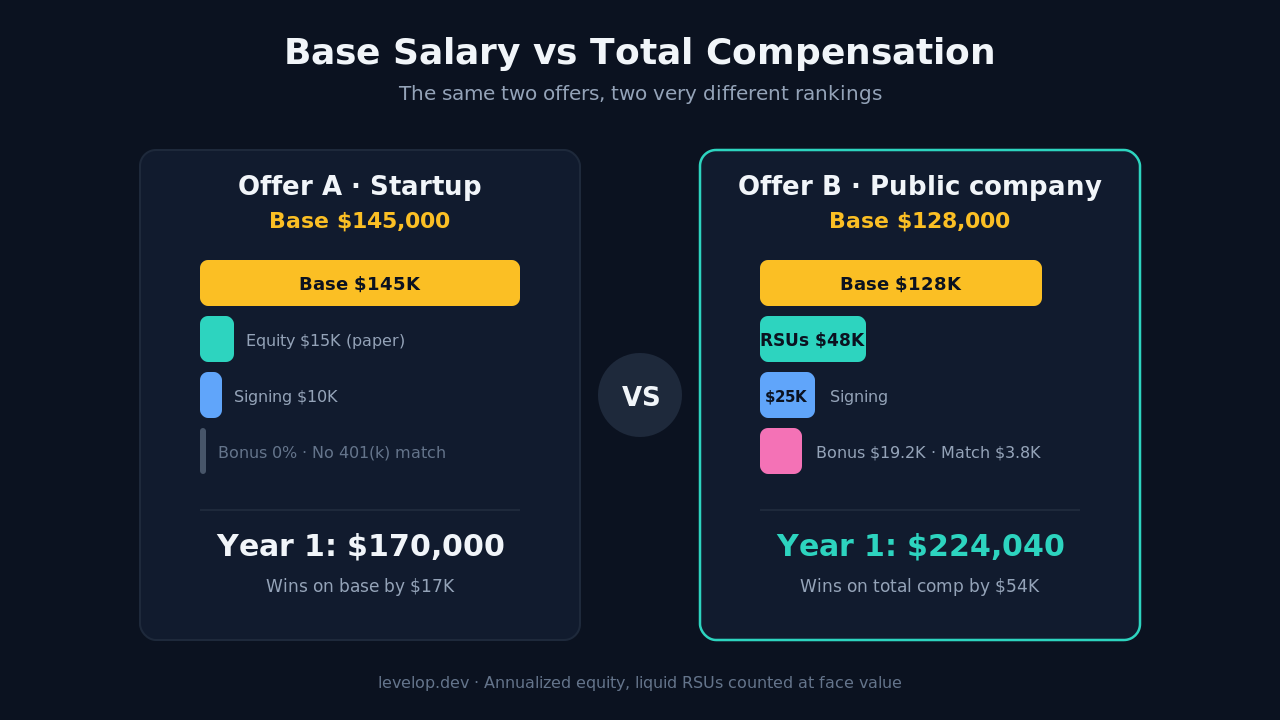
- Base salary: Offer A (startup) $145,000 vs Offer B (public company) $128,000
- Equity per year: Offer A $15,000 in options (paper value) vs Offer B $48,000 in RSUs
- Target bonus: Offer A 0% vs Offer B 15% ($19,200)
- 401(k) match: Offer A none vs Offer B 50% up to 6% ($3,840)
- Signing bonus (year 1): Offer A $10,000 vs Offer B $25,000
- Year 1 total: Offer A $170,000 vs Offer B $224,040
Offer A wins on base salary by $17,000. Offer B wins on total compensation by $54,000, and its equity is liquid stock I could sell the day it vests, not options in a company that might never exit.
The pattern generalizes. Public tech companies often hold base salaries inside tight bands and differentiate offers with equity and bonus. Startups push base higher because their equity is illiquid. That difference is a deliberate compensation strategy, not an accident. If you compare offers on base alone, you are comparing the one number companies deliberately keep similar.
Base salary still matters more than its dollar value suggests, though. Your bonus is usually a percentage of base. Your 401(k) match is a percentage of base. Your next job's recruiter will anchor on it. Raises compound from it. So treat base as the foundation and everything else as multipliers on top.
How to Calculate Total Compensation
The formula is simple. The discipline is in being honest about each input.
def total_compensation(base, equity_grant, vest_years,
                       bonus_pct, match_pct, match_cap_pct,
                       signing=0, stipends=0, equity_discount=1.0):
    """Annualized total comp. equity_discount: 1.0 for liquid RSUs,
    0.25-0.5 for private company equity (illiquidity risk)."""
    equity_per_year = (equity_grant / vest_years) * equity_discount
    bonus = base * bonus_pct
    retirement = base * min(match_pct, match_cap_pct)
    return base + equity_per_year + bonus + retirement + signing + stipends

offer_b = total_compensation(
    base=128_000, equity_grant=192_000, vest_years=4,
    bonus_pct=0.15, match_pct=0.06, match_cap_pct=0.03,
    signing=25_000
)
print(f"Offer B year 1: ${offer_b:,.0f}")  # $224,040
Three rules keep the calculation honest:
Annualize the equity. A "$192,000 grant" vesting over four years is $48,000 per year, not $192,000. Recruiters quote the four-year number because it sounds bigger.
Discount private equity hard. RSUs at a public company are cash with a delay. Options at a Series B startup are a lottery ticket. I apply a 50 to 75 percent discount to private equity when comparing, and treat anything pre-Series A as zero for decision purposes. If it pays off, that is a bonus. I refuse to pay rent with hypothetical money.
Separate year 1 from steady state. Signing bonuses inflate year 1. Run the calculation twice, once with the signing bonus and once without. The steady-state number is the one your lifestyle should be built on.
Sites like Levels.fyi standardize this math across companies, which is why their numbers often look so different from a job posting's advertised salary. For a sanity check on cash baselines, the U.S. Bureau of Labor Statistics puts the median software developer wage at around $133K, but that figure excludes equity and bonus entirely, which is most of the gap between median and top-of-market pay.
Equity Compensation: RSU vs Stock Options
Equity is the form of compensation where most evaluation mistakes happen. Each type of equity behaves like a different financial instrument, and the RSU vs stock options distinction decides how much risk you carry.
Restricted stock units (RSUs) are shares given to you on a vesting schedule. When they vest, you own stock worth whatever the market says. At a public company, vested RSUs are as good as cash. You can sell the same day. The standard schedule is four years with a one-year cliff: nothing vests for 12 months, then 25 percent, then monthly or quarterly after that.
Stock options are the right to buy shares at a fixed exercise price, called the strike. Their value is the difference between the market price and your exercise price. If the company never grows past your strike price, options are worth nothing. They also usually expire 90 days after you leave, which means quitting can force you to spend real cash exercising them or walk away from years of vesting.
The questions I now ask about any equity grant:
- RSUs or options? Public or private company?
- What is the vesting schedule and the cliff?
- For options: strike price, latest 409A valuation, and post-termination exercise window
- For private RSUs: is there a liquidity program (tender offers, secondary sales)?
- Do refresh grants exist, and when do they typically start?
That last question matters more than it looks. At many large companies the initial grant is front-loaded and refreshes are smaller, so your total comp can drop in year 5 after the initial grant fully vests. People call it the cliff after the cliff.
For private companies, Carta's equity reports are useful for understanding what typical grants and valuations look like at each funding stage. If the company will not share its 409A valuation or preferred price, that opacity is itself information.
The Benefits That Move the Number
Benefits feel fuzzy until you price them. A few that swing real money:
401(k) match. A 50 percent match on 6 percent of a $130K salary is $3,900 of guaranteed annual return. Over a career with compounding, the difference between no match and a good match is six figures.
Health insurance premiums. Two companies can both say "great health insurance" while one charges you $80 per month for family coverage and the other charges $600. That delta is $6,240 per year, post-tax.
Employee stock purchase plans (ESPP). Buying company stock at a 15 percent discount with a six-month lookback is close to free money if you sell on purchase day. Maxing an ESPP can add $3,000 to $5,000 per year.
HSA contributions, wellness and home office stipends, education budgets. Individually small, often $2,000 to $5,000 combined.
PTO policy. Hard to price, easy to feel. "Unlimited" PTO often means less actual vacation than a defined 25 days, and it also means no payout of accrued days when you leave.
Remote policy. Some companies pay the same rate no matter where you live. Working remotely from a cheaper area for one of them is the single biggest arbitrage in the comparison. A $10K pay cut for full remote can be a net raise after you account for commuting costs and geography.
None of these show up in the offer letter's headline number. All of them show up in your bank account.
How to Evaluate a Job Offer: The 30-Minute Framework
When an offer lands, I run this sequence before reacting to any single number:
- Build the table. Put every component of each offer into the six-component table above. Force yourself to write a dollar value (or zero) in every cell.
- Annualize and discount. Divide equity by vest years, apply your liquidity discount, compute bonus and match from base.
- Compute year 1 and steady state. Two totals per offer.
- Check the growth levers. Bonus percentage at the next level, refresh grant culture, promotion velocity. A $200K offer at a company where comp grows 3 percent a year loses to a $180K offer with real promotion paths within three years.
- Price the lifestyle terms. Remote policy, on-call expectations, PTO. Decide what they are worth to you in dollars per year, and add or subtract them from each offer.
- Only then compare.
The output of this exercise is also your negotiation map. Once you see that a company is rigid on base but heavy on equity, you know to negotiate the grant, not the salary. That is where the framework hands off to the negotiation script I wrote about earlier.
Common Mistakes I Made (So You Don't Have To)
I compared a startup's four-year equity number against a public company's one-year RSU vest. The startup quoted "$200K in options" and I mentally filed it next to "$50K per year in RSUs" as if they were the same kind of money. Annualize everything, discount for liquidity, then compare.
I ignored the bonus structure's fine print. A "15 percent target bonus" at one company paid out at 60 to 80 percent of target most years. Target is not guaranteed. Ask about the last three years of actual payout.
I treated the signing bonus as free money. Mine had a 12-month clawback. When a better opportunity appeared at month 9, leaving would have cost me $20,000. Read the repayment terms.
I never asked about pay bands for the next level. I optimized for the offer in front of me and joined a company where senior engineers topped out $40K below market. The ceiling matters as much as the entry point.
What to Practice Next
Comparing compensation packages is a skill, and like any skill it improves with reps. Pull up two real or hypothetical offers on Levels.fyi and run the 30-minute framework end to end. Then go one step further and rehearse the conversation where you push back on the weakest component.
I've been building Levelop to help engineers with the technical side of the job hunt, from coding patterns to system design. But offers are won twice: once in the interview, and once when you evaluate and negotiate what lands in your inbox. This framework covers the second half.
Frequently asked questions
What is the difference between base salary and total compensation?
Base salary is the guaranteed cash portion of your pay. Total compensation includes base salary plus equity, bonuses, retirement matching, and the monetary value of benefits. In tech, total compensation often exceeds base salary by 30 to 100 percent, especially at senior levels where equity dominates.
What does total compensation mean in a job offer?
It means the full annual value of everything the company pays you: base, annualized equity, target bonus, 401(k) match, and benefits. Companies present it to show the complete value of the offer, but you should recalculate it yourself, because offer letters often quote four-year equity totals or assume bonus targets that are not guaranteed.
How do I answer "what are your total compensation expectations"?
Give a researched total comp range anchored to market data for the role and level, and explicitly say it is a total compensation figure. For example: "Based on market data for senior engineers at companies of this stage, I'm targeting total compensation around $X, and I'm flexible on how that splits between base and equity." This keeps every component on the table.
Are RSUs better than stock options?
RSUs are lower risk: they hold value as long as the stock is worth anything, and at public companies they are effectively cash on vest. Options have higher upside at early-stage startups but can expire worthless, and exercising them costs real money. Neither is universally better. RSUs suit stability, options suit conviction in a specific company's growth.
How do I calculate total compensation from a job offer?
Add base salary, equity grant value divided by vesting years (discounted if the company is private), target bonus in dollars, employer retirement contributions, and any recurring stipends. Calculate year 1 (with signing bonus) and steady state (without) separately. The steady-state number is the one to compare across offers.