

Software Engineer Job Outlook 2026: What the BLS Data Shows
Back with another one in the series where I dig into the questions people keep asking me instead of giving the easy answer. This time it is not an algorithm or a system design pattern. It is the question that shows up in my DMs more than any LeetCode problem: is software engineering a good career in 2026, or did I pick the wrong field right as the door was closing?
For a long time I answered from anecdote rather than evidence. Layoff headlines, AI demos, a friend who heard nothing back after 80 applications. Eventually I stopped arguing from stories and read the primary data instead. The Bureau of Labor Statistics publishes a software engineer job outlook every year, with real wage data and ten-year employment projections. So I pulled the latest figures, sat with them, and the picture that came out was very different from the one in my feed.
The gap between the headlines and the data
Here is what tripped me up for a long time. The two stories I was hearing could not both be true, yet both felt true. Story one: the market is brutal, juniors cannot get callbacks, and AI is writing the code now. Story two: there are still hundreds of thousands of open roles and the pay is among the best of any profession. I assumed one of them had to be a lie.
They are not. They describe different things. The headlines describe the short-term hiring climate, which is genuinely harder than the 2021 free-for-all. The BLS data describes the structural, ten-year trajectory of the occupation. Once you separate those two, the noise settles and you can plan against something concrete. So let me walk through what the data says, then talk honestly about the part the data does not capture.
What the BLS actually projects for software developers
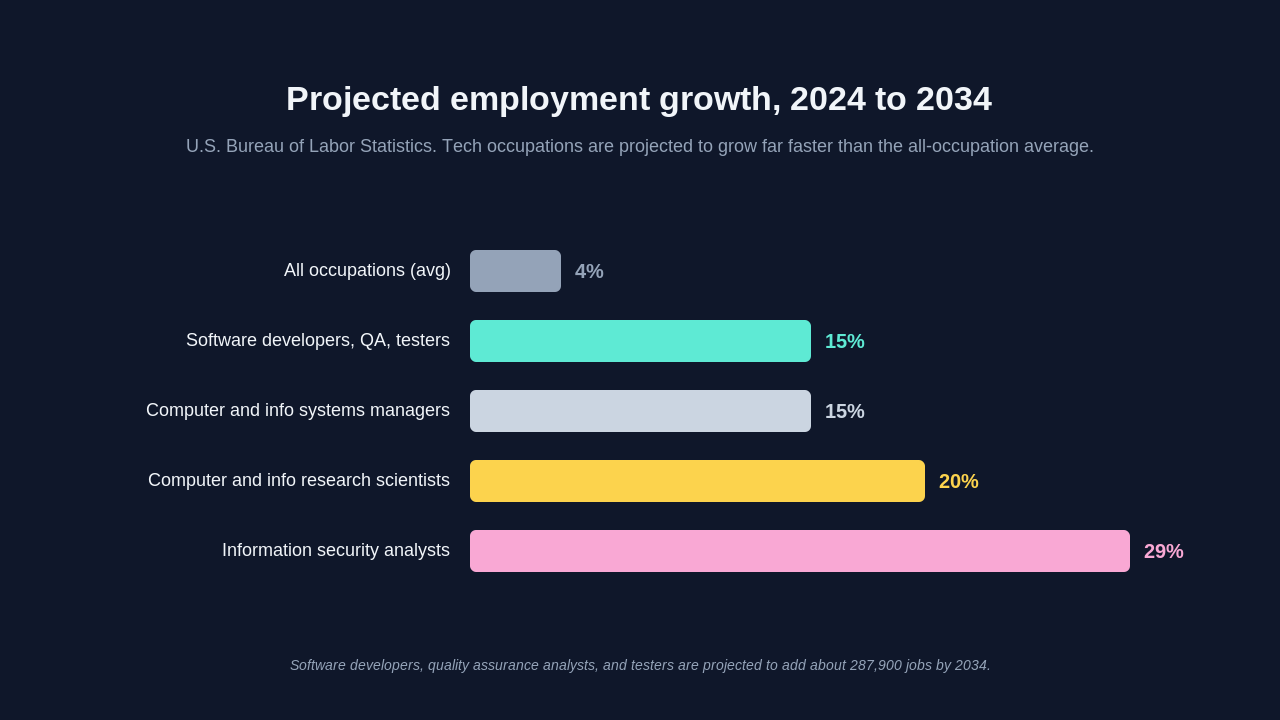
The headline number first. The BLS projects employment of software developers, quality assurance analysts, and testers to grow 15 percent from 2024 to 2034. For context, the average projected growth across all occupations in the United States is about 4 percent. So this group is growing close to four times faster than the typical job.
That 15 percent is not a small base either. As of 2024 there were roughly 1,895,500 of these jobs, and the projection adds about 287,900 more by 2034. On top of that growth, the BLS estimates about 129,200 openings per year on average over the decade, once you include people retiring or moving into other roles. Openings from replacement need are the part people forget. Even in a flat-growth field there is constant churn, and software is not flat-growth.
The salary picture is not collapsing
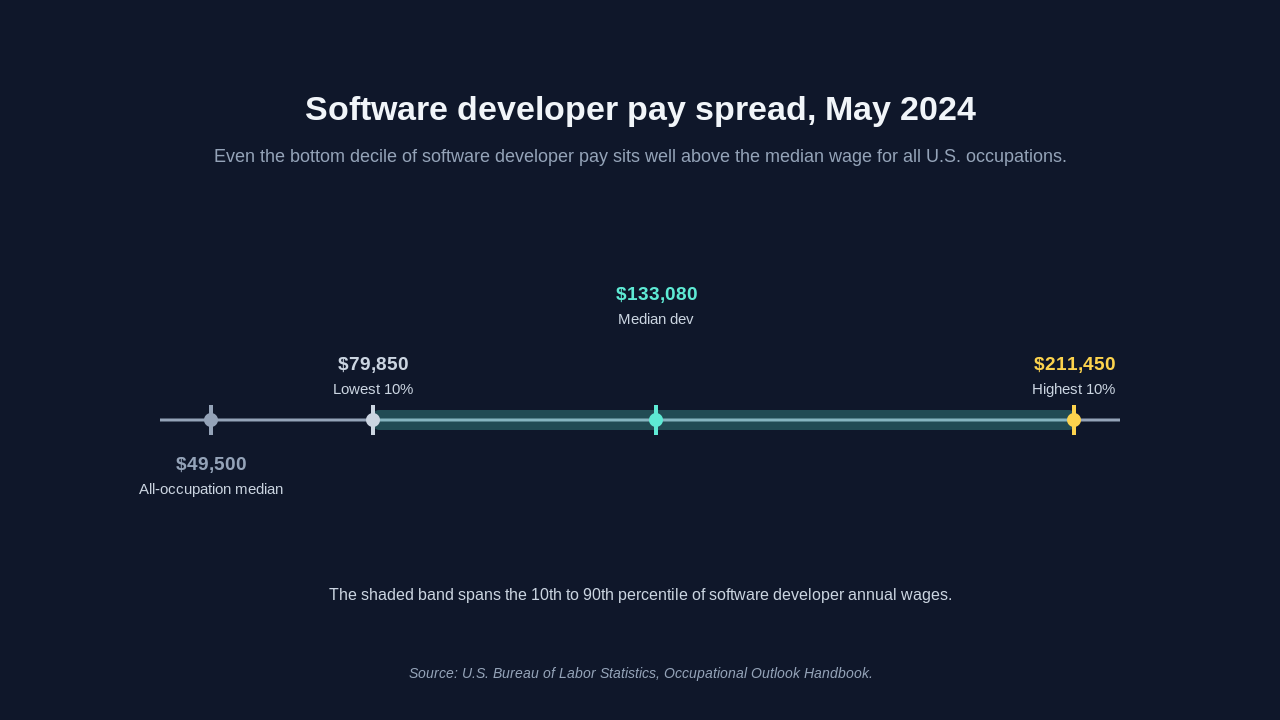
Now the compensation question, the one most readers came here for. The median annual wage for software developers was $133,080 in May 2024. The spread is wide and worth understanding. The lowest 10 percent earned less than $79,850, and the highest 10 percent earned more than $211,450. That bottom-decile number matters: even the entry band of this field pays well above the national median wage for all occupations, which the BLS put at $49,500.
When people search for a software developer salary 2026 figure, this is the anchor to start from. If you zoom out to the whole computer and information technology family, the median annual wage was $105,990 in May 2024. Quality assurance analysts and testers, often an easier entry point, had a median of $102,610. So whether you come in through development or through QA, the floor is high relative to almost any other field you could pick.
A few adjacent roles, for anyone mapping a longer career:
- Information security analysts: median $124,910, projected to grow 29 percent through 2034.
- Computer and information research scientists: median $140,910, projected to grow 20 percent.
- Computer and information systems managers: median $171,200, projected to grow 15 percent.
The pattern is consistent. The roles that sit closest to building and securing software pay well and are projected to grow faster than average. If you sum it up, the software developer career outlook is strong demand, high pay, and a rising bar for entry. That is not the signature of a dying field.
Median is a starting point, not your number. Total compensation in tech leans heavily on equity, bonus, and location. Before you compare two offers on base salary alone, read how to evaluate a tech compensation package beyond the base salary. The headline base can be the smaller half of the story.
What the projections do not capture
Here is where I want to be honest, because a post that just quotes growth numbers and tells you everything is fine would be lying by omission. The BLS projects the occupation. It does not project how painful any single year of hiring will be, and it does not capture how the work itself is shifting.
Two things are happening at once that the 15 percent number flattens out.
First, the demand is real but it is front-loading toward people who can ship. The 2025 Stack Overflow Developer Survey found that 84 percent of developers are now using or planning to use AI tools, up from 76 percent a year earlier, and 51 percent of professional developers use them daily. AI is not removing the developer from the loop. It is removing the parts of the job that were pure typing. The same survey found trust in AI accuracy actually fell to 29 percent, down from 40 percent, with 66 percent of developers frustrated by AI solutions that are "almost right, but not quite." Someone still has to know when the almost-right answer is wrong. That someone is the engineer.
Second, juniors feel this harder than seniors. When the boring 60 percent of a task gets automated, the work that remains is the judgment-heavy 40 percent, which is exactly the part that is hard to do without experience. That is why the entry market feels colder than the BLS growth rate suggests. The roles are coming, but the bar for what a "junior" needs to demonstrate has moved up.
Running the numbers yourself
I am wary of taking even the BLS at face value without testing it, so I wrote a short script to sanity-check the openings claim against the supply of new graduates. The National Center for Education Statistics reports on the order of 100,000 bachelor's degrees in computer and information sciences awarded per year in the United States. Here is the rough back-of-envelope:
# All figures: U.S. BLS Occupational Outlook Handbook (May 2024 data, 2024-34 projections)

annual_openings = 129_200       # software developers, QA, and testers
current_jobs = 1_895_500        # employed in 2024
projected_growth_pct = 15       # 2024-2034
cs_grads_per_year = 100_000     # approx. bachelor's in CS, rough NCES order of magnitude

# How many openings are NOT covered by new domestic CS grads?
uncovered = annual_openings - cs_grads_per_year
print(f"Openings beyond new CS grads each year: ~{uncovered:,}")

# Sanity check the 10-year growth figure
added_jobs = round(current_jobs * projected_growth_pct / 100)
print(f"Net new jobs by 2034: ~{added_jobs:,}")
Running it prints roughly 29,000 openings a year beyond what new domestic CS graduates can fill, and about 284,000 net new jobs by 2034 (close to the BLS figure of 287,900, the small gap being rounding). The point of the exercise is not the exact digits. It is that the openings number is large enough that even a steady stream of new graduates does not saturate it. That is a structural tailwind, not a marketing line.
What the data means for your next move
I am not going to tell you what to do, because your situation is not mine. But here is how I now read the data when someone asks me the question.
If you are deciding whether to enter the field, the ten-year outlook is strong by every BLS measure, and the pay floor is high even at the bottom decile. The risk is not that the jobs disappear. The risk is that you enter with only the skills AI now does for free. So the entry strategy that the data points to is depth: be the person who can debug the almost-right answer, design the system around it, and explain why a tradeoff was made.
If you are already in and worried, the honest read is that the work is shifting toward judgment and away from rote production. That favors people who understand systems, not just syntax. It is a good time to get deliberate about the fundamentals that do not get automated: how data flows, where things fail, how to reason about scale.
When you do land the interviews, the offer stage is where most engineers leave money on the table. The negotiation playbook in the script that got me a 35 percent higher offer is the single highest-return hour you can spend in this whole process.
A mistake I made reading this data
The first time I looked at the numbers, I treated the 15 percent growth as a promise to me personally. It is not. It is a projection about the occupation, and an occupation can grow while a specific slice of it (say, generic entry-level front-end roles) gets more competitive. I conflated "the field is healthy" with "I am safe," and those are different claims. The data tells you the ocean is rising. It does not tell you that you, specifically, will float. That part is still on you.
Once I separated those two, the anxiety became useful instead of paralyzing. The market is not closing. It is raising the bar on what counts as a strong candidate. That is a problem you can train for.
What to look at next
If you want to keep pulling on this thread, here is the order I would go in:
The BLS Occupational Outlook Handbook entry for software developers. Read the full quick-facts table, not just the growth number.
The broader computer and information technology occupations page, to compare adjacent roles before you specialize.
The 2025 Stack Overflow Developer Survey, specifically the AI section, for how the day-to-day work is shifting.
On the compensation side, our breakdowns of negotiating your first offer with zero leverage and the equity trap.
These figures came up while I was building out Levelop's career track, and this question kept surfacing from learners often enough that I wanted the data-backed version written down rather than the anecdotal version. More breakdowns like this live on the Levelop blog.
Frequently asked questions
Is software engineering a good career in 2026?
By the BLS numbers, yes. Software developer employment is projected to grow 15 percent from 2024 to 2034, about four times the average for all occupations, with around 129,200 openings a year and a median wage of $133,080 as of May 2024. The ten-year structural outlook is strong. The short-term entry market is more competitive than it was in 2021, so the data favors candidates who can demonstrate depth, not just syntax.
Will AI replace software engineers?
The data does not support a wholesale replacement. The 2025 Stack Overflow Developer Survey found 84 percent of developers using or planning to use AI tools, yet 64 percent still do not see AI as a threat to their jobs, and trust in AI accuracy actually fell to 29 percent. AI is automating the routine production work and leaving the judgment, debugging, and design to engineers. The role is shifting, not disappearing.
How much do software developers make according to the BLS?
The median annual wage for software developers was $133,080 in May 2024. The lowest 10 percent earned under $79,850 and the highest 10 percent earned over $211,450. The broader computer and IT occupations group had a median of $105,990, well above the $49,500 median for all occupations.
Which tech roles are growing fastest?
Within the computer and IT family, information security analysts have the fastest projected growth at 29 percent through 2034, followed by computer and information research scientists at 20 percent. Software developers, QA, and testers sit at 15 percent, and computer and information systems managers also at 15 percent with a median wage of $171,200.
Is it too late to learn to code?
The projections argue no. With about 129,200 openings a year and a degree-level entry path, the field continues to absorb new entrants faster than domestic graduate supply fills it. The realistic caveat is that the bar has moved: the highest-value skill is now the judgment to know when an AI-generated answer is wrong and how to build the system around it.
References
- U.S. Bureau of Labor Statistics, "Software Developers, Quality Assurance Analysts, and Testers," Occupational Outlook Handbook (May 2024 data, 2024-34 projections).
- U.S. Bureau of Labor Statistics, "Computer and Information Technology Occupations," Occupational Outlook Handbook.
- Stack Overflow, "2025 Developer Survey," survey.stackoverflow.co.
- U.S. National Center for Education Statistics, Digest of Education Statistics, degrees conferred in computer and information sciences.